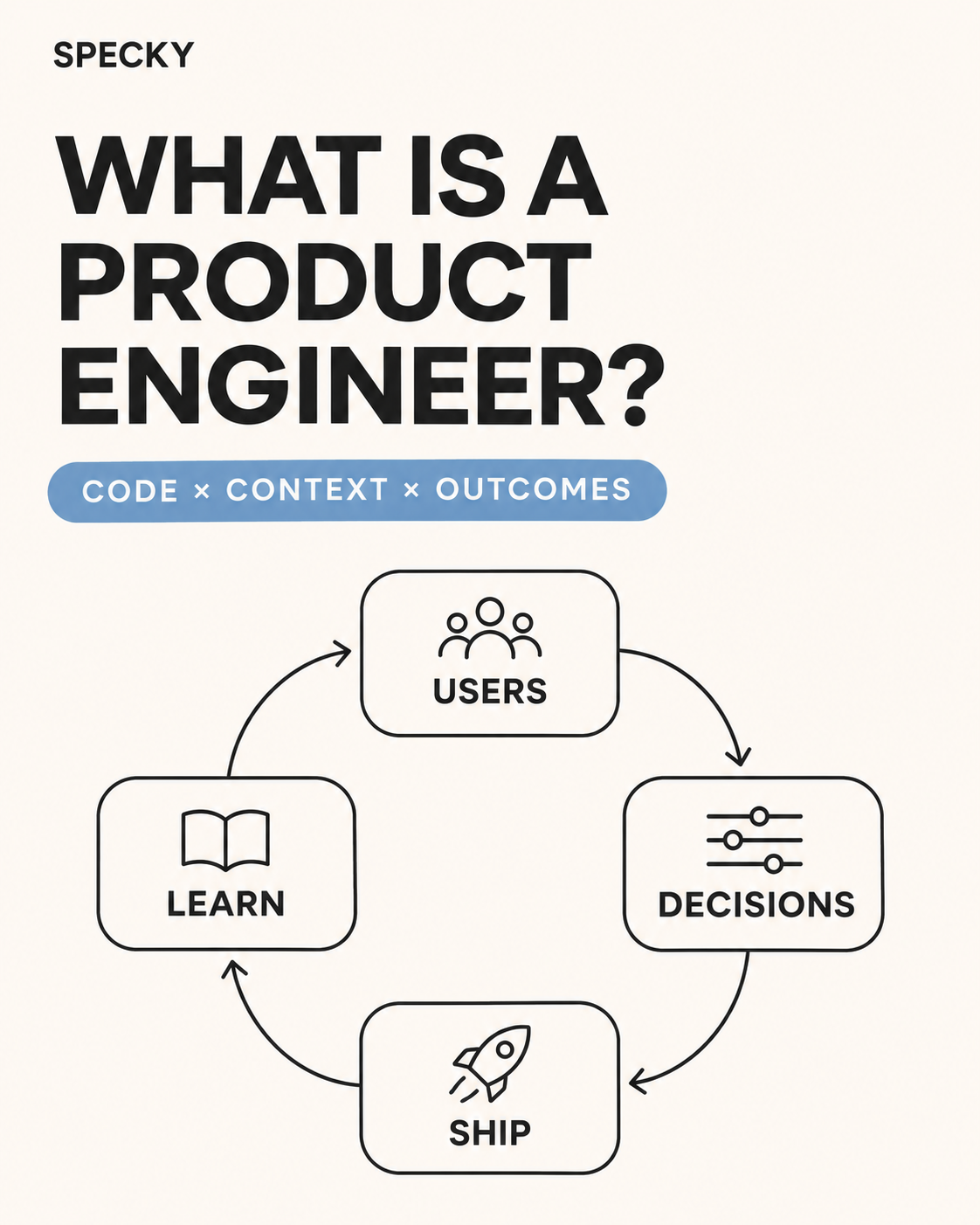
What Is a Product Engineer? Role, Skills, and Team Fit
A product engineer combines software-building skill with direct product responsibility. Learn what the role owns, how it differs from PM and engineering roles, and how small teams can work with one.
Share
A product engineer is an engineer who stays close to the user problem and takes responsibility for whether the shipped solution works in practice. The role combines technical depth with product judgment: understand the job, choose a small solution, build it, observe what happens, and adjust.
The title varies between companies, so the label alone does not tell you who owns discovery, scope, or outcomes. This guide gives founders, product managers, and engineers a practical way to define the work.
What does a product engineer do?
A product engineer connects product decisions to working software. Depending on the team, that can include:
Talking with users or reviewing support and usage evidence.
Turning a problem into a small, testable product change.
Making technical tradeoffs that protect user value and future options.
Shipping and instrumenting the change.
Watching how people use it, then improving or removing it.
The job is not to own every part of product management and engineering at once. It is to keep the engineering work connected to a real user outcome.
A product engineer might work with a product manager who owns market research, strategy, and prioritization. In a tiny startup, the same person may cover more of those responsibilities. Agree on the boundaries before work starts.
Product engineer vs. software engineer vs. product manager
These roles overlap, especially on small teams. The difference is the center of responsibility, not a fixed list of tasks.
Role
Main responsibility
Typical question
Product engineer
Build a useful solution and learn from how it performs
“Did this solve the user’s problem well enough to change what we do next?”
Software engineer
Build and operate reliable software within the agreed product direction
“Is this correct, secure, maintainable, and ready to ship?”
Product manager
Choose which customer problem and outcome the team should pursue
S
Specky Team
Writing about AI-native product development at Specky.
“Is this the right problem and the right bet for the business?”
A strong team lets each person contribute beyond the role boundary. Engineers should challenge unclear requirements. PMs should understand technical constraints. Product engineers still need collaborators for design, research, security, and operations when the work calls for them.
A practical product-engineering workflow
Consider a small team whose users say that preparing a weekly report takes too long. “Add AI summaries” is a proposed solution, not yet a confirmed problem.
Find the real job. Ask a few users to walk through the last time they prepared the report. Look for the repeated steps, delays, and workarounds.
Separate evidence from guesses. “Three users copied figures into a spreadsheet” is an observation. “Everyone wants an AI report” is an assumption until tested.
Choose the smallest useful change. It might be a saved report, a data export, or a summary. Compare the options against the user’s actual bottleneck.
Write the behavior and boundaries. State who can use it, what data it reads, what it produces, what it must not do, and how a user can correct it.
Ship with a check. Pick a measure tied to the job, such as successful report completion or repeat use on the next reporting cycle. Add a quality or safety check where needed.
Review the result. Combine usage data with user follow-up. Decide whether to improve, expand, or stop the change.
This is product engineering in practice: software work is part of a learning loop rather than a handoff that ends at release. For more on choosing the next build, see this product-builder decision framework. For teams building AI features, continue with the AI-native product development workflow, which adds clear AI boundaries, evaluation, and staged release checks.
Product engineer skills
Technical judgment
A product engineer can choose an implementation that meets the user need without making avoidable reliability, privacy, or maintenance problems. They know when to reduce scope, when to test a risky assumption, and when a quick prototype should not become production code.
Problem framing
They can ask what the user is trying to accomplish, what blocks that job, and what evidence would change the team’s mind. This keeps a plausible feature from becoming the default answer to every request.
Shipping and measurement
They can break work into a first useful release, add the right instrumentation, and check whether people reached the intended outcome. “Merged” and “deployed” are delivery states; they do not prove user value.
Collaboration
They can explain tradeoffs in language that users and teammates can act on. Product engineering is collaborative work, not a reason to skip design, product, or customer conversations.
When should a startup hire a product engineer?
The role can fit when a team needs an engineer who can take a problem from customer evidence through delivery and follow-up. It is especially useful when founders are close to customers but cannot personally carry every product decision and implementation.
It is a poor substitute for clarity. If nobody can say which customer, problem, or outcome matters, adding a broadly scoped “product engineer” will not settle the strategy. Start by naming the decision the team needs this person to own.
Before hiring, write down:
Which users will this person work with?
Which product decisions can they make independently?
Who sets priorities when customer value and technical risk conflict?
What outcome should change after a release?
What still needs a PM, designer, researcher, or technical specialist?
For a practical way to build customer conversations into engineering work, read Customer Discovery for Product Engineers. If you are an engineer or founder who prototypes with AI tools, the AI coding-agent PRD template shows how to hand a bounded problem to Cursor or Claude Code.
How can an engineer grow into product engineering?
Start by taking responsibility for a user problem, not by adding more meetings to your calendar.
Join a customer conversation and write down what you observed.
Propose two possible solutions, including a smaller non-AI option.
State the expected user outcome and the risks before coding.
Ship one narrow change with a clear way to evaluate it.
Follow up with users and share what you learned, including when the result did not match your expectation.
Build a short portfolio around decisions and outcomes. Show the original problem, the evidence, the tradeoffs, what you shipped, and what changed afterward. A polished demo without that context shows implementation skill; it does not show product judgment.
Frequently asked questions
Is a product engineer a product manager who can code?
Not necessarily. Some teams use the title for a software engineer with broader product ownership; others use it for a builder who spans discovery and delivery. Define the decisions and outcomes attached to the role instead of relying on the title.
Does every startup need a product engineer?
No. A small team may share product work across a founder, PM, designer, and engineers. Hire for a real ownership gap, not because the title is popular.
Do product engineers replace product managers?
No. The roles can overlap, but teams still need someone accountable for choosing the market, customer problem, and product bet. One person may hold several responsibilities in an early startup; that does not make the responsibilities interchangeable.
Should product engineers build with AI coding agents?
They can use coding agents to explore and implement bounded work, but generated code still needs product context, technical review, and checks. See how much spec to write for an AI coding tool for a practical starting point.
Product engineering makes the connection between a customer problem and shipped software more direct. The useful measure is not how many hats one person wears; it is whether the team can make a clear bet, deliver it responsibly, and learn what to do next.