AI Customer Research Synthesis: Keep Evidence Separate from Interpretation
Use AI to organize product research without turning uncertain interpretations into facts. A five-step workflow keeps claims tied to their original evidence.
Share
AI can turn a folder of interview notes into a tidy summary in seconds. That is useful for finding material to inspect. It is also an easy way to turn an uncertain interpretation into a confident-sounding product decision.
The safer goal is not to ask AI to tell you what customers want. Ask it to help you navigate the evidence, then make every important interpretation traceable to what a person actually said or did.
This distinction matters for small product teams. A founder or first PM may have a handful of calls, support threads, and usage observations—not a research department with time to re-read everything. AI can help organize that material, but it cannot make a thin or biased sample representative.
The evidence and the story are different things
Imagine three interviewees describing a confusing setup step. One says they did not know which source to connect. Another connected the wrong account. A third asks for a setup checklist.
The observations are specific. “Users need an onboarding checklist” is already an interpretation. “The integration picker is the problem” is another. Neither should be stored as though it were a direct quote.
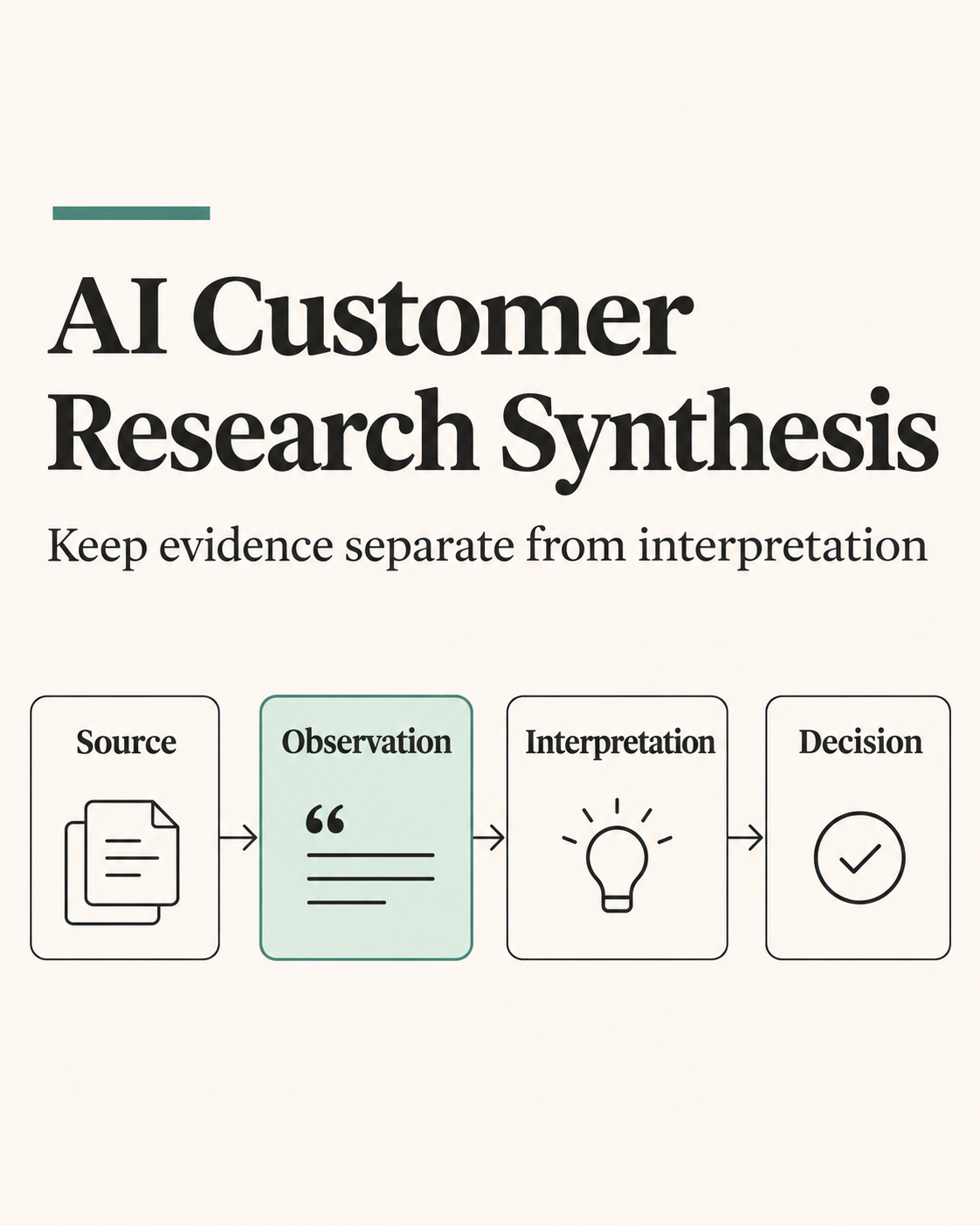
A useful synthesis keeps four layers visible:
Source: the original interview, support message, or observed session.
Observation: what the person said or did, with enough context to interpret it.
Interpretation: the possible need, cause, or pattern you infer.
Decision: what the team will do, test, defer, or learn next.
When these layers collapse into one summary, the team loses the ability to challenge the interpretation without questioning whether the source itself is real.
What research says about AI-assisted qualitative analysis
Studies comparing generative AI with human qualitative analysis show why a review step matters. In one comparison using 40 short SMS messages from a digital health intervention, AI and human teams found overlapping themes, but agreement was imperfect. The models missed some context-dependent meanings that human coders recognized. The authors concluded that generative AI could support faster analysis, while recommending it as an assistant to human coders rather than a replacement.
S
Specky Team
Writing about AI-native product development at Specky.
A separate study comparing ChatGPT with human researchers analyzing Japanese clinical interviews found stronger agreement on descriptive themes than on themes requiring cultural or emotional interpretation. The authors likewise described AI as an auxiliary tool and emphasized the need for human expertise.
These studies involve health research, not startup product discovery. Their results do not tell us how accurately an AI model will analyze your customer interviews. They do support a more modest operating rule: use generated themes as proposals, keep the source close, and verify the interpretation in context.
Write down the product decision the research should inform. For example:
Should we simplify the first-run connection flow, or first explain which source a user should connect?
This prevents a broad prompt such as “analyze these interviews” from producing attractive themes that do not help with the decision at hand. It also makes it easier to notice when the material does not answer the question.
2. Prepare the source material responsibly
Use only material your team is allowed to process in the selected AI tool. Remove personal or sensitive details unless you have a clear, approved reason to retain them. Keep a source identifier and date so a reviewer can find the original record, while controlling access to the underlying transcript.
Do not combine notes from different customer groups or research questions without labeling them. A founder interview, a support ticket, and an observed usability session can all be useful; they are not interchangeable evidence.
3. Ask AI to organize, not conclude
Give the model a bounded task. Ask it to:
extract observations relevant to the decision;
attach a source ID and exact supporting passage to each observation;
separate direct statements from inferred needs;
list counterexamples and conflicting evidence;
mark missing context and questions it cannot answer;
avoid counting repeated mentions as independent users unless the source set supports that count.
Do not ask for a definitive persona, a market-wide conclusion, or a ranked roadmap based on a few conversations. A model can format uncertainty out of view unless you specifically ask it to preserve uncertainty.
4. Verify every claim that could change the roadmap
A PM or founder should open the original source for each proposed high-impact theme. Check whether the quote supports the claim, whether surrounding context changes its meaning, and whether the model merged different people’s experiences.
Then look for evidence that does not fit. If two users describe the same symptom for different reasons, preserve both explanations. If one vivid story is the only support for an idea, label it as a signal to investigate rather than a proven pattern.
A practical review table looks like this:
Proposed theme
Supporting source
What is directly observed?
Interpretation
Counterevidence or gap
Next step
Setup source is unclear
Interview 04, session note
Person connected a different account than intended
The choice labels may be ambiguous
One observation; no task replay yet
Review the recording and test label comprehension
Users want a checklist
Interview 07, transcript
Person asked for a checklist after getting stuck
They may need guidance at the decision point
Request may reflect this person’s preference
Compare with support cases and observe first-run use
The table is deliberately modest. It does not turn two conversations into a percentage or claim that “users” all behave the same way.
5. Record the decision and its learning trigger
Once the team reviews the evidence, record what it decided and why. Include the decision owner, the supporting sources, the most important uncertainty, and what future evidence would change the choice.
For example:
Decision: Test clearer source descriptions before building a full setup checklist. Why: Two independent sources point to uncertainty at the connection choice, but we have not observed enough first-run sessions to know whether the issue is labels, order, or missing guidance. Review trigger: Revisit after reviewing several representative setup sessions or if support reports point to a different failure point.
The exact sample needed depends on the decision, the risk, and the diversity of users. Do not treat a fixed interview count as proof of saturation or representativeness. If the evidence remains mixed, the next useful step may be another observation—not a more polished summary.
A prompt that preserves the audit trail
You can adapt this prompt for a permitted, appropriately protected source set:
Help organize these research notes for the decision: [decision question]. For every proposed observation, include the source ID and exact supporting passage. Separate direct evidence from interpretation. List contradictory examples, missing context, and alternative explanations. Do not infer frequency beyond the records provided. Do not recommend a roadmap decision. If a claim cannot be supported by a passage, label it unsupported. Return a table with observation, quote, source, interpretation, confidence reason, counterevidence, and follow-up question.
The prompt does not make the output reliable on its own. It makes the work easier to inspect.
Make the product record carry the context
A research synthesis is useful only if the next person can see how it informed the work. Connect the source material to the observation, the decision, and the resulting brief or experiment. Keep the original evidence accessible to the people who need to review it; do not replace it with the AI summary.
That is the practical role of product memory: preserve enough context to understand why the team acted, what it still did not know, and what would cause it to change direction. Specky helps small teams keep evidence, decisions, product briefs, and follow-up work connected in one workspace. Learn more at specky.space.
AI can make the first pass easier to navigate. The product judgment still comes from people who inspect the evidence, question the interpretation, and own the next decision.