AI Product Discovery for Startups: A Practical Two-Week Loop
When AI makes prototypes cheap, discovery becomes the work that keeps small teams building the right thing. Use this two-week loop to test a real user problem before expanding a build.
Share
AI coding tools make it easier to turn an idea into a working prototype. They do not tell you whether the problem is important, whether the workflow fits a real user, or whether the AI output is good enough to trust.
That changes the product team's bottleneck. When implementation gets cheaper, product discovery becomes the work that prevents a small team from building more of the wrong thing. A useful AI product discovery workflow connects customer evidence to one testable decision, then uses the smallest prototype that can change that decision.
Before opening an AI coding agent, get clear on five things:
Who is the user, and what recent task are they trying to complete?
What evidence shows the task is painful or important?
What is still an assumption?
Why might AI help more than a simpler workflow or deterministic rule?
What result would change the next product decision?
If you cannot answer these yet, the next step may be a short customer conversation, a support-ticket review, or a manual test. It may not be a larger prototype.
For a broader path from problem discovery through release, see the AI product development workflow. This guide focuses on the earlier bottleneck: how a startup team can decide what to test when building is fast.
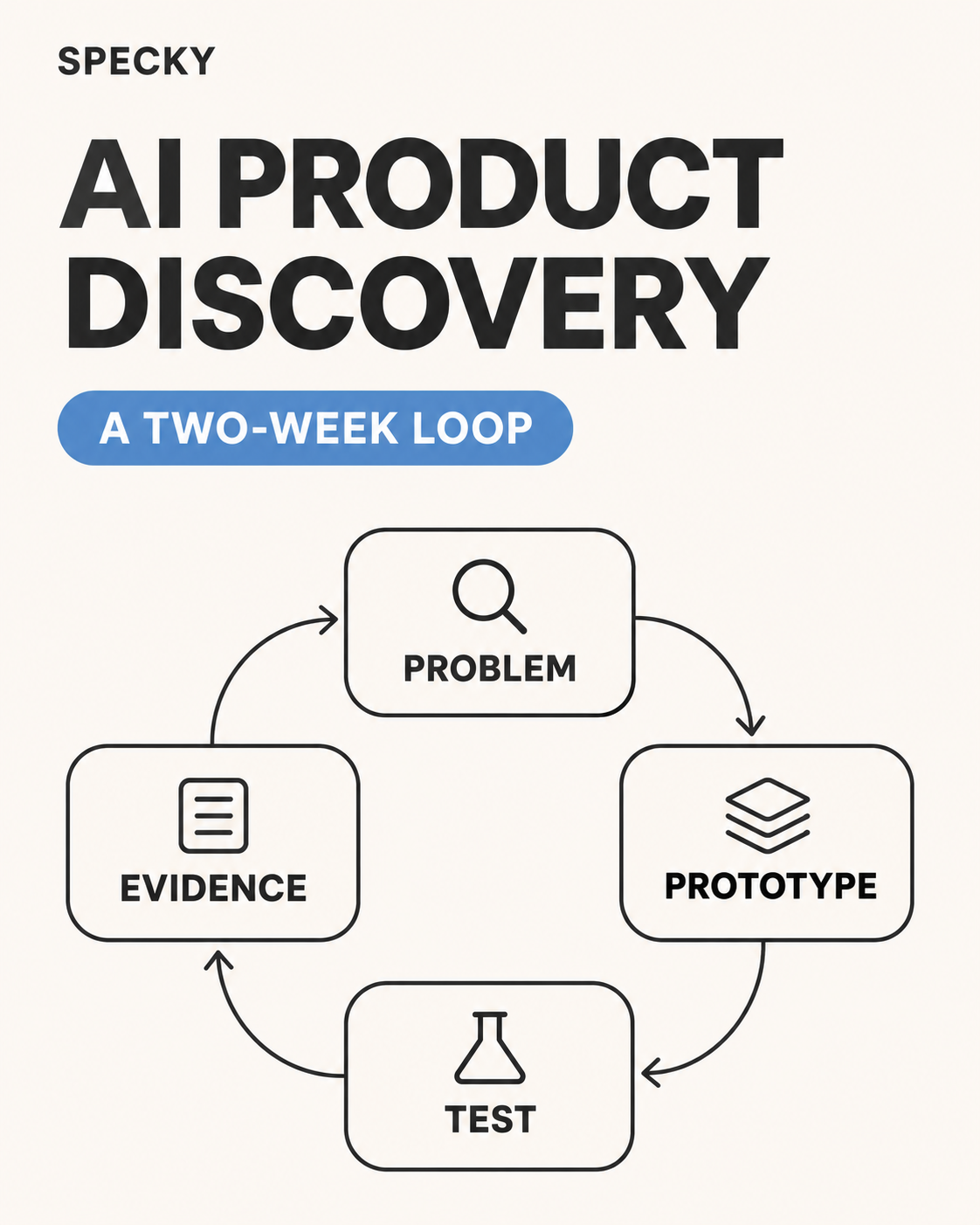
A two-week AI product discovery loop
The timing below is a planning aid, not a promise that every idea can be validated in ten workdays. A solo founder can compress it; a regulated or high-risk product may need more review. Keep the order: learn, choose a risk, test, then decide.
S
Specky Team
Writing about AI-native product development at Specky.
One user, one job, one decision the evidence could change
3–4
Collect direct evidence
Notes tied to real conversations, observed behavior, support requests, or product use
5–6
Choose the riskiest assumption
A small test with a clear success signal and failure condition
7–8
Build the smallest useful test
A prototype, mock, manual service, or workflow slice
9–10
Observe and decide
A short decision record: continue, change, pause, or stop
Days 1–2: Start with a product decision
Write one sentence that names the decision:
Should we help [specific user] complete [specific task] by [proposed change]?
Then list the assumptions underneath it. Separate the problem assumption from the solution assumption. For example:
Problem assumption: a solo product engineer spends time turning scattered user requests into a decision about what to build.
Solution assumption: an AI-assisted workflow can organize that evidence without losing the source or overstating what it proves.
Risk assumption: the user can check and correct the result before it influences a build decision.
The example is illustrative, not a customer claim. The point is to make the assumptions visible so the team can test one at a time.
Choose a narrow group by role, workflow, or constraint. “Startups” is usually too broad for a useful first test. “Technical founders building a B2B tool who review support conversations before prioritizing work” gives the team a more concrete place to begin.
Days 3–4: Collect evidence that already exists
Start with real material your team can inspect:
Notes from conversations about a recent task
Support requests or onboarding questions
Product usage that shows where users pause or repeat work
A screen share or task observation
A sales or customer-success conversation, labeled with its context
Keep observations separate from interpretations. “The user copied the same account details into three screens” is an observation. “They need an AI agent” is a hypothesis.
A small number of conversations can reveal language, missing steps, and plausible causes. It cannot estimate how common a problem is across a market. If you need a prevalence estimate, plan a suitable quantitative study instead of turning a handful of interviews into a percentage.
Engineers and product builders can take part directly in discovery without becoming full-time researchers. This lightweight customer-discovery workflow for product engineers covers how to ask about real behavior and capture evidence around a build decision.
Days 5–6: Pick the assumption with the highest decision risk
Do not test every unknown. Rank assumptions by two questions:
If this assumption is wrong, how much rework or user harm could follow?
How quickly can a small test reduce the uncertainty?
For an AI feature, the risky assumption might be that users want generated output, that the system can handle the input variation, or that people can review a mistake before it matters. Start with the assumption that could most change what you build.
Also compare AI with a simpler baseline. A model is worth testing when it offers a meaningful user benefit for a task with variable or unstructured inputs. A predictable rule, search, or manual step may be a better first version. Use the four-question AI feature test to make that comparison.
Days 7–8: Build only what the test needs
A prototype is an instrument for learning, not evidence by itself. Make only enough to put the risky assumption in front of the right person.
That could be:
A clickable mock for a workflow question
A manual or “concierge” version of the result
A narrow prototype using a small, representative set of examples
A thin implementation behind a limited rollout
A non-AI baseline to compare with the proposed AI interaction
Before building, write down what you will observe. If the question is whether a user can review and correct an AI-generated summary, the test should let them do that task. A polished demo that skips the review step will not answer it.
If an AI coding agent is helping, give it a bounded brief: the user, task, evidence, scope, expected behavior, failure cases, and how the team will check the result. The AI coding-agent PRD template is a starting point for that handoff.
Days 9–10: Observe a real task and make the decision
Ask a person from the target group to complete a realistic task. Watch what they do before asking what they think. Note where they hesitate, correct the output, switch to a workaround, or stop.
Pick one or two success signals that match the task. Depending on the feature, that may be task completion, time to finish, correction rate, successful handoff, or whether the user returns to the workflow. For AI systems, also record important failure cases, latency, and cost where those affect the experience. Do not treat a better offline evaluation score as proof that the user experience improved.
Then record the decision:
Decision
Use it when
Continue
The observed result supports the problem and the test met its prewritten success signal
Change
The problem appears real, but the workflow, audience, or proposed behavior did not fit
Pause
A high-risk unknown still needs evidence or review
Stop
The evidence weakens the problem or the proposed solution adds little over a simpler option
This is not a statistical proof of product-market fit. It is a way to make the next product decision more traceable and less dependent on the confidence of the person who wrote the prompt. When you move from discovery tests to post-launch evidence, see our AI product-market fit guide for a scorecard covering repeat use, user outcomes, trust, and cost.
A reusable AI prompt for evidence-backed discovery
Use AI to organize material you provide, not to manufacture market evidence. Keep source notes available so a person can verify every claim.
You are helping a small product team prepare one discovery decision. Use only the evidence I provide.
Separate direct observations, user-reported statements, team interpretations, and unanswered questions. Link each observation to its source label. Flag contradictions and missing context. Do not invent quotes, users, market size, frequency, or percentages.
From this evidence, identify one assumption that could most change the product decision. Propose the smallest test that could reduce that uncertainty. Include the target user, task, expected behavior, likely failure cases, one or two observable success signals, and what result would change the decision. Compare the AI approach with a simpler baseline. Mark all recommendations as hypotheses until tested.
Review the output against the original notes. If the model cannot point to the source for a claim, remove the claim or gather the missing evidence.
Common mistakes when product teams use AI to move faster
Treating a generated prototype as validation. It shows that something can be built, not that the target user needs it.
Using synthetic users as customer evidence. AI can help rehearse questions or expose edge cases, but simulated answers do not replace conversations or observed behavior.
Asking only whether someone likes the idea. Ask about a recent task and watch the person try a realistic workflow.
Measuring output instead of the job. Prompts run, code merged, and features shipped are delivery signals. They do not by themselves show that the customer completed a task more successfully.
Letting a metric hide a trade-off. An AI result can score well in an evaluation and still feel too slow, confusing, or hard to correct. Pair technical checks with a user task.
Keeping evidence in disconnected tools. Record the source, decision, test, and outcome together so the team can revisit what changed its mind.
Frequently asked questions
What is AI product discovery?
AI product discovery is the work of using customer and product evidence to decide what problem to solve, whether AI is a useful part of the solution, and what small test should happen before a broader build. AI tools can assist with synthesis and prototypes; the team remains responsible for checking sources and making the decision.
Can AI validate a startup idea?
AI can help organize evidence, generate test variations, and build a prototype quickly. It cannot establish that real customers have the problem or will adopt the solution. Use conversations, observed tasks, and product behavior as evidence; treat AI-generated analysis as a hypothesis until checked.
Do product engineers need to do customer discovery?
Product engineers can join conversations, observe workflows, inspect support requests, and challenge implementation assumptions directly. A small repeatable loop helps connect engineering choices with the user task. It does not require every engineer to run a formal research program.
How is product discovery different from product development?
Product discovery reduces uncertainty about the user, problem, and solution. Product development builds and operates the product. The work overlaps: a prototype can be part of a discovery test, and product development should continue to feed learning after release. The key is to know whether the team is testing an assumption or delivering a validated change.
Keep the evidence connected to what you build
The useful promise of AI for a small product team is more room to test ideas and improve a product—not a reason to skip the evidence. Start with a real task, make the riskiest assumption explicit, use the smallest test that can change your mind, then carry what you learned into the next brief.
Research note: The Reddit links above are practitioner discussions selected for the questions they raise. They are qualitative examples, not representative studies.