AI-Native Product Management: A Practical Operating Guide for Small Teams
A lightweight operating model for founders, product engineers, and product builders to connect customer evidence, product decisions, coding agents, releases, and learning.
Share
AI coding agents make it easier to turn a product idea into a working build. The harder job is keeping each build connected to a real customer problem, the decisions the team has already made, and what happened after release.
AI-native product management gives a small team a lightweight way to do that. AI can help gather and organize signals, explore options, draft product briefs, and carry out bounded work. People still decide which problem matters, what trade-offs to accept, and whether the result should reach customers.
What is AI-native product management?
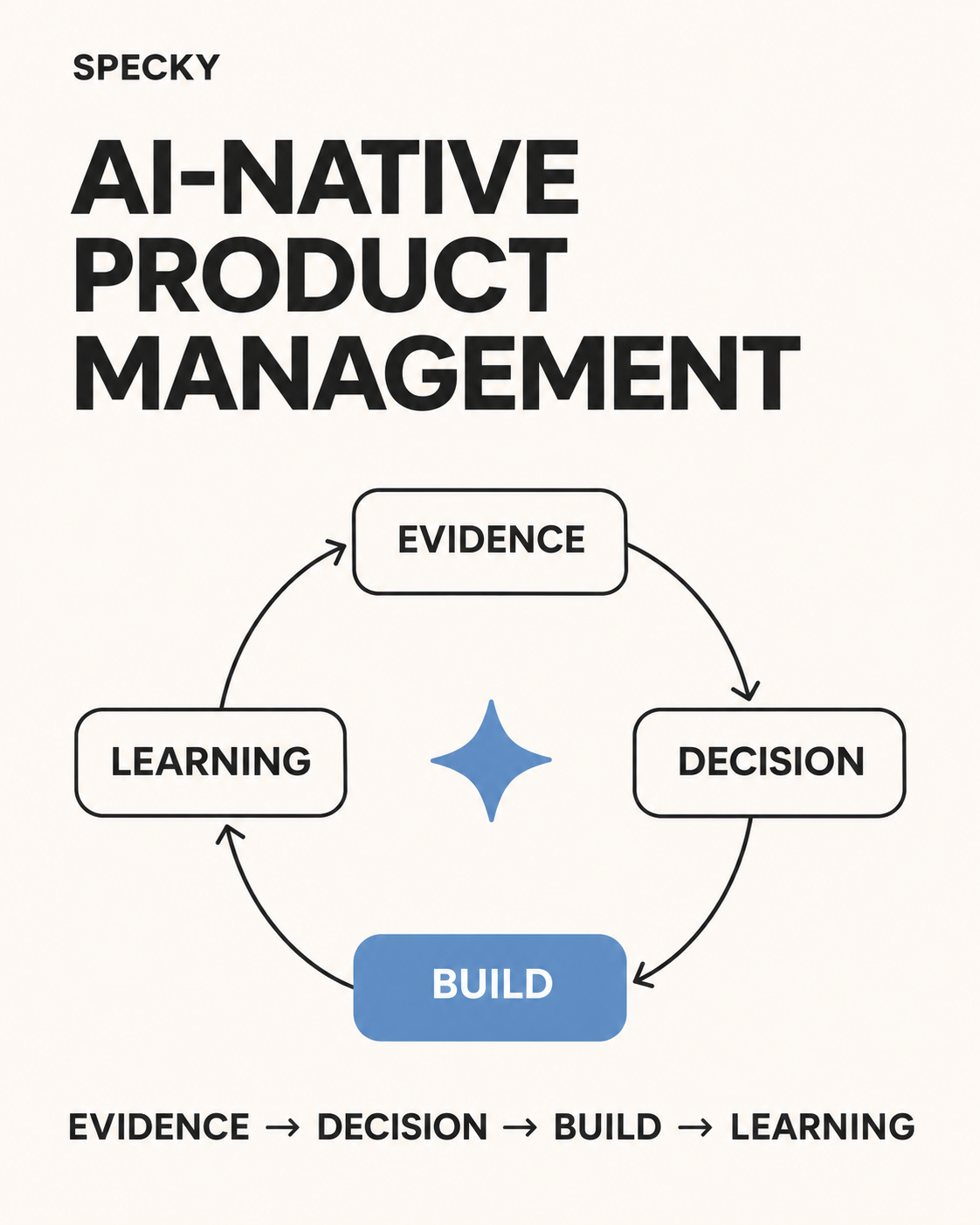
AI-native product management is a way of running product work in which AI participates across the recurring loop from customer signals to decisions, implementation, and learning. The team keeps enough shared context for an AI assistant or coding agent to help with more than a one-off prompt.
That context does not need to be a giant knowledge base. It needs to make the current product direction, evidence, constraints, and open questions easy to find and update.
A conceptual paper published in October 2026 describes a similar shift: AI participates persistently across sensing, exploration, decision-making, realization, and learning. The paper presents a vision and research agenda, not proof that one operating model works for every team. The practical question for a startup is smaller: can your team make a sound product decision and help an agent act on it without losing the reason behind the work? Read the paper.
Why product context matters when coding gets faster
A coding agent can follow a local instruction and produce code that compiles. It cannot infer from code alone which customer asked for a change, what the team promised, which architecture constraint matters, or why an earlier option was rejected.
A Product Management discussion about stateful product and architecture context for coding agents describes teams seeing drift across concurrent agent sessions. Treat that thread as an anecdote; it illustrates one way product drift appears across concurrent agent sessions. It does make the failure mode concrete: separate agents can complete separate tasks while the product starts moving in inconsistent directions.
S
Specky Team
Writing about AI-native product development at Specky.
For product engineers, founders, and product builders, the answer is a small operating system that travels with the work.
A lightweight AI product management workflow
Use these six steps for each meaningful product bet. A bet can be a feature, an onboarding change, a workflow improvement, or a decision to stop building something.
1. Capture evidence with its source
Record what a customer said or did before turning it into a solution request. Keep the original source link, date, and context next to the summary.
A useful evidence note includes:
The user and situation
What they said or did
Where the signal came from
What the team thinks it could mean
What is still unknown
Keep observations separate from interpretations. “Three trial users stopped during setup” is an observation. “They need a guided setup” is a hypothesis to test.
2. Frame the decision
Write down the decision the team needs to make, not just the feature someone requested. State who has the problem, what outcome would improve, the evidence behind the opportunity, and the cost of waiting.
Ask an AI assistant to find themes, list alternative explanations, or point out missing evidence. Treat those suggestions as prompts for investigation. The decision owner remains responsible for choosing what to pursue.
3. Maintain a short shared product brief
Keep a current summary of the product that a person or agent can understand quickly:
Who the product serves now
The main problem it helps them solve
The outcome the team is working toward
Current priorities and non-goals
Important product and technical constraints
Links to evidence and recent decisions
Link to source material instead of pasting every conversation, ticket, and document into one file. A small, well-maintained brief is easier to trust than a large dump that mixes current facts with stale assumptions.
4. Give each build a bounded brief
For a task that is ready for implementation, include the user problem, the evidence, the desired behavior, what is in and out of scope, relevant technical constraints, and observable acceptance checks.
A useful brief explains what should change and how the team will verify it. It leaves implementation choices to the engineer or agent when those choices do not affect the product decision. The AI coding agent PRD template provides a copyable task-level version.
5. Review the result before release
Ask the coding agent to summarize the decision it is implementing, list assumptions, and identify the checks it ran. Review the behavior against the customer problem and acceptance criteria. Have the responsible engineer check security, data handling, architecture, and production readiness.
A prototype helps answer questions about feasibility and usability. It does not establish demand on its own. Before release, decide who will see the change, what to watch, and how to roll it back if the experience is worse.
6. Close the loop with what happened
After release, record what changed, who received it, what the team observed, and whether the original decision still holds. Use product analytics, support messages, and customer conversations together when they answer different parts of the question.
If the signal is too small to support a conclusion, say so and choose the next observation. A small sample calls for careful learning and calibrated conclusions.
Copyable product bet template
# Product bet

User and situation:
Observed evidence and source links:
Problem we think this points to:
What remains uncertain:
Decision and owner:
Why this matters now:
In scope:
Out of scope:
Technical or product constraints:
Acceptance checks:
What we will observe after release:
Review date or trigger:
This template creates a path from evidence to work without turning every idea into a long PRD. Link a task-specific spec when more detail is needed.
Keep AI useful and human decisions clear
AI can summarize feedback, compare alternatives, draft a first brief, identify conflicting documents, propose test cases, and explain code changes. Those tasks help a small team move through work with less manual coordination.
People should own decisions that commit the team: choosing the customer problem, setting priorities, accepting risk, making promises, approving production changes, and deciding what success means. The team can delegate more implementation as its checks improve, but delegation should stay bounded by permissions, tests, and a named reviewer.
This boundary matters for product engineers and builders who can move from idea to prototype in an afternoon. The faster the build, the more useful it is to keep the decision and the checks close to the code change.
A simple weekly cadence for an AI-native team
A solo founder can review the loop in a few minutes before a build session. A small team can use a short weekly review:
Add new customer and usage signals to the evidence list.
Revisit the active product bet and note what changed.
Pick one next step: learn more, prototype, ship, or stop.
Give the agent a bounded brief with the current context.
Review the shipped result against the original decision.
Update the brief when a decision changes, a new constraint appears, or evidence changes the team’s understanding; the document should support that work rather than create a new meeting obligation.
Start with a few checks you can answer from real work:
Can the person starting a task find the customer problem and the latest decision?
Do engineers and agents have the constraints they need before implementation?
How often does work need to be reopened because the goal or context was unclear?
After release, can the team tell what evidence would support continuing, changing, or stopping the work?
Use these as process checks. Compare your own baseline over time and keep the sample size visible.
Frequently asked questions
Is AI-native product management only for AI products?
No. It describes how a team uses AI in product work. The product being managed may use AI, traditional software, or both.
Does an AI-native product team need a full-time product manager?
Not always. A founder or product engineer can own the product decisions in a small team. The important part is to make the evidence, decision owner, and review trigger clear.
Should product managers let coding agents ship to production?
A coding agent can implement bounded work when the team’s repository rules and checks allow it. A named human should review consequential changes and remain accountable for release decisions. A working prototype is not automatic approval for production.
What should a team put in its AI product context?
Keep the current audience, product goal, open decisions, evidence links, non-goals, and relevant technical constraints. Add detail when it changes what the team should build or how the result should be checked.
AI-native product management works when the product’s evidence and decisions stay usable throughout the work. Start with one product bet, keep its context current, and use what happens after release to choose the next one.