Reversibility Is a Product Requirement: How to Spend Decision Effort Wisely
The fastest product teams are not the ones that decide everything quickly. They match decision effort to reversibility, recovery cost, and the evidence required to change course.
Share
Some product decisions deserve a week of careful thought. Others deserve ten minutes and a way back.
Most small teams do not separate the two. A pricing change, a navigation label, a research question, and a data migration all arrive in the same backlog, enter the same meeting, and receive the same vague request for “more confidence.” The result is predictable: reversible decisions move too slowly, while genuinely hard-to-undo decisions can move forward without the right evidence.
The missing field is reversibility.
Reversibility is not a personality trait. It is a product requirement: a description of how the team can recover if the decision is wrong. Once that field is explicit, the team can match its process to the cost of being wrong.
Research on new product development describes a similar pattern across the lifecycle: uncertainty changes as ideas become concrete, while the difficulty of reversing decisions tends to increase. See the 2026 systematic review of AI in new product development. Separate design research has explored how structured decision knowledge can be reused across product-development work instead of disappearing after the meeting; see the ontology-based framework for reusing decisions.
The practical lesson is simple: do not spend the same amount of thinking on every decision. First classify the door. Then design the evidence, ownership, and review around it.
Reversibility is not the same as importance
A decision can be important and reversible.
Changing the onboarding sequence may affect activation, support volume, and the first impression of the product. It matters. But if the old flow can be restored with a feature flag and the data model is unchanged, the decision may still be easy to reverse.
A decision can also look small and be hard to reverse.
Renaming a core object might seem like a copy change. If the name appears in exported files, customer workflows, search indexes, API payloads, and sales material, reversing it can be expensive and confusing. The surface area is small; the recovery path is not.
Use two separate questions:
How much does this matter if we are wrong?
S
Specky Team
Writing about AI-native product development at Specky.
Importance tells you the potential impact. Reversibility tells you how much optionality you have after acting. They should not be collapsed into one priority score.
The five-part reversibility check
Before a product decision enters a planning meeting, write five short answers.
1. What exactly is the decision?
State the choice as a sentence with a verb.
Bad: “Onboarding.”
Better: “For new workspaces, show the evidence-import step before the first roadmap view.”
A decision sentence prevents the team from debating a theme while believing it has decided something concrete. It also gives the later decision record a stable subject.
2. What is the safe baseline?
Name the state you can return to.
This is not always “what we have today.” If today’s state already contains a risky migration, the safe baseline may be a versioned release, a feature-flag state, or a known-good dataset.
Write:
baseline state;
where it is stored;
who can restore it;
how long restoration should take;
what information would be lost, if any.
If the team cannot describe the baseline, the decision is not reversible yet, even if everyone calls it an experiment.
3. What makes reversal expensive?
List the actual cost, not only the technical step.
Common reversal costs include:
migrated or deleted data;
customer habits and training;
public promises or contractual language;
support and documentation changes;
security, privacy, or compliance review;
search and analytics continuity;
reputation or trust after a visible change;
dependencies that other teams will build on.
This is where “we can always roll it back” often breaks. The code may be reversible while the surrounding product state is not.
4. What evidence is enough for this door?
Reversible decisions do not need zero evidence. They need the right evidence.
For a reversible decision, the minimum may be:
a clear problem statement;
a small experiment or preview;
an owner;
a stop condition;
an observation date.
For a costly-to-reverse decision, raise the bar:
evidence from more than one source;
explicit alternatives, including doing nothing;
a failure-mode review;
affected stakeholders;
a migration or recovery plan;
a decision owner who can say no.
The point is not to make every decision heavy. It is to make the threshold visible before the meeting begins.
5. When will we look again?
A decision without a review trigger becomes a permanent assumption.
Attach one of these:
a calendar date;
a usage threshold;
a customer signal;
a failure condition;
a milestone that changes the context.
For example: “Review after the first ten workspaces complete the new flow,” or “Revisit when the migration reaches 25% of active workspaces.” These are not promises about results. They are instructions for when the team should learn.
A simple decision matrix
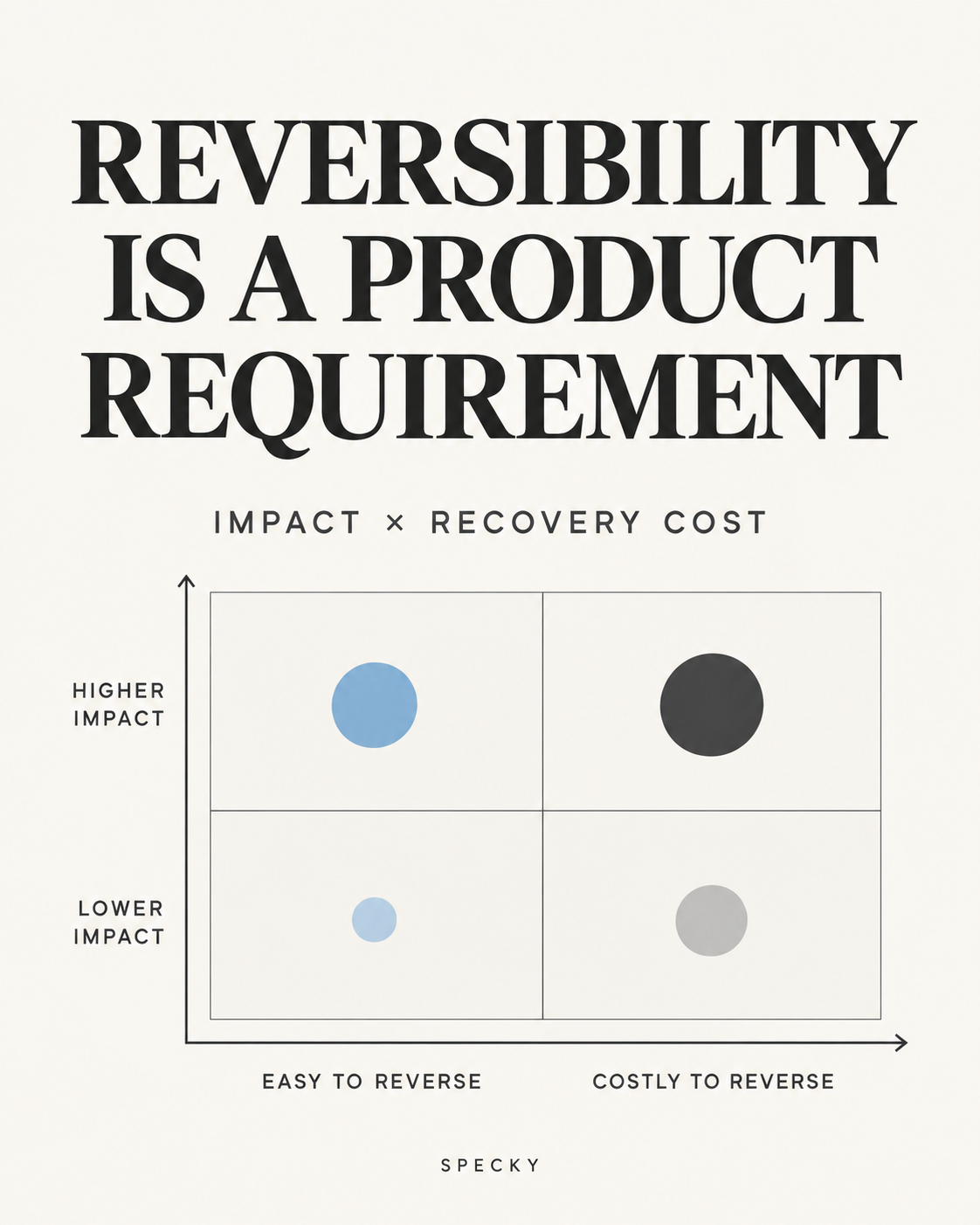
You can classify most product decisions with two axes: impact and reversibility.
Easy to reverse
Costly or hard to reverse
Lower impact
Decide quickly, log the rationale, instrument the result.
Use a short preflight checklist and name the recovery owner.
Higher impact
Run a bounded experiment with a clear stop condition.
Slow down, widen the evidence, review failure modes, and record explicit approval.
The matrix is a triage tool, not a verdict. A low-impact decision can become high-impact when it touches trust, permissions, or durable data. A high-impact decision can become easier to reverse when the team deliberately adds a flag, a staged rollout, or an exportable state.
The design goal is to move decisions toward the top-left without pretending every decision starts there.
Worked example: adding an AI-generated summary
Imagine a team wants to add an AI-generated summary to a customer-feedback inbox.
The first version might be easy to reverse if it is:
opt-in;
clearly labeled as generated;
rendered beside the original feedback;
excluded from the source record;
disabled by one configuration change;
evaluated against a small set of representative examples.
The same idea becomes much harder to reverse if the summary replaces the original feedback, is written back into the system of record, drives prioritization automatically, or is included in exports that customers rely on.
The feature idea did not change. The decision architecture did.
A useful brief would therefore separate the reversible decision from the irreversible one:
Reversible: show a generated summary in a review surface.
Costly to reverse: store the summary as canonical customer context.
Separate decision: allow the summary to change priority without human review.
This separation keeps the first learning loop small. It also prevents a team from smuggling a durable policy into what sounds like a harmless UI experiment.
Make reversibility part of the product record
A decision record should not end at “we chose option B.” Add the fields that preserve optionality:
decision statement;
problem and evidence;
impact if wrong;
reversibility class;
safe baseline;
reversal mechanism;
owner;
evidence threshold;
review trigger;
links to the resulting brief, experiment, build change, and outcome.
This is where product memory becomes useful. A future teammate should be able to understand not only what the team chose, but how confidently it chose, what it intentionally left open, and what would cause it to change course.
In Specky, that means keeping the decision connected to the evidence, product brief, agent work, and outcome check rather than storing the rationale in a meeting note that no later workflow can reach. The graph is not the decision. It is the context that lets the decision remain inspectable.
A weekly habit for small teams
Do this once a week:
Pick the five decisions most likely to enter execution.
Label each one easy to reverse, costly to reverse, or unclear.
For every unclear decision, write the missing recovery step.
Move one evidence requirement earlier in the workflow.
Review one old decision and ask whether its reversibility label was accurate.
That last step matters. Reversibility is an estimate, and teams get better by comparing the estimate with what actually happened. A “quick experiment” that required weeks of cleanup should change how the team classifies the next one.
The takeaway
Decision speed is not the goal. Correctly allocated decision effort is.
Move quickly when the team has a safe baseline, a bounded test, a named owner, and a way to notice a wrong turn. Slow down when reversal would touch durable data, customer trust, public commitments, or system-wide behavior.
Every product decision should answer one question before it asks for approval:
If we are wrong, how do we get back to a safe state?
If the answer is clear, the team can move with confidence. If the answer is vague, the next product task is not more debate. It is designing the recovery path.
Specky helps teams keep that path visible by connecting decisions, evidence, briefs, builds, and outcomes in one product workspace. → specky.space