AI Use Case Prioritization: A Scorecard for Product Teams
Compare AI product ideas with a practical scorecard for user evidence, impact, AI advantage, risk, and testability. Choose what to validate next.
Share
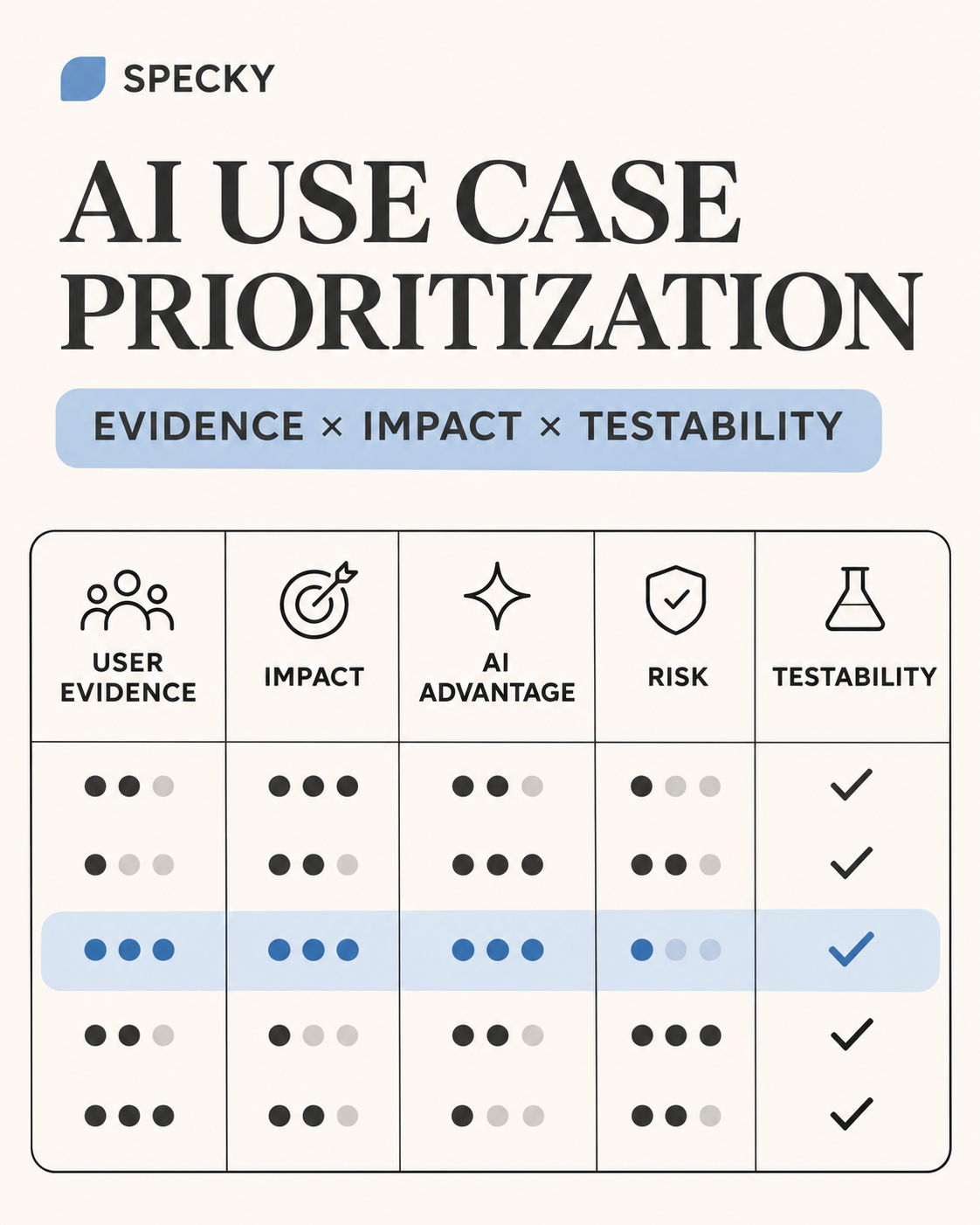
Short answer: AI use-case prioritization is the process of comparing several possible AI product ideas and choosing which user problem to investigate or test first. Rank candidates by the strength of the problem evidence, expected user outcome, AI’s advantage over a simpler option, evaluation readiness, and the cost of failure. Treat the score as a way to expose trade-offs, not as a forecast.
This is a different decision from asking whether one feature should use AI. The four-question AI fit test helps assess a single feature. This scorecard helps a founder, first product hire, PM, or product engineer decide which of several candidates deserves the team’s limited attention.
Start with candidate problems, not AI features
An idea list often mixes different things: user problems, requested features, experiments, and technical possibilities. Normalize each candidate before comparing it.
For every idea, write down:
User and situation: Who encounters the problem, and when?
Job: What are they trying to do?
Current approach: What do they do today, including workarounds?
Evidence: What was directly observed, and where can the team inspect it?
Desired outcome: What would be better for the user?
AI contribution: What part of the task may benefit from language, synthesis, or adaptation?
Failure cost: What could go wrong, and who would notice?
First test: What is the smallest experiment that can answer a meaningful question?
“Add an AI roadmap assistant” is not ready to compare. “A first product hire spends Friday combining support requests and interview notes before deciding what to investigate” is a more useful candidate: it names a user, a task, and evidence the team can look for.
Do not treat a stakeholder request, an upvote, or a convincing prototype as proof that a problem is common. Keep the original source attached and record what it does not establish. The AI product discovery loop and customer interview synthesis template show ways to collect and review those signals.
S
Specky Team
Writing about AI-native product development at Specky.
A high score should not hide a basic reason to wait. Before ranking ideas, check three gates:
The user problem is specific enough to investigate. You can name a user, describe a recent situation, and identify at least one source or a clear discovery step.
A useful outcome can be observed. The team can say what should improve and what guardrail must not get worse.
A costly failure has a visible control. The team can detect, review, limit, or reverse the relevant failure before expanding the feature.
If an idea fails a gate, mark the missing evidence or design work. It can remain on the list, but it should not win simply because a prototype is easy to build.
Score and compare the candidates
Use a 1–5 score for each dimension. The weights below are a starting point for discussion, not a research-validated formula. Change them if your team’s strategy or risk profile calls for it. Keep the written rationale next to every score.
Dimension
Weight
1 — weak
3 — mixed
5 — strong
Problem evidence
30%
Mostly an assumption
One credible signal, pattern unclear
Repeated, inspectable evidence from the intended users
User outcome
25%
Benefit is vague or internal
A plausible user benefit with gaps
A specific task or outcome should improve
AI advantage
15%
A rule or ordinary search may work as well
AI could help one part
AI addresses meaningful variation, language, or synthesis
Evaluation readiness
15%
No examples or review criteria
Some examples, important gaps remain
Representative cases and observable quality checks are available
Failure control
10%
Errors could be silent or hard to reverse
Some review or fallback exists
Errors are visible, contained, and recoverable for the test
Time to learn
5%
The test needs broad integration or a long commitment
A pilot is possible with dependencies
A small, reversible test can answer the next question
Calculate a weighted score as score divided by 5 and multiplied by the weight, then add the six results. Use the number to structure a conversation, not to imply that a 4.1 idea is objectively better than a 3.9 idea. A serious risk or failed readiness gate still needs a direct decision.
Example: compare three possible AI workflows
The example below is hypothetical. It illustrates how a small team might compare ideas; it is not a Specky customer result or market research.
Candidate
Evidence to inspect
Main uncertainty
Sensible first test
Group customer interview notes into themes
Recent interviews and existing synthesis time
Whether the suggested themes preserve disagreement and source context
Ask reviewers to trace each theme to original excerpts and flag missing counterexamples
Draft a product brief from customer evidence
Examples of briefs, source documents, and rewrite steps
Whether the draft saves review work without adding unsupported claims
Require source links for factual claims and have a PM or product engineer review the draft
Automatically rank roadmap requests
Request sources, decision history, and how priorities are currently set
Whether a ranking hides missing context or is mistaken for a decision
Show evidence and trade-offs first; keep the prioritization decision with a person
The first two may be reasonable assistive experiments if the evidence and review path are available. The third could carry a higher decision risk because a ranked list can appear authoritative. The team should compare those risks with its own evidence and users before selecting a pilot.
Make the AI advantage concrete
“AI makes this smarter” is not a useful score rationale. Name the specific work where a model may help, then compare it with the simplest useful baseline:
Does the task involve varied language or unstructured evidence?
Does synthesis across sources matter?
Can a user check the output against those sources?
Would search, a rule, a filter, or a short workflow solve the same problem?
What cost, latency, review, and maintenance does the AI version add?
Google’s People + AI Guidebook is a useful reference for grounding AI design in user needs. It does not validate the weights in this scorecard. For deciding whether a single proposed feature needs a model at all, use the AI fit test.
Design the first test to reduce the biggest uncertainty
Do not pilot an entire roadmap idea when a narrow test can answer the next question. Choose the test based on what is least known:
Problem uncertainty: Observe the current workflow or interview people about a recent, concrete instance.
AI-fit uncertainty: Compare the model with a rule, search, or current manual process on representative examples.
Quality uncertainty: Define review criteria and include difficult or ambiguous inputs.
Trust uncertainty: Let intended users inspect, correct, reject, or undo the result.
Outcome uncertainty: Pick a measure tied to the user’s task, plus a guardrail for quality, errors, cost, or time.
Write down the continuation and stop conditions before looking at results. For example, continue only if people can verify the output, the agreed quality checks pass, and the test improves the task without creating unacceptable review work. Set actual thresholds with the team based on the consequence and baseline; there is no universal pass score.
The NIST AI Risk Management Framework offers a voluntary way to organize risk work across mapping, measuring, and managing. Use it as a prompt for product-specific questions, not as a certification or a substitute for domain review.
Copyable AI use-case prioritization scorecard
Candidate:
User and situation:
Job to be done:
Current approach or workaround:

Evidence and source links:
What the evidence shows:
What it does not show:

Desired user outcome:
AI contribution:
Simplest useful baseline:

Problem evidence (1–5):
User outcome (1–5):
AI advantage (1–5):
Evaluation readiness (1–5):
Failure control (1–5):
Time to learn (1–5):
Weighted score:
Reason for each score:

Readiness gates:
[ ] Specific user problem and evidence
[ ] Observable outcome and guardrail
[ ] Failure is detectable, contained, or reversible

Smallest useful test:
Owner:
Continue if:
Stop or redesign if:
Review date:
Keep the original evidence links with the scorecard. If a score changes, record what new information changed it. A lightweight product decision log can preserve the rationale and the conditions for revisiting the choice.
How product engineers and builders can use the scorecard
Product engineers and technical founders often see an implementation path before the team has compared the underlying problems. Use that speed to make a test cheaper, not to skip problem evidence. Engineers can identify data access and integration constraints, prepare representative examples, and make a prototype reversible. Product builders can help expose assumptions in the spec and make the review path explicit.
Keep product judgment with the team. AI can organize candidate evidence or draft options; it should not silently turn a score into a roadmap commitment. For a related engineering-led discovery workflow, see customer discovery for product engineers. To move a selected idea into a requirements draft, use the free AI PRD generator and keep the source evidence attached.
Frequently asked questions
What is AI use-case prioritization?
AI use-case prioritization compares candidate user problems and workflows to decide which one to investigate or test first. A useful comparison includes user evidence, expected outcome, AI’s specific advantage, evaluation readiness, and failure controls.
How do you prioritize AI features?
Start with the user problem and current workaround. Apply readiness gates, compare candidates with consistent criteria, and run a small test on the highest-priority idea whose risks can be controlled. Keep the score and rationale visible so new evidence can change the decision.
Should a small team build several AI features at once?
Usually, test fewer ideas at a time when the team cannot evaluate them in parallel. A narrow pilot makes it easier to attribute review effort, quality problems, and user outcomes to a particular workflow. Choose the scope based on available evidence and capacity.
What if two AI use cases have similar scores?
Compare the uncertainty each test would reduce, the downside if the workflow fails, and whether the ideas depend on the same data or integration. If the evidence is still tied, run a discovery step or a small reversible test instead of inventing precision in the scoring.
Does an AI use-case score predict product success?
No. A score is a structured summary of current evidence and assumptions. It does not predict adoption, revenue, or product-market fit. Validate the user problem and measure what happens in a real workflow.
Choose a test, then update the decision with evidence
A useful AI use-case prioritization process makes the choice and its uncertainty easier to see. Compare candidate problems, show why one test comes first, and record what would change the decision. The goal is to learn which workflow creates a real user benefit—not to put AI on the roadmap by default.