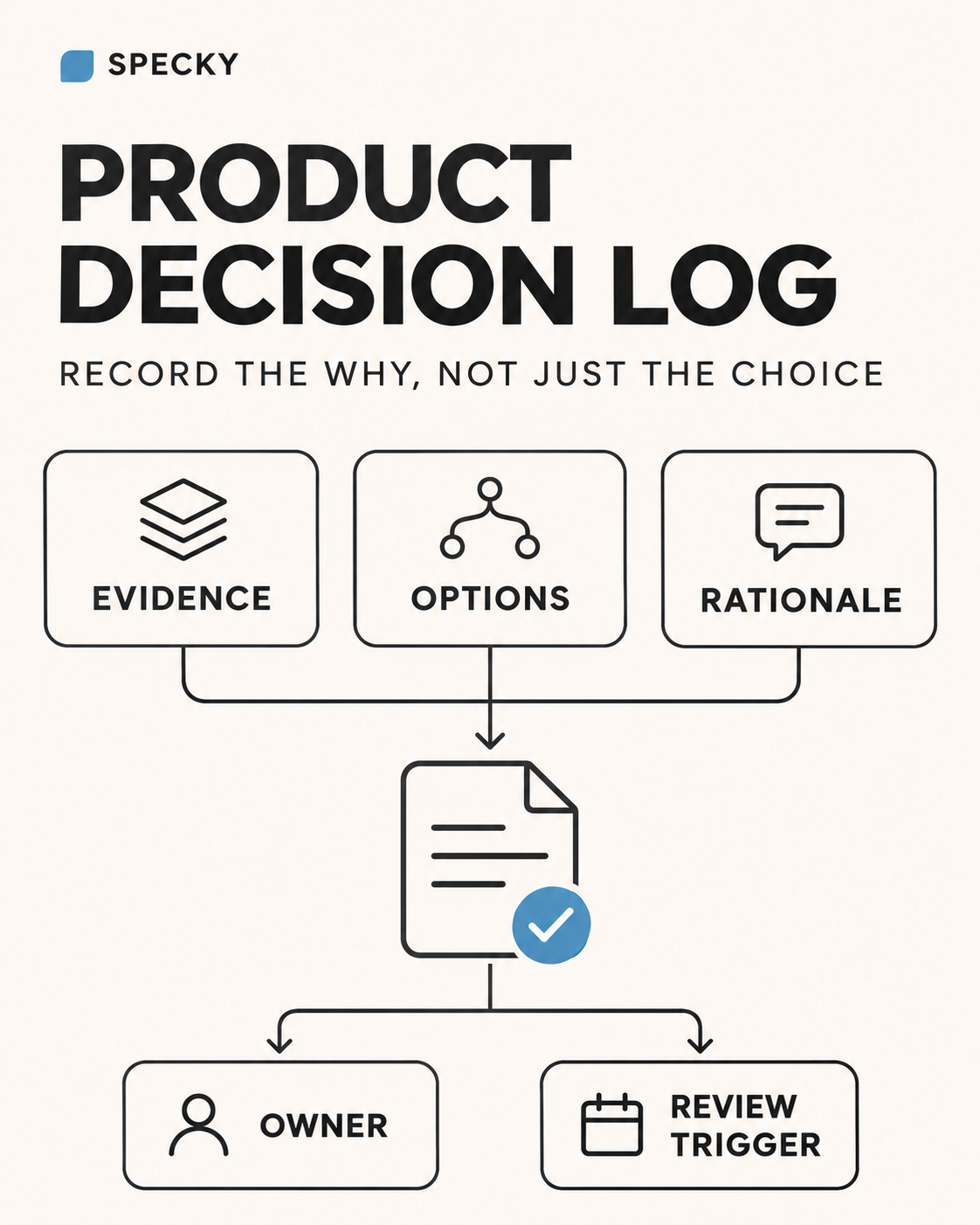
Product Decision Log Template: Record the Why, Not Just the Choice
Copy a practical product decision log template for small teams. Capture evidence, options, rationale, owners, confidence, and the trigger for revisiting a product choice.
Share
A product decision log is a short record of an important product choice: the user problem, evidence, options, rationale, owner, and the condition that would make the team revisit it. It helps founders, product managers, and engineers recover why a choice was made after the original conversation has disappeared into Slack, a document, or a ticket.
Use a product decision log for choices that affect the roadmap, customer experience, important constraints, or a meaningful product bet. Keep routine implementation details in the ticket or spec. The goal is not to document every conversation; it is to preserve the context that will matter later.
Copyable product decision log template
Copy this template into the document or workspace where your team keeps product context. Link to the original evidence and delivery work so the record stays short and verifiable.
Decision:
Status: proposed | decided | testing | superseded
Date:
Decision owner:
People consulted:

User problem and affected segment:
Decision question:
Evidence and source links:
Observed facts:
Assumptions and unknowns:

Options considered:
Chosen option:
Why this option:
Tradeoffs accepted:

Confidence: low | medium | high — and why
Reversibility: easy | costly | hard to reverse
Success signal:
Revisit date or trigger:

Related brief, ticket, or release:
Outcome and what we learned:
A complete record can fit on one screen. If the decision needs a long explanation, link to a brief or research synthesis rather than copying it all into the log.
How to fill in each part
Write a decision question, not a task
A task says what someone will do: “Add an AI summary button.” A decision question makes the choice visible: “Should the product generate a summary automatically, offer one on request, or keep the current manual workflow?”
The question should identify the choice and the user or outcome it affects. That makes it easier to tell whether the decision is still open and which evidence could change it.
Link evidence and separate it from interpretation
S
Specky Team
Writing about AI-native product development at Specky.
Link to the interview note, support conversation, product analytics, experiment, or customer request that informed the choice. Include enough context to find the relevant passage: date, segment, source, and a short description.
Then distinguish what the evidence shows from what the team infers. For example:
Observed: “Three interviewees described copying the same account details into two tools.”
Interpretation: “Reducing duplicate entry may matter more than adding another reporting view.”
Unknown: “We have not checked whether this happens for most active accounts.”
The example is illustrative, not research from Specky customers. In real records, link to the underlying source and state its limits. Do not turn one request into a claim about every user.
Record the options the team actually considered
List the plausible alternatives, including “do nothing yet” when it is viable. The record does not need a long pros-and-cons essay. One sentence per option is usually enough to show what was compared and why the chosen path won.
Avoid rewriting the reasoning after the result is known. Capture the main tradeoff at decision time: what the team optimized for, what it knowingly gave up, and what risk remains.
Make confidence and reversibility useful
Use low, medium, or high confidence, then explain the reason in plain language. “Medium: repeated in recent support conversations, but not checked against usage data” tells a future teammate more than “70% confident.”
Reversibility is about the cost of changing course. A small prototype with a clear rollback is easier to reverse than an API, data-model, or customer-commitment change. When a decision is easy to reverse, a bounded test can be more useful than another week of debate. When it is hard to reverse, collect stronger evidence and identify the approval owner first.
Choose a signal and a revisit trigger
A success signal should describe an observable user or product outcome, not just work shipped. For an onboarding change, that might be the share of new users who finish the setup step and then complete a meaningful action. For an AI suggestion, track whether people accept, edit, or reject it and whether they can trace it to the source evidence.
Write down when the team will look. Use a date for a time-bounded experiment or a clear event as the trigger for a durable choice. Examples include: “revisit after the first release cohort,” “reopen if the source data changes,” or “review if support reports a repeated failure.” A trigger prevents an old assumption from quietly becoming permanent.
Decision log vs. PRD, ticket, and roadmap
Artifact
Main question it answers
Keep here
Product decision log
Why did we choose this, and when would we reconsider?
What outcomes or bets are planned, and in what order?
Priorities, sequencing, timing, and status
Link these artifacts instead of making each one repeat the others. A ticket can point to the decision record; the record can link to the brief and the evidence. That way an engineer can see both what to build and why it matters.
A fictional example: choosing an AI-assisted feedback workflow
Suppose a small team is deciding whether to turn customer feedback into roadmap tickets automatically. In this fictional example, the team has seen feedback copied between notes and a tracker, but has not measured how often this happens or whether automation would improve the process.
The decision record could say:
Question: Should the system create a ticket automatically, suggest an editable draft, or leave the workflow manual?
Evidence: Link the specific feedback notes and current workflow observations; label frequency and representativeness as unknown.
Options: Automatic ticket creation; a suggested draft with links to source evidence; no change.
Choice: Test an editable draft that preserves source links and requires a person to confirm before it becomes work.
Tradeoff: The human check adds a step, but makes it easier to catch a wrong interpretation before it reaches the backlog.
Signal: Track drafts accepted, materially edited, and rejected; ask users whether the linked evidence is enough to verify the suggestion.
Revisit trigger: Review after the agreed test period, or sooner if people cannot trace suggestions to their source.
This record does not claim the workflow will save time. It states the hypothesis, limits, and test that can answer the question. If the team later automates the step, the reason and evidence for that change are still visible.
Keep the log lightweight and current
Start with one shared index, then give each consequential choice a stable link. Link from the relevant brief, ticket, research note, or release entry. Restrict access to sensitive customer material; a decision log should link to approved sources rather than copying private data into a broadly visible page.
Review open experiments during an existing product check-in. When the team changes direction, mark the old entry superseded and link the new decision. Do not delete the old rationale: the history helps explain what changed and prevents the same question from being reopened without new evidence.
AI can help group notes or draft a first pass, but a named decision owner should verify every source and confirm the rationale. Keep quotes and links attached to the evidence. A generated summary is an aid to reading the sources, not proof that users said something the sources do not support.
One archived r/ProductManagement discussion includes a practitioner describing how a decision in Slack, a spec in a document, an engineering ticket, and a meeting change can leave teammates reconstructing the current state. This is one self-selected anecdote, not a survey or evidence of how common the problem is. It informed the template's emphasis on keeping rationale and source links together. Read the discussion.
Frequently asked questions
What should a product decision log include?
Record the decision question, user problem, evidence links, assumptions, options considered, rationale, owner, confidence, reversibility, success signal, and a date or event for review. Add links to the implementation brief and ticket rather than copying their full contents.
Which product decisions should be logged?
Log choices that change a meaningful user experience, roadmap bet, product constraint, or commitment—or choices likely to be revisited by someone who was not in the original discussion. Routine implementation decisions can stay in the spec or ticket.
How is a product decision log different from an architecture decision record?
An architecture decision record focuses on a technical or system-design choice and its consequences. A product decision log can cover user problems, segments, business tradeoffs, research, and delivery choices across product, design, and engineering. A technical decision can be linked from the broader product record.
Can AI write a decision log?
AI can draft a summary from supplied materials, but the owner should check every source link, separate facts from interpretations, and approve the final rationale. Never let a generated summary invent customer evidence, agreement, or confidence.