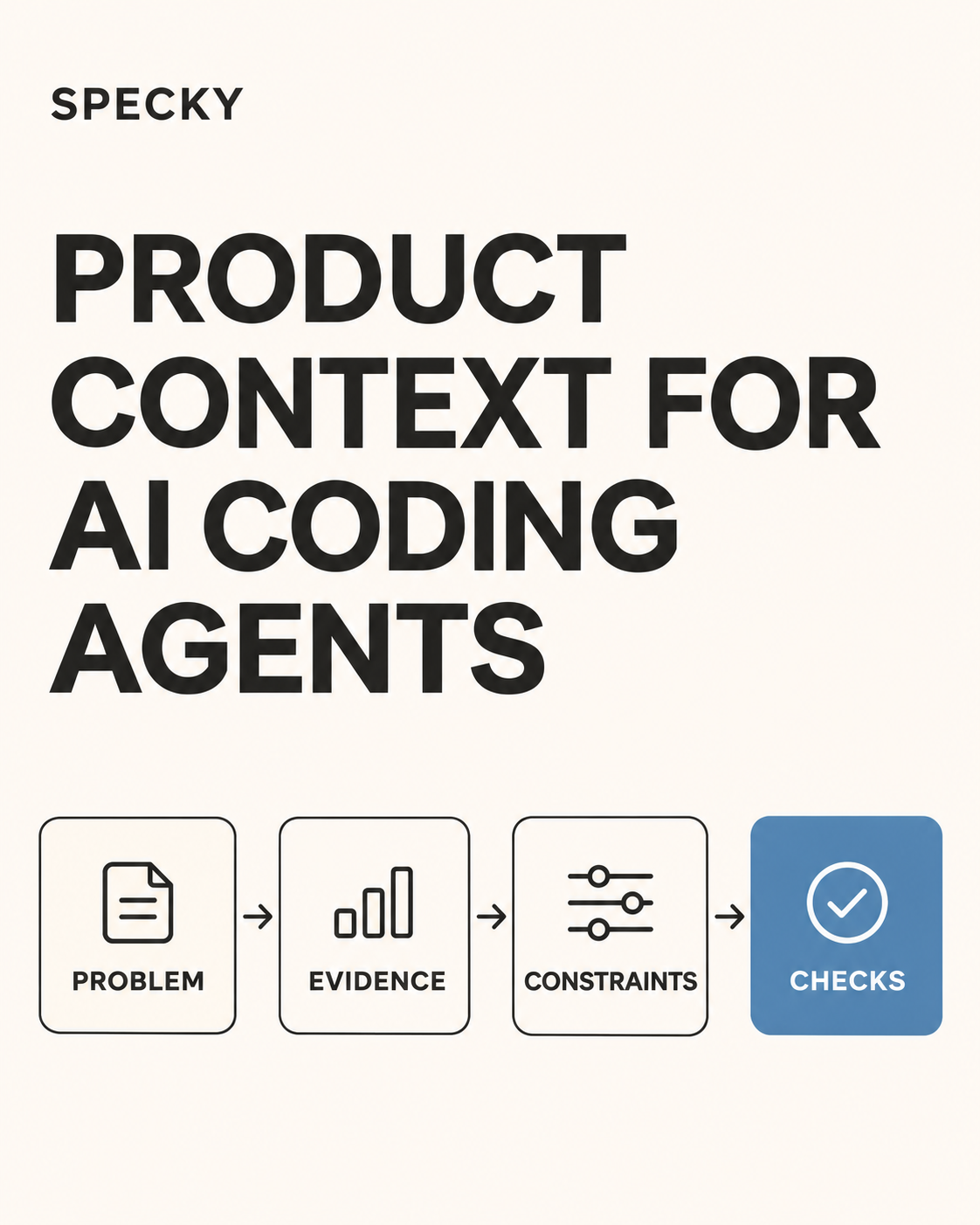
How to Give an AI Coding Agent the Product Context It Needs
Give AI coding agents the context they need without copying stale docs. This workflow keeps product decisions in one shared source of truth and gives each task clear evidence, constraints, and review checks.
Share
The short answer
An AI coding agent needs a small, current slice of product context: who has the problem, what evidence supports it, what outcome the change should create, which constraints matter, and how a person will check the result. Keep the team's product decisions in their shared home. Give the agent task-specific links and instructions instead of maintaining a second product wiki just for AI.
Why product context is easy to get wrong
A coding agent can work from a prompt, repository files, connected tools, or some combination of them. Each source can be useful; each can also be incomplete, out of date, or unrelated to the task. A large context dump may contain the right answer somewhere while making it harder to tell which decision is current.
A public r/ProductManagement discussion asked how teams can move decisions from meeting notes into a shared resource that people and language models can use. It is one thread, not evidence of prevalence, but it captures the operational tension: an agent needs current context while people still need a shared place to make and update decisions.
The answer is to separate durable decisions from task-specific context. Do not copy every useful fact into every repository. Link to the authoritative source, select what matters for this change, and make uncertainty visible.
The mechanics vary by coding tool. As one concrete example, VS Code's documentation on agent context describes context assembled from instructions, conversation, explicit references, and tool outputs. It also notes that explicit references use context-window space, so adding more files is not automatically better.
OpenAI's engineering team describes treating repository instructions as a map to deeper sources rather than an encyclopedia. That is one team's operating report, not a universal benchmark; the practical lesson is to keep durable instructions short, current, and linked to the detail people and agents need.
Keep three kinds of context distinct
S
Specky Team
Writing about AI-native product development at Specky.
This is where the team records the customer problem, research evidence, strategic choices, and decisions that multiple people need. Keep it in the product workspace the team already uses. A decision should have an owner, a date, a reason, and links to the evidence when possible.
2. Repository instructions
A repository can hold stable engineering guidance: how to run the app, coding conventions, architecture boundaries, test commands, and security rules. These instructions help an agent work safely in that codebase. They should not become an unreviewed copy of the roadmap or customer research.
3. The task packet
The task packet is the short bridge between product intent and one coding session. It points to the relevant product decisions and states what this change should do. It can live in an issue, a brief, or a prompt, as long as the responsible people can find it and the links remain usable.
This separation gives a coding agent enough context to act while leaving the team's lasting product knowledge in a place people can discuss and update.
A workflow for giving a coding agent context
1. Start with one user problem
State who is affected and what they are trying to do. Link to the interview, support examples, analytics, or other evidence that actually informed the decision. Label assumptions as assumptions. Do not present a plausible AI-generated explanation as customer evidence.
2. Link the decision, not a pile of documents
Choose the small set of sources that can change the implementation or acceptance decision. A recent decision note plus two representative user examples is often more useful than a full export of the backlog. If sources disagree, say which source is current and ask a person to resolve material conflicts.
3. State the intended outcome and boundaries
Describe the user-visible result. Then name the important limits: permissions, data handling, existing workflows, accessibility, performance, supported states, or a feature that must remain out of scope. Be explicit about decisions that are still open.
4. Make the packet easy to verify
Include a short checklist for what a reviewer should observe. Where a requirement depends on a specific source or state, link to it. Avoid acceptance checks such as “works well” or “looks polished”; write an observable behavior instead.
5. Ask the agent to report uncertainty
Tell the agent to surface missing context, conflicting instructions, and assumptions before it makes a consequential choice. For a reversible, low-impact change, it may be reasonable to proceed with a clearly labeled assumption. For access control, billing, private data, or destructive actions, unresolved ambiguity should go back to a person.
6. Review and return new decisions to the shared source
The agent's output is a proposal. A person checks whether it follows the product intent and technical constraints, then updates the product record if the work revealed a new decision. This avoids leaving the only copy of an important choice inside a chat transcript or code comment.
Example: a context packet for a small product change
Suppose a technical founder asks an AI coding agent to add saved filters to an internal dashboard. This is an illustrative scenario, not a Specky customer story or a research finding.
A request such as “add saved filters” leaves several product choices open: who needs the feature, whether views are private or shared, what happens when source data changes, and how a user finds a saved view later.
A task packet could say:
User and problem: In this hypothetical, a team member rebuilds the same filtered view before a weekly review.
Evidence: Link the interview note or observed workflow behind the request. If no evidence exists yet, label the idea as an assumption.
Desired outcome: A user can save a named view, reopen it later, and tell when its data was refreshed.
Constraints: Do not change report definitions. Keep saved views private by default and respect existing workspace permissions.
Acceptance checks: Save and reopen a view; rename and delete it; handle an empty result; show a clear state after access is revoked; make the controls usable by keyboard.
Open decision: Should a saved view be shared with the workspace? Name the person who decides before the agent implements shared access.
Out of scope: A new dashboard builder or a redesigned reporting model.
The agent now has a user outcome and boundaries, but it still has room to choose a safe implementation. The unresolved sharing decision is visible before code is written instead of being silently guessed. After implementation, the reviewer can check the same behaviors and put any new product decision back in the team's shared source.
A compact context packet to reuse
For each agent-assisted feature, capture:
User and problem: who needs what, and what they do today.
Evidence: links to the specific observations or data behind the decision.
Desired outcome: the change a user should notice.
Relevant decisions: the current product choice and its owner or date.
Constraints: security, permissions, data, accessibility, compatibility, or performance requirements.
Acceptance checks: observable behavior, including important empty, loading, and error states.
Open questions: what is unknown, and who should answer it.
Out of scope: adjacent work the agent should leave alone.
Review owner: the person who can accept the result and update the shared decision record.
Keep the packet proportional to the change. A one-screen prototype may need a few bullets. A change to sensitive data access needs a more explicit review and verification plan.
What belongs in a context file?
Put durable, repository-specific rules in repository instructions when they apply to future coding tasks. Keep product evidence and changing product decisions in their shared product source. For a particular agent task, link or summarize the relevant slice and record the date or version so the reviewer can tell whether it is current.
If the same product rule must be copied into several files, decide which copy is canonical and assign an owner to update the others. Better still, link to the canonical source where the workflow permits. A file called “context” is not automatically current just because it sits next to the code.
A quick context quality check
Before handing over work, ask:
Can a teammate find the evidence behind the request?
Is the current decision distinguishable from an old proposal?
Does the agent know the intended user outcome?
Are important constraints and non-goals explicit?
Can a reviewer check the result without reconstructing the whole conversation?
Is there a named person for unresolved product choices?
If several answers are no, improve the task packet or resolve the decision with the team before asking the agent to build.
The goal is not to give an agent every fact about the company. It is to make the right product decision, evidence, and constraints available for the task, then keep any new decision in a place the whole team can find.
Specky is the AI product workspace that shows its work — it connects customer evidence to product decisions and specs before coding starts. → Specky