Product-Market Fit Survey: Questions and a Practical Template
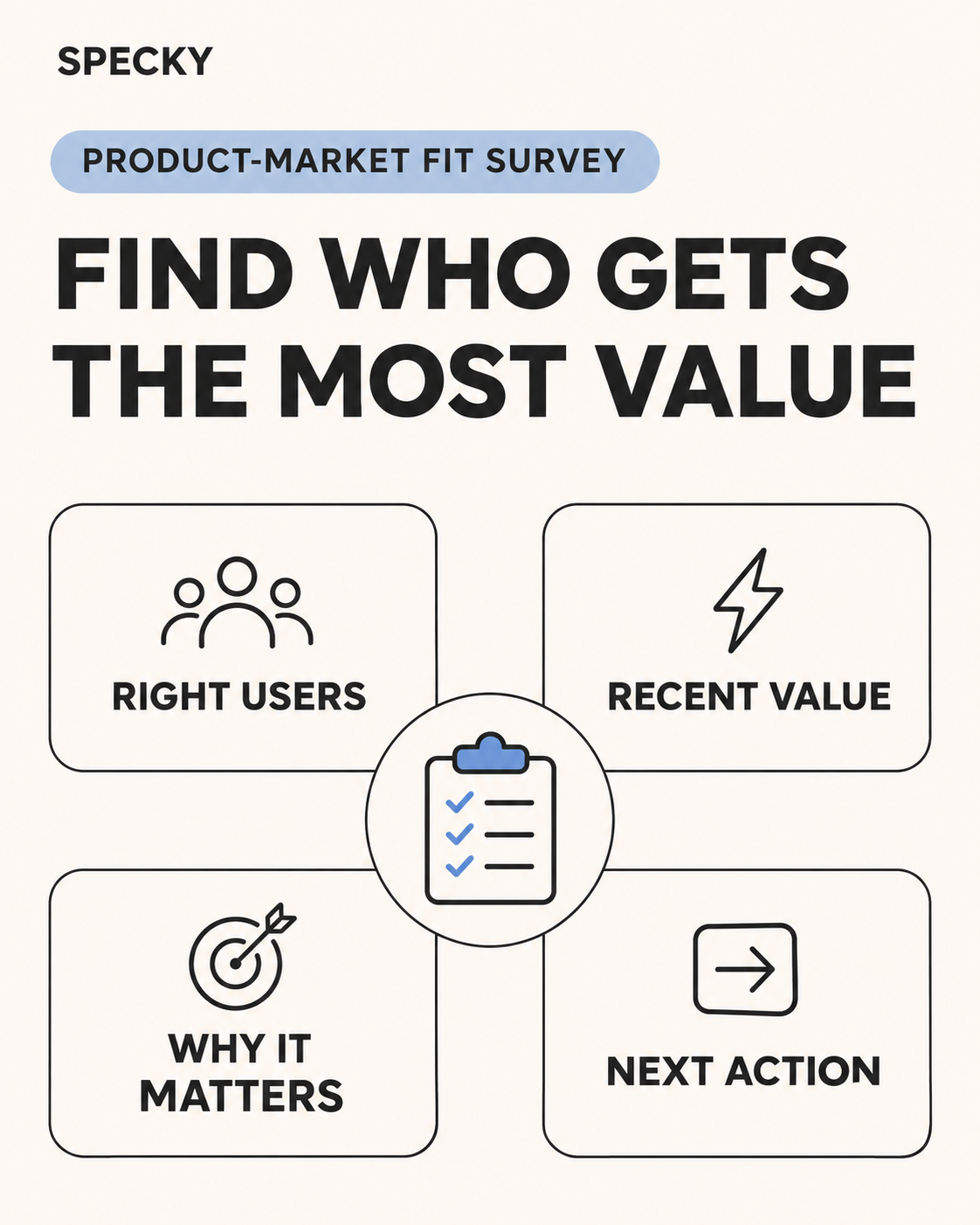
Use a product-market fit survey to find which users get the most value and why. Copy a four-question template, choose a useful respondent group, and interpret the 40% heuristic carefully.
Share
A product-market fit survey helps a team learn which users receive meaningful value, what they value, and what still gets in the way. It is a useful diagnostic for founders and product teams, but a survey score cannot prove product-market fit on its own.
Use the questions below to understand a specific user segment. Then compare the answers with repeat usage, customer conversations, retention, willingness to pay, and the job your product is meant to do. For the broader measurement loop, see AI Product-Market Fit: A Practical Guide for Founders.
Who should answer a product-market fit survey?
Ask people who have recently experienced the product’s core value. If you survey every signup, including people who never reached the main workflow, the result mostly measures onboarding and acquisition.
Choose an eligibility rule that matches the product’s natural usage cycle. For a frequently used tool, that might mean completing the core action more than once in the last two weeks. A team with a monthly workflow should use a longer window. Keep the rule consistent when comparing rounds.
In Superhuman’s account of its method, the team surveyed users who had used the product at least twice in the previous two weeks. That is an example, not a universal threshold; the right window depends on the job your product serves. Read the original walkthrough from First Round Review.
A four-question product-market fit survey template
Replace the brackets with your product and the specific workflow you want to learn about. Keep the wording neutral and ask about actual use.
1. How would you feel if you could no longer use [product]?
Very disappointed
Somewhat disappointed
Not disappointed
I no longer use it
I have not used the core workflow enough to say
S
Specky Team
Writing about AI-native product development at Specky.
This is the Sean Ellis question. It helps identify people who feel a strong loss if the product disappears. It does not ask whether they like the brand or would recommend it in the abstract.
2. What type of person do you think would benefit most from [product]?
Let people describe the user in their own words. Look for a repeated role, situation, company type, or trigger. Compare those answers with your current target customer rather than assuming your preferred segment is the best fit.
3. What is the main benefit you receive from [product]?
Ask for one main benefit. If people mention speed, fewer handoffs, lower risk, or a task they can now complete, preserve their exact phrases. This can reveal whether customers value the same outcome your positioning promises.
4. What is the one improvement that would make [product] more useful to you?
This question gathers friction and missing value. Do not turn every answer into a roadmap item. Group repeated problems, check who reports them, and compare them with the behavior you can observe.
Optional follow-up for AI products
If AI is central to the workflow, ask: “What did you do with the output, and what did you need to check or correct?” This helps separate a convincing demo from an outcome users trust and repeat. Add a question about the job only if it will change a product decision; long surveys tend to lose respondents.
How to interpret the 40% product-market fit rule
The common heuristic says that if roughly 40% of qualified respondents would be “very disappointed” to lose the product, the team may have a strong value signal. Sean Ellis developed the benchmark after comparing startup survey results; Rahul Vohra later described using it at Superhuman. Treat it as a prompt to investigate, not a universal pass/fail line.
A high score does not show that the market is large, that acquisition will scale, or that customers will keep using the product. A low score does not automatically mean the product should be abandoned. The sample may include the wrong users, the core workflow may be too new, or the product may solve a narrower problem exceptionally well.
Read the result alongside the open answers:
Who chose “very disappointed”? Look for a concrete segment and shared job.
What benefit did they name? Is it the outcome you intend to deliver?
What would improve the product? Is there a recurring blocker for this segment?
Do they return to the workflow? Compare their answers with behavior over the product’s natural usage cycle.
Do they trust the result? For AI products, look at review, correction, and failure handling, not just whether users clicked “generate.”
The 40% rule is not a statistical guarantee. The original benchmark was a practitioner comparison across startups, not a controlled experiment that predicts every market. Use the result to narrow questions and decide what to test next.
A simple way to run the survey
Pick one segment and one core workflow. Do not combine users who use different parts of the product for different jobs.
Set the eligibility rule. Write down what counts as recent, meaningful use before sending the survey.
Invite respondents after they have experienced value. Keep the invitation neutral and explain why you are asking.
Review answers by segment. Read the open responses before turning percentages into a decision.
Choose one next action. Improve a repeated blocker, interview the strongest-fit users, or test whether the value holds through another usage cycle.
Small samples can produce useful direction, but avoid presenting them as precise market estimates. Report who answered, how they were selected, and how many responses you received. If the sample changes between survey rounds, say so before comparing percentages.
Product-market fit survey pitfalls
Surveying inactive signups: They may not have seen the core value. Analyze activation separately.
Changing the respondent group: A higher score may reflect a different sample, not a better product.
Treating the number as a verdict: The score does not replace retention, customer evidence, or business viability.
Leading the respondent: Avoid asking whether a feature is “exciting” or whether AI would make their work easier.
Building from one response: Look for a pattern, then confirm it with behavior or a conversation.
Ignoring who loves the product: A useful next step is often to understand the strongest-fit users more deeply, not to add requests from every segment.
Is the Sean Ellis test the same as product-market fit?
It is a survey heuristic associated with product-market fit. It can help a team identify users who feel strong value, but it does not measure every part of fit or establish that a business can scale.
How many people should answer the survey?
There is no universal sample size for every product and segment. Use enough qualified responses to reveal useful patterns, and disclose the number and selection rule. For a small sample, treat percentages as directional.
When should a startup run a product-market fit survey?
Run it after a defined group has experienced the product’s core workflow, then compare the answers with product behavior and follow-up conversations. Do not use it as a substitute for early problem discovery.
A good product-market fit survey helps you ask a better next question. Keep the sample clear, read the open answers, and let real usage tell you whether the value lasts.
Keep the open answers, product evidence, and next decision together as you validate. Founders can see how Specky connects this context in its product management workspace for founders.