AI Product Discovery Interview Questions: A Script for Product Builders
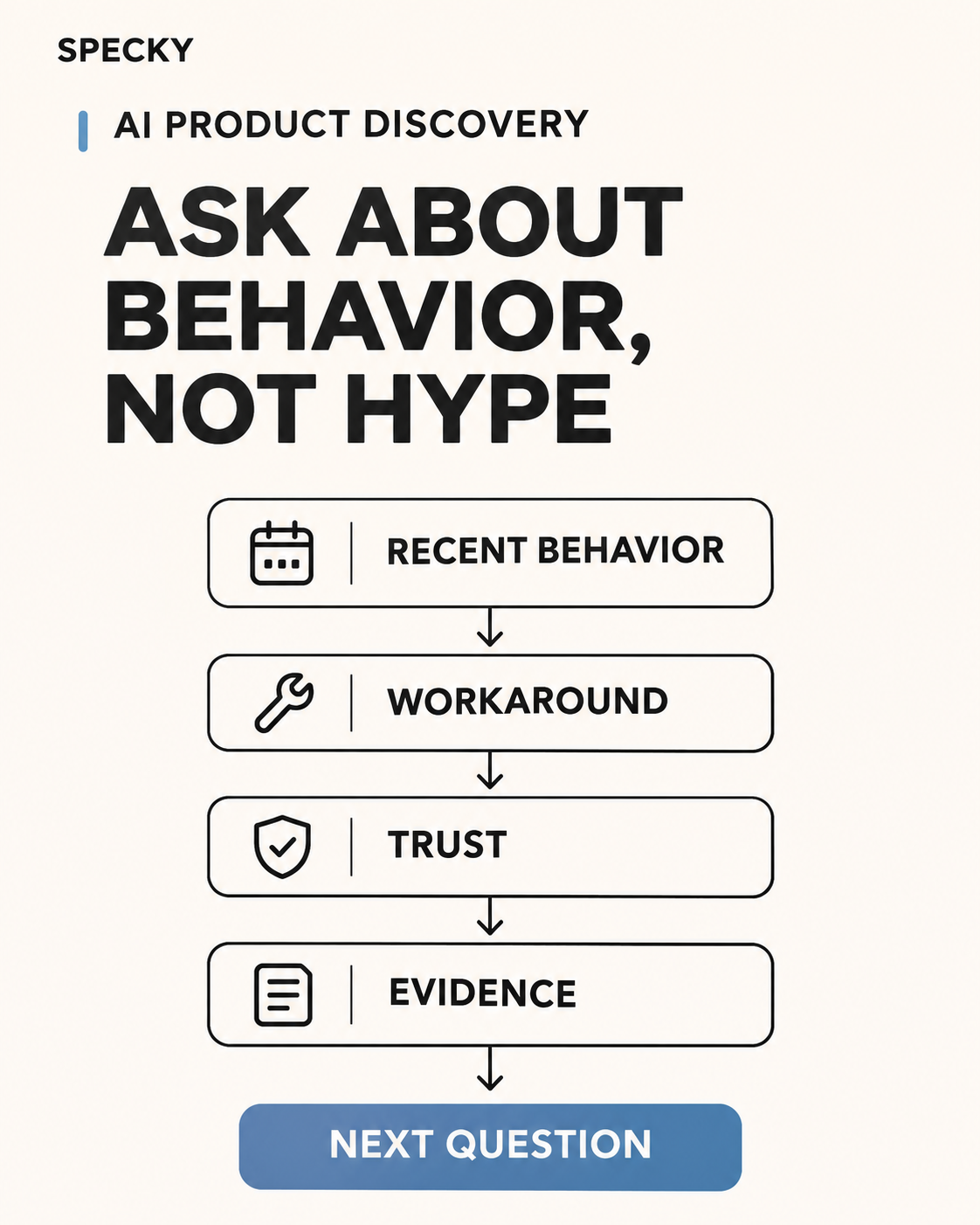
A practical interview script for founders, product engineers, and PMs testing an AI product problem. Ask about recent behavior, workarounds, trust, and the evidence that would change your next build decision.
Share
Short answer: good AI product discovery interviews ask people about recent tasks, workarounds, consequences, and moments where automation would or would not be acceptable. They do not begin by asking whether someone likes your AI idea. Start with what happened in a real workflow, then test the riskiest assumption.
This matters for solo founders and product engineers because an AI coding tool can turn an idea into a prototype quickly. Speed does not tell you whether the problem is frequent, important, or suited to AI. A few focused conversations can help you choose what to prototype and what to leave alone.
Write down the decision you hope to make after the interviews. Examples:
Should we prototype AI-assisted support reply drafting?
Which step in a user's current workflow creates the most rework?
Does a user need a generated answer, or a faster way to find and verify the right information?
What needs human approval before an AI system can take action?
Then write the assumption behind that decision. For example: “Support leads lose time because they search across old tickets before answering a new issue.” This is testable. “Support teams need AI” is too broad.
If no possible answer would change your next step, the interview plan is not ready.
A 25-minute interview script
Explain that you are researching the workflow, not selling a product. Ask permission before recording, and do not collect sensitive details you do not need.
1. Set the context
S
Specky Team
Writing about AI-native product development at Specky.
“Can you walk me through your role and the part of this workflow you handle?”
“When did you last do this task?”
“What was happening that made it necessary?”
Ask for a recent example rather than a general description of the person's ideal process.
2. Reconstruct the last time it happened
“What did you do first?”
“Which tools or people were involved?”
“Where did you get stuck, wait, or repeat work?”
“What did you do when the normal path did not work?”
“What happened as a result?”
Follow the sequence. If someone says, “I need a better AI summary,” ask what they were trying to decide, what they read before, and what they did after the summary. The task may be search, comparison, approval, or communication rather than summarization.
3. Understand the workaround and its cost
“How do you handle it today?”
“How often has this happened recently?”
“What have you already tried?”
“What does the workaround cost in time, money, risk, or missed opportunity?”
“Who else is affected?”
Use the person's examples and language. Avoid asking them to estimate a precise annual cost if they have never tracked it. Ask what changed the last time the problem occurred.
4. Explore where AI might help
Only after the current workflow is clear, ask questions such as:
“Which step, if any, would you want software to handle for you?”
“Where would you want a suggestion but still make the decision yourself?”
“What information would a system need to give you a useful result?”
“When would you need to check the result against its source?”
“What is the consequence if the output is wrong?”
“What should the system never do without your approval?”
Do not ask “Would you use AI for this?” People can agree with a concept without changing their behavior. Ask about the task, the acceptable level of review, and the failure that would make them stop using it.
Google's People + AI Guidebook is a useful reference for designing AI around users' needs and expectations. For higher-consequence workflows, NIST's AI Risk Management Framework can help teams consider trustworthiness and risk throughout design and evaluation.
5. Test a prototype through a task
If you have a prototype, do not give a feature tour first. Give the participant a realistic task and observe:
What do they try first?
What do they expect to happen?
Where do they hesitate or correct the system?
What evidence do they look for before acting?
What would they do if the result were incomplete or wrong?
Ask, “What were you expecting here?” rather than “Do you like this?” If the participant has to be coached through the interface, note what they did before you explain it.
6. Close with a concrete next step
“What would need to be true for you to try this in your workflow?”
“What would prevent you from using it?”
“Who else would need to approve or adopt it?”
“Could we follow up after you have tried the next version on a real task?”
A scheduled follow-up, access to a representative workflow, or a willingness to test with real data is stronger evidence than a polite compliment. It is still one signal; compare it with other users and the costs of switching.
Questions that create biased answers
Avoid
Ask instead
“Would you use an AI tool that does this?”
“How did you handle this the last time it happened?”
“Would this save you time?”
“What did you do before and after this step?”
“Do you like this feature?”
“What would you try to do next?”
“Would you pay $X?”
“How do you pay for or staff the current workaround?”
“Does this solve your problem?”
“Which part of your current task would change, and what would remain?”
The goal is not to catch the participant giving the “wrong” answer. It is to avoid supplying the answer before you understand their situation.
Capture evidence without turning every interview into a feature request
Right after each conversation, record:
The user's role and relevant context.
The recent task they described or performed.
Direct observations, with source or timestamp.
Their current workaround and its consequence.
What they said AI could do, clearly separated from what you observed.
Your interpretation and confidence limits.
The question or decision that remains open.
Across conversations, compare people with similar roles and workflows before combining their feedback. A theme should have supporting examples and visible exceptions. One enthusiastic participant is a reason to learn more, not proof of market demand.
At the end of a small discovery round, choose one of four next steps:
Investigate: the problem may matter, but the user group or workflow is still unclear.
Prototype: the problem is concrete and a prototype can answer a specific usability or feasibility question.
Test a non-AI alternative: a simpler rule, search improvement, or process change may solve the task with less risk.
Stop or narrow: the evidence does not justify more work on this audience or problem yet.
Do not score interviews by counting “yes” answers. Review what people did, what they already tried, what they gave up to address the problem, and what they are willing to do next. Keep the decision reversible where you can; make a larger investment only when the remaining uncertainty is worth taking on.
Common questions
How many AI product discovery interviews should I run?
There is no universal number that proves demand. Start with a narrow audience and a decision, then continue until you understand the important similarities, differences, and unanswered questions well enough to choose a next step. A small interview set can reveal workflow details; it cannot represent an entire market by itself.
Should I show my AI prototype during the interview?
Usually, first learn about the existing behavior without showing the solution. If the prototype is relevant, introduce it after that discussion and ask the participant to complete a task. This makes it easier to distinguish a real workflow problem from a reaction to your demo.
What makes an AI product interview different?
In addition to the user's task and desired outcome, explore the information the system would need, how the user would verify its output, what happens when it is wrong, and which actions require human approval. The questions depend on the consequences of the workflow.
Can AI conduct customer discovery interviews for me?
AI can help prepare a guide, organize notes, and identify questions to explore. It should not be treated as a replacement for direct contact with users when you need to understand their behavior, environment, and constraints.
Connect discovery to the work you ship
For a 90-day execution rhythm, use the startup product planning guide to connect customer evidence, outcomes, and the next product bets.
Interview notes are more useful when the next product decision can point back to them. Specky helps product teams connect customer evidence with decisions, specs, and delivery work. Explore the product intelligence workflow or the AI PRD generator when you are ready to turn a validated problem into a brief.
This interview script is a starting point. Adapt it to the user's context, the risk of the AI behavior, and the decision your team needs to make.