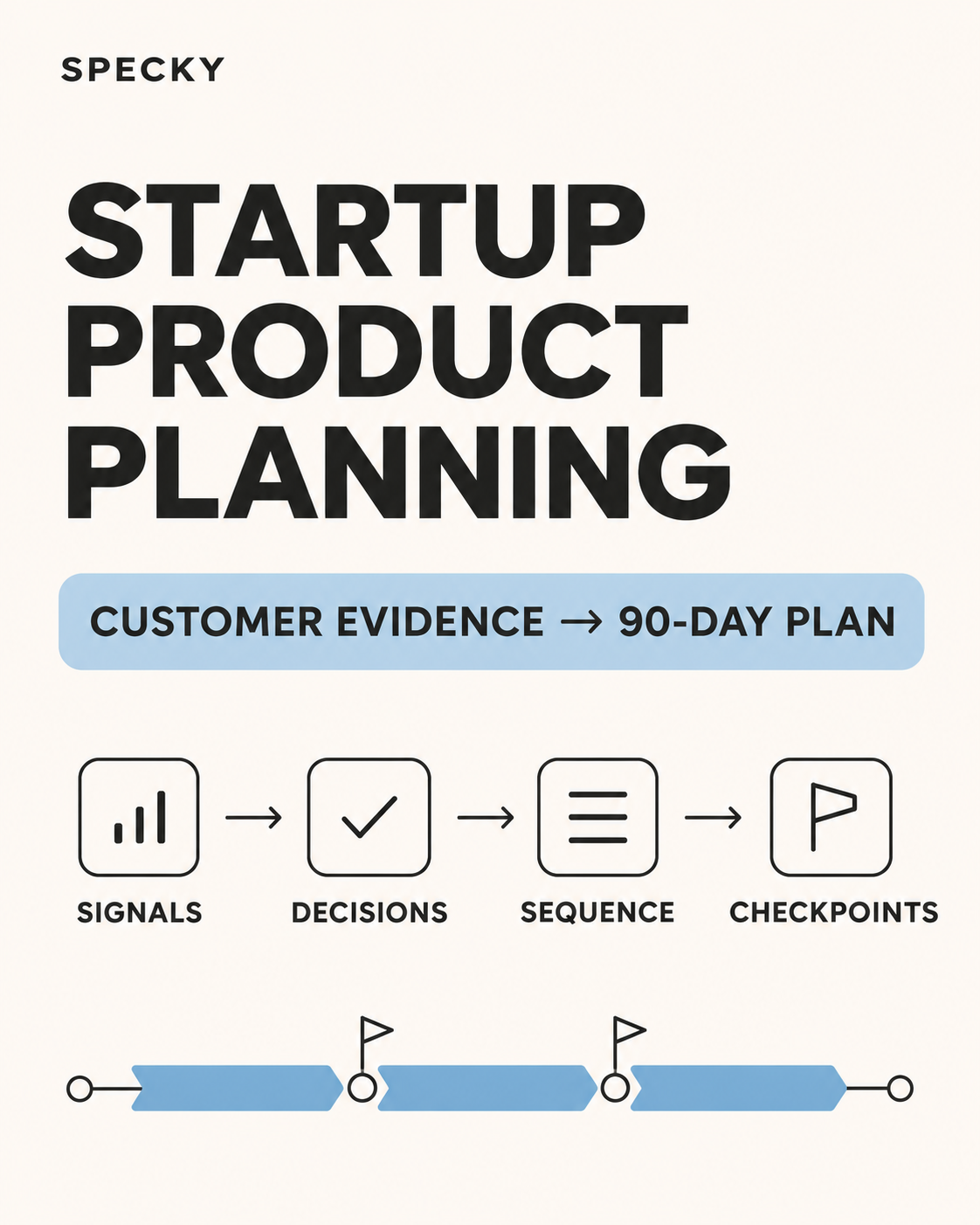
Startup Product Planning: Turn Customer Evidence into a 90-Day Plan
A practical startup product planning process for founders, first PMs, and product engineers: turn customer signals into a focused 90-day sequence without pretending uncertain bets are commitments.
Share
Startup product planning starts with a decision
Startup product planning is the work of choosing which customer outcome to pursue, what the team needs to learn, and how to sequence the next bets. A useful 90-day plan gives a small team direction while leaving room to change course when evidence changes.
This is especially useful for founders, a first product hire, and product engineers building with AI tools. When implementation gets faster, the constraint often moves to deciding which problem is worth solving and how to tell whether a release helped. In one recent Product Management discussion, people described delivery speeding up while customer feedback and requirements remained bottlenecks. Treat that thread as a useful prompt for discovery, not as a representative survey.
A 90-day plan is a planning window, not a promise that every bet will ship on a fixed date. It should make four things clear:
Which customer or business outcome matters most right now?
What do we know about the problem, and what is still an assumption?
What is the next smallest bet that can reduce uncertainty or improve the outcome?
What evidence would make us continue, change direction, or stop?
Keep the roadmap, delivery backlog, and customer commitments distinct. The roadmap communicates direction and trade-offs. The backlog holds implementation tasks. A customer delivery date belongs in a delivery commitment only when the team has agreed to it.
1. Choose one outcome and set a baseline
Start planning with a specific outcome, not a feature name. “Add an AI assistant” describes a solution. “Help a new user finish the first useful task without asking support for help” describes a result the team can investigate.
S
Specky Team
Writing about AI-native product development at Specky.
Share
Choose one primary measure and at least one guardrail. For example:
Outcome: more new users complete the first useful task.
Baseline: the current completion rate for a clearly defined cohort.
Guardrail: support requests, errors, or time to complete do not get worse.
Use a measure the team can actually observe. If the event is not instrumented or the cohort is too small, write that down as a measurement gap and plan how to resolve it before reading too much into the result.
2. Build an evidence register before ranking ideas
Bring together a small, coherent set of customer signals. Useful inputs include recent interviews, support tickets, product behavior, sales conversations, and observed workarounds. For each signal, record:
The source and date.
The customer segment or situation.
What the person was trying to do.
The problem or workaround they described.
What remains uncertain.
Keep the original source nearby. One support ticket proves that one person encountered an issue; it does not establish how common the issue is. A funnel drop-off can show where behavior changes, while an interview may help explain why.
Use AI to group related evidence, suggest questions, or summarize a source set. Keep the quotes and links attached, and check counterexamples before treating a theme as a product decision. The two-week AI product discovery loop shows how to gather and review those signals; use the AI product discovery interview script to ask about recent behavior and real workarounds.
3. Turn feature requests into problem statements
Several customers may request different features because they are trying to complete the same job. Start by describing the situation and the cost of the problem, then compare possible solutions.
A useful problem statement answers:
Who is affected?
What are they trying to do?
What makes the current approach slow, risky, or frustrating?
What evidence supports that description?
What evidence would weaken it?
Avoid treating request counts as a vote. Ten comments from one customer segment may matter less than three repeated cases from the segment your product is designed to serve. Segment, severity, recency, and evidence quality all matter.
4. Prioritize the next bet, not a pile of features
For each problem, compare the value of learning or acting now with the time, risk, and opportunity cost. A lightweight discussion can use these dimensions:
User impact: how costly is the problem when it happens?
Evidence strength: do multiple sources support it, and are they recent?
Strategic fit: does solving it support the product's current customer and business outcome?
Cost and risk: what would a failed change cost, including ongoing AI usage or human review?
Learning value: what could a small test teach before the team commits to a larger build?
Do not turn the dimensions into precise scores unless the team can explain what the numbers mean. A comparison is useful when it helps people expose assumptions and trade-offs; a formula that hides weak evidence creates false confidence. For a structured AI-specific comparison, see AI evaluation framework for product teams.
5. Sequence the plan into horizons
Use horizons to distinguish commitment from uncertainty:
Now: the active outcome and the smallest useful delivery or experiment.
Next: the problem or opportunity the team expects to investigate after the current bet.
Later: options that need more evidence, depend on another decision, or are not yet a commitment.
The first part of the cycle may be mostly learning: review usage, interview customers, instrument a missing step, or test a prototype. Later work can include building and improving the smallest solution that answers the question. The exact sequence depends on what the team knows; do not force every plan into the same number of weeks.
Keep active work limited. If everything is in Now, the plan does not help the team choose. If the team has many dependencies, name the one that could block the outcome and decide how to test it early.
When the sequence is clear, use the free product roadmap template to communicate it. The template is the artifact; this process is the reasoning that should go into it.
6. Plan for AI quality and failure modes
AI product planning needs checks beyond whether a feature was shipped or opened. Define what a good result looks like on representative tasks, how mistakes will be caught, and what the product should do when the model is uncertain or unavailable.
Depending on the use case, the plan may need to include:
A small evaluation set based on real tasks.
A review path for high-impact or low-confidence results.
A fallback when the model cannot complete the task.
A way to monitor quality, latency, and cost after release.
A clear point where a human can correct or override the result.
The AI coding-agent PRD guide can help turn an approved bet into a brief engineers and coding agents can follow. Google's People + AI Guidebook offers additional guidance on designing human-centered AI experiences.
Example: planning around onboarding friction
Consider a fictional small AI software team that sees new users start setup but not reach a useful first result. The team does not assume that a new dashboard or chatbot will fix the problem.
Now: inspect the setup path, confirm the activation event, and speak with a few users who stopped early.
Next: test the most common point of confusion with a short prototype or copy change.
Later: keep broader automation ideas visible until the team sees repeat usage and understands the failure cases.
This example is illustrative; it does not describe Specky customer data. The team should define its own cohort, baseline, and success threshold before interpreting a result.
Run a focused product-planning review
A short planning review works best when the team has shared evidence in advance. A 60-minute session can follow this sequence:
Reconfirm the outcome and baseline.
Review new evidence, including signals that contradict the current view.
Name the biggest uncertainty or customer problem.
Compare the next bets and the cost of waiting.
Agree on what is Now, what is Next, and what stays Later.
Record the owner, the next review date, and what would change the decision.
Review active work briefly each week. Revisit the evidence and sequence monthly, or sooner when a customer, product, or market change makes the current plan less credible. After a meaningful release, check whether the target behavior changed and whether the guardrails held. The AI product-market fit guide covers the longer-term signals to watch.
Frequently asked questions
How should a startup plan its product?
Start with one target customer outcome, collect evidence about the problem, compare a small number of bets, and sequence the next learning and delivery work. Keep assumptions visible and set a review date so the plan changes when the evidence does.
How far ahead should a startup plan?
A rolling 90-day window is useful when it supports a real planning or coordination decision. Keep detail highest for work the team understands, and use a later horizon for possibilities that still depend on discovery.
Is product planning different for an AI startup?
The core planning questions are the same, but AI features also need quality, failure, human-review, latency, and cost checks. Add those checks to discovery and release planning instead of treating them as a final technical review.
When should I use a product roadmap template?
Use a template after the team has clarified the customer outcome, evidence, and next bets. A format can make decisions easier to share, but it cannot decide which problem matters or turn a weak assumption into evidence.