Competitor Research for Startups: Should You Follow a Launch?
A competitor launch is a market event, not proof your customers need it. Specky puts competitor moves next to your own evidence before you decide.
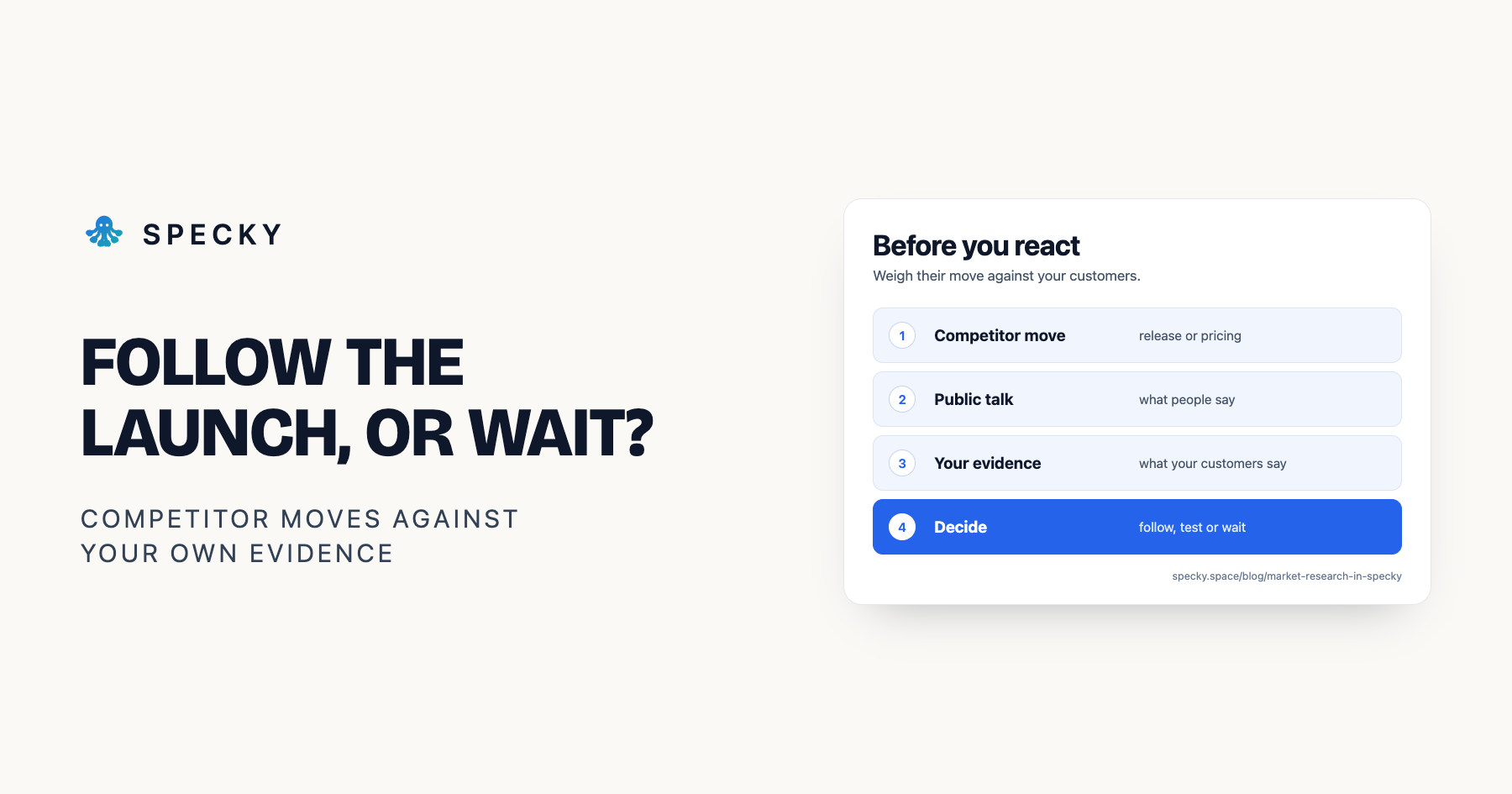
A competitor ships a feature and the urge is to match it. For a small team, copying the wrong launch can eat a month of build time. The useful question is narrower: does this solve a problem your own customers have raised?
What it does
- Researches a market question you scope with your market, geography and the question itself, and points to relevant sources and gaps.
- Inspects accessible competitor product pages, release notes, pricing and documentation. It separates an announcement from an available feature, and a published fact from an inference about strategy.
- Explores accessible public reviews and social conversations, with the source and its limits kept close by.
- Compares those outside signals with your ICP, customer evidence and objectives, and gives the strongest case for and against the idea.
- Ends with a source-linked brief that names the next assumption worth testing.
How it works in practice
Phrase the research as a decision with a scope. The page's worked example: a competitor added offline setup. You ask, "Check the latest release notes and accessible installer discussions. Does offline setup address a problem for our target customers?"
Specky returns a brief that keeps three things apart: what the competitor published, what your customers have said, and what is inference. You review the published capability, the source dates, your own field observations and any conflicting feedback, and mark what is still unknown.
If the case looks plausible, the next step is a small test, such as a prototype with relevant users, rather than a roadmap commitment. A competitor launch or social attention is not treated as proof of demand.
You can also set up a recurring workflow for a competitor watchlist, with named competitors, sources, a cadence and an output destination.
Where it stops
- Public-source access varies. Specky does not promise every social post, access to private communities or a representative sample of the market.
- Asking in chat works on any plan. Ongoing competitor monitoring is on Scale, and research availability depends on the tools configured.
- Check the first run of a scheduled watchlist and its citations before you rely on it.
Try it
From Claude or ChatGPT, the Specky connector can save a competitor move into your Product Graph so it sits next to your customer evidence. Ask it to "save this competitor pricing change as a signal in Specky."
Bring the bet you're weighing to specky.space/features/market-research.
Keep reading
Keep Your Strategy, Assumptions and OKRs Linked to Bets
Write the strategy once and keep it linked to the assumptions, OKRs, bets and experiments it depends on, so the reason behind the roadmap stays visible.
Rerunnable Research Playbooks for Competitors and Markets
Specky loads a research method in chat and follows the same steps every run. Each run ends in a written brief with its sources, kept for comparison.
Find Your First Product Wedge: One Job, One Trigger, One Test
A practical guide for founders and first PMs to choose a focused product starting point by naming one user, one triggering moment, one job, and one testable belief.