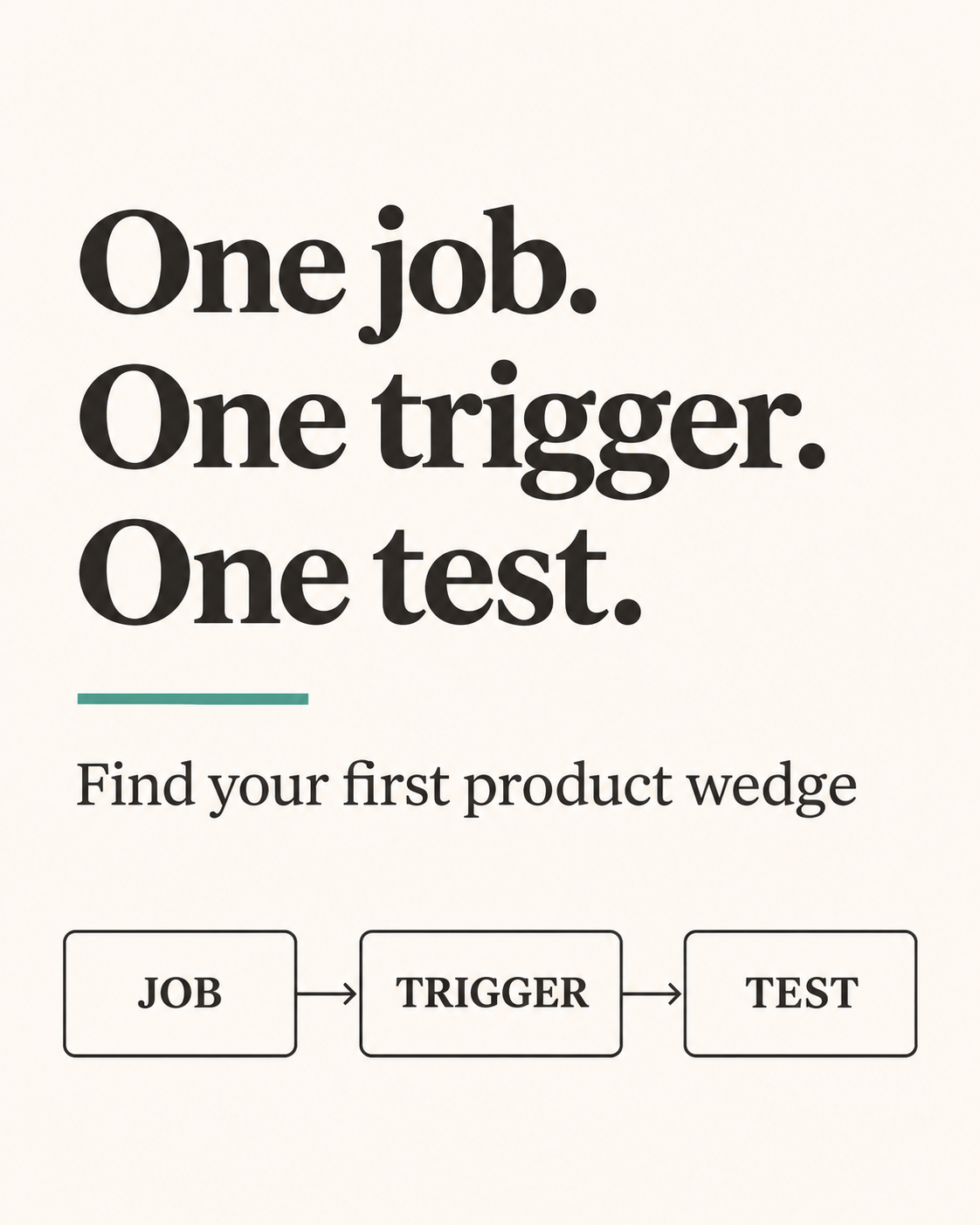
Find Your First Product Wedge: One Job, One Trigger, One Test
A practical guide for founders and first PMs to choose a focused product starting point by naming one user, one triggering moment, one job, and one testable belief.
Share
Start narrower than your product idea
A founder says, “We’re building a workspace for small product teams.” That describes a category and an audience. It does not yet tell the team which problem to solve first.
A product wedge is a narrow, useful entry point: a specific user, in a recognizable situation, trying to finish one job that current options leave awkward or incomplete. The wedge gives a small team a place to start learning and building. It is not a promise to ignore every other customer forever.
A practical way to describe one is:
When [triggering moment], [specific user] needs to [job], but [current workaround or obstacle] makes it hard to [desired outcome].
This sentence is more useful than a feature idea because each part can be checked with real people and evidence.
Why “small teams” is not a wedge
“Small teams” can contain founders, engineers, sales leads, and product managers with different responsibilities. Even one person can have several jobs during the week. Choosing a segment without a situation leaves the team guessing which moment matters.
The Value Proposition Canvas gives teams a way to describe a customer segment through the jobs people are trying to complete, the pains they encounter, and the gains they value. Strategyzer also recommends focusing on a few important jobs and pains rather than trying to address every need at once. YC’s startup guidance similarly advises early teams to focus on the acute customer problem before adding features to cover every issue.
The useful lesson is focus. A broad audience can be a starting hypothesis, but a wedge names the situation where your product could create value first.
Find the triggering moment
Start with the moment the user notices the problem. A trigger can be a deadline, a handoff, a decision, a new responsibility, or a repeated task.
What happened just before the user looked for help?
What are they trying to finish right now?
What goes wrong if they postpone it?
Which other people or systems are involved?
How do they handle it today?
“Product teams need better alignment” is too broad to observe. “Before sprint planning, the founder and first PM cannot tell which customer evidence supports the feature request” points to a moment, a job, and a gap.
Do not begin by asking whether someone likes your proposed feature. First learn how the job is done today. The difference matters: a person can be interested in a feature and still have no reason to use it in the actual workflow.
Map the workaround before proposing a solution
People already solve the job somehow, even when the process is frustrating. They may use a spreadsheet, ask a colleague, copy notes between tools, accept the delay, or skip the task.
Write down:
What to learn
Example question
Existing workaround
“What did you do the last time this happened?”
Friction
“Which step took the most effort or caused a delay?”
Consequence
“What happened because that step was slow or missing?”
Frequency and context
“When does this come up, and what is different between cases?”
Existing alternatives
“What else have you tried, and why did you stop?”
Use the user’s account as evidence, not as a verdict on what to build. One painful story can reveal a useful problem. It does not establish how common the problem is or which solution will work. Keep those as separate questions.
Compare candidate wedges with the same questions
Founders often have several plausible starting points. Compare them with a consistent set of prompts rather than debating which idea sounds largest.
Candidate
Trigger
Current workaround
What remains uncertain
Preserve the reasoning behind a roadmap decision
Priorities change after new customer evidence
Notes live across documents and chat
Which decision details teammates need to revisit
Help a first PM turn research into a reviewable product brief
A team is preparing a feature decision
A PM summarizes sources manually
Whether traceable evidence makes the review easier
Help a founder check a risky assumption before building
A roadmap commitment is approaching
The founder asks a few people or relies on instinct
Which test would produce enough evidence for this choice
These are illustrative candidates, not findings about customer demand. The table does not pick a winner. It shows what the team still needs to learn.
For each candidate, ask:
Can we name the user and moment precisely?
Can we find people who recently experienced it?
Can we see or verify the workaround?
Is the consequence meaningful to the user?
Can we test a solution without building the full product?
Does the team have a credible reason to help with this job?
A strong starting wedge is specific enough to investigate and important enough to change what the team does next. It does not need a confident market-size estimate before discovery begins.
Decide what is inside the first wedge
A wedge creates boundaries. Write what the first version must help the user accomplish, then write what it will leave alone for now.
For example, a product that helps a small team review evidence before a feature decision might need to:
keep a claim connected to its source
show what remains uncertain
make the next decision or test clear
It may not need to:
replace the team’s roadmap process
decide which customer segment to prioritize
turn every note into a task
automate a decision that requires domain judgment
Those boundaries give design and engineering room to create a coherent first experience. They also give the PM a way to explain why a requested feature is outside the current bet.
The boundary can change when evidence changes. It should not expand simply because the team discovers another feature it could build.
Turn the wedge into a testable belief
A product wedge is still a hypothesis. Write down the belief that makes it worth pursuing:
We believe [user] struggles with [job in a specific moment] because [observed obstacle]. If we help them [meaningful outcome], they will [observable action].
Then separate what you know from what you assume. Perhaps you have watched several people work through the current process; perhaps you have only heard one person describe it. Either way, be clear about the source and its limits.
Choose a test that can change the decision. If you do not know whether the problem occurs, speak with people who experienced the moment recently. If the problem is clear but the proposed workflow is not, test a rough prototype. If the uncertainty is whether someone will commit time, money, or access, ask for evidence appropriate to that commitment.
Our guide to choosing a product experiment walks through matching a test to the belief and the cost of being wrong. The purpose of an early test is to reduce a specific uncertainty, not to generate activity for its own sake.
An illustrative example
Suppose a small product team is deciding whether to add an AI summary to its customer research workflow. The first idea is “help PMs understand customer feedback faster.” That could mean many things.
The team narrows the wedge to: “Before a roadmap review, the first PM needs to show which interview evidence supports a proposed change, but the evidence and interpretation are mixed across notes.”
Now the team can investigate the last roadmap review, inspect how sources were collected, and learn what reviewers needed to trust the summary. It can test whether separating source-backed observations from interpretations helps the group make a clearer decision. This is a hypothetical example; it does not claim that a particular team or feature produced a result.
If the interviews show that the real obstacle is missing context rather than slow summarization, the wedge should change. That is useful learning: the team avoided polishing the wrong output.
Keep the wedge connected to the decision
A wedge is most useful when it remains connected to the evidence and decisions that follow. Record the user, moment, job, current workaround, unresolved beliefs, test, and what the team decided after learning more. When a new request appears, compare it with the wedge: does it improve this job, test an important assumption, or start a separate bet?
In Specky, you can keep the candidate as an assumption, attach the evidence behind it, choose a test, and record what happened. That helps a founder or first PM trace the path from a customer problem to the next product decision instead of treating each request as a new roadmap item.
Start with one user, one triggering moment, and one job. Learn how the person handles it today. Then choose the smallest test that could change your mind about solving it.
GDPR-aligned. EU workspace data is stored in Frankfurt, Germany. GDPR and EU data Built in Vienna, Austria. A product of influence solutions fm GmbH (FN 675374y). Imprint 14-day trial. Card required, and nothing is charged until day 14. 30-day refund after subscribing. See pricing