Why Did Signups Drop? Answering Product Questions With Evidence
Your dashboard says what changed, not why. Specky checks the live source, adds customer context and gives you an answer with its evidence and unknowns.
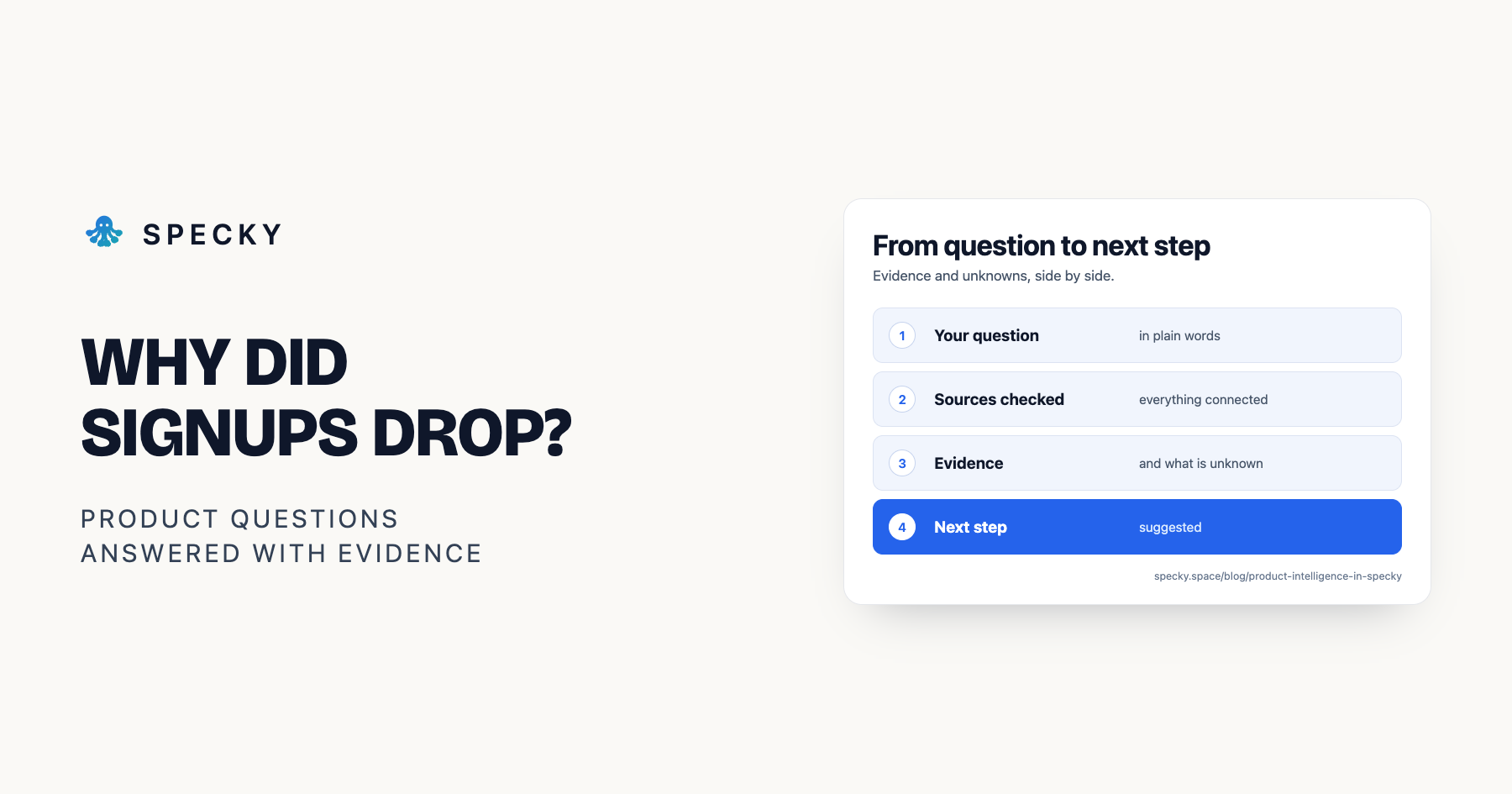
A dashboard tells you signups changed. It does not tell you why, or what to do next. For a founder doing product work alongside everything else, stitching analytics, support threads and call notes together to find out can take the afternoon you didn't have.
What it does
- Takes a plain-language product question, checks the live connected source first for what is happening now, then adds context already in your workspace, such as past decisions and research.
- Returns the evidence behind the answer with the unknowns called out. "We do not know yet" is an allowed answer.
- Brings pending inbox items, strategy tension and open questions to the surface.
- Compares opportunities by evidence, RICE, confidence, impact and the constraints you actually have.
- Keeps shipped bets visible until the metric or customer outcome has a considered verdict, and keeps sample data separate from real data.
How it works in practice
The page's example question is: "Why did signups change over the last five days?"
First, Specky queries the connected analytics source, such as PostHog. Then it compares support, calls, Slack and recent releases. It separates correlation, evidence and open questions. The result is a decision brief you can review: what moved and how confident it is, the customer evidence that explains the pattern, and the next investigation or smallest useful experiment.
From there, you turn the finding into a priority, spec or experiment, and attach the result to the bet that created it.
What you give Specky is simple: a question, the metric or support pattern behind it, the connected sources and your constraint, such as team capacity or a launch window. Sources it can read include analytics, support, call, delivery and docs tools, plus REST, webhooks, files, URLs and custom MCP.
Where it stops
- It does not replace your judgment. It shortens the distance between the question and the evidence, and people still approve consequential changes.
- The answer can only use the sources you have connected. If the evidence isn't there, the useful answer is a clear statement of what is unknown.
- A one-person app with one feedback channel usually doesn't need this yet.
Try it
Through the Specky connector, Claude or ChatGPT can search your workspace and read the latest customer signals. Ask it, "What have customers said most recently in Specky about signup?"
Start with one real question at specky.space/features/product-intelligence.
Keep reading
Sort Customer Signals by Your Own Product Areas
Name your product areas once. Specky files every new signal under them, with the source and classification confidence you can check.
Group PostHog, Sentry and Pendo Issues by Problem
Bugs and friction from PostHog, Sentry and Pendo, grouped by the problem behind them, with every affected session in one place and a link to the fix.
Import Customer Feedback From a CSV, Doc or URL
You already have feedback in exports and docs. Upload a file, add a URL or paste a batch, and Specky turns it into signals you can group and quote.