Fake Door and Waitlist Tests Linked to Your Experiments
Publish a focused page to test demand before you build. Specky counts views, clicks and responses, and saves what people wrote to the experiment.
A feature request is not demand, and neither is a founder's hunch. Building the thing to find out is the most expensive test there is. A small team needs a cheaper way to see whether the right people care.
What it does
- Turns an experiment into a public validation page for a fake-door, waitlist, feature-interest, concierge or prototype test.
- Shows respondents one focused page on a public /validate/ link, with one call to action and a short form. They do not need a Specky account.
- Counts views, unique visitors, CTA clicks, responses and conversion, and saves each response to the Product Graph linked to the experiment.
- Compares a control and up to five active variants with Wilson confidence intervals, and marks the read not ready when the sample is too small.
- Can put a static fake-door page, a validation manifest and a README on a specky/validation/... branch in your connected GitHub repository.
How it works in practice
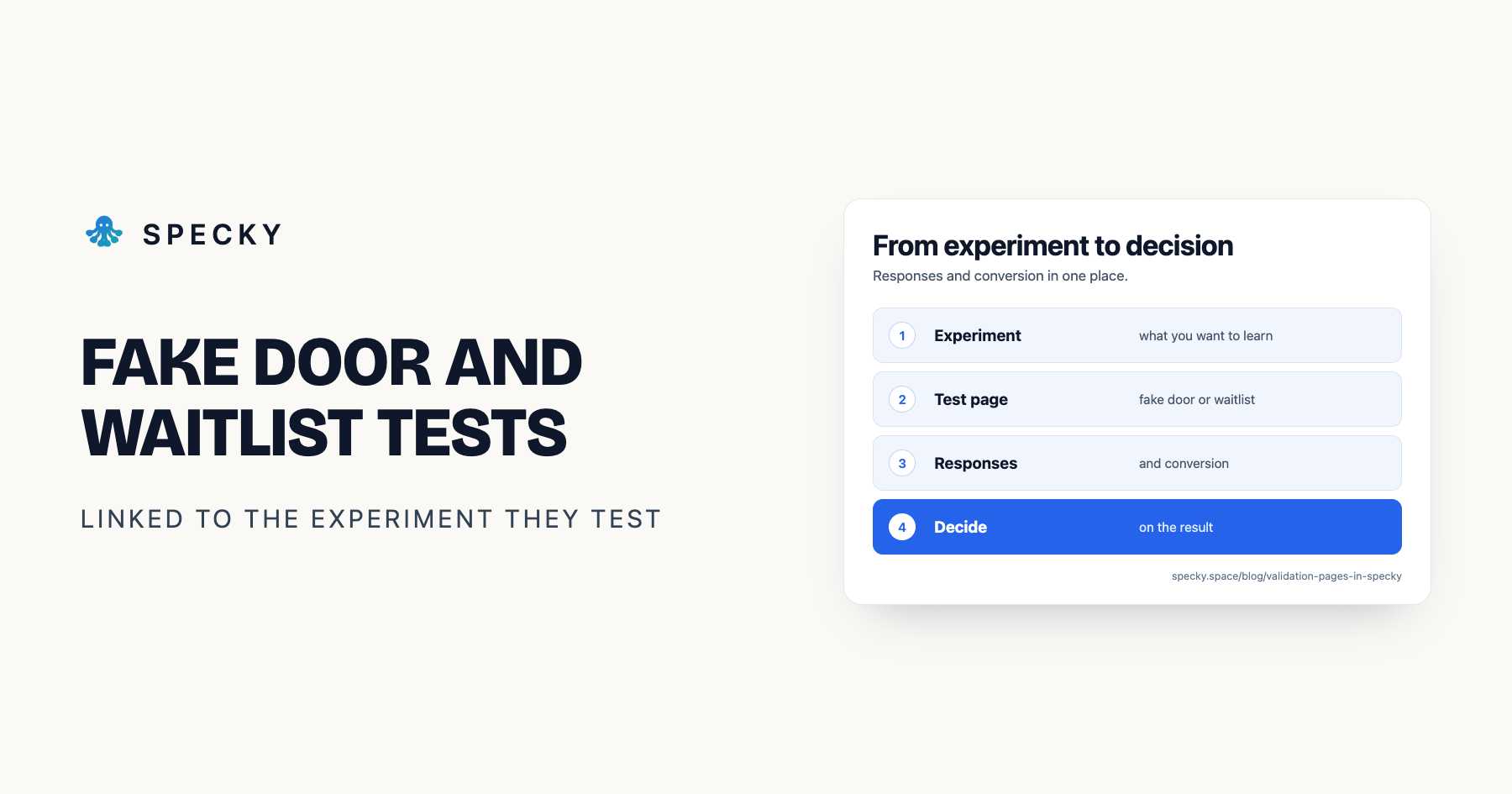
You start with an experiment in Specky: what you believe, who it is for, and what decision the test should unlock. Specky drafts a page with a headline, the problem, the benefits and one next action. You edit every line so the page only promises what you can stand behind.
Then you share the link with people who actually have the problem. The page asks for context, not applause, so you get the reason along with the click.
As responses come in, you read the numbers next to the words. A high click rate with vague answers can mean the promise is interesting but the job is unclear. Fewer, detailed requests may be stronger evidence.
When the test ends, you record the result yourself as Validated, Invalidated or Inconclusive, and write what you observed. Then you decide: build, interview more, narrow the job, or stop.
Where it stops
- Specky does not claim the idea is validated. Generated copy is framed as an experiment, and the verdict is your call.
- Delivery to GitHub does not change your application. It adds no dependencies and no routes, and the call to action still points at the hosted page.
- With too little data, the read stays marked not ready.
Try it
On Growth, you can ask Claude or ChatGPT to "make a waitlist page for this experiment" or "how is my validation page doing?" through the Specky connector.
See how validation pages work at specky.space/features/validation-pages.
Keep reading
Synthetic User Testing as an Early Read, Not Proof
Generated personas react to a concept in chat, and a memo sums up the objections with its caveats attached. A cheap early read, not proof of demand.
How to Test the Riskiest Assumption in a Product Idea
Shipping fast doesn't make a wrong idea right. Specky ranks the beliefs behind an idea by risk and plans the cheapest credible test of the worst one.
Assumption Mapping: How to Find and Test Your Riskiest Bets
Every roadmap item rests on beliefs nobody has checked. Assumption mapping sorts them by importance and evidence, so you test the one that could sink the bet before you build.