How to Test the Riskiest Assumption in a Product Idea
Shipping fast doesn't make a wrong idea right. Specky ranks the beliefs behind an idea by risk and plans the cheapest credible test of the worst one.
When you can ship a feature in an afternoon, it is tempting to skip validation. But every backlog item hides several beliefs: the problem exists, the right people care, they will change behaviour and the business benefits. If the wrong one is false, the build was wasted, however fast it was.
What it does
- Ranks desirability, viability, feasibility and usability assumptions by how much it would hurt if each one were wrong.
- Shows evidence for, evidence against and evidence gaps, with a confidence read.
- Recommends the smallest next test, with a method, success criteria and a timebox.
- Writes a LinkedIn recruitment post, a follow-up, candidate outreach and a behavioural interview guide designed not to pitch the idea.
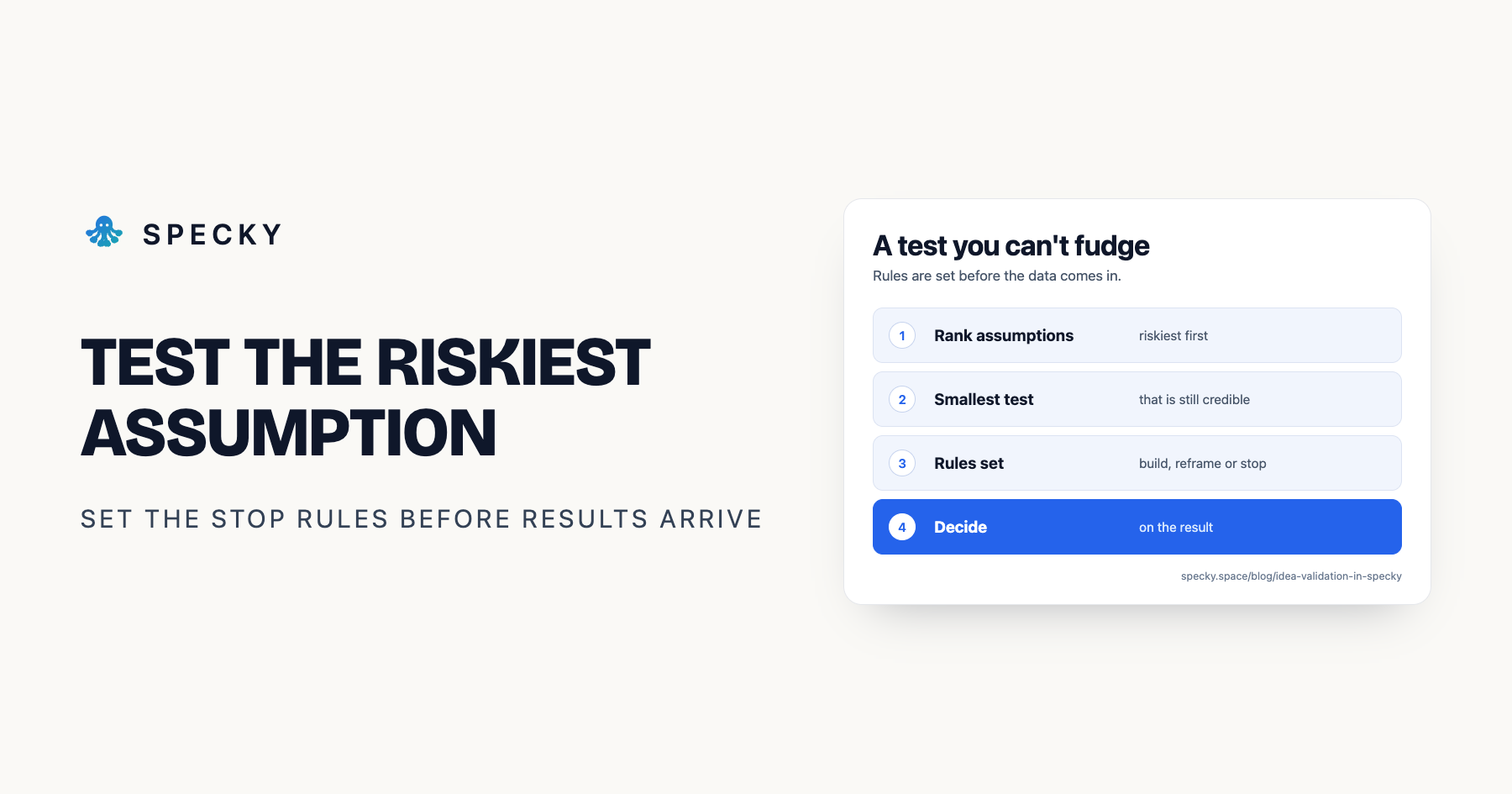
- Records build, reframe and stop rules before any results come in.
How it works in practice
Pick one idea and the ICP segment you expect to help. The page's example is a weekly explanation of signup changes for growth PMs at 20 to 200 person B2B SaaS companies. The evidence so far: two calls mention reporting pain, and nothing proves recurring use.
Specky names the critical assumption: PMs will use the brief without redoing the investigation themselves. The plan is five behavioural interviews about the last signup review, plus a two-week concierge test. The rule is set up front: build if three target PMs use it in a real review and ask for another, otherwise reframe or stop.
From the plan, press Create real Alex campaign to turn the hypothesis into a shareable customer interview. Or press Create experiment to open a linked experiment record. For a fake door or waitlist, attach a Validation Page. Views, CTA clicks, responses and conversion are counted against it, and each response is saved and linked to the experiment.
When the timebox ends, move the assumption from Untested to Supported or Contradicted. Then a person chooses Keep testing, Build with confidence, Reframe the idea or Stop this bet. Promote to Decision Packet sends the reasoning to the Decision log.
Where it stops
- AI cannot prove product-market fit. Fit shows up in real behaviour, such as repeat use and paying. Specky organises the evidence and leaves the build decision to your team.
- If the audience is unknown, the plan says so instead of hiding it. A weak input still gives a weak plan.
- How many Alex interviews you get depends on your plan.
Try it
From Claude or ChatGPT, the Specky connector can start an Alex interview link, and on Growth it can also create an experiment and a validation page. Ask it to "create an experiment to test whether growth PMs will reuse a weekly signup brief."
Read more at specky.space/features/idea-validation.
Keep reading
Fake Door and Waitlist Tests Linked to Your Experiments
Publish a focused page to test demand before you build. Specky counts views, clicks and responses, and saves what people wrote to the experiment.
Find Your First Product Wedge: One Job, One Trigger, One Test
A practical guide for founders and first PMs to choose a focused product starting point by naming one user, one triggering moment, one job, and one testable belief.
How to Choose a Product Experiment: 55 Methods by Risk and Evidence
Most ideas lose when tested. Name the riskiest belief, decide how strong the evidence must be, then pick the cheapest of 55 product experiments that gets you there.