Ask Questions About Your Product and Get Cited Answers
Ask Specky answers product questions from the evidence in your workspace, names the sources it used, and says so when the evidence is missing.
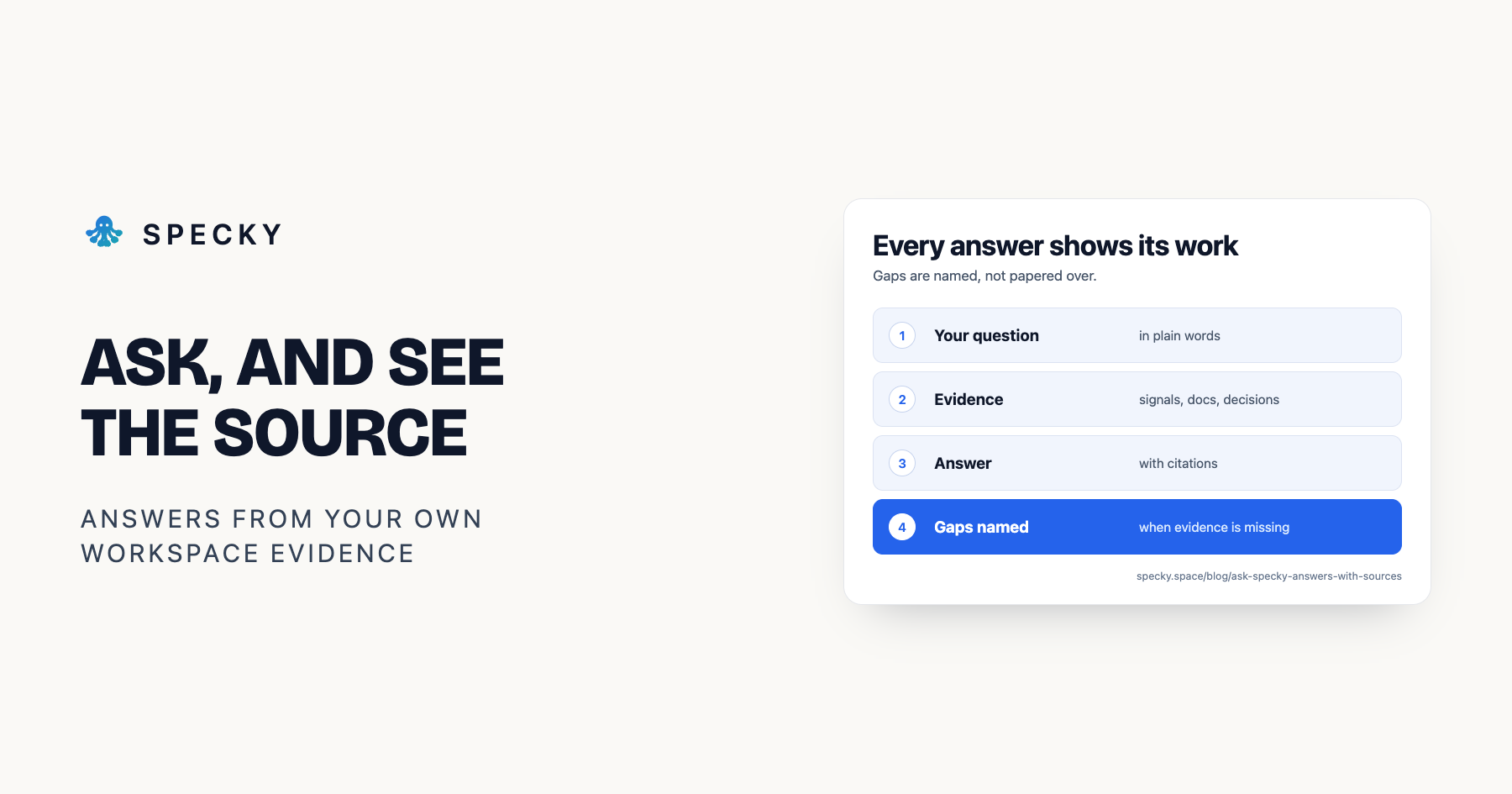
A generic chatbot will answer "what should we build next?" with confidence, whether or not it knows anything about your customers. For a founder deciding where the next month goes, a confident guess is worse than no answer. You need to see what the answer is based on.
What it does
- Takes a question in plain language and answers it against the workspace and product you are in.
- Searches the current product's documents, signals, decisions, specs and connected-source records, then reads the ones that matter before it answers.
- Names the source type and signal behind a claim, with a workspace record ID and a date where available.
- Says when the evidence is not there, and names the smallest missing source or observation instead of presenting a guess as a customer fact.
- Pauses consequential writes for an explicit Approve or Deny.
How it works in practice
You type: "Which customer problem should we solve next, and what do we actually know?"
Specky searches the records in your current workspace and the evidence from your connected sources. The reply names what it used. You open a cited record and check the customer's actual wording before you repeat it in a spec or a team update.
If your workspace has nothing relevant, the answer says that, and tells you what kind of source would fill the gap. That is your cue to run an interview or connect another tool, not to ship on a hunch.
If you follow up with "turn that into a decision", the write does not happen on its own. It waits for you to approve it.
You can also reach the same workspace from Claude or ChatGPT through the Specky connector by asking "search my Specky workspace for what customers said about exports".
Where it stops
- An answer is a draft to review, not a verified fact. Read the attached sources before treating it as correct.
- Chat is scoped to one workspace. A prompt from another product is rejected rather than carried over.
- It cannot change a decision, spec or ticket on its own. Nothing changes until a person approves.
Try it
Ask one real question about your product, then check the sources attached to the answer. Start on the feature page.
Keep reading
AI-Native Product Management: A Practical Guide for Small Teams
AI-native product management treats AI as a participant in every step from customer signal to release review, with people owning the decisions. A six-step framework, templates and a weekly cadence for teams of 1-10.
AI Product Discovery for Startups: A Practical Two-Week Workflow
AI makes prototypes cheap, so discovery is now the work that keeps small teams building the right thing. Use this two-week loop to test a real problem before you scale a build.
What Should I Build Next? A Decision Framework for Product Builders
A practical way for solo founders and product engineers to choose the next build from customer evidence, product usage and small tests, not from the loudest request or the newest AI idea.