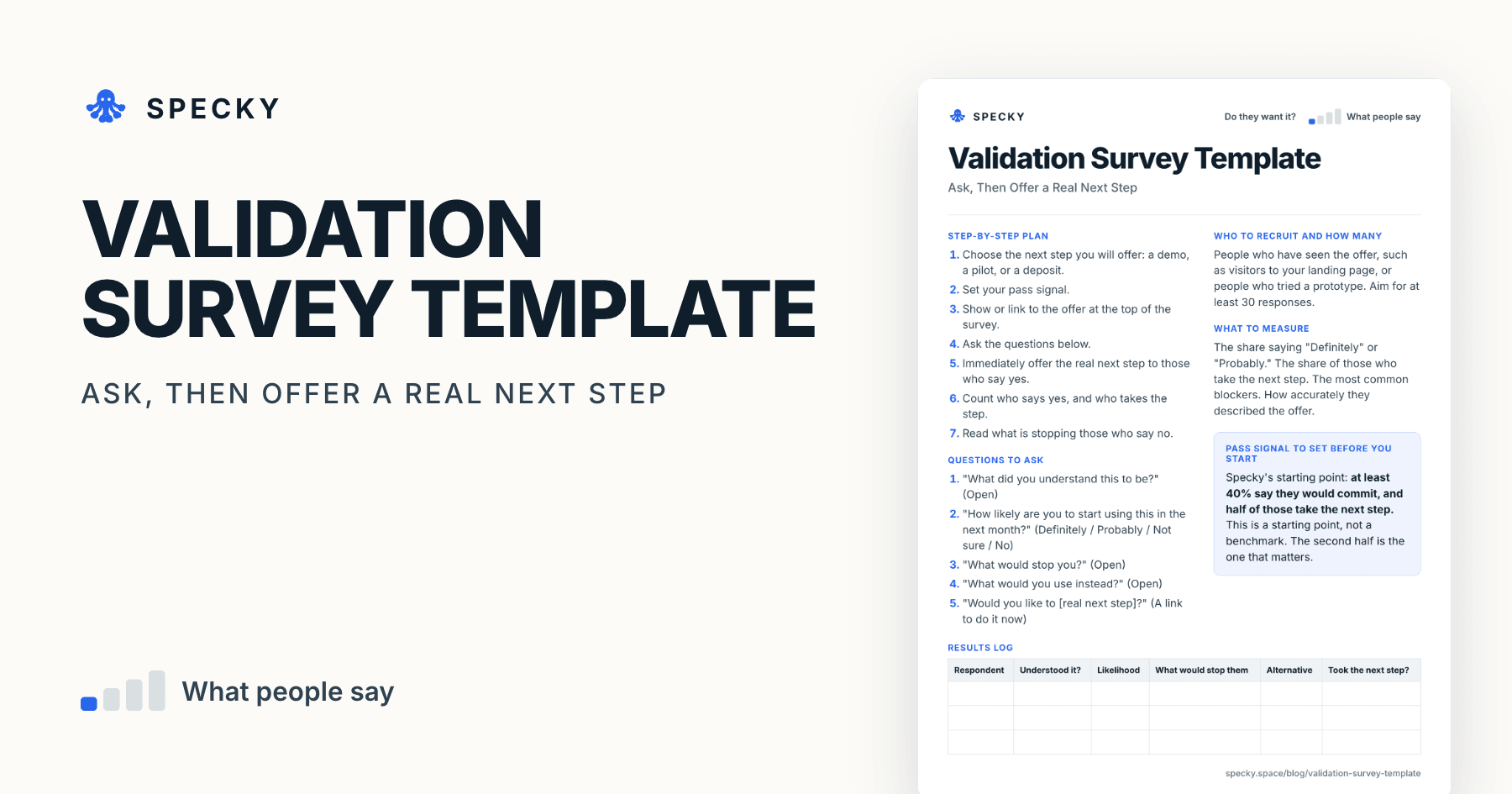
Validation Survey Template: 5 Questions, Then a Real Next Step
"Would you use this?" is a weak question on its own. Follow it with a real next step, and read the gap between what people say and what they do.
Share
A validation survey is a short questionnaire for people who have already seen a concrete offer, such as a landing page, a demo or a prototype. It asks whether they would commit and what would stop them, then invites them to take a real next step on the spot. What you learn is the gap between what people say and what they then do.
Key takeaways
It is one of the "call to action" validation experiments in Strategyzer's Testing Business Ideas library of 43 experiment types (Strategyzer).
Saying is not doing. Across 47 experiments, changing what people intended (d = 0.66) changed what they did about half as much (d = 0.36) (Webb & Sheeran, 2006).
So the survey ends with a real next step: a call, a pilot or a deposit. Who takes it is the number that counts.
Specky's starting pass signal: at least 40% say they would commit, and half of those take the next step, from at least 30 responses.
What is a validation survey?
A validation survey tests one specific offer with people who have seen it. Everyone who answers has looked at the same page, demo or prototype, so their answers are about the same thing.
The format has two halves. The first asks for words: what they understood, how likely they are to start, what would stop them. The second asks for an action, by putting a real next step in front of the people who said yes. Reading the two side by side is the point.
Strategyzer's experiment library poster files it under validation, next to the simple landing page, crowdfunding, the split test and the presale, while the discovery survey sits under discovery.
Which risk does it test, and how strong is the evidence?
This tests desirability: having seen it, will people say they will commit? The evidence is opinion, and the gap between what people say and what they do is the very thing this template measures. Our guide to choosing a product experiment has more on that gap.
The next step is what lifts it. A booked call, an introduction to a colleague or a deposit is behaviour, and it counts for more than any answer on the form.
When should you use a validation survey, and when not?
Use it after people have seen something concrete, such as a page, a demo, or a prototype, and you want to know what is holding them back. The most useful part is what happens when you follow up with an actual ask.
Good moments: right after a landing page test, at the end of a clickable prototype test or demo while the offer is fresh, or before a bigger commitment test, to find the blockers you will need to answer.
Do not use it before anyone has seen the offer. Without something concrete, you are collecting guesses, and a discovery survey is the better tool. Do not stop at the survey, either. "Would you commit?" on its own is one of the least reliable questions in product work.
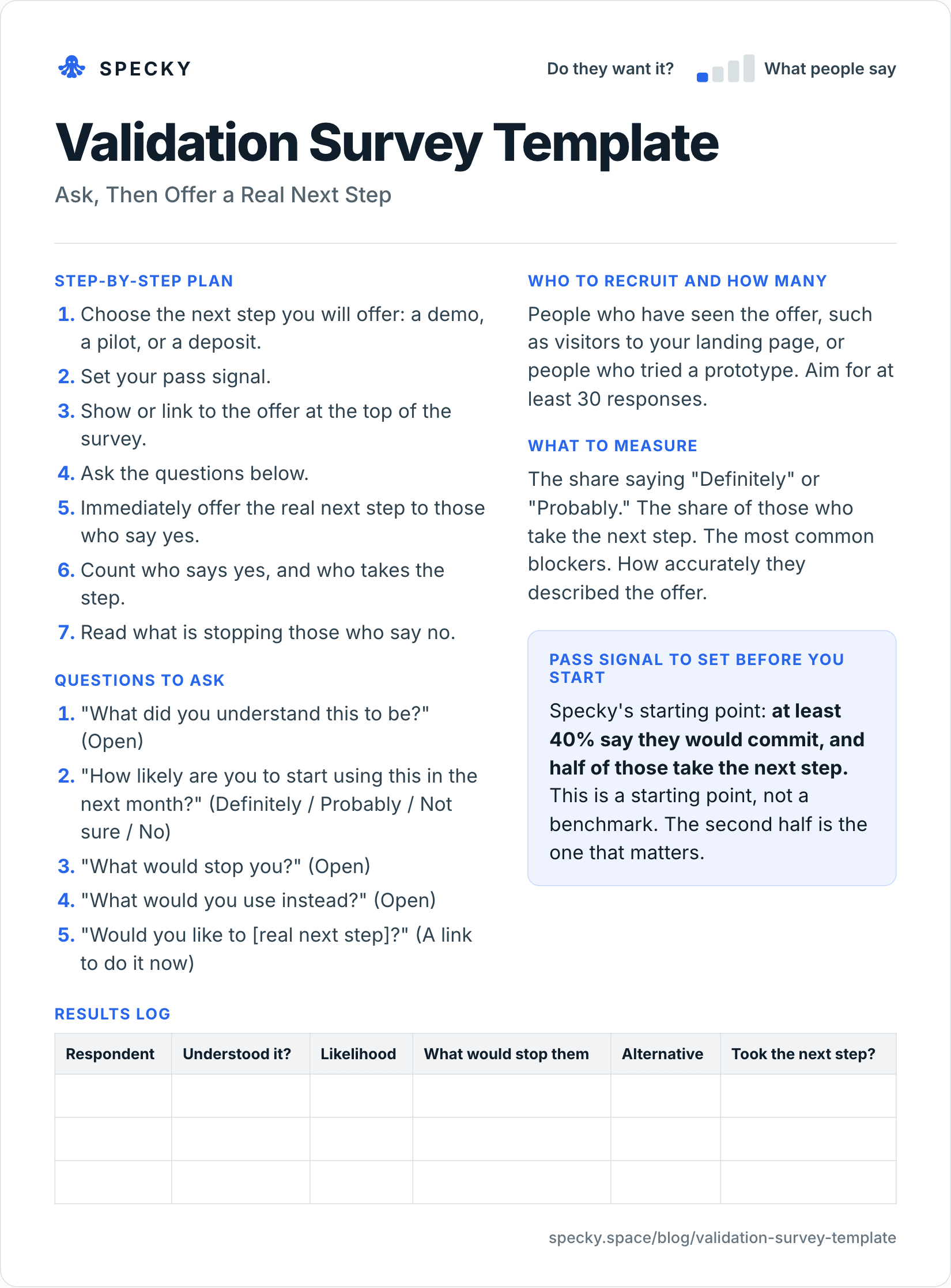
Copy-and-use validation survey template
Open the image at full size, or copy the text version below.
Who to recruit and how many
People who have seen the offer, such as visitors to your landing page, or people who tried a prototype. Aim for at least 30 responses.
Step-by-step plan
Choose the next step you will offer: a demo, a pilot, or a deposit.
Set your pass signal.
Show or link to the offer at the top of the survey.
Ask the questions below.
Immediately offer the real next step to those who say yes.
Count who says yes, and who takes the step.
Read what is stopping those who say no.
Questions to ask
"What did you understand this to be?" (Open)
"How likely are you to start using this in the next month?" (Definitely / Probably / Not sure / No)
"What would stop you?" (Open)
"What would you use instead?" (Open)
"Would you like to [real next step]?" (A link to do it now)
What to measure
The share saying "Definitely" or "Probably." The share of those who take the next step. The most common blockers. How accurately they described the offer.
Pass signal to set before you start
Specky's starting point: at least 40% say they would commit, and half of those take the next step. This is a starting point, not a benchmark. The second half is the one that matters.
Results log
Respondent
Understood it?
Likelihood
What would stop them
Alternative
Took the next step?
Why are the validation survey questions written this way?
Each of the five questions guards against a known way surveys mislead.
Question 1 checks the offer landed. If people describe something you are not selling, their "Definitely" is about a different product. Score each description right, partly right or wrong.
Question 2 uses named options and a time frame. "Definitely" and "Probably" stay separate, and "in the next month" turns a wish into a plan.
Questions 3 and 4 are open on purpose. A list of blockers you wrote suggests answers. Pew Research Center found 58% named the economy when it was a listed option, but only 35% volunteered it when the question was open (Pew Research Center).
Nothing hints at the answer you want. Avoid "Do you agree this saves time?" Pew reports that people tend to agree with statements put to them, and Nielsen Norman Group advises neutral questions that don't reveal your expectations (NN/g, 2016).
Question 5 is a link, not a question. Without it, you have half a test.
Before sending, have one person from the segment think aloud as they answer; NN/g suggests about four such rounds.
Why do people say yes and then not follow through?
Saying yes costs nothing and feels polite. Acting takes time and carries risk. Research on this gap is consistent:
Intentions move more than behaviour. Across 47 experiments, a change in intention (d = 0.66) produced roughly half that change in behaviour (d = 0.36) (Webb & Sheeran, 2006).
Hypothetical money is cheap. Across 28 stated-preference studies (83 observations), hypothetical valuations ran about 1.35 times real ones on the median, with a long tail of larger gaps. Choice-based questions reduced the bias (Murphy et al., 2005).
Compliments are not data. Rob Fitzpatrick's The Mom Test treats compliments and promises about the future as fluff, and judges a conversation by whether it ends in a commitment of time, reputation or cash (Unusual Ventures review, 2024).
How many responses do you need for a validation survey?
Aim for at least 30, and read the results as ranges. With 30 responses, a 50% "yes" share carries a margin of error of about ±18 points at the usual 95% level. Pew's example shows how this shrinks: 1,067 cases give about ±3 points, a subgroup of about 160 about ±8 (Pew Research Center, 2016).
The second half runs on a smaller group, only the people who said yes. If 15 say yes and 7 book a call, you have 7 actions to learn from: enough to spot a pattern, not to forecast revenue. If the result sits at the edge of your pass signal, call it unclear and run a second round.
Worked example (hypothetical)
This example is made up to show the method. A team has shown a clickable demo of an onboarding tool to HR managers at small companies. They survey the 44 who watched, then offer a 20-minute pilot setup call.
Twenty say "Definitely" or "Probably," which is 45%. But only four book the call, which is 20% of those people. The top blocker in the open answers, by far, is, "I'd need to get IT to approve it."
The first half passes, and the second fails. Words and actions disagree. The team records the test as failed, and writes a new assumption about getting IT approval.
Extending the example. At 44 responses, the 45% yes share has a margin of roughly ±15 points, so the first half is a soft pass. The second half is not close: 4 of 20 is far below 10 of 20. The team writes a one-page security summary for IT, adds it to the demo page, and changes the next step to "Book a call with your IT contact on the line." In a second round, 38 people respond, 17 say yes (45%), and 9 book (53% of the yes group). Both halves now pass, and the IT assumption moves to a letter of intent test.
Validation survey vs discovery survey vs product-market fit survey
All three are surveys. They answer different questions at different stages.
Map the problem, test one offer, then check whether real users would miss it.
Common mistakes
Stopping at "would you." Stated intent means little without an action to compare it to.
Asking people who haven't seen it. They are guessing.
Skipping "what would stop you?" The blockers are where the value is.
Making the next step fake. It has to be something they can actually do.
Averaging "probably" with "definitely." Read each separately.
Offering the next step later. Put it on the thank-you screen. A follow-up email a week later measures your email, not their intent.
Is it fair to ask for a commitment before the product exists?
It is, if you are honest about what exists. If the demo shows features that are not built, say so at the top of the survey. Offer a pilot only if you can run one. If the step is a deposit, say whether and when it is refunded if you don't build. Ask only for the contact details the next step needs, and delete them if the idea dies.
How to run it in Specky
On the Assumptions page, click the note and choose Pick a test, then Validation survey. Specky fills in the steps, the pass signal, and a one-week timeline.
Click Test with a page. Specky builds a Feature interest page and collects responses. It has one open question, plus optional name, role, company, and email, so use it to ask what would stop them.
For the full five questions, use your survey tool. A connected Typeform brings responses in with the rest of your evidence.
You provide the real next step, such as a booking link.
Click Start running, then record both numbers and the result.
A pass shows as Early signal on the board, not Supported, because the test is rated as opinion. If the next step is a real commitment, log that as its own test, so that the board can credit it.
Unclear: Many say yes, but few act. That is a finding. Work on the top blocker, and try again.
Contradicted: Even with the offer in front of them, people will not say yes. Read what they would use instead. Any bet resting on this note now shows as Contradicted.
Frequently asked questions
What is a validation survey?
A validation survey asks people who have seen a specific product offer whether they would commit and what would stop them, then gives them a real next step to take. It compares what people say with what they do. Strategyzer's Testing Business Ideas library lists it among the "call to action" validation experiments.
What is the difference between a discovery and validation survey?
A discovery survey maps a problem before there is an offer: what people do today and how often. A validation survey asks about a specific offer the person has already seen, and ends with a next step. Run discovery first to choose the problem, then validation to test your answer.
What questions should a validation survey include?
Five is enough: what they understood the offer to be, how likely they are to start in the next month, what would stop them, what they would use instead, and an invitation to take a real next step. Keep the blocker and alternative questions open, so you don't put answers in their mouths.
How many responses does a validation survey need?
Aim for at least 30. At that size, a 50% yes share has a margin of error of about ±18 points, so treat results near your pass signal as unclear. The next-step half rests on the smaller group who said yes: read it as a pattern, not a forecast.
Why do people say yes and then not follow through?
Saying yes costs nothing and feels polite, while acting takes time and carries risk. A 2006 meta-analysis of 47 experiments found intentions changed nearly twice as much as behaviour. That is why the share who take the next step matters more than the share who say yes.