How to Build an Evidence-Backed ICP for Your Startup
Most ICPs are personas written from memory. Specky drafts one from your interviews, calls and feedback, and keeps every claim linked to its source.
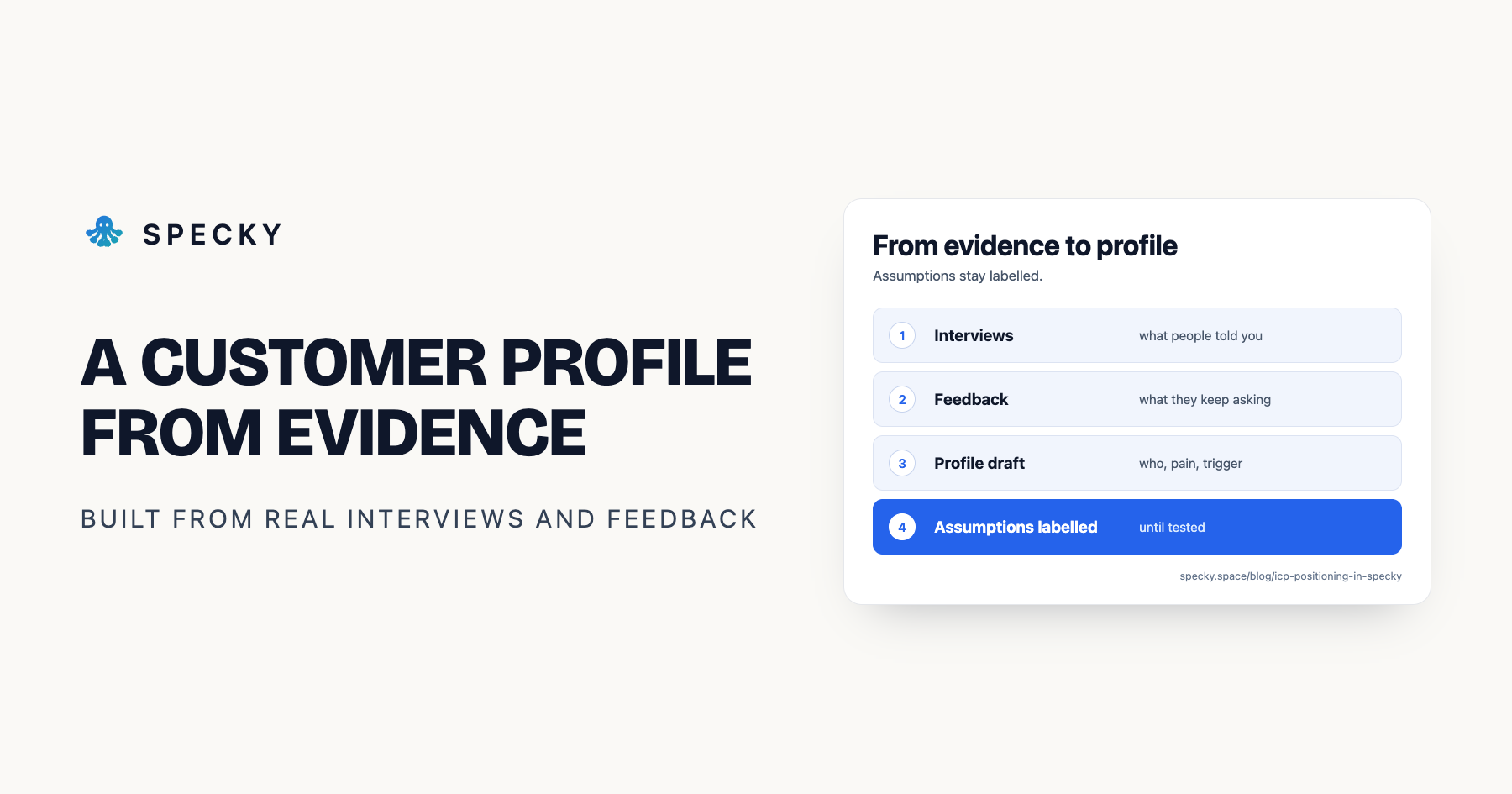
Most early ICPs are a founder's best guess, written once and never checked again. That guess still decides which interviews you run, what you build first and what your landing page says. When nobody can tell which parts come from real customers, the whole team builds on an assumption without knowing it.
What it does
- Drafts an ideal customer profile from your starting belief plus the interviews, feedback, support threads, call transcripts and analytics already in your workspace.
- Splits customers into primary, secondary and experimental segments, each with its own jobs, pains, desired outcomes and trigger events.
- Gives each segment a fit score (an AI estimate out of 100) and a separate evidence strength: assumption, emerging or strong.
- Keeps customer language, objections and a "Not a good fit" list next to the segments, so you can rule people out as clearly as you rule them in.
- Links only to source records that actually exist in your Product Graph. Example records are left out.
How it works in practice
Start with one honest sentence, such as "founders of 20 to 200 person SaaS companies who can't explain why activation moved." Specky reads the signals in your workspace and drafts a profile. A fresh draft is marked Learning, not Validated.
Then review it. Open the citations behind each pain and trigger. Look for a segment that scores well on fit but has weak evidence. That gap is the next thing to learn, not a reason to commit.
From the Activate tab, carry one chosen segment into idea validation, customer research, experiments, planning or launch copy. The page gives a simple example: choosing "growth PMs at 20 to 200 person SaaS companies" as the primary segment changes which interview questions you ask and which roadmap item looks most urgent.
When a new batch of interviews or feedback arrives, press Refresh from evidence, review what changed and save the profile with an updated confidence state.
For a solo founder, this replaces the persona doc written at launch and never reopened. For a small team hiring its first PM, it gives the new hire a customer definition they can check instead of inherit.
Where it stops
- Specky drafts the profile. It does not pick your segment. Choosing who to prioritise stays a human decision.
- The readiness score measures how complete the profile is, not whether it is true.
- A one-sentence belief is enough for a first draft, but the profile only gets sharper as real evidence comes in.
Try it
The ICP view lives in the Specky app. Through the Specky connector, Claude or ChatGPT can read your confirmed product context, including who the product is for and its positioning, before it answers: ask it to "read my Specky product context first."
See how it works at specky.space/features/icp-positioning.
Keep reading
Run AI Customer Interviews Without Losing the Evidence
Alex runs customer interviews from a link and writes up what it heard. A finding only counts once a person attaches the evidence and accepts it.
Turn Customer Calls into Searchable, Sourced Product Signals
Specky turns calls and meetings from your existing tools into signals with a transcript, summary and themes, each linked back to the conversation it came from.
AI Research Synthesis: Keep Evidence Separate from Interpretation
AI can sort a folder of interviews in minutes, but studies show it misses interpretive themes. A five-step workflow, prompt and review checklist keep every claim tied to its source.