Run AI Customer Interviews Without Losing the Evidence
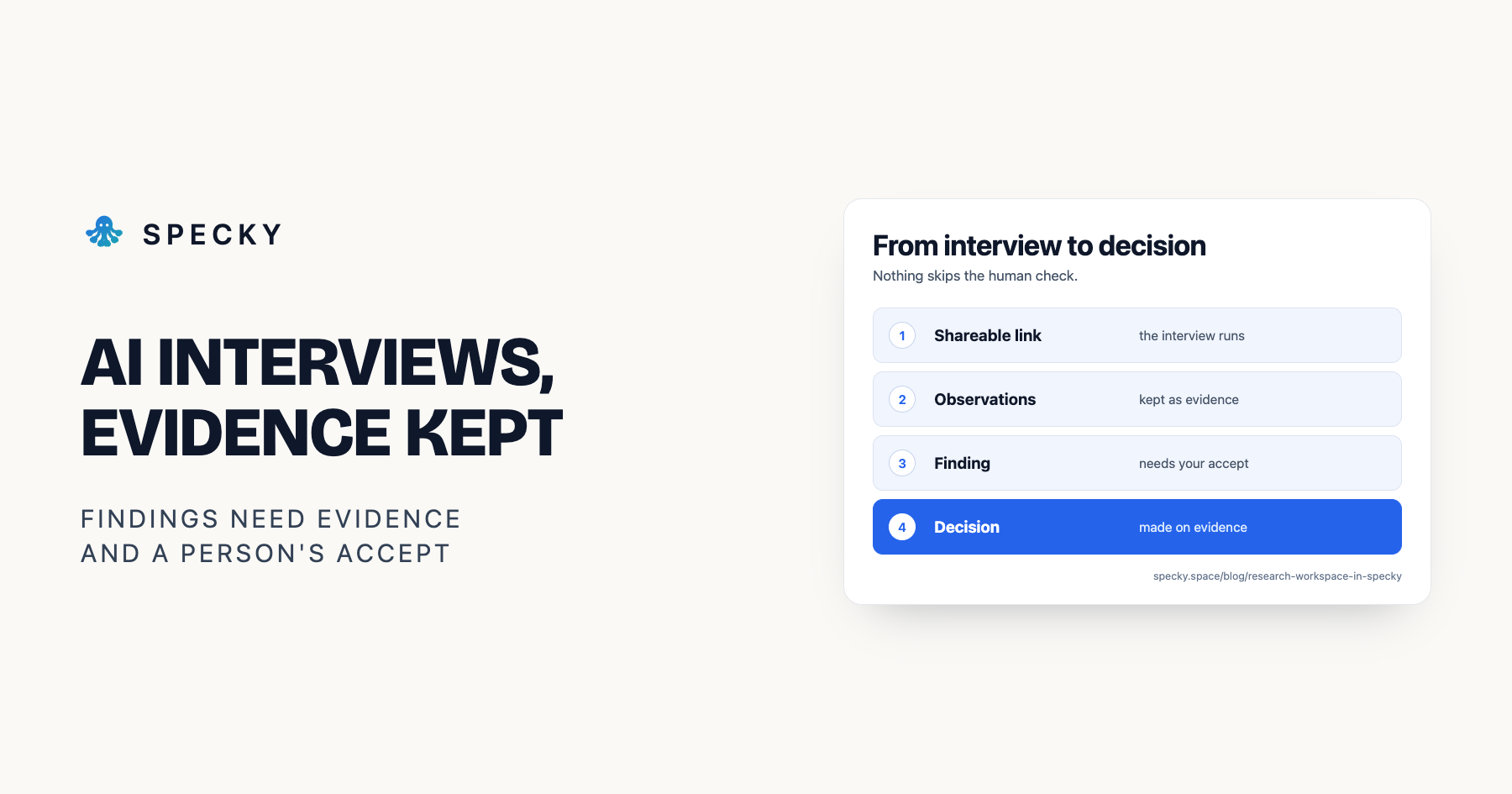
Alex runs customer interviews from a link and writes up what it heard. A finding only counts once a person attaches the evidence and accepts it.
You shipped something, and now you need to know what customers actually think. As a solo founder or a small team, you rarely have time to schedule calls, take notes and write them up. When you do, the notes end up in a doc nobody checks against what was really said.
What it does
- Alex, Specky's AI interviewer, runs customer interviews from a shareable link and writes up what it heard.
- Interviews, user testing, shadowing, synthesis and AI-user testing share one workspace, with the same evidence rule for every method.
- A finding needs observation evidence and an explicit accept or reject from a person before it moves anywhere.
- AI-generated evidence stays labelled as synthetic.
- An accepted finding can become a decision, with the user need, edge cases and acceptance criteria carried along with it.
How it works in practice
Say you want to know why trial users stall after setup. You start an interview, share the link with a few customers, and let Alex run the conversations. Each write-up captures what was said and observed.
Then you do the part that matters. You read the write-up, attach the observation that supports a finding, and accept or reject it. A finding like "people skip the invite step" only counts once you have pointed at the moment a customer said or did that.
When a finding is accepted, you can turn it into a decision. The user need, the edge cases and the acceptance criteria travel with it. So when you or your team sit down to plan the work, the detail from the interview is still there, not lost in a summary.
This matters more as the team grows. The person planning the work may not be the person who ran the research. With the evidence attached, they can check the finding instead of trusting it.
Where it stops
- Alex does not decide what counts as a finding. It writes up what it heard. A person attaches the evidence and makes the call.
- The write-up is the start of the record, not the final word on what it means.
- Results from AI-user testing stay labelled as synthetic, so they are not mistaken for what real customers said.
Try it
If you use Claude or ChatGPT with the Specky connector, you can ask it to "start a customer interview about why trial users stall" and it will set up an Alex interview with a shareable link.
See how the research workspace works at specky.space/features/research-workspace.
Keep reading
How to Build an Evidence-Backed ICP for Your Startup
Most ICPs are personas written from memory. Specky drafts one from your interviews, calls and feedback, and keeps every claim linked to its source.
One Feedback List for Slack, Support, Calls and Email
Specky puts requests from Slack, support tools, calls and email in one list grouped by the problem behind them, with question boards and a portal you control.
Turn Customer Calls into Searchable, Sourced Product Signals
Specky turns calls and meetings from your existing tools into signals with a transcript, summary and themes, each linked back to the conversation it came from.