Plan a Roadmap That Fits Your Team's Real Capacity
Score bets independently, test them against real capacity, flag drift and share a Now, Next, Later story, all from one plan with the reasons attached.
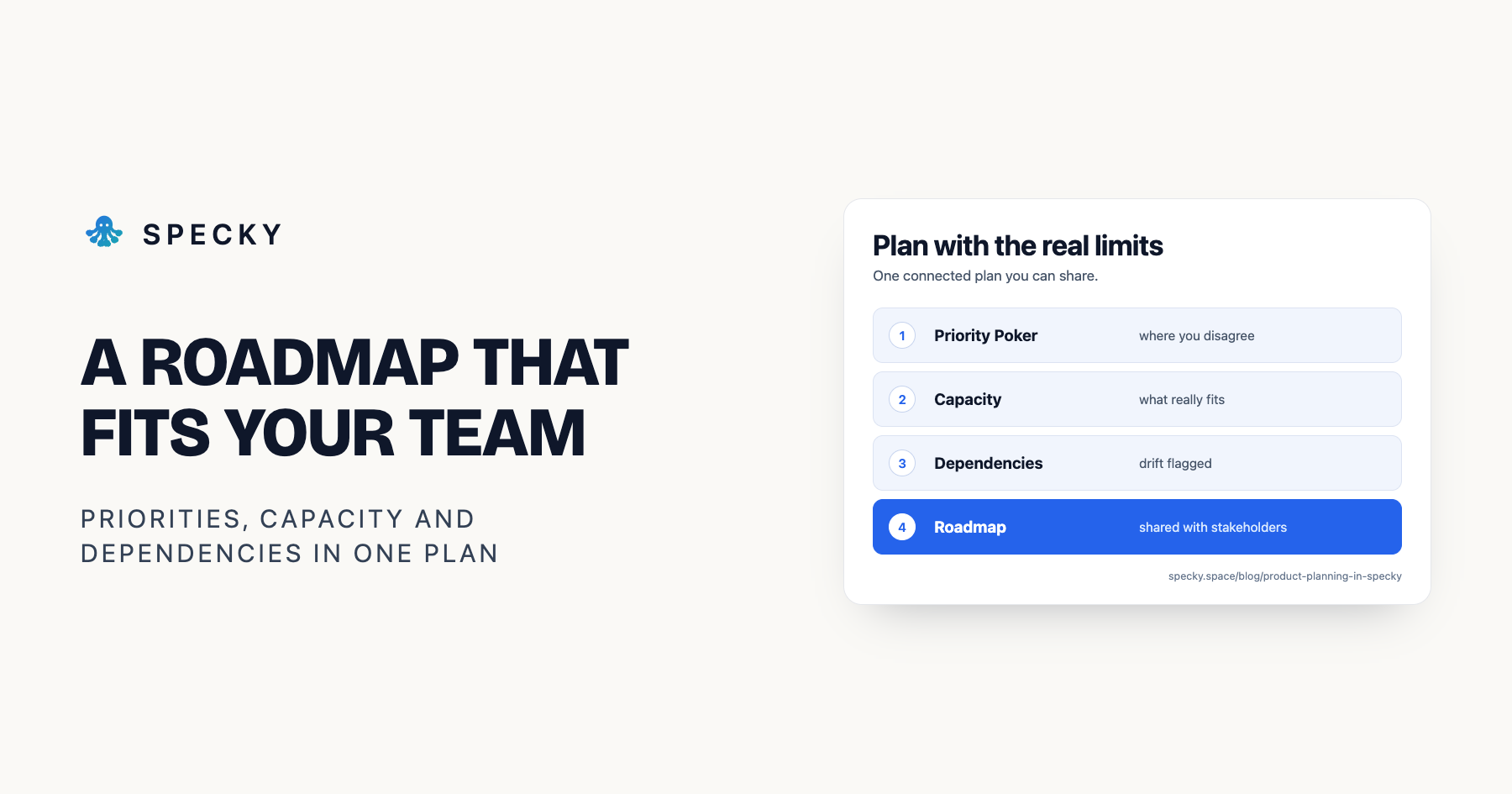
In a 3 to 10 person team, the roadmap is often whatever got argued for last. Capacity is a guess, dependencies show up mid-sprint, and the plan shared with sales carries dates nobody believes.
What it does
- Priority Poker: a round holds 2 to 30 items. Each person scores them from 1 (not now) to 5 (must matter), and nobody sees scores until Reveal votes.
- Capacity Planning: set points per week, a horizon and a reserve, and see what fits. Work past the line shows Overflow, and an item with no estimate is marked Unestimated instead of guessed.
- Dependencies and drift: fixed rules flag a target quarter that has passed, logged hours more than 25% over the estimate, or an open item with no update for 14 days.
- Portfolio rollups: compare objectives, roadmap progress, risks and customer signals across products.
- Stakeholder roadmaps: a Now, Next, Later story per audience, with Exploring, Likely or Committed confidence labels and no invented dates.
How it works in practice
Say the team has 20 points a week for six weeks. That is 120 points. Hold back a 20% reserve and 96 remain to commit. If four items need 108 points, the last one shows Overflow, and you choose to commit what fits, test first or defer.
The page's example goes further. Eight candidate bets go into a Priority Poker round. Sales scores an enterprise export a 5. Engineering scores it a 2, because permissions are unresolved. Capacity fits five smaller bets, not all eight. The permissions dependency is blocked and stale. So the stakeholder roadmap for sales leadership reads: Now, onboarding reliability. Next, permissions model. Later, enterprise export.
Start the discussion with the item whose votes are spread widest. That disagreement usually hides a missing fact. Copy update then gives you plain text for an email or doc.
Where it stops
- It does not replace Jira or Linear. Specky helps decide and explain the plan, and approved work moves into your tracker with its context attached.
- Scores and drift warnings are not AI decisions. Confirm a drift signal with the owner before a commitment changes.
- Priority Poker, capacity planning, portfolio and stakeholder roadmaps are on the Growth plan. Growth covers up to 5 products in the portfolio.
Try it
Through the Specky connector, Claude or ChatGPT can list what is on your roadmap, with status and target quarter, and build a roadmap board from it. Ask it to "list what is on my Specky roadmap by target quarter."
See the planning tools at specky.space/features/product-planning.
Keep reading
RICE, ICE and Priority Poker With the Evidence in View
Score bets with RICE, ICE or your own weights while the customer evidence stays on screen. See where the team disagrees, and flag roadmap items nobody decided.
A Roadmap Board That Never Invents a Quarter
Ask Claude for your Specky roadmap as a board: columns by target quarter, quiet items flagged, decisions alongside, and no made-up dates.
Stakeholder Management for Product Managers in the Age of AI
Every stakeholder now has an AI assistant and a roadmap opinion. The PM's edge is no longer more information but specific, searchable customer evidence. Here is how to map stakeholders and use it.