RICE, ICE and Priority Poker With the Evidence in View
Score bets with RICE, ICE or your own weights while the customer evidence stays on screen. See where the team disagrees, and flag roadmap items nobody decided.
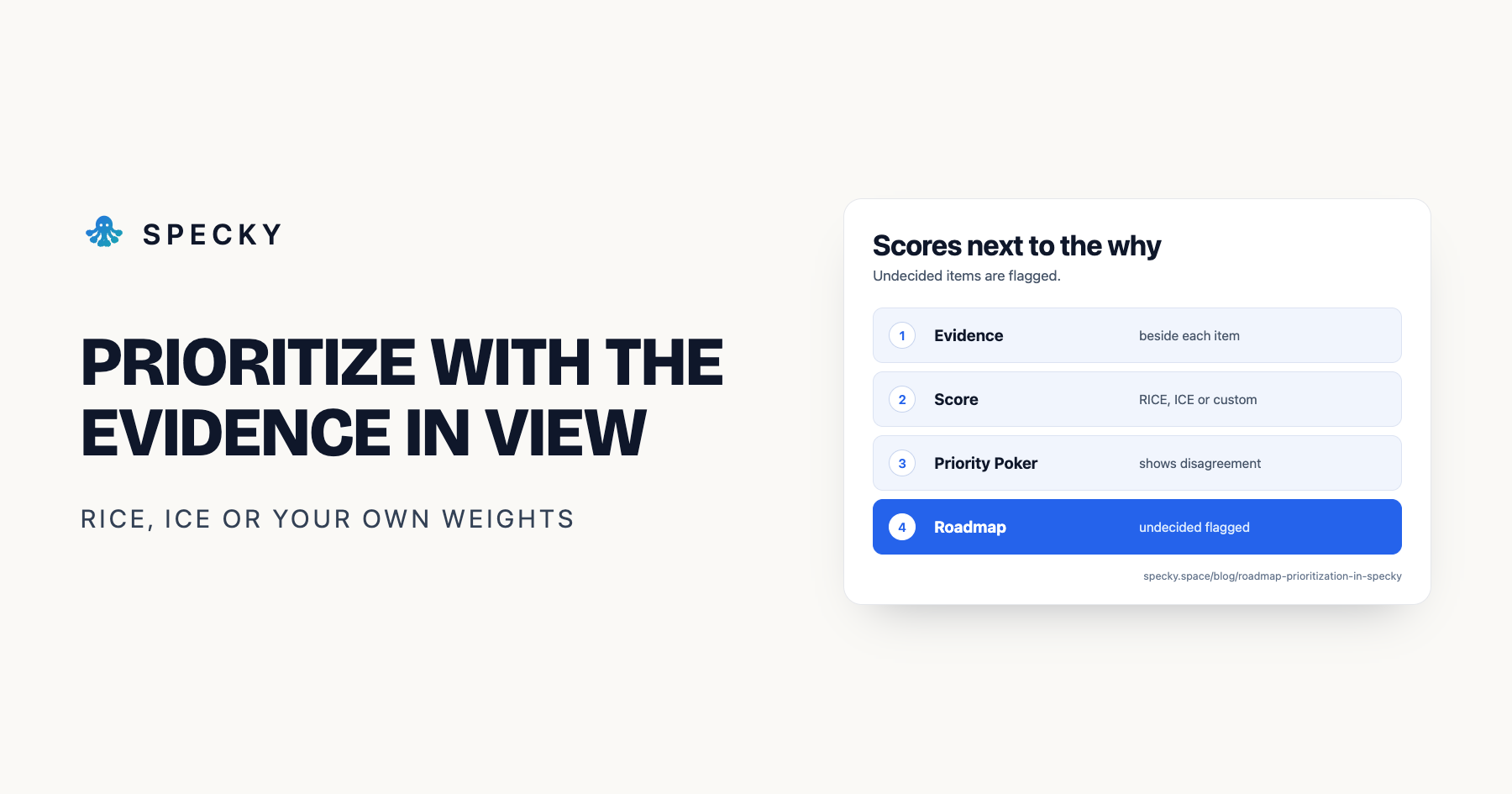
When a small team prioritizes, the score usually wins the argument and the reason gets lost. Three months later, nobody remembers why one bet beat another. A number on its own cannot tell you, and it cannot tell the next person who joins.
What it does
- Score ideas with RICE, ICE or your own weighting, with the customer evidence next to every score.
- Run Priority Poker: everyone scores on their own, then you see where Sales, Product and Engineering disagree.
- Use the opportunity map to link goals to customer problems to ideas, so any roadmap item can be traced back to the goal it serves.
- Before you commit, the roadmap flags items with no decision behind them.
- Plan by quarter, or let the AI draft a roadmap from your opportunities and decisions.
How it works in practice
Your team has a list of candidate bets for next quarter. You score them with RICE. Instead of a bare number in a spreadsheet, each score sits beside the signals behind it, so anyone can ask "where did this reach estimate come from?" and get an answer.
Then you run Priority Poker. Each person scores alone. Maybe the founder ranks custom exports first and the engineer ranks fixing permissions higher. Specky shows that split instead of averaging it into a number nobody trusts. Now you have the real conversation.
Next, open the opportunity map. Each idea hangs under a customer problem, and each problem under a goal. If an idea does not connect to any goal, that is worth noticing before you commit to it.
Finally, you build the roadmap. Any item with a high score but no recorded decision gets flagged. You either write down why the team chose it, or you leave it off. A high score alone is not a record of why you built something.
Where it stops
- Specky does not choose your priorities. You pick the scoring model and make the call.
- Prioritization, Priority Poker, the opportunity map and the roadmap are Growth plan features.
Try it
With the Specky connector, Claude or ChatGPT can answer "what is on our roadmap?" from your workspace, and on Growth can add a new opportunity to your opportunity map when you ask.
See how it works at specky.space/features/roadmap-prioritization.
Keep reading
Plan a Roadmap That Fits Your Team's Real Capacity
Score bets independently, test them against real capacity, flag drift and share a Now, Next, Later story, all from one plan with the reasons attached.
A Roadmap Board That Never Invents a Quarter
Ask Claude for your Specky roadmap as a board: columns by target quarter, quiet items flagged, decisions alongside, and no made-up dates.
Stakeholder Management for Product Managers in the Age of AI
Every stakeholder now has an AI assistant and a roadmap opinion. The PM's edge is no longer more information but specific, searchable customer evidence. Here is how to map stakeholders and use it.