Specky board recipe
Track your quarterly goals in Claude with a board built from Specky
“Which goals are slipping before the quarter ends?”
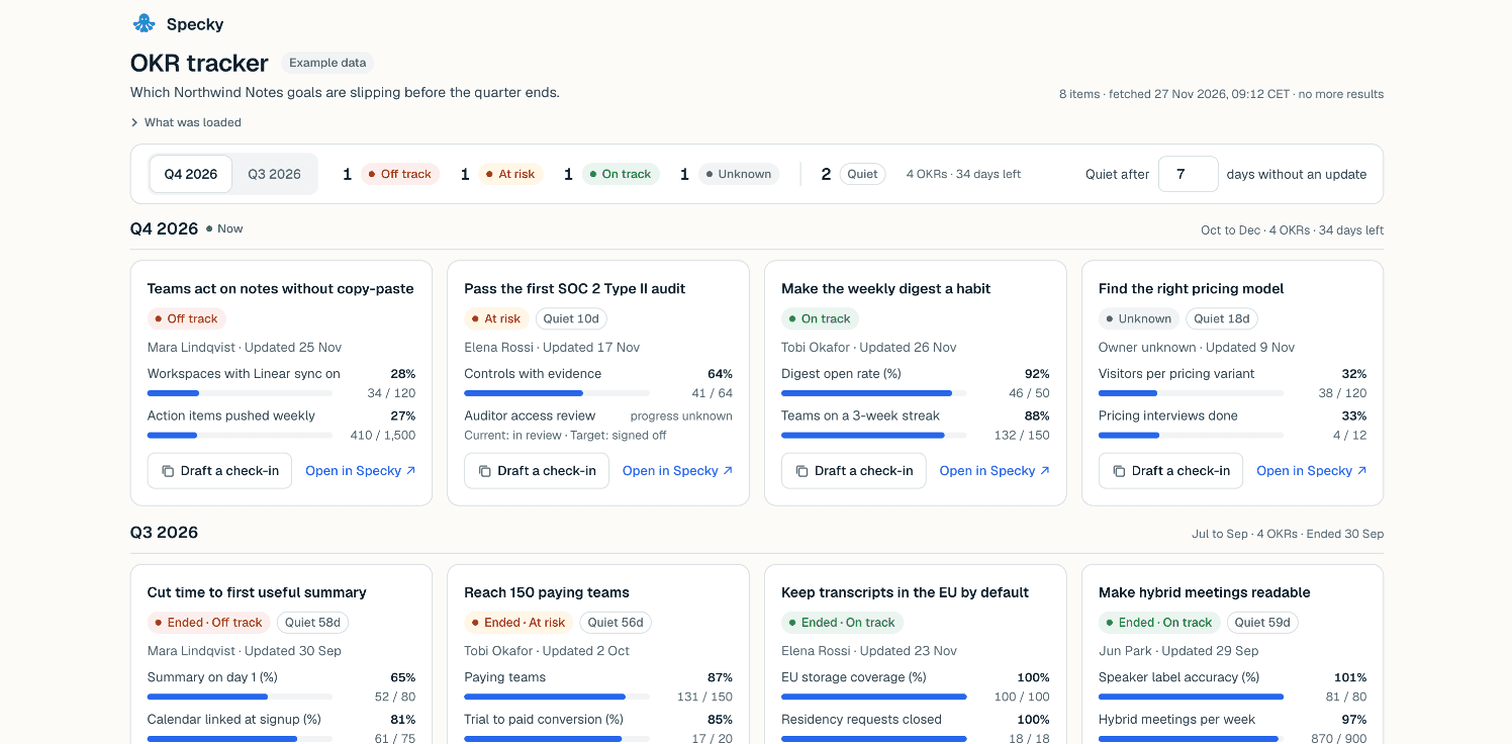
Claude groups your quarterly goals and their key results (OKRs) by quarter and sorts the at-risk ones first, with a progress bar per key result wherever the numbers allow one.
What you see
- OKRs by quarter, newest first, off track and at risk at the top.
- One progress bar per key result, only when both current and target are numbers.
- A quiet flag on OKRs with no update in your window.
- A Draft a check-in button that copies a ready prompt. Paste it in the chat and Claude drafts the update for your approval.
How to build it
- 1Add Specky as a custom connector in Claude (ChatGPT works too, on plans that allow custom connectors) with the URL
https://www.specky.space/api/mcp. Sign in and pick your workspace. Step by step - 2Ask your assistant to “build my okr tracker with Specky”, or paste the recipe below into a new chat for full control.
- 3Your assistant reads your workspace, applies the Specky look and builds the board next to the chat.
OKR tracker recipe
A private OKR tracker over your live Specky workspace: OKRs by quarter, key-result progress bars, at-risk OKRs first.
Build me a private interactive OKR tracker as an interactive artifact (a canvas or app if you are not Claude), using my connected Specky connector. It should show me which goals are slipping before the quarter ends.

1. Use my real workspace
- Find the Specky connector and call its tools now. Read only with: get_brand_kit, list_workspace_items, read_workspace_item.
- Call get_brand_kit first and build in its look.
- Never use sample, placeholder or invented data. If a call fails, show the error on the board instead of filling the gap.
- If the Specky connector is not connected, stop and ask me to connect it as a custom connector at https://www.specky.space/api/mcp.

2. Be honest about scope
- Show what was loaded in plain words in the header: the item count, the fetched time, and whether more results remain (has_more is true, or a tool without has_more returned exactly its limit). Put the exact tools and filters in a small "What was loaded" disclosure, not in the header.
- Never present a partial list or a failed request as the complete picture. Show a missing field as "unknown", never as zero.

3. Load
- list_workspace_items with types ["okr"] and limit 100. Follow next_cursor while has_more is true, up to 5 pages, and say so if more remain.
- read_workspace_item for one OKR at a time, only when I open its details drawer.

4. Tracker view
- Group OKRs by fields.quarter, newest quarter first. OKRs with no quarter go in a "No quarter" group.
- Inside a quarter, at-risk first: off_track, then at_risk, then on_track, then any other or missing status (shown as "unknown").
- Each card shows the title, owner, status badge, last update and a link to its url.
- One progress bar per key result in fields.key_results: current divided by target, only when both are numbers and target is not zero. Otherwise show the raw values and "progress unknown" instead of a bar. Never estimate a percentage.
- Flag OKRs with no update in the last 7 days as "quiet".
- Every card links to its item's url in Specky.
- Label items whose fields.origin is "onboarding" as "AI-generated at signup", so they never read as my team's own work.

5. Summary strip
Counts by status for the selected quarter, counting each OKR once.

6. Check-in hand-off
Each card has a "Draft a check-in" button that copies a prompt for this chat, for example: "In Specky, read OKR <id> with read_workspace_item and draft a check-in: what moved, what is blocked, one next step per key result. Draft it here in the chat first; only after I approve, save it with create_document, which saves a draft." Use the real id.

7. Editable threshold
Let me change the quiet window (default 7 days) on the board without reloading.

8. Stay read-only
- The artifact must never call any Specky tool not listed in step 1.
- Drafting happens in this chat, not in the artifact: use a copy button labelled with what it drafts or asks (for example "Draft a look-back") whose prompt names the exact item id and tells Claude to draft in the chat first and save nothing until I approve.

9. Make it work
- Look like Specky: the get_brand_kit logo inline with the word "Specky" in the header, its light and dark colours, status badge pairs, type scale, layout rules and footer. Never a generic dashboard.
- Readable cards, a search box and a details drawer. Polished empty, loading and error states. Usable from 360px wide.
- If the artifact cannot re-call the connector itself, label the data "Snapshot" with its fetched time. Never show a "Live" label you can't back.
- Keep the artifact private. People outside my organization get no connector access, so share this recipe, never a board that carries my data.
What it reads from Specky
The board only reads. Anything that writes happens in the chat, after you say yes.
get_brand_kitThe Specky logo, colours and layout rules, so every board your AI builds looks like Specky in light and dark.list_workspace_itemsOpportunities, decisions, experiments, OKRs, tickets, insights and objectives with their status and a link back to Specky, ready for your AI to build a board from.read_workspace_itemRead a full PRD, decision, insight or ticket with its links.
Good to know
- No percentage is ever estimated. Without numbers you see the raw values and progress unknown.
- Counts by status for the selected quarter count each OKR once.
Why it works this way: read the launch note →
More Specky boards
No Specky workspace yet?
Sign up, then add the connector. Or start in Claude: add the connector and it asks you to sign up.
Card required · Nothing charged until day 14 · 30-day refund