Specky board recipe
Turn your Specky roadmap into a board in Claude
“What is planned, when, and what is stuck?”
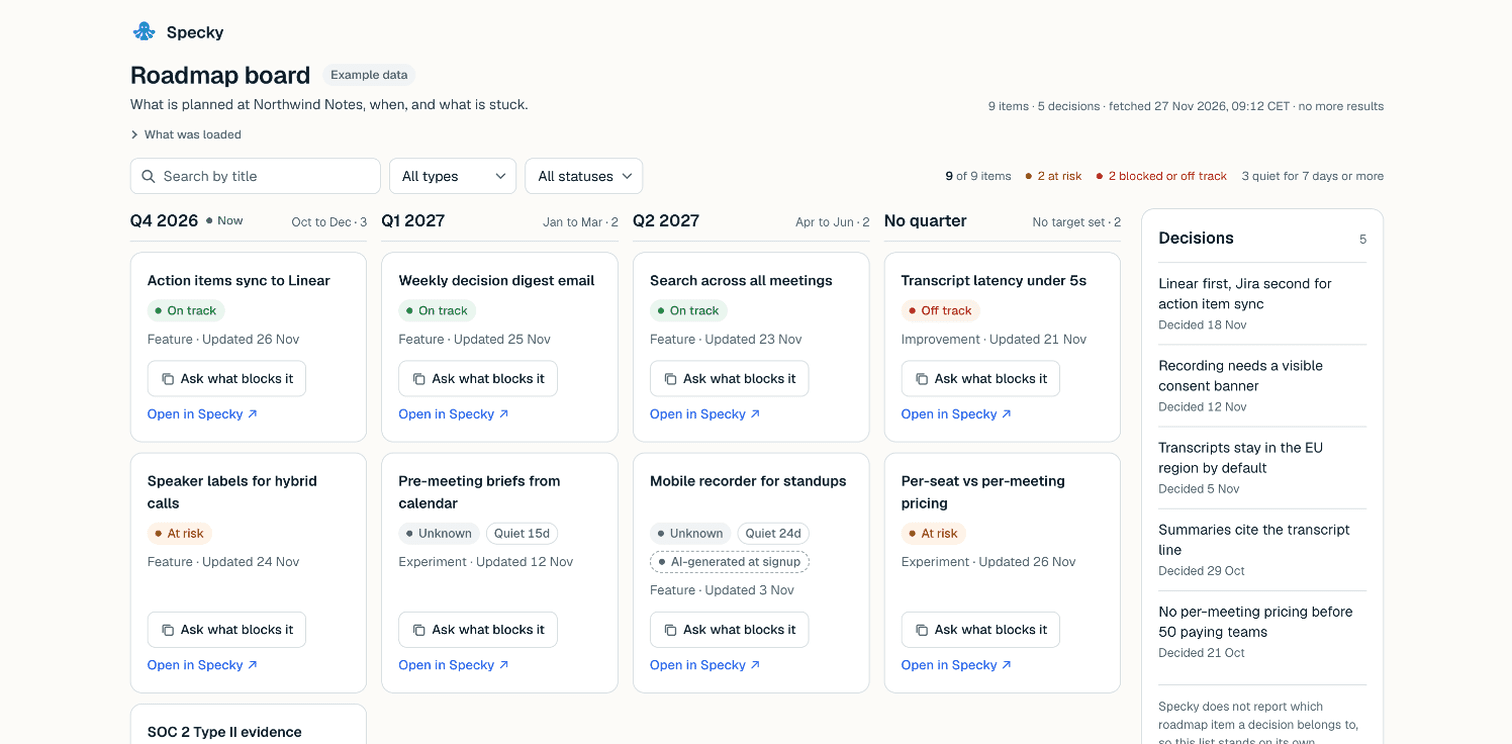
Ask for your roadmap as a board and Claude lays out every roadmap item and quarter-targeted document in columns by quarter, earliest first, with anything that has gone quiet flagged.
What you see
- Columns by target quarter, with a No quarter column last. No quarter is ever invented.
- Cards with title, type, status and last update, linking back to the item in Specky.
- A quiet badge on anything not touched in your window.
- Filters for type and status, search by title, and your decisions in a side list.
How to build it
- 1Add Specky as a custom connector in Claude (ChatGPT works too, on plans that allow custom connectors) with the URL
https://www.specky.space/api/mcp. Sign in and pick your workspace. Step by step - 2Ask your assistant to “build my roadmap board with Specky”, or paste the recipe below into a new chat for full control.
- 3Your assistant reads your workspace, applies the Specky look and builds the board next to the chat.
Roadmap board recipe
A private roadmap board over your live Specky workspace, grouped by target quarter, with your recent decisions listed alongside.
Build me a private interactive roadmap board as an interactive artifact (a canvas or app if you are not Claude), using my connected Specky connector. It should show me what is planned, when, and what is stuck.

1. Use my real workspace
- Find the Specky connector and call its tools now. Read only with: get_brand_kit, list_roadmap_items, list_workspace_items, read_workspace_item.
- Call get_brand_kit first and build in its look.
- Never use sample, placeholder or invented data. If a call fails, show the error on the board instead of filling the gap.
- If the Specky connector is not connected, stop and ask me to connect it as a custom connector at https://www.specky.space/api/mcp.

2. Be honest about scope
- Show what was loaded in plain words in the header: the item count, the fetched time, and whether more results remain (has_more is true, or a tool without has_more returned exactly its limit). Put the exact tools and filters in a small "What was loaded" disclosure, not in the header.
- Never present a partial list or a failed request as the complete picture. Show a missing field as "unknown", never as zero.

3. Load
- list_roadmap_items with limit 100. While has_more is true, call again with next_offset, up to 5 pages, and say so if more remain.
- list_workspace_items with types ["decision"] and limit 100, so I can see which decisions exist.
- read_workspace_item for one item at a time, only when I open its details drawer.

4. Board view
- Columns by target_quarter, earliest first, with a "No quarter" column last. Never invent a quarter.
- Cards show title, type, status badge, last update and a link to the item's url. Items with no update in 7 days get a "quiet" badge.
- A side list of decisions by title and link. The connector does not say which roadmap item a decision belongs to, so never draw that link yourself.
- Filter by type and status, plus a text search.
- Every card links to its item's url in Specky.
- Label items whose fields.origin is "onboarding" as "AI-generated at signup", so they never read as my team's own work.

5. Hand-off
Each card has an "Ask what blocks it" button, for example: "In Specky, read <id> with read_workspace_item and tell me what is blocking it. Answer here; save nothing." Use the real id.

6. Stay read-only
- The artifact must never call any Specky tool not listed in step 1.
- Drafting happens in this chat, not in the artifact: use a copy button labelled with what it drafts or asks (for example "Draft a look-back") whose prompt names the exact item id and tells Claude to draft in the chat first and save nothing until I approve.

7. Make it work
- Look like Specky: the get_brand_kit logo inline with the word "Specky" in the header, its light and dark colours, status badge pairs, type scale, layout rules and footer. Never a generic dashboard.
- Readable cards, a search box and a details drawer. Polished empty, loading and error states. Usable from 360px wide.
- If the artifact cannot re-call the connector itself, label the data "Snapshot" with its fetched time. Never show a "Live" label you can't back.
- Keep the artifact private. People outside my organization get no connector access, so share this recipe, never a board that carries my data.
What it reads from Specky
The board only reads. Anything that writes happens in the chat, after you say yes.
get_brand_kitThe Specky logo, colours and layout rules, so every board your AI builds looks like Specky in light and dark.list_roadmap_itemsWhat is planned and when, with status and target quarter, ready for a roadmap board.list_workspace_itemsOpportunities, decisions, experiments, OKRs, tickets, insights and objectives with their status and a link back to Specky, ready for your AI to build a board from.read_workspace_itemRead a full PRD, decision, insight or ticket with its links.
Good to know
- Specky doesn't say which decision belongs to which roadmap item, so the board never draws that line for you.
- Read-only. Ask in the chat what is blocking an item; nothing is changed from the board.
Why it works this way: read the launch note →
More Specky boards
No Specky workspace yet?
Sign up, then add the connector. Or start in Claude: add the connector and it asks you to sign up.
Card required · Nothing charged until day 14 · 30-day refund