Mash-Up MVP: Test Your Idea with Existing Tools Before You Build
Your product might already exist as five tools taped together. Prove the whole chain works before you build any of it.
Share
A mash-up MVP is a product experiment where you connect tools that already exist, such as forms, spreadsheets, automations and messaging services, to deliver your product's result to three to five real customers before you build anything custom. It tests whether the whole chain works end to end, and shows exactly which link breaks. Below is a free mash-up MVP template with a tool map and failure log.
Key takeaways
Strategyzer rates the mash-up 3 out of 5 for cost and 5 out of 5 for evidence strength, because real customers get a real result (Strategyzer poster).
Expect 1 to 3 weeks and $50 to $600 in total, according to Kromatic's Real Startup Book (Kromatic).
Free tiers run out fast. Zapier's free plan covers 100 tasks a month with 15-minute polling (Zapier).
Every tool is another company holding customer data. Under GDPR Article 28 each processor needs a contract.
What is a mash-up MVP?
A mash-up MVP is a working version of your product made from parts you did not build. A form collects the request, a spreadsheet stores it, an automation moves it, a message delivers the result. Customers get real value; only your own code is missing.
Eric Ries described the MVP as the version that brings the most validated learning for the least effort (Ries, 2009). When your product is mostly a sequence of steps, existing tools are usually the least effort. People also call this a mashup MVP or a no-code MVP.
Of the 44 experiment types in David J. Bland and Alex Osterwalder's Testing Business Ideas (Strategyzer), the mash-up is a validation experiment, grouped with the concierge MVP and the single-feature MVP.
Product Hunt. It began as an email list Ryan Hoover ran with Linkydink, an existing tool that collects links from a group and emails them out. Nathan Bashaw then coded a first website over a Thanksgiving break, adding discussion to the list (VentureBeat, 2014).
Food on the Table. The meal-planning service ran on Google spreadsheets as its front end and database, delivered by email, with simple Ruby scripts added to automate the copying (Rosso, SlideShare). It began as a concierge test and grew into a mash-up as the team automated steps.
When should you use a mash-up MVP, and when not?
Use it when your product is mostly a chain of steps, and the question is whether that chain really works end to end. You can have a working version in days, and when it breaks, you will know exactly which link broke.
Do not use it if the risky part is something no existing tool can do, because then the mash-up avoids the actual question. For that, use a technical spike. Be careful about customer data: every tool you add is another place their information goes, so check each one's terms.
Which risk does a mash-up MVP test, and how strong is the evidence?
This tests feasibility: can this outcome be delivered with what exists, and does it hold together? The evidence is behaviour, because real customers go through it. It shows the job can be done. It does not show the economics at scale, since those tools have their own costs and limits. See our guide to choosing a product experiment.
Strategyzer scores the mash-up 3/5 for cost, 3/5 for setup time, 4/5 for run time and 5/5 for evidence strength, across desirability, feasibility and viability. It costs more than a concierge (1/5) because you pay for tools and wiring, and less than a single-feature MVP (4/5) because you write little or no code.
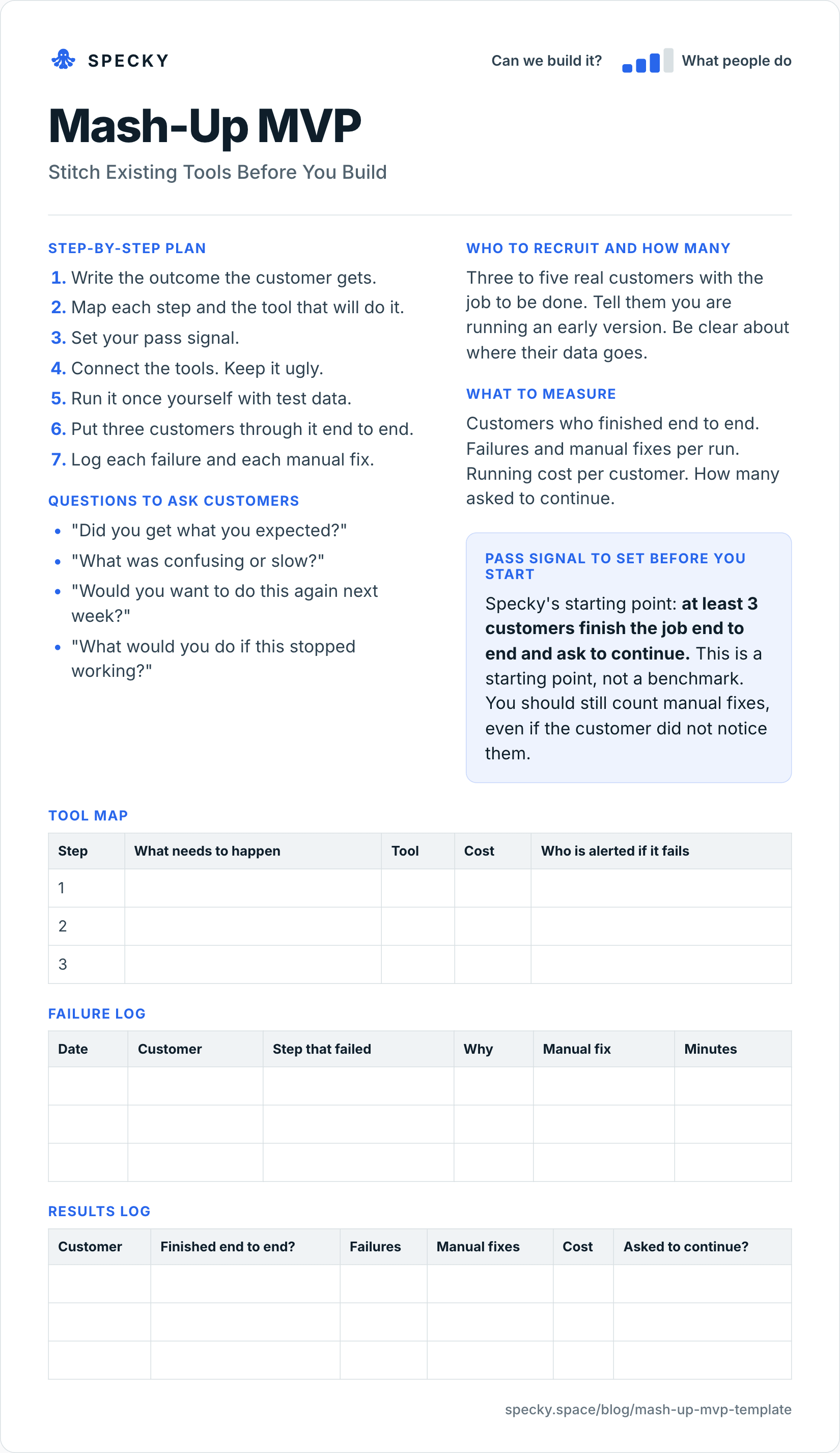
Mash-up MVP template (copy and use)
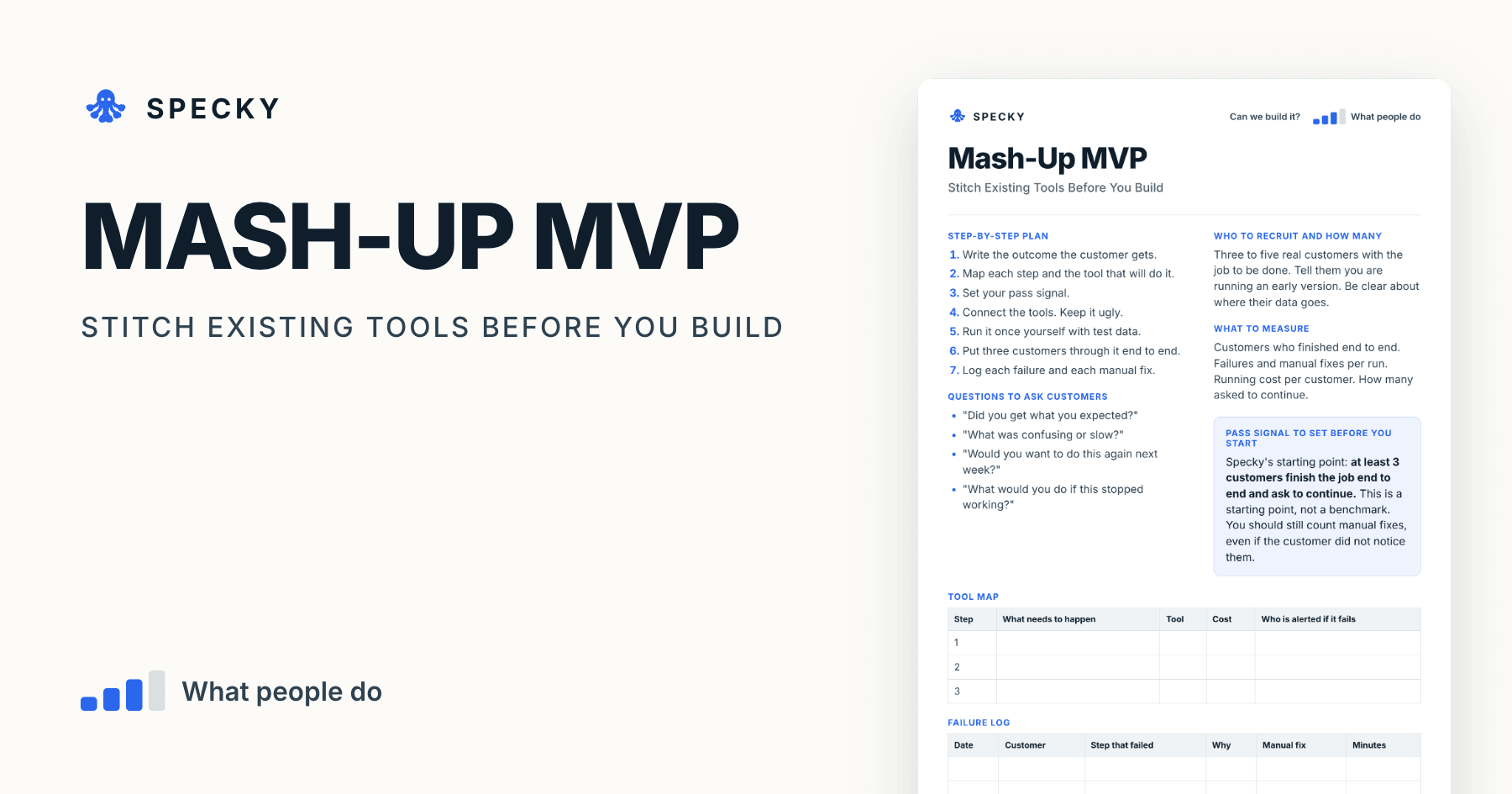
Open the image at full size, or copy the text version below.
Who to recruit and how many
Three to five real customers with the job to be done. Tell them you are running an early version. Be clear about where their data goes.
Step-by-step plan
Write the outcome the customer gets.
Map each step and the tool that will do it.
Set your pass signal.
Connect the tools. Keep it ugly.
Run it once yourself with test data.
Put three customers through it end to end.
Log each failure and each manual fix.
Tool map
Step
What needs to happen
Tool
Cost
Who is alerted if it fails
1
2
3
Failure log
Date
Customer
Step that failed
Why
Manual fix
Minutes
Questions to ask customers
"Did you get what you expected?"
"What was confusing or slow?"
"Would you want to do this again next week?"
"What would you do if this stopped working?"
What to measure
Customers who finished end to end. Failures and manual fixes per run. Running cost per customer. How many asked to continue.
Pass signal to set before you start
Specky's starting point: at least 3 customers finish the job end to end and ask to continue. This is a starting point, not a benchmark. You should still count manual fixes, even if the customer did not notice them.
Results log
Customer
Finished end to end?
Failures
Manual fixes
Cost
Asked to continue?
How do you build a mash-up MVP step by step?
The template's plan covers the order. These rules decide whether the result means anything:
Map the journey before choosing tools, then the capability each step needs: collect, store, process, notify, charge.
Put the risky step in the chain. If transcription accuracy is the doubt, the mash-up must include transcription, not a person typing.
Set limits before you start. Kromatic recommends fixing a willingness-to-pay threshold and a cap on weekly operating hours before building.
Run a real end-to-end pass yourself, including a real payment you refund afterwards, as Kromatic suggests.
Give every step an owner and an alert, so failures are never silent.
Freeze the setup during the test. If you keep adding tools, you are building a product, not testing one.
How much does a mash-up MVP cost?
Kromatic puts a typical mash-up at $50 to $600 in total, with tool subscriptions of $50 to $200 a month once you outgrow free tiers. Free tiers are smaller than they look. Zapier's free plan includes 100 tasks a month, two-step automations and 15-minute polling; its Professional plan starts at $19.99 a month billed annually ($29.99 monthly) for 750 tasks.
Two warnings. A 15-minute polling delay can make your "product" feel slow; Kromatic lists tool limits mistaken for product problems as a common trap. And prices change with volume, so your test's cost per customer is a floor, not a forecast.
How many customers do you need for a mash-up MVP?
Specky's template uses three to five, because you will be fixing breaks by hand and need to see every one. Kromatic suggests 10 to 50, recruited through your launch channel, when you also want a read on willingness to pay. Avoid friends: they forgive broken steps that strangers would not.
What should you measure in a mash-up MVP?
Measure
What it tells you
Customers who finished end to end
Whether the chain delivers the outcome
Failures per step (seam)
Which link to replace first
Minutes of manual fixing per run
The hidden labour cost
Running cost per customer
Whether the economics could work
Customers who asked to continue
Whether the result is worth having
Kromatic adds a useful ratio: weekly operating hours divided by paying customers. If it rises as customers grow, the chain is not ready to scale.
Mash-up MVP vs concierge vs Wizard of Oz vs single-feature: which should you use?
Does the experience work if a machine could do it?
Do they return to one slice, unprompted?
Does the chain of tools hold end to end?
Strategyzer cost / setup / run / evidence (of 5)
1 / 2 / 3 / 5
2 / 3 / 3 / 5
4 / 3 / 4 / 5
3 / 3 / 4 / 5
Specky template
5 customers, 3 weeks
5 customers, 2 weeks
10 users, 3 weeks
3-5 customers, 2 weeks
Specky pass signal
3 of 5 come back or pay
3 of 5 finish and don't notice or mind
4 of 10 use it again in week 2
3 finish end to end and ask to continue
A mash-up and a Wizard of Oz can look identical to the customer; the difference is whether connected software or a person does the work.
What does a mash-up MVP look like in practice?
This example is made up to show the method. A founder wants to turn customer voicemails into tasks for plumbers. Before building anything, he connects a phone number, a transcription service, and a shared spreadsheet, with an automation that sends a text message to the plumber.
Four plumbers use it for two weeks. Three finish every job through it and ask to carry on. But the failure log shows that addresses are transcribed wrongly about one time in four, and he has been fixing them by hand.
The signal passes, but the log shows the real problem. Address accuracy becomes his next test, and he now knows what to build first.
Here is how the numbers could read. Say the four plumbers receive 60 voicemails over the two weeks. One in four wrong is 15 address fixes; at four minutes each, that is an hour of hidden work, which would grow with every new plumber. Sixty calls in two weeks is about 120 a month. If each call uses even one automation task, that already exceeds a 100-task free plan, so the true running cost includes a paid tier.
What are the most common mash-up MVP mistakes?
Making it pretty. Nobody needs a clean version to answer this question.
Hiding the manual fixes. They are the finding.
Testing the easy part. Make sure the mash-up includes the risky step.
Ignoring the data trail. Know where customer information goes.
Assuming the tool costs will hold. Prices and limits change at higher volumes.
Going blind to the seams. Kromatic warns that founders stop noticing awkward hand-offs that first-time customers find jarring.
How should a mash-up MVP handle customer data?
Each tool that stores or processes customer details is, in GDPR terms, a processor. Article 28 says you may only use processors that provide sufficient guarantees, that their processing must be governed by a contract, and that they need your written authorisation to bring in other processors (GDPR, EUR-Lex). In practice:
List every tool in the tool map that touches personal data, and check each has a data processing agreement you have accepted.
Send the minimum. If the plumber only needs an address and a problem, do not forward the full recording.
Tell customers which services are involved, and delete test data when the experiment ends.
How to run it in Specky
On the Assumptions page, click the note and choose Pick a test, then Mash-up. Specky fills in the steps, the pass signal, and a two-week timeline.
You run this one. Specky keeps the plan and the result. Connect the tools yourself.
Click Start running. Paste the tool map, failure log, and running cost onto the test.
Record the result.
A pass shows on the board as Supported, because customers going through it is behavior.
What should you do with each outcome?
Supported: The chain holds. Replace the weakest link first, using a technical spike to check the hardest part.
Unclear: It worked, but only with lots of manual repair. Decide what level of repair is acceptable, and rerun it with a clear limit.
Contradicted: It broke or customers stopped. Find which link failed. If that link is central, the idea needs to change. Any bet resting on this note now shows as Contradicted.
A mash-up MVP delivers a product's outcome by connecting existing tools, like forms, spreadsheets, and automations. It tests whether the idea works end to end before you build anything custom. Product Hunt is a well-known example: it started as an email list run on an existing link-sharing tool before anyone coded a website.
When should I use a mash-up instead of building?
Use a mash-up when your idea is mainly a sequence of steps that existing tools can handle. If the risky part is something no tool can do, test that part directly with a technical spike. Kromatic puts a typical mash-up at 1 to 3 weeks.
What is the difference between a mash-up and a Wizard of Oz test?
A mash-up uses connected software to do the work. A Wizard of Oz test has a person doing the work behind what looks like a finished product. Choose a mash-up when the question is whether existing tools can deliver the outcome, and Wizard of Oz when no tool can yet and you need to test the experience.
How much does a mash-up MVP cost?
Kromatic estimates $50 to $600 in total, with subscriptions of $50 to $200 a month once you leave free tiers. Free plans are small: Zapier's covers 100 tasks a month. Count your own hours too, since manual fixes are a real cost even when no invoice arrives.
Is a no-code MVP the same as a mash-up MVP?
Mostly. A mash-up MVP is usually built with no-code tools, but the defining feature is that existing services do the work, connected together. A no-code app builder that creates one custom product is closer to a single-feature MVP. What matters is whether you are testing the chain of tools or one new feature.