Concierge MVP: Free Template, Real Examples and a 5-Customer Plan
The fastest way to learn what people will pay for is to do it for them by hand, openly, and then ask for the money.
Share
A concierge MVP is a product experiment where you deliver the outcome your product promises by hand, to about five customers who know a person is doing the work, and then ask them to pay or book again. It tests whether people want the result enough to commit, before you write code. Below is a free concierge MVP template, a script, a delivery log and real examples.
Key takeaways
In Strategyzer's experiment library for Testing Business Ideas, the concierge ties for the cheapest validation experiment: 1 out of 5 for cost, yet 5 out of 5 for evidence strength (Strategyzer poster).
Start with 3 to 5 customers. Kromatic's Real Startup Book puts a concierge test at 2 weeks to 3 months and roughly $0 to $300 (Kromatic).
It only counts as commitment if you ask for money or a second booking. A free service everyone enjoys is a favour, not a result.
Specky's starting pass signal: at least 3 of 5 come back for a second round or pay.
What is a concierge MVP?
A concierge MVP replaces the product with you. You do the job the software would do, personally, for a handful of customers, on a schedule and at a price. The customer knows a person is behind it. That openness separates it from a Wizard of Oz test, where the customer believes a machine is doing the work.
Eric Ries described the MVP in 2009 as the version that brings the most validated learning for the least effort, and warned that it is not about building minimal products (Ries, 2009). A concierge MVP takes that to the limit: no product, only the outcome.
Of the 44 experiment types in David J. Bland and Alex Osterwalder's Testing Business Ideas (Strategyzer), the concierge is a validation experiment, grouped with the single-feature MVP and the mash-up MVP.
The best-known case is Food on the Table, a service that built weekly meal plans and grocery lists around what was on sale at a family's store. Ries uses it in The Lean Startup to illustrate the concierge approach (Shortform summary). Founder Manuel Rosso's own deck shows how it ran (Rosso, SlideShare):
The goal was the first 20 users, found through discovery contacts, well-connected "mavens" and the team's networks.
First a face-to-face meeting, then a phone call, after which recipes and the grocery list arrived by email.
Google spreadsheets stood in for the front end and the database. Recipes were copied by hand; simple Ruby scripts came later.
They narrowed the work on purpose. Early users all shopped at the same grocery store.
That last point is the one most teams miss. A concierge test is only cheap if you restrict who you serve.
What are some other concierge MVP examples?
Airbnb. The company's history starts in 2007 with two hosts welcoming three guests into their San Francisco home (Airbnb). Kromatic describes the founders hosting those paying guests themselves.
Zappos, which is disputed. In 1999 Nick Swinmurn photographed shoes at a Sunnyvale store, posted them online, and bought each pair at full price only when someone ordered (Fortune, 2012). Strategyzer calls it a concierge MVP; Nielsen Norman Group lists it as Wizard of Oz (NN/g, 2024).
Settle such debates with one question: does the customer know a human is doing the work? Zappos shoppers saw an online store, so it fits Wizard of Oz better.
When should you use a concierge MVP, and when not?
Use it when you think you know what people want, and need to learn what they will come back for or pay for.
Do not use it when you cannot deliver the outcome yourself (test that part with a technical spike), when customers must believe it is automatic to judge it fairly (that calls for Wizard of Oz), or when the value only appears at scale, as with marketplaces and network products.
And do not let a nice service fool you. Part of what people are enjoying may be you. Kromatic calls this the "concierge halo": praise for the personal touch rather than for the outcome.
Which risk does a concierge MVP test, and how strong is the evidence?
This tests desirability at the level that matters most: will people come back or pay? The evidence is commitment, the top rung of the ladder in our guide to choosing a product experiment, as long as you actually ask for money or a repeat booking. If you give it away and nobody commits to anything, what you have is a favour, not evidence.
Strategyzer rates the concierge 1/5 for cost, 2/5 for setup time, 3/5 for run time and 5/5 for evidence strength. The trade-off is time: you are the product, so every customer costs hours. For how this compares with interviews and surveys, see what counts as evidence for the four product risks.
Concierge MVP template (copy and use)
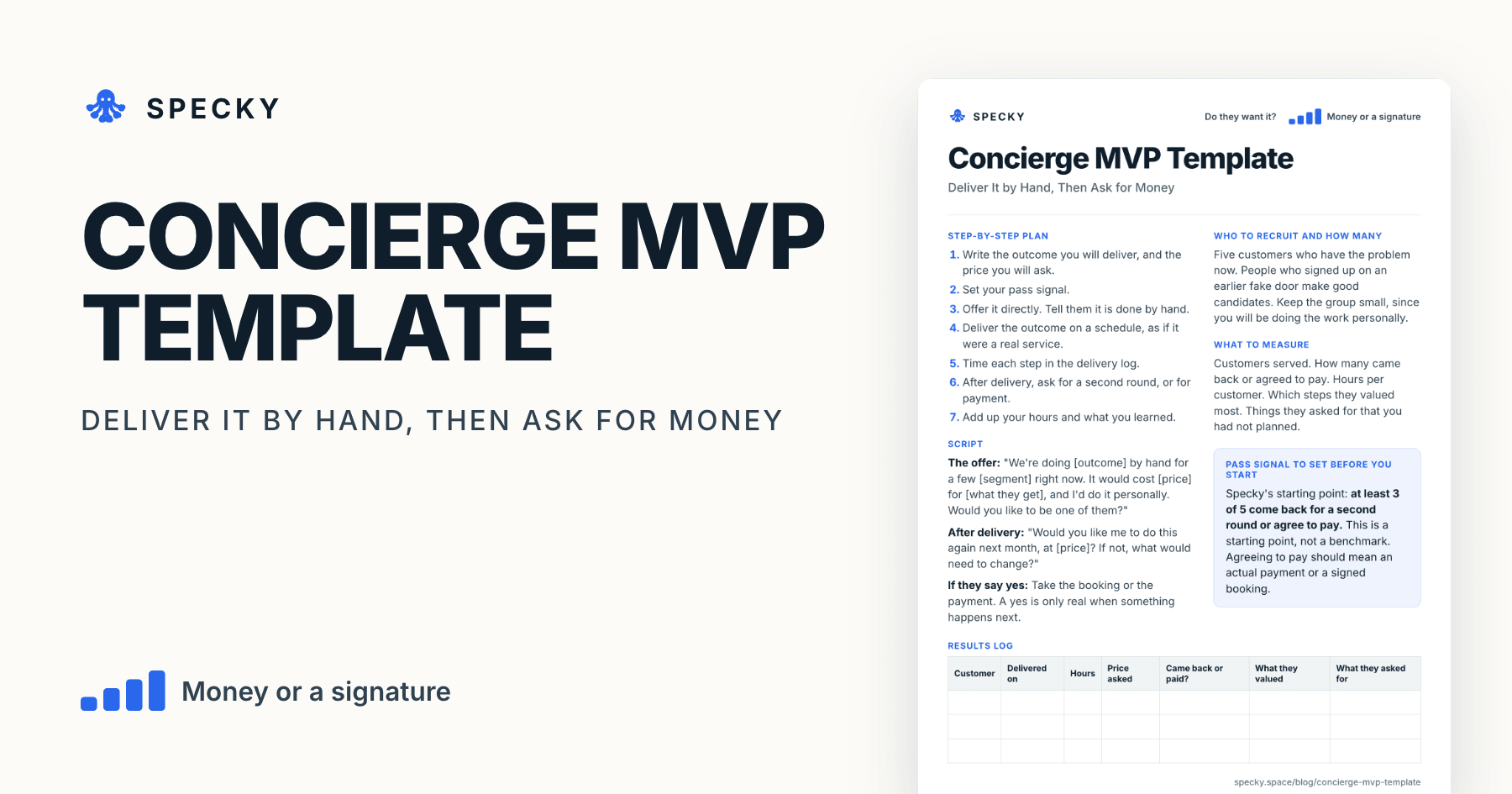
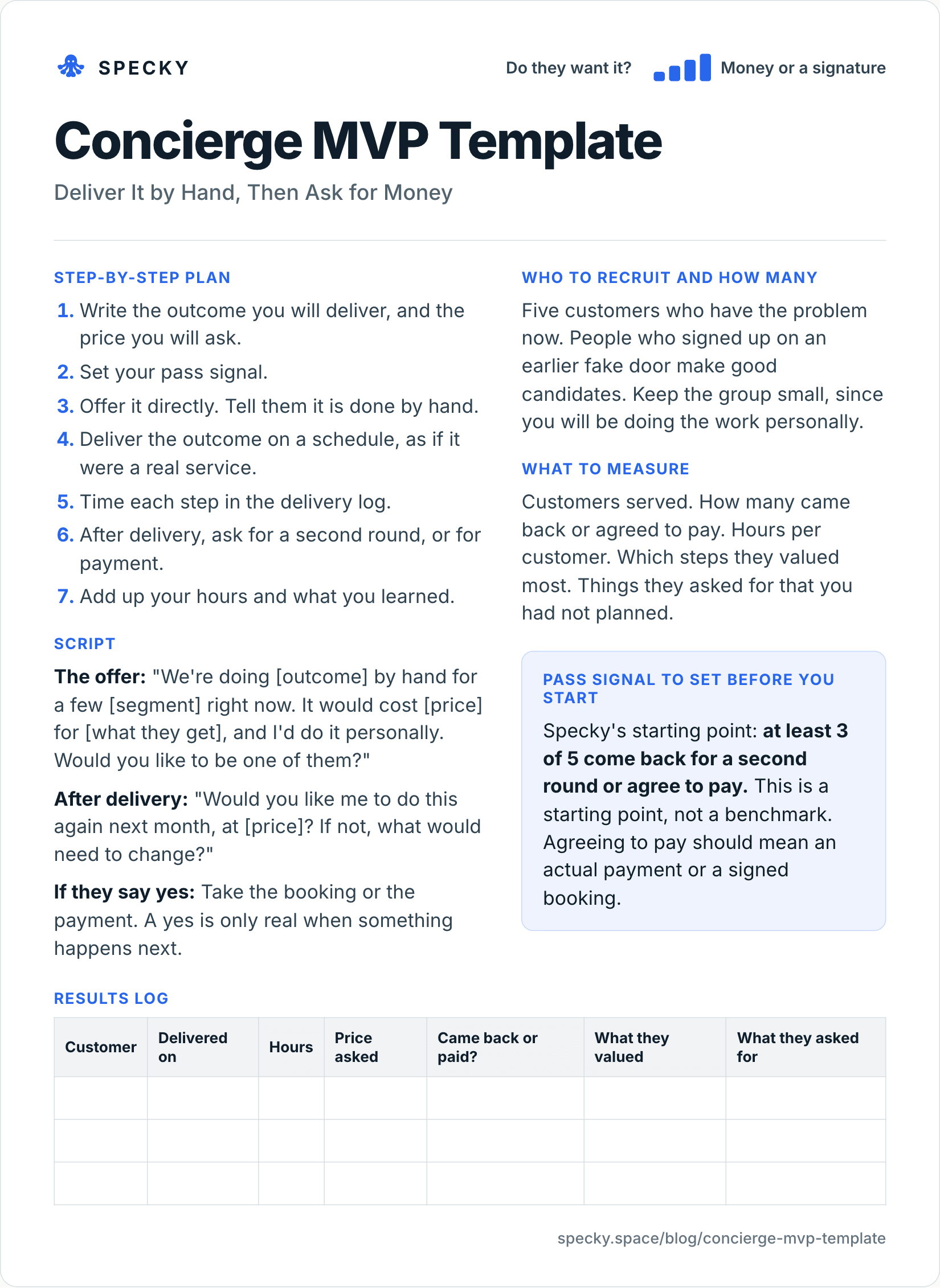
Open the image at full size, or copy the text version below.
Who to recruit and how many
Five customers who have the problem now. People who signed up on an earlier fake door make good candidates. Keep the group small, since you will be doing the work personally.
Step-by-step plan
Write the outcome you will deliver, and the price you will ask.
Set your pass signal.
Offer it directly. Tell them it is done by hand.
Deliver the outcome on a schedule, as if it were a real service.
Time each step in the delivery log.
After delivery, ask for a second round, or for payment.
Add up your hours and what you learned.
Script
The offer: "We're doing [outcome] by hand for a few [segment] right now. It would cost [price] for [what they get], and I'd do it personally. Would you like to be one of them?"
After delivery: "Would you like me to do this again next month, at [price]? If not, what would need to change?"
If they say yes: Take the booking or the payment. A yes is only real when something happens next.
What to measure
Customers served. How many came back or agreed to pay. Hours per customer. Which steps they valued most. Things they asked for that you had not planned.
Pass signal to set before you start
Specky's starting point: at least 3 of 5 come back for a second round or agree to pay. This is a starting point, not a benchmark. Agreeing to pay should mean an actual payment or a signed booking.
Results log
Customer
Delivered on
Hours
Price asked
Came back or paid?
What they valued
What they asked for
Delivery log (one per customer)
The results log says whether it passed; this log says what to build. Kromatic suggests tagging each step "must stay human", "automate first" or "automate later".
Step
Minutes
Did the customer notice or value it?
Keep human, automate first, or automate later?
Intake call
Doing the core job
Sending the result
Follow-up
How many customers do you need for a concierge MVP?
Five is enough to see a pattern and small enough to serve well. Kromatic recommends 3 to 5 early adopters, in small batches. Food on the Table aimed for its first 20, one at a time.
The real limit is your calendar: five customers at six hours each is 30 hours. If each takes longer, cut the scope before adding customers, as Food on the Table did with one store. Skip friends, who pay out of loyalty. Kromatic's stopping rule: stop adding customers once feedback stops surprising you.
Concierge MVP vs Wizard of Oz vs single-feature vs mash-up: which should you use?
All four are MVP experiments that deliver a real result to real customers. They differ in who does the work and what the customer sees.
Does the experience work if a machine could do it?
Do they return to one slice, unprompted?
Does the chain of tools hold end to end?
Strategyzer cost / setup / run / evidence (of 5)
1 / 2 / 3 / 5
2 / 3 / 3 / 5
4 / 3 / 4 / 5
3 / 3 / 4 / 5
Specky template
5 customers, 3 weeks
5 customers, 2 weeks
10 users, 3 weeks
3-5 customers, 2 weeks
Specky pass signal
3 of 5 come back or pay
3 of 5 finish and don't notice or mind
4 of 10 use it again in week 2
3 finish end to end and ask to continue
A common order: concierge first, then a mash-up or Wizard of Oz to systematise delivery, then a single-feature MVP to see if people return without you.
What does a concierge MVP look like in practice?
This example is made up to show the method. A founder thinks small online shops would pay to have their product photos rewritten as listings. She offers five shops: "I will rewrite your 20 best listings by hand this month, for €150."
Four agree. She delivers, spending about six hours on each. When she asks about next month, three book again and pay. All three say the same thing: they do not care about the writing so much. They care that someone looks at which products are not selling.
Three of five came back and paid, so the test passes. She has real evidence of demand, plus a surprise about what the product should be.
Her delivery log adds the economics. Round one took 24 hours for €600, about €25 an hour. Of each six hours, four went on writing and two on reviewing sales data, the part customers valued. At €150 a month, she needs each delivery under two hours, around €75 an hour, so she systematises the sales review first.
What are the most common concierge MVP mistakes?
Giving it away. Free delivery means no commitment.
Over-serving. If you do things you could never scale, you will mislead yourself.
Not timing it. Your hours decide whether this can become a business.
Hiding that it's manual. You do not need to, and it costs you trust.
Stopping at "that was great." Ask for the next round.
Inventing the price mid-call. Write it down first, or you will anchor low.
Treating praise as proof. If people love the call more than the result, you are measuring the concierge halo.
Is a concierge MVP honest with customers?
Yes. You tell people up front that a person is doing the work, and charge a fair price for a real result. Say what you will do with their data, do not promise a software launch date to win the booking, and refund anything undelivered if you stop.
How to run it in Specky
On the Assumptions page, click the note and choose Pick a test, then Concierge. Specky fills in five customers, the pass signal, and a three-week timeline.
Click Test with a page. Specky builds a Concierge offer page with a "Talk to the team" call to action, and collects responses from people who want it.
The delivery is yours. Specky keeps the plan and the result, but it does not do the work and it does not take payment on this page.
Click Start running. Paste in hours and who came back or paid, and record the result.
A pass shows on the board as Supported, and moves toward the strongest evidence level, because payment or a repeat booking is commitment.
What should you do with each outcome?
Supported: You have people paying for an outcome. Look at your delivery log, and automate the most expensive step first with a single-feature MVP.
Unclear: They liked it but did not commit. Try again with a clearer price, or find a group with a more urgent need.
Contradicted: Having received it, they will not come back. That is a clear message. Ask why, then change the outcome or the customer. Any bet resting on this note now shows as Contradicted.
For where a concierge test sits in a full validation plan, see the guide to validating a SaaS idea.
Frequently asked questions
What is a concierge MVP?
A concierge MVP delivers a product's outcome by hand to a few customers, and the customers know a person is doing it. It tests whether people will come back or pay before you build anything. Eric Ries illustrates it in The Lean Startup with Food on the Table, which ran meal plans from spreadsheets and email.
What is the difference between a concierge MVP and a Wizard of Oz test?
In a concierge MVP, the customer knows a person is doing the work. In a Wizard of Oz test, the customer sees what looks like a finished product while a person works behind the scenes. Use a concierge to learn what people value, and Wizard of Oz to test whether an automated experience would work.
Should I charge for a concierge test?
Yes, if you can. Charging is what turns the result into commitment evidence. If you deliver free and nobody commits, you have learned far less. Even a small amount counts, as does a signed booking for a second round.
How long does a concierge MVP take?
Specky's template plans three weeks for five customers, enough for one delivery and the ask for a second round. Kromatic's range is 2 weeks to 3 months, with complex B2B services at the long end.
What are good concierge MVP examples?
Food on the Table is the classic: its first 20 users got meal plans run from spreadsheets and email. Airbnb began in 2007 with two hosts and three guests. Zappos is often cited too, but shoppers did not know a person was buying the shoes, so it fits Wizard of Oz better.