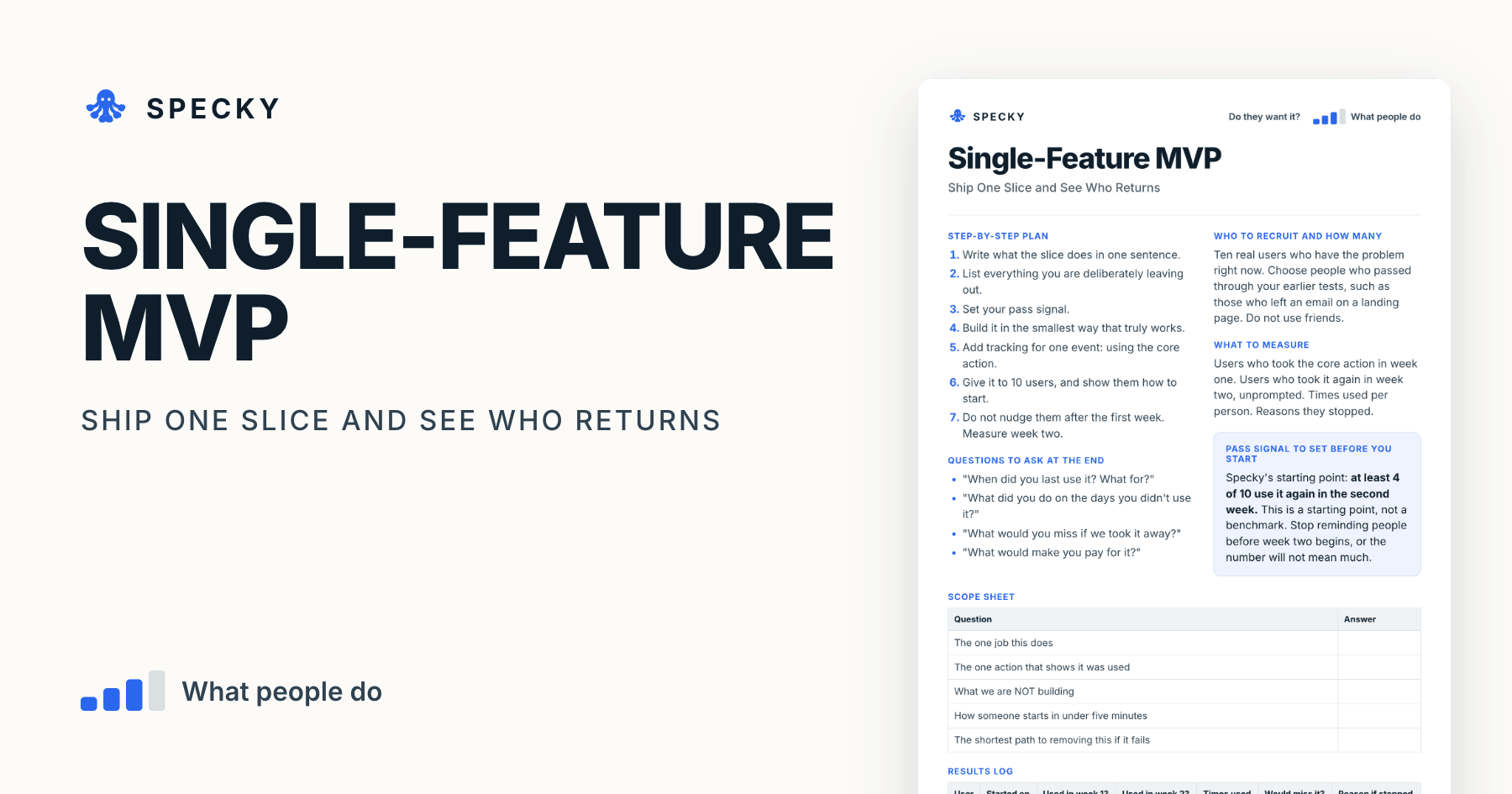
Single-Feature MVP: Template, Examples and a Week-Two Test
An MVP is not a small product. It is one slice and one question: do people come back?
Share
A single-feature MVP is a product experiment where you ship one working slice of your product, with nothing around it, to about ten real users, and count how many come back to it in the second week without being reminded. It tests whether the core of the idea earns repeat use before you build the rest. Below is a free single-feature MVP template with a scope sheet, pass signal and results log.
Key takeaways
It is the most expensive of the four MVP experiments: Strategyzer rates it 4 out of 5 for cost and 5 out of 5 for evidence strength (Strategyzer poster). Run cheaper tests first.
Write the feature in one sentence with no "and" in it, Kromatic's scoping rule (Kromatic).
Measure week two, unprompted. Signups and first use say little; repeat use is the evidence.
Ten users gives a clear pass or fail. A retention curve needs more: Kromatic suggests 50 to 200 users.
Specky's starting pass signal: at least 4 of 10 use it again in the second week.
What is a single-feature MVP?
A single-feature MVP is real, working software that does exactly one job, given to a few real users. No settings page, no accounts dashboard, no second feature. The constraint is scope, not quality: the one thing it does has to work properly, or you will measure your bugs.
Eric Ries defined the MVP in 2009 as the version that brings the most validated learning for the least effort, and warned that it is not about creating minimal products (Ries, 2009). That warning matters most here, because this is the MVP closest to a real product: the goal is one answer, not a small launch.
David J. Bland and Alex Osterwalder's Testing Business Ideas lists 44 experiment types (Strategyzer). The single-feature MVP is a validation experiment, grouped with the concierge MVP and the mash-up MVP.
Buffer. Joel Gascoigne wanted to take the scheduling feature found in Twitter apps and "make that single feature awesome": a queue for tweets. After a two-page landing and pricing test, he estimated one week to build it; it took seven weeks of evenings and weekends, and he cut features to hit the deadline. Buffer launched on 30 November and got its first paying customer within 4 days. About two and a half months in, it had over 500 users, with roughly 4% on paid plans (Buffer, 2011).
Instagram. Kevin Systrom and Mike Krieger cut their check-in app, Burbn, down to one feature: photo sharing. As Systrom put it, "We cut features, we focused on what we thought the world needed" (Startup Archive).
When should you use a single-feature MVP, and when not?
Use it after lighter tests have passed, and you need to find out whether something works in real life over time. Only repeat use can answer that, and only a real, working slice produces it.
Do not use it as your first test, since it is the most expensive test in this group. In a CB Insights analysis of 101 startup post-mortems, 42% of founders cited no market need (Fortune, 2014); interviews and fake doors find that out for a fraction of the cost. If you can deliver the result by hand first, a concierge MVP is cheaper. And it is a poor fit for products that are only useful once they have many users, or that need a long setup.
Which risk does a single-feature MVP test, and how strong is the evidence?
This tests desirability at its most honest: do people use this again without being asked? The evidence is behaviour, and it is the strong kind, because it happens in real life and over time. Note that returning is not the same as paying. See our guide to choosing a product experiment.
Strategyzer rates it 4/5 for cost, 3/5 for setup time, 4/5 for run time and 5/5 for evidence strength, across desirability, feasibility and viability. Its book summary puts usage and retention in the strongest evidence tier, above stated intentions and opinions.
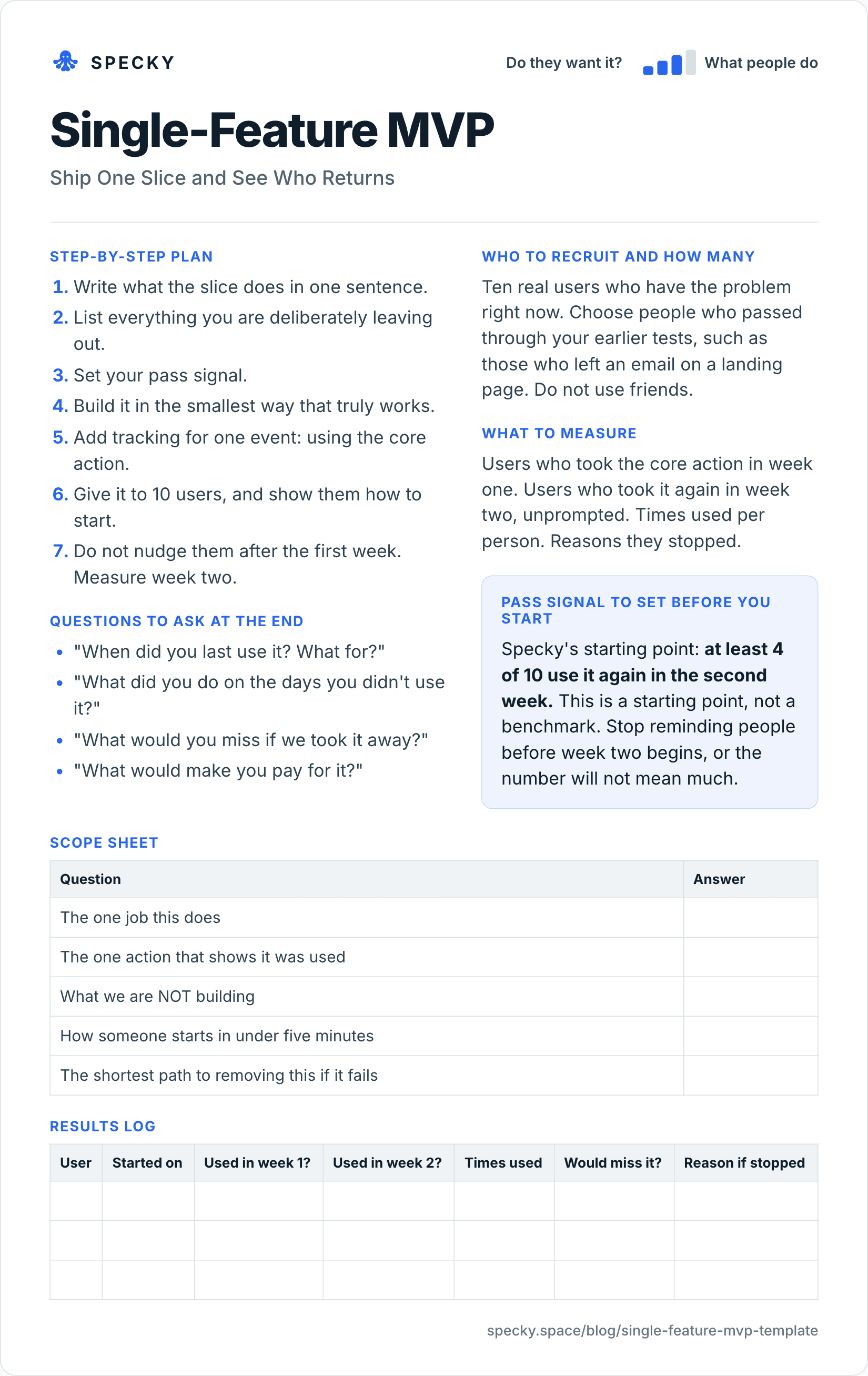
Single-feature MVP template (copy and use)
Open the image at full size, or copy the text version below.
Who to recruit and how many
Ten real users who have the problem right now. Choose people who passed through your earlier tests, such as those who left an email on a landing page. Do not use friends.
Step-by-step plan
Write what the slice does in one sentence.
List everything you are deliberately leaving out.
Set your pass signal.
Build it in the smallest way that truly works.
Add tracking for one event: using the core action.
Give it to 10 users, and show them how to start.
Do not nudge them after the first week. Measure week two.
Scope sheet
Question
Answer
The one job this does
The one action that shows it was used
What we are NOT building
How someone starts in under five minutes
The shortest path to removing this if it fails
Questions to ask at the end
"When did you last use it? What for?"
"What did you do on the days you didn't use it?"
"What would you miss if we took it away?"
"What would make you pay for it?"
What to measure
Users who took the core action in week one. Users who took it again in week two, unprompted. Times used per person. Reasons they stopped.
Pass signal to set before you start
Specky's starting point: at least 4 of 10 use it again in the second week. This is a starting point, not a benchmark. Stop reminding people before week two begins, or the number will not mean much.
Results log
User
Started on
Used in week 1?
Used in week 2?
Times used
Would miss it?
Reason if stopped
How do you scope a single-feature MVP?
Scope is where these tests fail. Four rules keep the slice honest:
One sentence, no "and". "Upload your sales file, get a reorder list" passes. "Track stock and suggest reorders" is two features.
Name the one event that proves use, and instrument only that. Kromatic's advice is to choose the retention metric before you build, so you cannot swap it later.
Write the "not building" list first. Logins, settings, exports, notifications, team accounts. Every item you add delays the answer.
Plan the removal. If it fails, how do you switch it off and tell the ten users? Knowing this makes it easier to stop.
Budget for overruns: Buffer's one week became seven, even with features cut.
How many users do you need for a single-feature MVP?
Specky's template uses 10, which is enough for a clear yes or no. With 10 users, each person moves the result by 10 percentage points, so 4 of 10 (40%) is a meaningful line and 1 of 10 is an obvious fail.
Ten is not enough to draw a retention curve. Kromatic suggests 50 to 200 users, about 3 to 6 weeks and $20 to $300 in hosting when you want D1, D7 and D30 data. Use 10 to decide whether the slice is worth a bigger launch, and 50 or more once you need to know where retention flattens.
What should you measure, and what counts as good retention?
Count users who take the core action in week one, then those who take it again in week two with no reminder. Stop all nudges first, or you are measuring your emails.
For daily-use products, Kromatic's rough usability thresholds are D1 above 40%, D7 above 20% and D30 above 10%. Weekly or monthly tools need their own benchmarks, which is why Specky's template asks a simpler question: did they come back in week two at all?
Once some users return, add Sean Ellis's question: how would you feel if you could no longer use this? After benchmarking nearly a hundred startups, Ellis found that products where fewer than 40% answered "very disappointed" tended to struggle to grow. Superhuman surveyed users who had used the product at least twice in the past two weeks, scored 22%, reached 33% by focusing on its best-fit segment, and later hit 58% (First Round Review, 2018). Our product-market fit survey questions cover how to run it.
Watch for the novelty effect: early use can be curiosity. Kromatic suggests waiting 2 to 4 weeks for a curve to settle, one reason week two beats week one.
Single-feature MVP vs concierge vs Wizard of Oz vs mash-up: which should you use?
Does the experience work if a machine could do it?
Do they return to one slice, unprompted?
Does the chain of tools hold end to end?
Strategyzer cost / setup / run / evidence (of 5)
1 / 2 / 3 / 5
2 / 3 / 3 / 5
4 / 3 / 4 / 5
3 / 3 / 4 / 5
Specky template
5 customers, 3 weeks
5 customers, 2 weeks
10 users, 3 weeks
3-5 customers, 2 weeks
Specky pass signal
3 of 5 come back or pay
3 of 5 finish and don't notice or mind
4 of 10 use it again in week 2
3 finish end to end and ask to continue
The single-feature MVP is the only one of the four with no human doing the work, which is why it is the only one that can show people return without you.
What does a single-feature MVP look like in practice?
This example is made up to show the method. A team wants to help independent bookshops track which titles to reorder. They ship one thing only: upload your sales file, get a list of what to reorder. No accounts page, no settings.
Ten bookshops try it. Nine use it in the first week. Only three return in the second week. When asked why, most say the file export is awkward, and that they would use it if it read their till directly.
Three of ten misses the line of four. The test fails as designed, but points to the next assumption: the value is real, but getting the data in is too hard.
The numbers make the diagnosis sharper. First-week use was 90%, so the promise landed; week-two use fell to 30%, so the habit did not form. A drop that steep, with the same complaint from most users, points at friction rather than value. The cheapest next test is a mash-up that pulls the till export automatically for five shops, before anyone builds an integration.
What are the most common single-feature MVP mistakes?
Scope creep. "Just one more thing" is how an MVP becomes a product.
Nudging in week two. You are then measuring your reminders.
Measuring signups. Signing up says little about returning.
Picking fans. You need people who need it, not people who like you.
Leaving it running. Make a decision when the test ends.
Changing the metric afterwards. Kromatic calls this vanity-metric substitution. Write the metric down first.
When it doesn't work: network products, long setups, and anything used less than once a fortnight.
How to run it in Specky
On the Assumptions page, click the note and choose Pick a test, then Single-feature MVP. Specky fills in ten users, the pass signal, and a three-week timeline.
You run this one. Specky keeps the plan and the result. Build and ship the slice in your own product.
Click Start running. If you have analytics connected, ask for the week-two number in chat. Otherwise paste it in.
Record the result.
A pass shows on the board as Supported, because repeat use is behavior.
Unclear: Some returned, for unclear reasons. Interview everyone who came back, and everyone who did not.
Contradicted: They tried it and did not return. Find out why before you add anything. Any bet resting on this note now shows as Contradicted.
Frequently asked questions
What is a single-feature MVP?
A single-feature MVP is a real, working product that does just one thing, given to a few users. It tests whether people come back to that one thing before you build more around it. Buffer's first version, a queue for tweets, is a well-documented example: it took seven weeks and had a paying customer within four days of launch.
How do you measure a single-feature MVP?
Track one core action and count how many users take it again in the second week, without being reminded. Repeat use tells you more than signups or first use. Once some users return, ask Sean Ellis's "very disappointed" question; he found products below 40% tended to struggle.
Should I build an MVP first or test the idea cheaper?
Test cheaper first. Interviews, fake doors and concierge tests cost far less. Build a single-feature MVP after these show that a problem is real. Strategyzer rates it 4 out of 5 for cost, the highest of the four MVP experiments.
How many users do you need for a single-feature MVP?
Ten real users is enough for a clear pass or fail on week-two return. Each user is 10 percentage points, so 4 of 10 is a meaningful line. If you need a retention curve with day-1, day-7 and day-30 data, Kromatic suggests 50 to 200 users over 3 to 6 weeks.
What is the difference between a single-feature MVP and a concierge MVP?
In a concierge MVP you deliver the outcome by hand, and customers know it. In a single-feature MVP, software does the job with no human involved. The concierge is cheaper and tests whether people value the outcome; the single-feature MVP tests whether they return to it on their own.