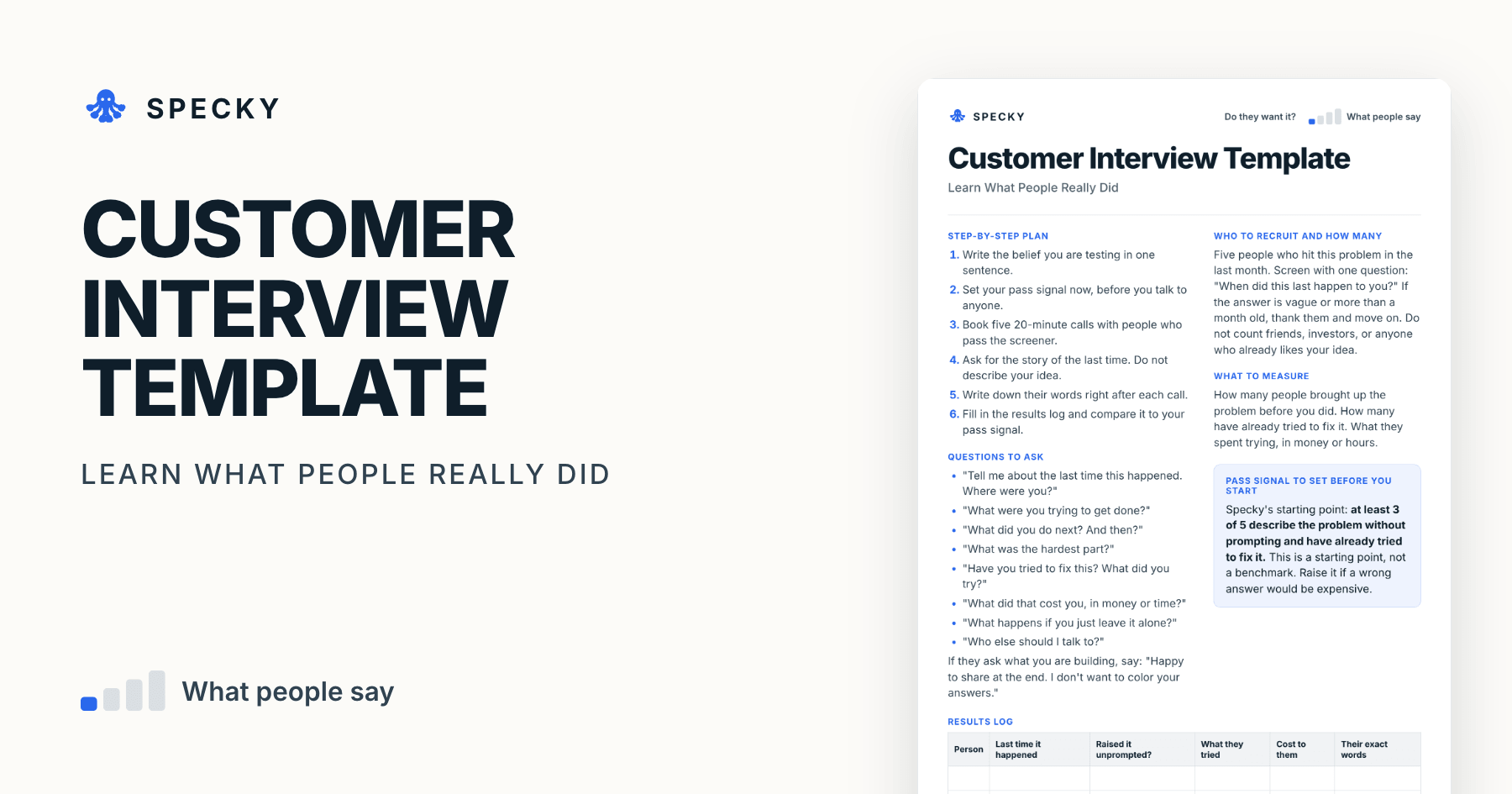
Customer Interview Template: Free Script, Questions and Notes Log
Stop collecting compliments. Copy a script that asks what people actually did the last time the problem hit, a question bank grouped by goal, and a pass signal you set before the first call.
Share
A customer interview template is a reusable script and notes sheet for one-to-one conversations about a problem: a screener, a short opening, story-based questions about the last time the problem happened, a question bank grouped by goal, and a results log with a pass signal you set before the first call. Below is a free version you can copy, plus the rules that stop interviews turning into compliments.
Key takeaways
Ask about specific past events, not opinions about the future. That is the core of Rob Fitzpatrick's The Mom Test (2013), and of Teresa Torres's story-based interviewing.
Start with 5–6 interviews per type of customer and stop when new calls add nothing. In one landmark study, 34 of 36 frequent themes had appeared after six interviews (Nielsen Norman Group, 2021).
Mapping a whole category takes more: Griffin and Hauser estimated that 20–30 interviews uncover 90–95% of customer needs.
Book 45 minutes per interview: 20–30 to talk, 15–25 to write it up while it's fresh (Product Talk).
An interview is opinion-level evidence. A passing round is a reason to run a stronger test, not proof of demand.
What should a customer interview template include?
A good customer interview template has seven parts, each with one job:
The belief you are testing, in one sentence.
A pass signal, written before any call, so you can't move the goalposts later.
A screener that admits only people who hit the problem recently.
A timed script: opening and consent, warm-up, the story, digging deeper, wrap-up.
A question bank grouped by goal, so you can swap questions without breaking the structure.
A results log that records what people did and their exact words.
A one-page snapshot per interview, filled in straight after the call.
Most free templates stop at a list of questions. The pass signal and the log are what turn conversations into a decision.
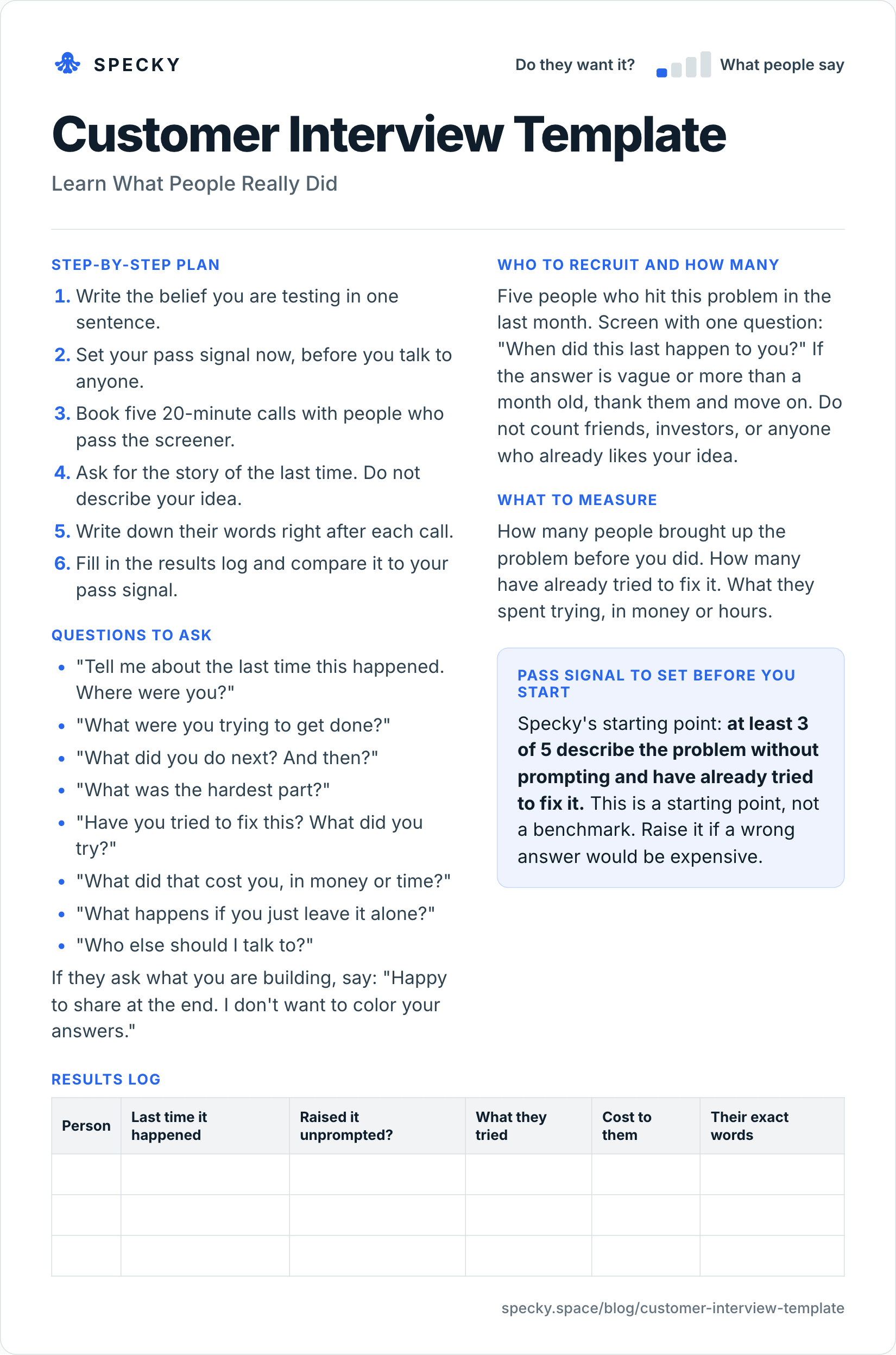
Open the image at full size, or copy the text version below.
Who to recruit and how many
Five people who hit this problem in the last month. Screen with one question: "When did this last happen to you?" If the answer is vague or more than a month old, thank them and move on. Do not count friends, investors, or anyone who already likes your idea.
Add two screener questions if you need them: their role, and what they use today. Keep each type of customer in its own group of five; mixing a freelancer with a 200-person team's ops lead gives you two half-studies.
Step-by-step plan
Write the belief you are testing in one sentence.
Set your pass signal now, before you talk to anyone.
Book five 20-minute calls with people who pass the screener, with 15 minutes after each to write notes.
Ask for the story of the last time. Do not describe your idea.
Write down their words right after each call.
Fill in the results log and compare it to your pass signal.
The 20-minute interview script
Minutes
Section
What to say or do
0–2
Opening and consent
"Thanks for making time. I'm trying to understand how people handle [problem], not to sell anything. There are no wrong answers. Is it OK if I record, so I can listen instead of typing?"
2–4
Warm-up
"What's your role, and what does a normal week look like?"
4–12
The story
"Tell me about the last time [problem] happened. Where were you? What were you trying to get done? What did you do next? And then?"
12–17
Dig deeper
"What was the hardest part? What have you tried to fix it? What did that cost you, in money or hours?"
17–20
Wrap-up
"Is there anything I should have asked? Who else should I talk to?"
If they ask what you are building, say: "Happy to share at the end. I don't want to colour your answers."
Recording is personal data. If you rely on consent, you must be able to show it was given, and people can withdraw it at any time (GDPR Article 7). Ask at the start, note the answer, and delete the recording on request.
Customer interview questions, grouped by goal
Pick 6–8 questions per call. The story questions are mandatory; the rest depend on what you need to learn. For more examples by situation, see the customer interview questions guide.
1. Context (warm-up)
"What's your role, and what are you responsible for?"
"What tools do you use for [job] today?"
2. The last time it happened (the core)
"Tell me about the last time this happened. Where were you?"
"What were you trying to get done?"
"What did you do next? And then?"
"How did it end?"
3. Workarounds and alternatives
"Have you tried to fix this? What did you try?"
"What do you use instead? What do you like and dislike about it?"
"Why do you bother?" (it shows whether the problem is worth their effort)
4. Size of the pain
"What did that cost you, in money or time?"
"How often does this come up? When was the time before that?"
"What happens if you just leave it alone?"
5. Switching and buying (Jobs to Be Done)
"When did you first think you needed something better? What was going on?"
"What nearly stopped you from switching?"
"Who else had a say in the decision?"
These follow the switch interview's timeline (first thought, passive looking, active looking, decision) and its four forces: the push of the problem, the pull of the new option, the anxiety that gave them pause and the habit they had to break (Jobs to Be Done, Moesta and Spiek). Use them only with people who recently changed tools.
6. Wrap-up
"What should I have asked that I didn't?"
"Who else should I talk to about this?"
"Can I follow up if I have one more question?"
What to measure
How many people brought up the problem before you did. How many have already tried to fix it. What they spent trying, in money or hours.
Pass signal to set before you start
A sensible starting point: at least 3 of 5 describe the problem without prompting and have already tried to fix it. This is a starting point, not a benchmark. Raise it if a wrong answer would be expensive.
Results log
Person
Last time it happened
Raised it unprompted?
What they tried
Cost to them
Their exact words
One-page snapshot after each call
Teresa Torres recommends an "interview snapshot" for every conversation: quick facts about the person, one memorable quote, a simple map of the story's key moments, the opportunities (needs and pain points) you heard, and any other insights (Product Talk). Fill it in straight after the call. By the next day, half the detail is gone.
What are the rules for asking good customer interview questions?
People are kind. Ask whether your idea is good and most will say yes, which tells you nothing. The Mom Test by Rob Fitzpatrick (2013, revised 2014) reduces the fix to three rules: talk about the customer's life instead of your idea, ask about specifics from the past, and talk less while listening more (Unusual Ventures, 2024). Teresa Torres makes the same point from research practice: direct questions get fast answers that feel true but often don't match what people actually do, so ask for a specific past story instead (Product Talk, 2022).
In practice, that means these swaps:
Instead of…
Ask…
Why
"Would you use a tool that does X?"
"Tell me about the last time you dealt with X."
The future invites polite guesses; the past has facts
"How do you usually handle X?"
"Walk me through the most recent time."
"Usually" gets an idealised average
"Is X a big problem for you?"
"What did it cost you last time? What did you try?"
Effort spent is evidence; adjectives are not
"How much would you pay?"
"What do you pay for the current workaround?"
People are generous with money they haven't spent
"Don't you hate it when…?"
"What happened next?"
Leading questions get agreement, not information
Four more habits keep the evidence clean:
One question at a time. Stacked questions get answered halfway.
Treat compliments, generic claims ("I always…") and wishes ("it would be great if…") as noise. Steer back to a real event.
Follow the emotion. A sigh or "ugh" marks where the cost is. Ask "What are the implications of that?"
End with a small commitment. An introduction to a colleague or a follow-up call is weak evidence of interest; a polite goodbye is none.
How many customer interviews do you need?
Start with five or six per type of customer, analyse as you go, and stop when new interviews stop telling you anything new. That is Nielsen Norman Group's advice, which also notes that recommendations in the literature range from about 5 to 50 (Nielsen Norman Group, 2021).
The research behind it:
Guest, Bunce and Johnson (2006) analysed 60 interviews in batches of six. Of 36 frequent codes, 34 had appeared after six interviews and 35 after 12 (summarised by Nielsen Norman Group).
Griffin and Hauser (1993) modelled how many interviews it takes to surface customer needs and estimated that 20–30 interviews uncover 90–95% of them (Marketing Science).
Nielsen's "five users" rule is often borrowed for interviews, but it comes from usability testing, where five users find about 85% of usability problems (Nielsen Norman Group, 2000). It is a different question.
Your goal
Interviews to plan
Stop when
Check one narrow problem with one type of customer
5–6
Three in a row add nothing new
Compare two or three customer segments
5 per segment
Each segment's pattern is stable
Map all the needs in a category (voice of the customer)
20–30
New interviews only repeat known needs
Estimate how many people have the problem
Don't use interviews
Run a survey or check usage data
If five stories look nothing alike, don't add ten more calls. Your group is too broad; narrow it and run another five.
How do you run a voice of the customer interview?
A voice of the customer (VoC) interview maps every need in a category, not one problem. The method comes from Griffin and Hauser's work: in a typical study, 10–30 customers are interviewed one-to-one for about an hour, and the discussions produce 75–150 phrases that express needs, which are then grouped into a hierarchy of primary, secondary and tertiary needs (Gaskin, Griffin, Hauser et al., 2011).
To turn this template into a voice of the customer interview template:
Lengthen the call to 45–60 minutes and ask about several recent experiences, not one.
Keep their words. Write needs in the customer's language, not your product jargon.
Probe until nothing new comes. The VoC interview ends when the interviewer can't draw out another need.
Group needs afterwards, ideally with someone who wasn't in the calls, then prioritise them with a survey of a larger sample.
For one product decision, the 20-minute version above is enough. Use VoC when you are entering a market or rebuilding a product around needs you haven't mapped.
How do you recruit people for customer interviews?
Recruiting is where most interview programmes die. Torres's fix is to automate it so interviews land on the calendar without someone chasing them every week: invite people right after they use a feature or contact support, and let them pick a slot with a self-scheduling link.
It can work fast. Zonar Systems put an in-app pop-up on its home page offering a $35 gift card for a short interview, linked to a booking page. Almost a dozen interviews were booked by about 5 a.m. after it went live at midnight, and the team has since run about 20 interviews with no manual recruiting (Product Talk, 2022).
Other sources, roughly from warmest to coldest:
Your own users, invited in-product or by email after a relevant action
Support and sales contacts who raised the problem
Communities and forums where the problem gets discussed
Your network's network, with a one-line ask
Paid panels, for consumer products or hard-to-reach roles
Screen every source with the same question: "When did this last happen to you?"
What does a customer interview round look like in practice?
This example is made up to show the method. A founder is building a tool that turns meeting notes into follow-up emails for freelance designers. She believes designers lose work because follow-ups slip.
She screens for people who sent a client follow-up late in the past month and talks to five. Four tell a story about a late follow-up. But only two brought it up on their own, and only one has tried to fix it, with a sticky-note system. Everyone else shrugs: the client waited, nothing bad happened.
Her pass signal needed three people who both raised it unprompted and had tried a fix. She got one. She records the test as failed and notices something else: three designers complained, unprompted, about chasing late invoices. That becomes her next assumption, and she runs five more interviews on it the following week.
What mistakes ruin customer interviews?
Pitching. Once you describe your idea, you are collecting compliments.
Asking about the future. "Would you use this?" gets a kind yes.
Talking to the wrong people. Friends and fans will not tell you the idea is dull.
Stopping at the first answer. The useful part usually comes after "and then what?"
Deciding what counts after the calls. Set the pass signal first, or you will find a way to pass.
Writing notes a day later. You will remember your interpretation, not their words.
Treating interviews as proof of demand. They show a problem may be real. Demand shows up when people act: sign up, pay or sign.
When not to use interviews: to learn whether people will pay (people are polite about money they haven't spent), to check whether a screen makes sense (a usability test answers that), or when you already log the behaviour. This tests desirability, and the evidence is opinion, the weakest rung in our guide to choosing a product experiment.
How to run it in Specky
On the Assumptions page, click the note you want to test and choose Pick a test, then Customer interview. Specky fills in the steps, the pass signal, and a one-week timeline. Edit anything.
Click Open in Vouch. Vouch, at vouch.specky.space, runs this as an AI interview. It gives you the questions, an outreach message, and a link each person can answer on their own.
Click Start running. Specky asks for a pass signal first, so you cannot judge the result by feel later.
Paste what people did back onto the test, then record the result.
A passing interview round shows on the board as Early signal, not Supported. Specky saves Supported for behavior or commitment, so opinions cannot quietly become facts.
What to do with each outcome
Supported (shows as Early signal): The problem looks real. Now test behaviour. Put an offer in front of people with a fake door or a landing page test.
Unclear: You probably talked to too broad a group. Narrow to one type of person and run three more. A diary study helps if people struggle to remember.
Contradicted: People do not care enough to act. Rewrite the assumption around what they did complain about, or drop it. Any bet resting on this note now shows as Contradicted, so review it before more work starts.
Start with five or six people of one type who hit the problem in the last month. If their stories match, run a stronger test. If they differ widely, your group is too broad, so narrow it before adding calls. Mapping every need in a category takes more: Griffin and Hauser estimated 20–30 interviews uncover 90–95% of customer needs.
What is the best question to ask in a customer interview?
"Tell me about the last time this happened" is the most useful question because it asks for a real event, not an opinion. Follow it with "What did you do next?" until the story ends. Questions about the future, such as "Would you use this?", invite polite guesses that rarely match what people later do.
How long should a customer interview be?
Twenty to thirty minutes is enough for one problem with one person; book 45 minutes so you have time to write notes straight afterwards. Voice of the customer interviews that map a whole category run longer, typically around an hour, because they cover several experiences. Longer calls rarely add depth to a single-problem interview; more people usually do.
Is a customer interview proof of demand?
No. A customer interview is opinion-level evidence. It shows a problem may be real and how people describe it, but demand only shows when people take an action that costs them something, such as signing up, paying, signing a letter of intent or giving time. Use a passing round of interviews as the reason to run a behaviour test next.
What is the Mom Test in customer interviews?
The Mom Test is Rob Fitzpatrick's set of rules for customer conversations, built on the idea that good questions get honest answers even from people who love you and want to be kind. The three rules: talk about their life instead of your idea, ask about specific past events instead of opinions about the future, and talk less while listening more.
Should I record customer interviews?
Yes, if the person agrees. A recording lets you listen instead of typing and keeps their exact words. Ask at the start, note their consent, and explain how long you keep the file. In the EU, GDPR requires that you can show consent was given and that people can withdraw it at any time, so delete recordings on request.