Life-Sized Prototype: Test the Experience in Cardboard First
Some problems only show up when a real person stands in the space. Find them for the price of cardboard.
Share
A life-sized prototype is a full-scale stand-in of a space or large product, usually built from tape, cardboard and foam, that lets you watch real people try to use it before you build the real thing. It finds problems of reach, flow and crowding that no drawing shows, for the price of materials and a few days. Below are a free template, a walk-through plan and a pass signal.
Key takeaways
It is the costliest stand-in in the prototype family. Strategyzer's experiment library rates it 5 out of 5 for cost and 4 out of 5 for setup time, so run a cheaper check first (Strategyzer poster).
It can save far more than it costs. At Kaiser Permanente's 37,000-square-foot mock-up centre, 20 nurses rejected a motorised medication cart within 5 to 10 minutes; another hospital had bought 3,000 of them (Stanford GSB, 2013).
Reach is measurable. The ADA Standards set the unobstructed reach range at 15 to 48 inches, about 38 to 122 cm (US Access Board).
Recruit people who will struggle, such as wheelchair users and first-time visitors, not only tall, able-bodied staff.
Set the pass signal first: at least 4 of 5 get through without stopping.
What is a life-sized prototype?
It is a mock-up at true scale of something people move through or around: a store layout, a kiosk, a vehicle interior, a hospital check-in desk, a booth. You mark the floor with tape, stand up cardboard for walls and fixtures, add only what people touch or read, and then give someone a real goal and follow them.
Designers at IDEO named the wider idea "experience prototyping". Marion Buchenau and Jane Fulton Suri described it in 2000 as any prototype that gives design teams, users and clients first-hand appreciation of existing or future conditions, useful for understanding, exploring and communicating a design (Buchenau and Fulton Suri, DIS 2000). A full-scale mock-up is the most literal version: you stand inside the idea.
In David J. Bland and Alex Osterwalder's Testing Business Ideas, it is one of the validation-stage interaction prototypes, next to the clickable prototype. Strategyzer's poster rates it 5/5 for cost, 4/5 for setup time and 3/5 for run time, shows its evidence strength as a range from 2 to 5, and tags it to all three risks: desirability, feasibility and viability.
Masking tape or floor tape for walls, doors and queues, at exact dimensions
Cardboard boxes or foam board for counters, shelves and screens
Printed paper for every sign, label and screen people must read
Movable cut-outs for equipment. Architects at Payette used movable 2D prints so hospital user groups could rearrange a cardboard inpatient room (Payette, 2018)
A tape measure, and a camera on a fixed tripod
When should you use a life-sized prototype, and when not?
Use it for things where scale and space matter: a store layout, a kiosk, a vehicle interior, a hospital check-in desk, a booth. Some problems only appear when a person is standing in the space. You cannot see them from a drawing. Payette's team found the same: handling a mock-up let people react to specific situations that images and drawings did not.
Hospitals rely on full-scale mock-ups because a wrong layout is expensive and dangerous. Kaiser Permanente's Garfield Innovation Center mocks up operating rooms, hospital floors and doctors' offices. In one mocked-up clinic, physicians asked for their offices at the front, where they could see activity, not at the back as the architects had assumed (Stanford GSB, 2013). Hospital mock-up testing reported by HFM magazine showed that nurse stations directly outside patient rooms were noisy, while stations across the corridor worked better (HFM, 2015).
Do not use it for anything that fits on a screen or in a hand. Those are cheaper to test with a clickable prototype or a 3D-printed model. And it is the most expensive stand-in in this library, so it should only come after a cheaper check.
Which risk does it test, and how strong is the evidence?
This tests desirability: when people are in the experience, does it work for them? The evidence is behaviour, because you watch real attempts. But it is artificial, and people often behave differently in a staged space.
Alex Osterwalder's rule is that what people say and do differ, and evidence gets stronger the closer it gets to a real purchase (Strategyzer, 2017). A cardboard corridor is a long way from a purchase. That is why a pass here leads to a real-world test, not straight to construction. Our guide to choosing a product experiment has the full picture.
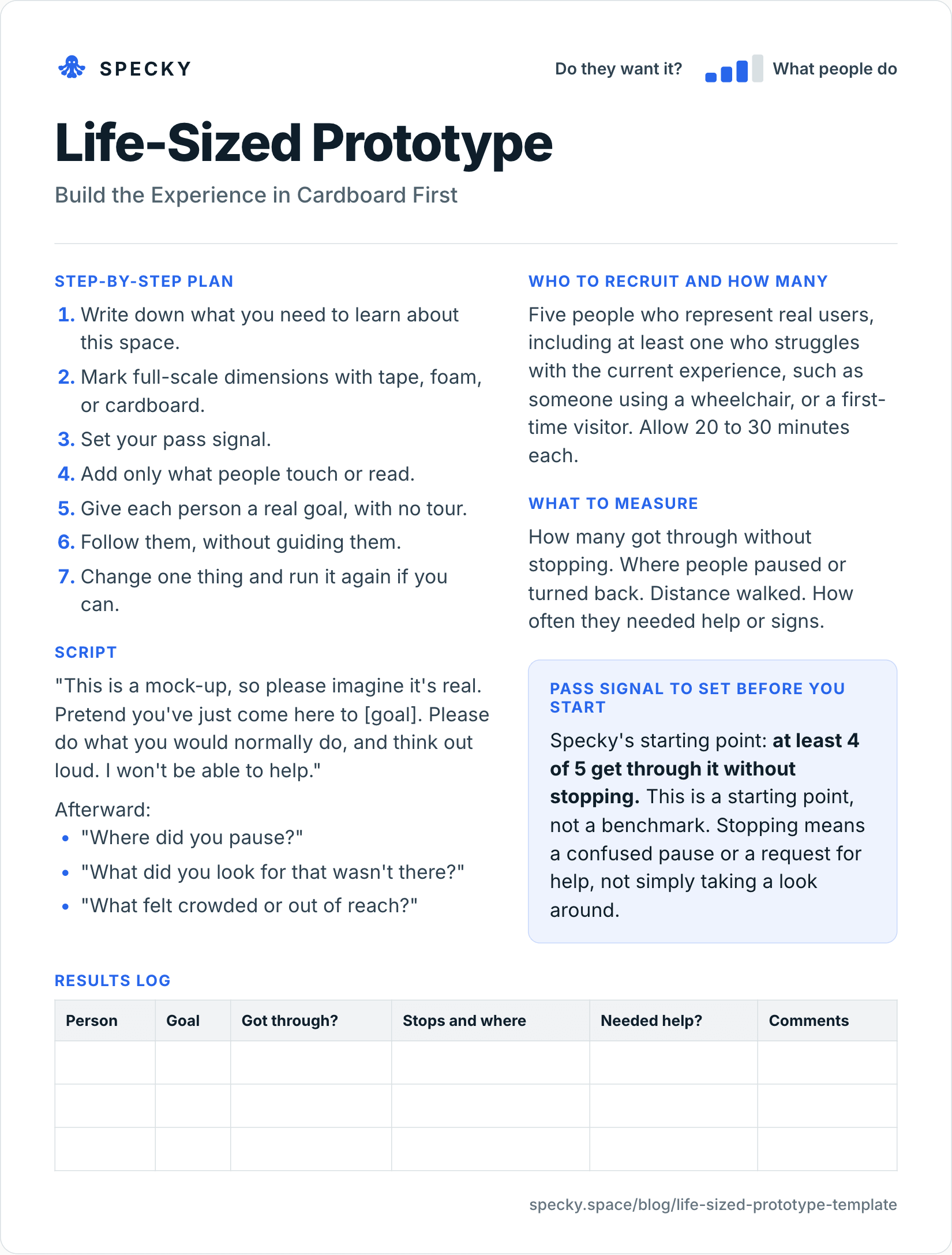
Life-sized prototype template (copy and use)
Open the image at full size, or copy the text version below.
Who to recruit and how many
Five people who represent real users, including at least one who struggles with the current experience, such as someone using a wheelchair, or a first-time visitor. Allow 20 to 30 minutes each.
Step-by-step plan
Write down what you need to learn about this space.
Mark full-scale dimensions with tape, foam, or cardboard.
Set your pass signal.
Add only what people touch or read.
Give each person a real goal, with no tour.
Follow them, without guiding them.
Change one thing and run it again if you can.
Script
"This is a mock-up, so please imagine it's real. Pretend you've just come here to [goal]. Please do what you would normally do, and think out loud. I won't be able to help."
Afterward:
"Where did you pause?"
"What did you look for that wasn't there?"
"What felt crowded or out of reach?"
What to measure
How many got through without stopping. Where people paused or turned back. Distance walked. How often they needed help or signs.
Pass signal to set before you start
Specky's starting point: at least 4 of 5 get through it without stopping. This is a starting point, not a benchmark. Stopping means a confused pause or a request for help, not simply taking a look around.
Results log
Person
Goal
Got through?
Stops and where
Needed help?
Comments
How do you run the walk-through step by step?
The template has the plan. These rules make the session worth the cardboard:
Build to the real numbers. Real corridor width, counter height and screen height; the wrong scale tests nothing.
Check reach before people arrive. Measure every button, slot and screen against the 15-to-48-inch (38 to 122 cm) reach range in the ADA Standards. The same guide says controls should work with one hand, without tight grasping or twisting, and at no more than 5 pounds of force (US Access Board).
Give a goal, never a tour. "Collect your parcel" is a goal. "Here are the lockers" is a tour.
Stay behind them and film from a fixed corner, with consent. Log where they stop, not what they say.
Run one crowded round. If real people will share the space, send two or three through at once. Blocking only shows up with company.
Make cut-outs movable. If a layout fails, move a box before the next person, and log which version each person saw.
What should you measure in a full-scale mock-up?
Measure
How to record it
Why it matters
Got through without stopping
Yes or no, per person
The pass signal
Stops
Where, how long, and why
Shows which spot to fix first
Help or signs needed
Each time, and what they asked
Every question is a missing sign
Reach failures
Anything they couldn't reach or operate
Checks the build against real bodies
Path and distance
Sketch the route on a floor plan
Reveals detours and dead ends
Blocking
Moments one person got in another's way
Only visible in the crowded round
How many people do you need?
Five per round, including at least one person who struggles with the current experience. Jakob Nielsen's model has five users finding about 85% of usability problems (Nielsen Norman Group, 2000).
Spaces usually serve more than one group: residents and couriers, patients and nurses, shoppers and staff. Nielsen suggests three to four people from each of two groups, or three each for three or more groups. So a parcel locker tested with residents and couriers needs six to eight people, not five.
Life-sized prototype vs 3D-printed prototype vs pop-up store: which should you use?
The order is usually left to right: get the object right, then the space, then see whether people pay.
What does a full-scale prototype test look like in practice?
This example is made up to show the method. A startup is designing self-service parcel lockers for apartment buildings. In a rented hall, they mark out a corridor and build a full-size cardboard locker bank with a tablet on a stand.
Five residents try to collect a parcel. Two of them stop to put their bags on the floor, blocking the corridor for others. One, using a walker, cannot reach the top row. Another stops to look for where to scan a code, which is placed too low.
Only one of five gets through without stopping. The signal fails, for reasons no drawing would have shown. A week later, a second cardboard version has a shelf and a raised screen.
Round two, also illustrative. The team first checks every slot against the reach range: the top row, at 160 cm, sits above the 122 cm limit, so it becomes courier-only storage. The screen moves to 110 cm, and a fold-down shelf at 90 cm takes the bags. Four of five residents get through without stopping, a pass. Cost: one more day in the hall and a roll of tape.
What are the most common mistakes with full-scale mock-ups?
Building too much. Only what people touch or read needs detail.
Giving a tour. Walking someone through ruins the test.
Testing only tall, able-bodied people. Include people who will struggle.
Falling in love with it. It is cardboard. Change it.
Reading enjoyment as demand. People enjoy a novel setup.
Testing alone in an empty hall. Real spaces have queues, noise and other people.
When it doesn't work: for anything small enough to hold, for questions about price or demand, and for problems that depend on real conditions a hall can't fake, such as weather, rush-hour crowds or a working network.
Is a cardboard mock-up safe and fair to test?
Yes, with care. Tape down cable runs and box edges, since cardboard on a smooth floor slides and people trip. Never ask anyone to lean on or climb a cardboard fixture. Pay every participant, and when you recruit people with disabilities, ask what they need to take part comfortably rather than assuming.
Be clear that it's a mock-up; the script does this in its first line. Ask before you film, say who will see the video and for how long, and film paths, not faces, where you can.
How to run it in Specky
On the Assumptions page, click the note and choose Pick a test, then Life-sized prototype. Specky fills in five attempts, the pass signal, and a three-week timeline.
You run this one. Specky keeps the plan and the result. Build the mock-up, and watch the attempts.
Click Start running. Paste your notes and link any photos.
Record the result.
A pass shows on the board as Supported, because real attempts are behavior.
What should you do with each outcome?
Supported: The experience works. Test it in the real world with a pop-up store where people can pay.
Unclear: Some got through. Look at who struggled, change one thing, and run it again.
Contradicted: Most people stopped or got lost. Redesign. You have found this out at the price of cardboard. Any bet resting on this note now shows as Contradicted.
Frequently asked questions
What is a life-sized prototype?
A life-sized prototype is a full-scale mock-up of a product or space, often made from cardboard, foam and tape, used to watch how people actually move through and use it. It sits between small prototypes, such as a 3D print, and a real-world trial, such as a pop-up store, and catches problems of reach, flow and crowding.
When is a full-scale mock-up worth the cost?
It is worth it when space and size matter, such as a store, a kiosk, a vehicle interior or a hospital room, and when mistakes in the final build would be expensive to fix. Kaiser Permanente's mock-up centre caught a medication cart nurses disliked within minutes; another hospital had already bought 3,000.
What can you learn from a cardboard prototype?
You can learn whether people can reach things, find their way, and complete a task in the space. Check reach against the 38 to 122 cm range in the ADA Standards. You cannot learn whether they would pay for it, or how the space behaves with real crowds, noise and weather.
How many people should walk through a full-scale mock-up?
Five per round, including at least one person who struggles with the current experience. If the space serves two groups, such as residents and couriers, test three or four from each. Add one round with two or three people at once, because blocking and queueing only show up with company.
How long does a life-sized prototype test take?
Plan for about three weeks, the timeline Specky suggests: a week to build, a week of sessions, and time to change the layout and run it again. Each walk-through takes 20 to 30 minutes. A tape-only version on an empty floor can be ready in a day.