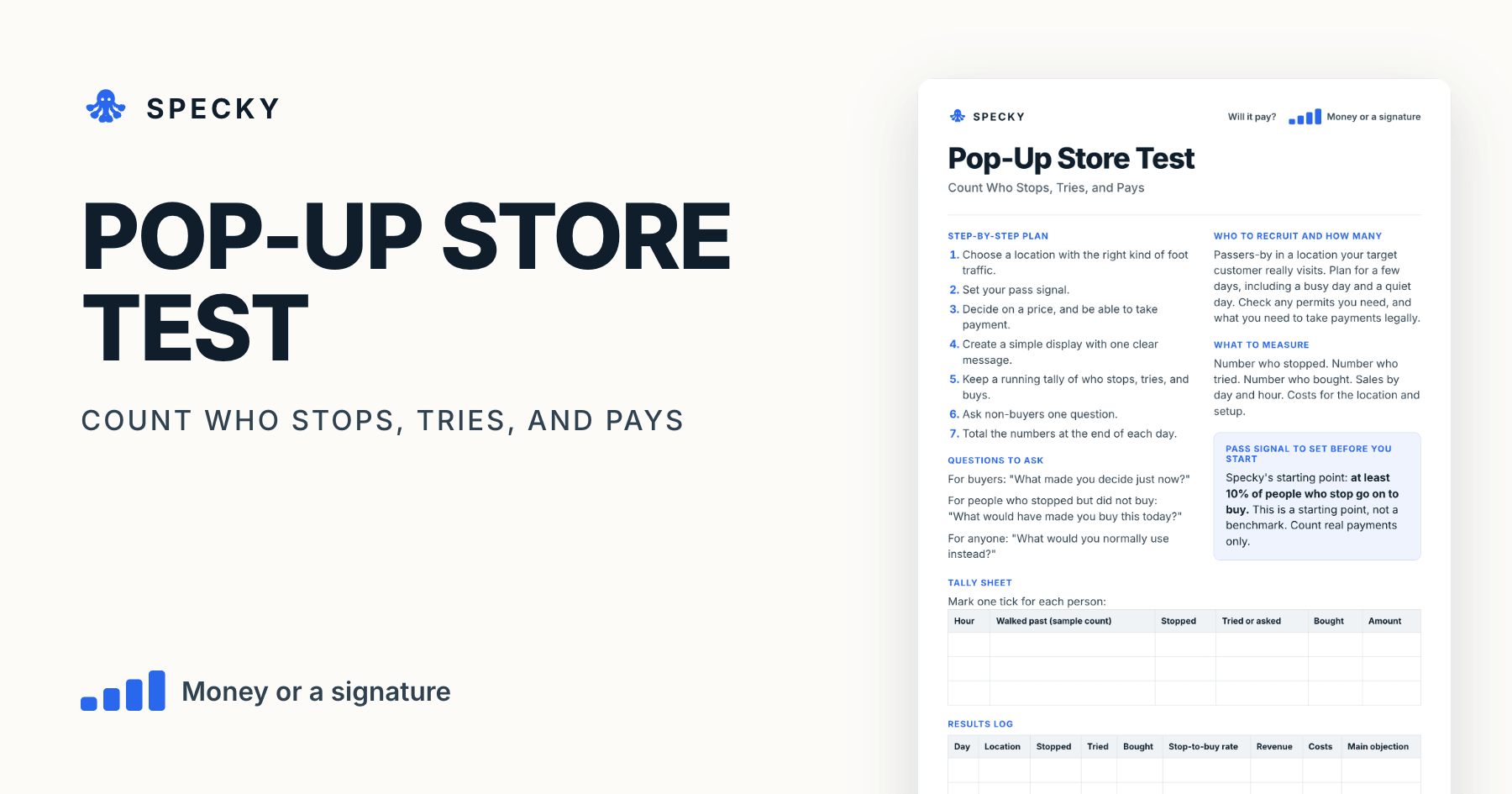
Pop-Up Store Test Template: Count Who Stops, Tries and Pays
Nothing teaches you like watching a stranger decide whether to pay. Count who stops, who tries, and who buys.
Share
A pop-up store test sells or demos your offer in a temporary real-world spot for a few days, such as a market stall or a short-let shop, and counts who stops, who tries, and who pays. It gives you real sales at a real price, plus the reasons people walk away, before you commit to a lease, a wholesale deal or a production run.
Key takeaways
Count three numbers by the hour: stopped, tried, bought. The stop-to-buy rate is the result.
Strategyzer's experiment library for Testing Business Ideas rates the pop-up store 4 out of 5 for cost, with evidence strength from 2 to 5 out of 5, depending on whether you count interest or payments (Strategyzer poster).
Budget for rent first. Shopify puts a one-day event space at $1,000 to $5,000 and a weekend at $2,000 to $10,000 in US cities (Shopify, 2026). A market stall is usually far cheaper.
Plan for about 140 people stopping per variant if you want to read a 10% rate to within ±5 points (our calculation).
One spot over a few days is one data point. A weak result may mean a weak location.
What is a pop-up store test?
A pop-up store test is a short, temporary sales experiment in a physical place your customers already visit. You set up one display with one message and one price, take real payments, and keep a tally of everyone who stops, tries and buys.
The method is one of the validation experiments in David J. Bland and Alexander Osterwalder's Testing Business Ideas, a library of 43 experiment types sorted by cost, time and strength of evidence (Strategyzer). It sits in the "simulation" group, next to the letter of intent, the mock sale and the Wizard of Oz.
Strategyzer's poster for the library scores it like this (Strategyzer poster):
It is one of the most expensive experiments in the library, and its evidence can reach the top of the scale. That top end needs real payments. Stops and smiles sit at the bottom.
Which risk does it test, and how strong is the evidence?
This tests viability: will strangers actually hand over money, here and at this price? The evidence is commitment, when you count real sales. Our guide to choosing a product experiment puts payment at the top of the ladder. Keep in mind this result reflects one place and a few days.
When should you run a pop-up store test, and when not?
Use it for products people want to see or touch before buying, like food, clothing, or home goods. It suits local services as well. You get to watch real reactions and take real money, and you can change the pitch from hour to hour.
Shopify's guide makes the same case for physical retail: run a pop-up for two to four weeks in your target market and track foot traffic, walk-in rate and conversion before deciding on a permanent store (Shopify, 2026). For an early product test, a few days is often enough to learn whether to keep going.
Do not use it for software or anything that needs a long consideration. It takes a lot of effort and depends heavily on location, weather, and footfall, so a bad result might only mean a bad spot. If you want to reach people more cheaply, start with an online ad.
How much does a pop-up test cost?
More than most experiments, which is why you should run it after cheaper tests have shown some interest. Shopify's 2026 ballparks for US retail space (Shopify, 2026):
Format
Space rental
Total budget
One-day event
$1,000-$5,000
$2,300-$9,800
Weekend pop-up
$2,000-$10,000
$4,600-$17,200
Short-term retail
$5,000-$25,000
$11,000-$42,000
The same guide says rent is typically about 30% of the budget, and cites IBISWorld's estimate that the US pop-up shop industry generates $15.6 billion in 2026. A stall at a weekend market or a shared space costs a fraction of these figures, and is usually the right starting point for a test.
Three costs people forget:
Payments. Card fees take a cut of every sale. Shopify Payments, for example, charges 2.4% to 2.9% plus 30 cents per transaction in the US.
Permits. In England and Wales you may need a street trading licence from the local council, and you might have to pay a fee (GOV.UK). Rules differ by city and country, and food has its own hygiene rules, so check before you book.
Stock you don't sell. Bring enough to meet a good day, and count the leftovers as a cost.
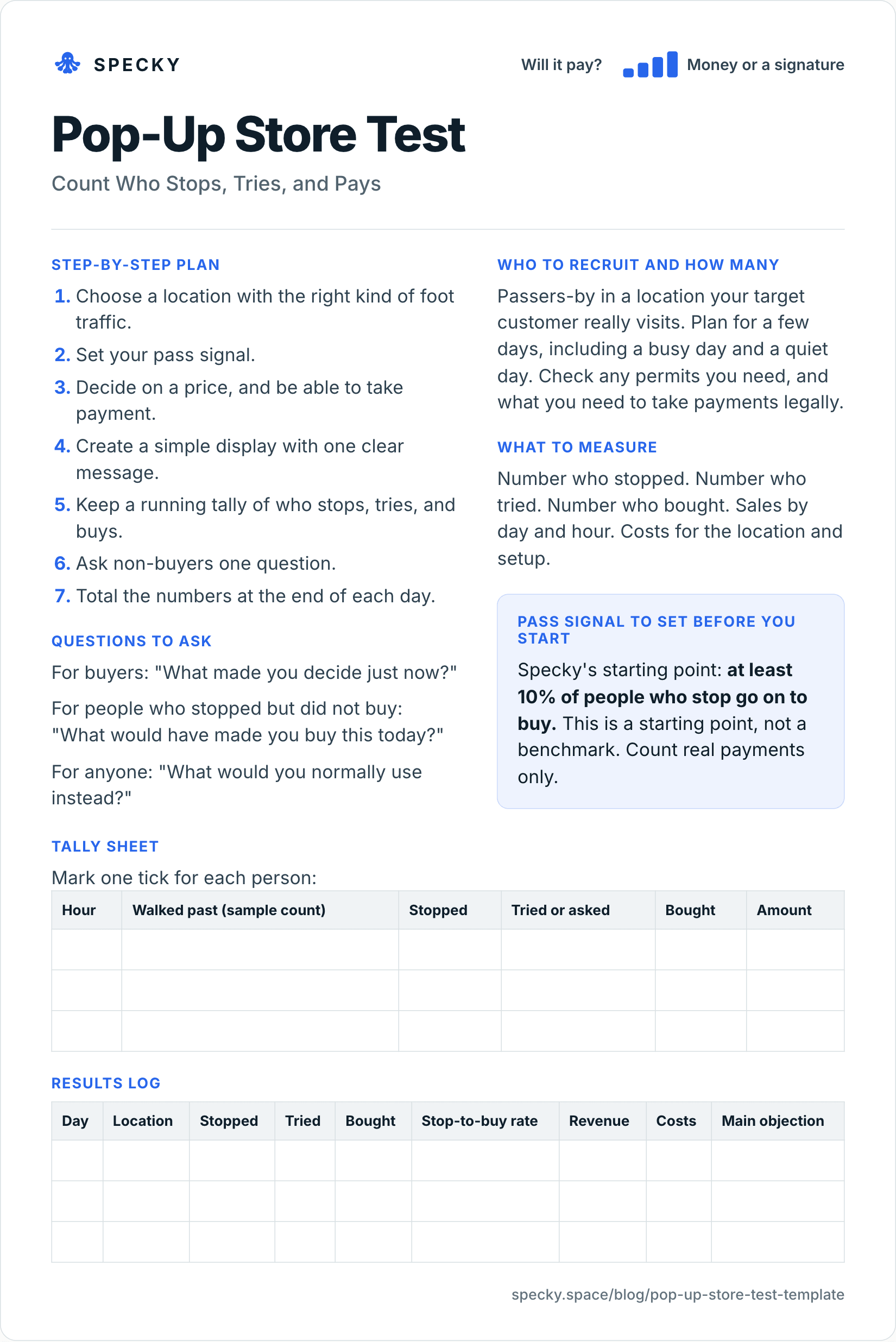
Pop-up store test template (copy and use)
Open the image at full size, or copy the text version below.
Who to recruit and how many
Passers-by in a location your target customer really visits. Plan for a few days, including a busy day and a quiet day. Check any permits you need, and what you need to take payments legally.
Step-by-step plan
Choose a location with the right kind of foot traffic.
Set your pass signal.
Decide on a price, and be able to take payment.
Create a simple display with one clear message.
Keep a running tally of who stops, tries, and buys.
Ask non-buyers one question.
Total the numbers at the end of each day.
Tally sheet
Mark one tick for each person:
Hour
Walked past (sample count)
Stopped
Tried or asked
Bought
Amount
Questions to ask
For buyers: "What made you decide just now?"
For people who stopped but did not buy: "What would have made you buy this today?"
For anyone: "What would you normally use instead?"
What to measure
Number who stopped. Number who tried. Number who bought. Sales by day and hour. Costs for the location and setup.
Pass signal to set before you start
Specky's starting point: at least 10% of people who stop go on to buy. This is a starting point, not a benchmark. Count real payments only.
Results log
Day
Location
Stopped
Tried
Bought
Stop-to-buy rate
Revenue
Costs
Main objection
What is a good conversion rate for a pop-up store?
There is no standard rate, because it depends on what you count as the starting point. Be precise about your denominator:
Walked past. Count a sample, for example 10 minutes every hour, to estimate footfall.
Stopped. Someone pauses and looks at the display for a few seconds. This is the denominator for the pass signal.
Tried or asked. They taste, touch, pick up or ask a question.
Bought. Money changes hands.
Shopify suggests a walk-in-to-purchase rate of 20% to 40% as a benchmark for a successful retail pop-up (Shopify, 2026). That counts people who chose to walk into a shop. A market stall's "stopped" is a looser group, so a lower rate can still be healthy. That is why the 10% stop-to-buy pass signal above is a starting point, not a benchmark: set your own bar from your margins.
Also log revenue per hour and cost per sale. A stall can pass on conversion and still lose money.
How many people need to stop before you can trust the result?
Enough that the rate stops jumping around. Using the standard formula for a proportion, reading a 10% stop-to-buy rate to within ±5 percentage points at 95% confidence needs about 140 people who stop (our calculation: 1.96² × 0.1 × 0.9 ÷ 0.05² ≈ 138). Reading it to within ±3 points needs about 385.
Practical rules:
Split by day, not just in total. A busy Saturday can hide a weak Friday.
Change one thing at a time. If you change the price on day two, treat each day as its own test with its own count.
Use a second location before blaming the first. One spot cannot tell you whether the problem is the place or the offer.
Pop-up store test vs landing page test: which should you use?
Both measure whether strangers take a real step. The difference is where they meet you and what it costs.
Objections in people's own words, handling, taste, packaging
Which message and channel bring people in, at what cost
Main weakness
Depends on location, weather and days
Clicks are cheap; intent is weaker
Best for
Physical, tactile or local products
Software and anything sold online
Ratings come from the Strategyzer poster. Many teams run both: a landing page to find the message, then a pop-up to see whether people pay for the real thing.
What does a pop-up test look like in practice?
This example is made up to show the method. A small food brand wants to sell ready-made ramen kits at €14. They rent a stall at a weekend market for three days.
Across three days, 460 people stop, 180 try a sample, and 71 buy, or 15% of those who stopped. Saturday sales are double those on Friday. Many who did not buy say they did not want to carry it home.
The signal passes. And the team now has a question they would never have thought about otherwise: is delivery a bigger opportunity than retail?
Extending the example with illustrative costs: 71 kits at €14 is €994 in revenue. Say the stall costs €150 a day (€450) and each kit costs €5 to make (€355). That leaves €189 before anyone's time is counted. The conversion passes, but the margin is thin, which makes the delivery question more urgent.
The 15% also comes with uncertainty. With 460 stops, the 95% interval runs from roughly 12% to 19% (our calculation), so the result clears the 10% bar comfortably.
What are the most common pop-up test mistakes?
Counting compliments. A nice comment at a market is not a sale. Rob Fitzpatrick's The Mom Test is built on the same warning: learn from customer conversations when everyone is lying to you (The Mom Test).
Giving things away. Free samples show taste, not willingness to pay.
Blaming only the location. It may be the offer. Try a second spot.
Losing track of costs. Include the rental, the staff, and the stock.
Taking only one day. One rainy Thursday tells you very little.
Not deciding the denominator. If "stopped" means different things to different helpers, the rate is meaningless. Agree a definition before the first hour.
When it doesn't work: for software, for products bought after weeks of research, and when the people walking past are not your customers.
Is it fair to the people who buy?
Yes, as long as what you sell is real and works as described. If you take orders for something not yet made, say so at the stall, give a delivery date and offer refunds. Ask before photographing or filming anyone, and keep your tally anonymous: you need counts, not names.
How to run it in Specky
On the Assumptions page, click the note and choose Pick a test, then Pop-up store. Specky fills in the steps, the pass signal, and a two-week timeline.
You run this one. Specky keeps the plan and the result. You arrange the location, stock, and payments.
Click Start running. Paste in the daily counts and main objections.
Record the result.
A pass shows on the board as Supported, and moves toward the strongest evidence level, because a paid sale is commitment.
What should you do with each outcome?
Supported: People pay in person. Find out if it transfers online with a landing page, or if the margin holds with a funnel test.
Unclear: Lots of people stopped, few bought. Change one thing, such as the price or the pitch, and try another location.
Contradicted: People walked past or did not buy, even at a good spot. Look at the objections. Any bet resting on this note now shows as Contradicted.
Frequently asked questions
What is a pop-up store test?
A pop-up store test sells a product in a temporary physical location for a few days, to see who stops, who tries it, and who actually pays. It gives you real sales evidence quickly, plus the objections of people who walked away. Strategyzer's experiment library rates its evidence from 2 to 5 out of 5, highest when you count payments.
How long should a pop-up test run?
A few days is usually enough for a first test, as long as you include a busy day and a quiet day. A single day can be heavily affected by weather or events. If you are deciding on a permanent shop rather than testing a product, Shopify suggests two to four weeks in your target market.
What is a good stop-to-buy rate?
There is no standard rate, since it varies by product and setting. Specky's starting point is 10% of people who stop going on to buy; adjust it for your margins. Shopify cites 20% to 40% of people who walk into a pop-up shop buying, but walking into a shop is a stronger signal than pausing at a stall.
How much does a pop-up shop test cost?
It ranges from the price of a market stall to thousands. Shopify's 2026 guide puts a one-day US event space at $1,000 to $5,000 in rent and $2,300 to $9,800 in total. Add card fees, permits, staff and unsold stock. For a first product test, a shared stall is usually enough.
Do I need a licence for a pop-up stall?
Often, yes. In England and Wales you may need a street trading licence from the local council, and there may be a fee. Other countries and cities have their own rules, and food sales usually have extra hygiene requirements. Check with the council or market organiser before you book the space.