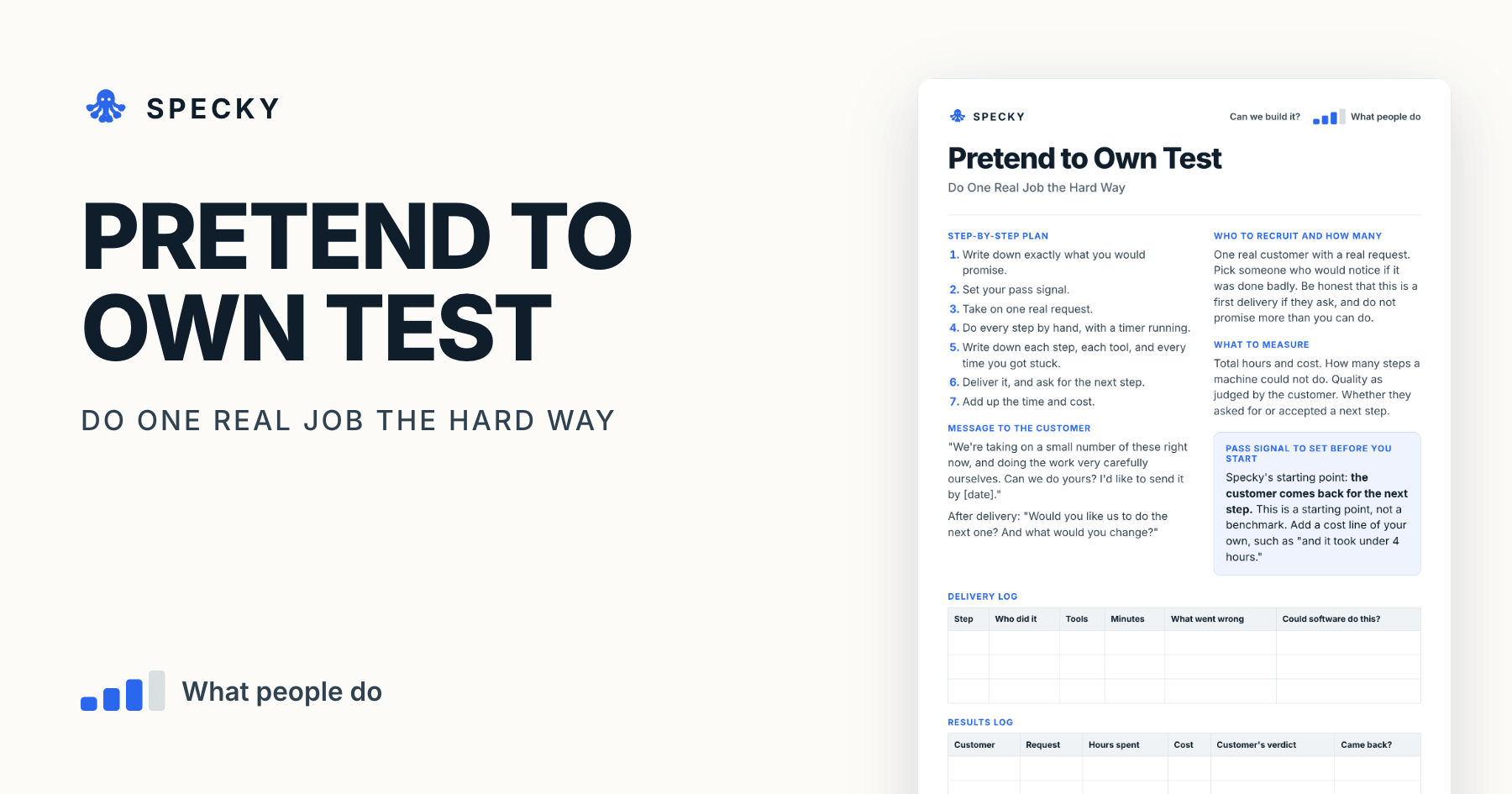
Pretend to Own Test: Do One Real Job by Hand Before You Build
Before you build the machine, do the job once by hand with a timer running. You will learn what your promise really involves, step by step and hour by hour.
Share
A pretend to own test treats one real customer request as if your capability already existed, does the work by hand with a timer running, and checks whether the customer comes back for the next one. Before you build anything, it shows what delivering your promise really takes: the steps, the hours, the cost, and where it breaks.
Key takeaways
The name comes from Alberto Savoia's Pretotype It (2011), where Pretend-to-Own means renting or borrowing what an idea needs instead of buying it (Savoia, 2011).
In Bland and Osterwalder's Testing Business Ideas, Pretend to Own is a non-working, low-fidelity mock-up used to see whether a product fits into the customer's everyday life, scored 1 out of 5 for cost and 2 out of 5 for evidence (Strategyzer poster).
This template applies the idea to a capability: deliver one real request by hand and log every minute. It tests feasibility, and the evidence is behaviour.
The hours are the finding. In the worked example, 3 of 9 hours went on a step nobody had planned for, and the real test is whether the customer asks again.
What is a pretend to own test?
The phrase has three related meanings, and it helps to know which one you are running.
Version
Source
What you pretend to own
What you learn
Pretend-to-Own pretotype
Alberto Savoia, Pretotype It (2011)
Expensive assets, such as a shop, a plane or a fleet, which you rent or borrow instead
Whether interest holds before a big investment
Pretend to Own experiment
Bland and Osterwalder, Testing Business Ideas
A non-working mock-up of the product
Whether it fits into the customer's day
Pretend to own test (this template)
Specky
The capability to deliver a promised outcome
The real steps, hours and cost of one delivery, and whether the customer comes back
Savoia's examples are deliberately cheap: a new shop should try a three-month deal on empty space before signing a five-year lease, and an electric-car rental idea should rent a few cars for a few weeks before buying a fleet. His summary: "Be a cheapskate until you know you have the right it" (Savoia, 2011).
The Testing Business Ideas version is a "discussion prototype": a non-functional, low-fidelity solution used to see whether it fits into the customer's everyday life, with usage tracked in an experiment log (UPV course slides).
This template shares the core move of both: act as if you already own the capability, and find out what owning it involves before you pay for it.
The Palm Pilot wooden block
The best-known story behind the mock-up version is Jeff Hawkins and the Palm Pilot. Savoia, quoting a 1998 Time article, tells how Hawkins cut a block of wood to fit his shirt pocket and carried it for months, tapping it as if checking his schedule and gluing on paper screens to try different layouts. Savoia named this kind of pretotype the "Pinocchio". The Computer History Museum holds a wooden model from about 1995; Hawkins used a chopstick as the stylus, took pretend notes in meetings, and counted the steps that common tasks took (Computer History Museum).
Counting steps is the link to this template: Hawkins learned what using the device would involve before anyone built one, and this test does the same for delivering a service.
Which risk does it test, and how strong is the evidence?
This tests feasibility: can you actually do this, end to end, and at what cost? The evidence is behaviour, since you and the customer really did it. A single delivery is a small sample, so it tells you what is possible, but not what happens at scale. Our guide to choosing a product experiment shows what comes after.
Testing Business Ideas ranks actual behaviour above stated intentions and opinions (Strategyzer, 2025). A customer who asks for the next delivery has done something, not just said something.
When should you use a pretend to own test?
Use it when your idea promises a capability you do not have yet, and you need to learn what delivering it really involves. Doing it once by hand shows you the true steps, the true time, and where it breaks.
Do not use it for something you could not actually deliver by hand, or that could harm someone if you got it wrong, such as medical or legal advice without the right expertise. If you plan to serve several customers by hand and see if they come back, that is a concierge test. If customers should believe it is automated, that is a Wizard of Oz test.
It works best when:
The output is something you can judge, like a report or a plan.
You can stitch the work together from tools you already have. If you need several existing tools wired together, the mash-up MVP is the next step.
The doubt is "can we?", not "do they want it?" Otherwise a paper prototype or a demand test comes first.
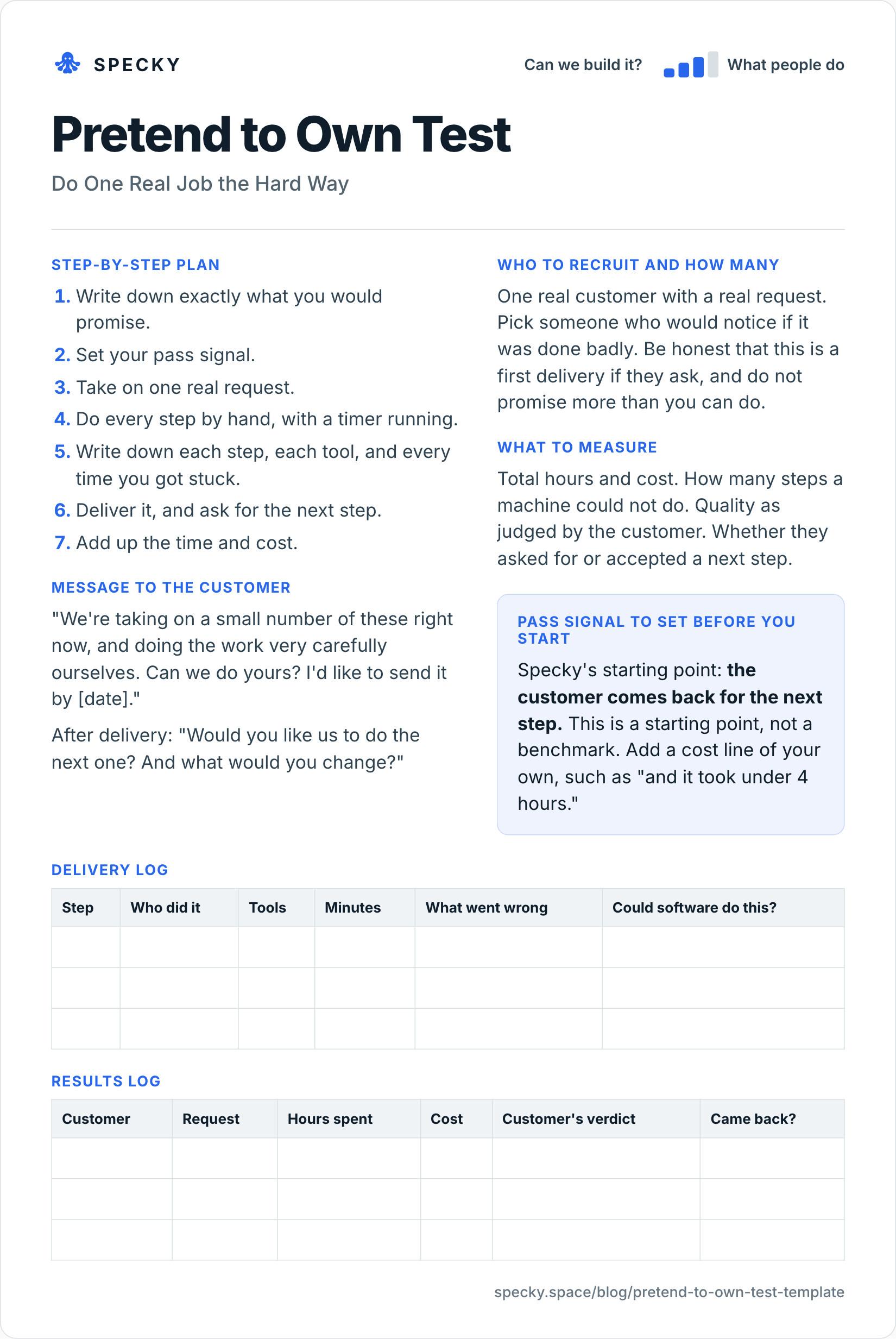
Copy-and-use pretend to own template
Open the image at full size, or copy the text version below.
Who to recruit and how many
One real customer with a real request. Pick someone who would notice if it was done badly. Be honest that this is a first delivery if they ask, and do not promise more than you can do.
Step-by-step plan
Write down exactly what you would promise.
Set your pass signal.
Take on one real request.
Do every step by hand, with a timer running.
Write down each step, each tool, and every time you got stuck.
Deliver it, and ask for the next step.
Add up the time and cost.
Delivery log
Step
Who did it
Tools
Minutes
What went wrong
Could software do this?
Message to the customer
"We're taking on a small number of these right now, and doing the work very carefully ourselves. Can we do yours? I'd like to send it by [date]."
After delivery: "Would you like us to do the next one? And what would you change?"
What to measure
Total hours and cost. How many steps a machine could not do. Quality as judged by the customer. Whether they asked for or accepted a next step.
Pass signal to set before you start
Specky's starting point: the customer comes back for the next step. This is a starting point, not a benchmark. Add a cost line of your own, such as "and it took under 4 hours."
Results log
Customer
Request
Hours spent
Cost
Customer's verdict
Came back?
What should you measure in a pretend to own test?
Three numbers turn the delivery log into a decision.
Cost per delivery = hours × the cost of an hour + tools used. This is your floor before any software exists.
Hours per step. Sort the log by minutes. The longest step is where engineering should start, and it is often not the one you expected.
Share of steps software could do. Count the "yes" answers in the log's last column. If most hours sit in steps marked "no", automation won't save you, and the promise may need to change.
Then watch what the customer does next. Savoia separates the initial level of interest from the ongoing level of interest, noting that most people will not keep opening a fake door. His invented example of a skydiving start-up shows why the second request matters: on a rented plane, 8 weekly flights saw signups peak at 28 on the third flight and fall to none by the seventh, with a loss on every flight from the fourth to the sixth. Renting instead of buying a plane kept that lesson cheap.
How many customers do you need?
One, for the first run: one honest, timed delivery answers "can this be done, and at what cost?" It cannot tell you what is typical, so before you automate, repeat it for several customers through a concierge test and compare the logs.
Worked example (hypothetical)
This example is made up to show the method. A founder is planning a service that turns recorded sales calls into a weekly coaching report for sales managers. He takes one request from a five-person sales team, and does it himself.
It takes him nine hours. Three of them go on untangling who said what in the transcript. The other parts turn out to be easier than he feared. The manager reads the report, forwards it to her team, and asks: "Can you do next week's by Friday?"
The signal passes, because she came back. But the log shows that the risky part is the transcript cleanup, not the coaching advice. That is where his first engineering effort needs to go.
Adding the cost line. Had he set the template's example cost line, "under 4 hours", the result would be mixed: she came back, but delivery took more than twice the budget. Say he planned to charge €300 a week for the report (an illustrative figure). Nine hours means about €33 an hour before any software. If tooling cut the transcript step from 3 hours to 30 minutes, the job would take 6.5 hours, or about €46 an hour. The log tells him exactly which step to fix to make the price work.
The second delivery. Next week's report takes seven hours, because he now knows the format. He takes that number into a technical spike on separating speakers.
Pretend to own test vs concierge test vs Wizard of Oz
The nearest sibling is the concierge test. All three deliver something by hand; they differ in how many customers, what the customer knows, and what you are trying to learn.
Commitment, if you ask for money or a repeat booking
Behaviour
Best next step
Concierge test or technical spike
Single-feature MVP
Automate the busiest steps
Run this test first when you doubt you can deliver; run the concierge test when you know you can and want to know whether people keep paying.
Is it honest to do the work by hand?
Yes, as long as the customer gets what you promised and you don't misdescribe how it was made. Paul Graham's essay on early start-ups says founders can sometimes get away with "doing by hand things that you plan to automate later". He describes Stripe's founders setting up merchant accounts by hand behind the scenes in the early days (Graham, 2013).
Savoia's own ethics note argues that cheap tests save customers, not just founders, from wasted time and money, and asks you to use your judgement. In practice:
Promise only the outcome you can deliver, by the date you name.
Never claim it is automated. If the customer asks how it works, tell them.
Handle their data as carefully as a finished product would. Sales call recordings hold personal data; agree who will see them, and delete them when you are done.
Common mistakes
Not timing it. The hours are the whole finding.
Promising too much. One careful delivery beats several rushed ones.
Picking an easy customer. A forgiving person hides the problems.
Stopping after the first delivery. The next request is the test.
Skipping the log. Without it, you only have a story.
Pricing from the first delivery. The second and third take less time as you learn; price from where the time settles, not from the first try.
How to run it in Specky
On the Assumptions page, click the note and choose Pick a test, then Pretend to own. Specky fills in the steps, the pass signal, and a one-week timeline.
You run this one. Specky keeps the plan and the result. Do the work yourself, and keep the log.
Click Start running. Paste your hours, cost, and what happened onto the test.
Record the result.
A pass shows on the board as Supported, because a real delivery is behavior. The note moves toward strong evidence, and any bet resting on it updates.
What to do with each outcome
Supported: You have proved it can be done once. Repeat it with several customers through a concierge test, or run a technical spike on the hardest step.
Unclear: You delivered, but the customer has not decided. Follow up in a week, or try with a second customer.
Contradicted: You could not do it, or it cost far more than the promise allowed. Change the promise, or drop it. Any bet resting on this note now shows as Contradicted.
Frequently asked questions
What is a pretend to own test?
A pretend to own test treats a real customer request as if your capability already existed, and fulfils it by hand. You time every step and see whether the customer asks for the next one. It shows what delivery really takes, in hours and cost, before you automate anything.
How is pretend to own different from a concierge test?
Pretend to own focuses on whether you can deliver at all, usually for one request. A concierge test delivers the outcome by hand to several customers to see if they come back or pay. Run pretend to own first if delivery is the doubt, and the concierge test once you know you can deliver.
Is it honest to do work manually without telling customers?
Delivering a real result by hand is fine, as long as you do not misrepresent what the customer is getting. If they ask how it works, tell them, and never claim the work is automated. Making customers believe software did it is a Wizard of Oz test, with its own ethics check.
Where does the name "pretend to own" come from?
From Alberto Savoia's 2011 book Pretotype It, where the Pretend-to-Own pretotype means renting or borrowing what you need before buying it. David J. Bland and Alex Osterwalder also use the name in Testing Business Ideas, for a non-working mock-up that shows whether a product fits into a customer's day, much like Jeff Hawkins' wooden Palm Pilot.
How long does a pretend to own test take?
About a week for one delivery and the follow-up; Specky's plan sets a one-week timeline. The book version runs longer: Strategyzer's library scores Pretend to Own 4 out of 5 for run time, because a mock-up needs time in real daily use.