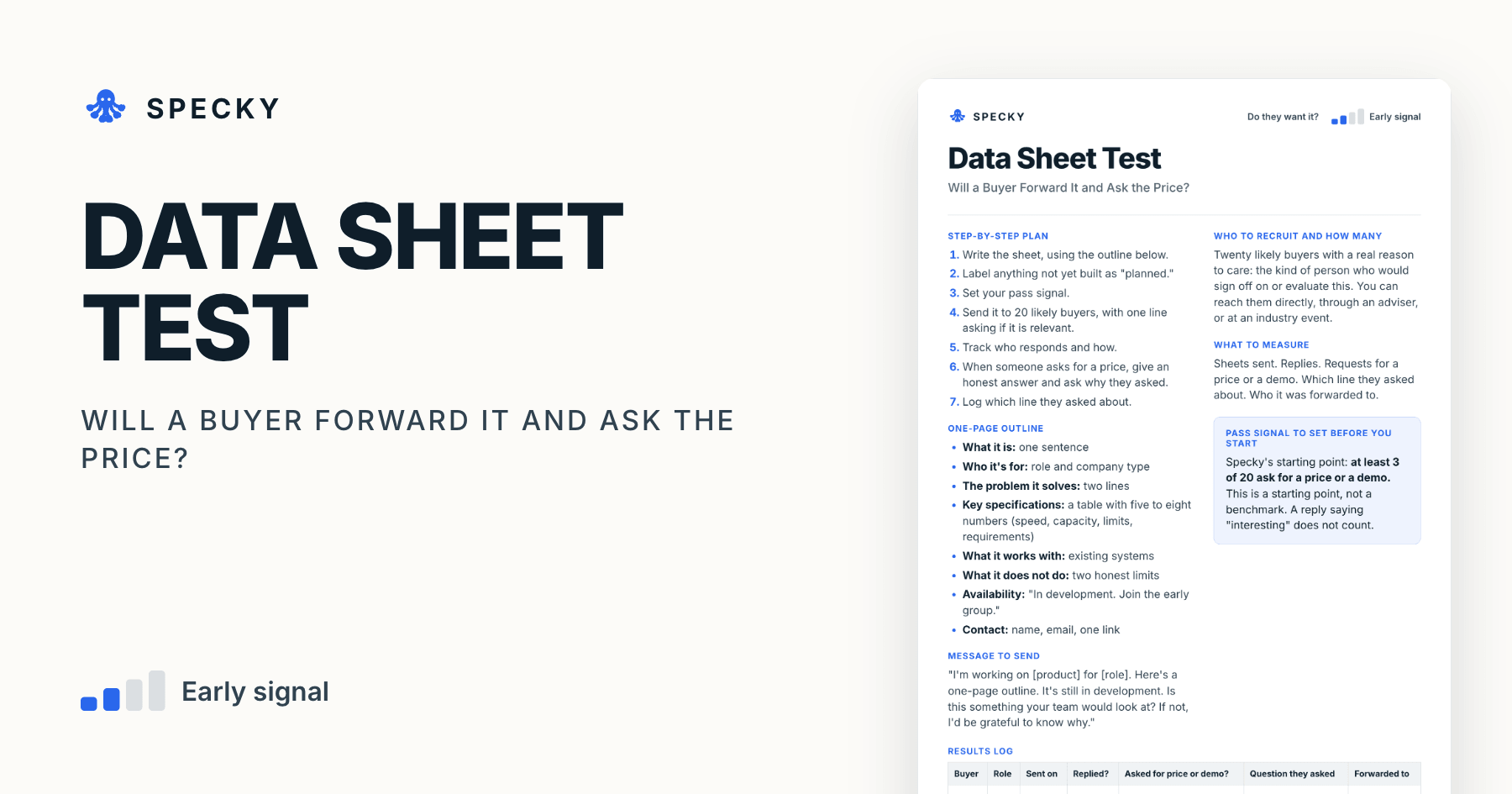
Data Sheet Test: Will a B2B Buyer Forward It and Ask the Price?
Serious buyers want numbers. Write a single page they could forward to a colleague, label what is planned, and see who asks for a price.
Share
A data sheet test is a quick demand test for business and technical buyers: you write your offer as a one-page specification a buyer could forward to a colleague, mark anything unbuilt as "planned", send it to about 20 likely buyers, and count who asks for a price or a demo. It tells you whether your numbers interest people who sign off on purchases.
Key takeaways
The data sheet is a "discussion prototype" in Testing Business Ideas by David J. Bland and Alex Osterwalder, rated 1 of 5 for cost and 3 of 5 for evidence strength (Strategyzer experiment library).
Business purchases are group decisions. Forrester's 2024 buying study found an average of 13 people involved, and 89% of purchases cross two or more departments (Forrester, 2024). Your sheet has to work without you, in someone else's inbox.
Specky's starting pass signal: at least 3 of 20 buyers ask for a price or a demo. "Interesting" does not count.
Every number reads as a promise. The US FTC expects objective evidence for a product claim before an ad runs (FTC). Label what is planned.
What is a data sheet test?
A data sheet test presents your product as a one-page specification and counts how many likely buyers take the next step: asking for a price or a demo.
It comes from the experiment library in Testing Business Ideas, where the data sheet sits among eight discussion prototypes next to the brochure. The library rates it 1 of 5 for cost, 2 of 5 for setup time, 2 of 5 for run time and 3 of 5 for evidence strength (Strategyzer).
Learning Loop's write-up stresses that the sheet is a test artefact, not a finished marketing document, and can be made in hours (Learning Loop).
Which risk does it test, and how strong is the evidence?
This tests desirability: are the specs attractive enough for a buyer to take the next step? The evidence is directional. Asking for a price is a real action, but a small one that commits them to nothing. Our guide to choosing a product experiment explains how it fits in.
When should you use a data sheet test, and when not?
Use it for business and technical buyers, who need to see the numbers and limits before they get serious. It suits hardware, infrastructure, developer tools and professional products, where a warm story is not how decisions get made.
Do not use it:
For consumers, who do not read specs.
When your buyer decides on a story more than on specifications. Use a brochure.
When you cannot say what the numbers will be. If you have no idea what speed or capacity you can reach, run a technical spike first.
Never with a specification you cannot reach. A data sheet reads like a promise, which makes it easy to overstate what you have.
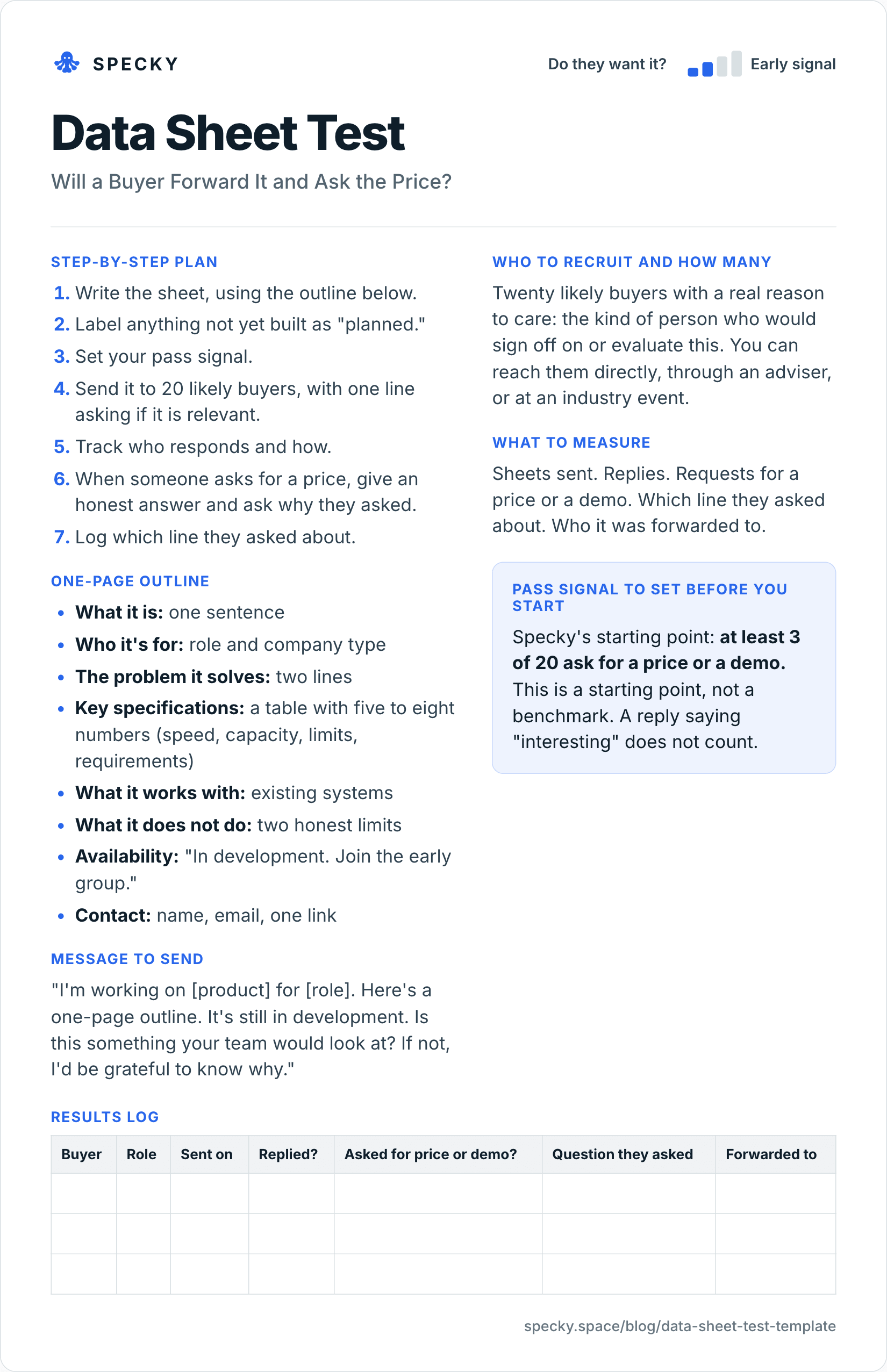
Copy-and-use data sheet test template
Open the image at full size, or copy the text version below.
Who to recruit and how many
Twenty likely buyers with a real reason to care: the kind of person who would sign off on or evaluate this. You can reach them directly, through an adviser, or at an industry event.
Step-by-step plan
Write the sheet, using the outline below.
Label anything not yet built as "planned."
Set your pass signal.
Send it to 20 likely buyers, with one line asking if it is relevant.
Track who responds and how.
When someone asks for a price, give an honest answer and ask why they asked.
Log which line they asked about.
One-page outline
What it is: one sentence
Who it's for: role and company type
The problem it solves: two lines
Key specifications: a table with five to eight numbers (speed, capacity, limits, requirements)
What it works with: existing systems
What it does not do: two honest limits
Availability: "In development. Join the early group."
Contact: name, email, one link
Message to send
"I'm working on [product] for [role]. Here's a one-page outline. It's still in development. Is this something your team would look at? If not, I'd be grateful to know why."
What to measure
Sheets sent. Replies. Requests for a price or a demo. Which line they asked about. Who it was forwarded to.
Pass signal to set before you start
Specky's starting point: at least 3 of 20 ask for a price or a demo. This is a starting point, not a benchmark. A reply saying "interesting" does not count.
Results log
Buyer
Role
Sent on
Replied?
Asked for price or demo?
Question they asked
Forwarded to
How do you write the specification table?
The table is the part buyers read first and question hardest. Give every number four things: a value, a unit, the conditions it holds under, and a status. The status column is what keeps the sheet honest.
Here is an illustrative table for the refrigeration sensor in the worked example below. The figures are invented to show the format.
Specification
Value
Conditions
Status
Leak detection time
Under 10 minutes
Standard units at 4°C
Measured on prototype
Battery life
24 months
Standard units, one reading a minute
Target
Battery life
Not yet measured
Freezer units at −18°C
Planned
Unit types
Reach-in and walk-in
Doors up to 2 m
Measured on prototype
Alerts
SMS and email
Within 1 minute of detection
Planned
Install time
15 minutes per unit
No tools beyond a screwdriver
Target
Three rules for the table:
Five to eight rows. More, and nobody can tell which numbers matter.
Use the buyer's units. If they budget in hours of downtime, give hours.
Write "not yet measured" when it is true. Honest gaps make the measured rows believable.
Why does a data sheet have to survive being forwarded?
Because the person you send it to rarely decides alone. In Forrester's State of Business Buying 2024, an average of 13 people were involved in a buying decision, 89% of purchases involved two or more departments, and 86% of purchases stalled at some point (Forrester, 2024).
Your reader will pass the sheet to an evaluator, a budget holder or procurement, without you. Write for that second reader:
Name the role in the first line ("For facilities managers running 20 or more refrigerated units").
Answer what a second reader asks: what it is, roughly what it costs, and what it does not do.
Send a link and offer a PDF. Some organisations forward attachments, others links.
Ask who else should see it once someone engages.
A forward is not part of the pass signal, but a forward to an unexpected role can point you at a better buyer. If you have salespeople, their notes on where deals stall tell you which rows to add.
How many buyers do you need for a data sheet test?
Twenty is a sensible minimum. For measuring a rate rather than spotting problems, Nielsen Norman Group advises about 20 participants (NN/g, 2000). Even then, the result is rough. Using a 95% Wilson interval (our calculation):
Asked for price or demo
Share
Plausible range for buyers like them
2 of 20
10%
about 3% to 30%
3 of 20
15%
about 5% to 36%
4 of 20
20%
about 8% to 42%
Decision rule: treat 3 or 4 of 20 as a reason to keep going, not as proof. Treat 0 or 1 of 20 from the right people as a clear no for this version of the sheet.
Worked example (hypothetical)
This example is made up to show the method. A small team is developing a sensor that detects leaks in commercial refrigerators. They write a one-page sheet, listing detection time, battery life, and the types of unit it fits, and mark two figures as planned.
They send it to 20 facilities managers. Seven reply. Four ask for a price, and two of those ask specifically about battery life in freezers, which the sheet had listed only for standard units. One forwards it to his insurance contact, which the team had not expected.
Four of 20 clears the line. The team now has a sharper question to test, and a new idea about who else might care.
Extending the example. The team answers each price request with an honest range and asks why they asked. Two managers say one spoiled freezer costs more than the sensor. Next come two tests: a lab measurement of freezer battery life, and three calls with insurers to see if the forward points at a second buyer. For the four who asked about price, the next step is a letter of intent.
Data sheet test vs brochure test vs letter of intent
The brochure is the data sheet's closest sibling; the letter of intent is the usual next step.
Data sheet test
Brochure test
Letter of intent
Question it answers
Will buyers who judge on numbers ask for a price or demo?
Library ratings are from Strategyzer's experiment library poster (Strategyzer). Rob Fitzpatrick's The Mom Test counts a letter of intent or a pre-order as a money commitment, a step beyond the time a buyer gives you on a call (summary by Yevgeniy Brikman).
Common mistakes
Claiming specs you don't have. Mark what is planned, every time.
Leaving out limits. Honest limits make the rest believable.
Sending it to people who can't buy. You will get friendly comments and no decisions.
Counting "interesting." Only a request for a price or a demo counts.
Ignoring the question they asked. That line tells you what they really care about.
Relying on the sheet alone. Learning Loop warns that a short sheet can be misread and is rarely enough on its own (Learning Loop). Follow every price request with a call.
Can you list features that are not built yet?
Yes, as long as you label them as planned. A data sheet reads like a promise, so never present something unbuilt as if it already exists.
Advertising rules point the same way. The US Federal Trade Commission says advertising must be truthful and not deceptive, and advertisers need objective evidence for product claims before the ad runs (FTC). A sheet sent to 20 people is not an ad campaign, but the habit is right:
"Measured" only for numbers you have measured.
"Target" for numbers you are designing towards.
"Planned" for features that do not exist yet.
No price you would not honour, and no orders against planned features.
How to run it in Specky
On the Assumptions page, click the note and choose Pick a test, then Data sheet. Specky fills in the steps, the pass signal, and a one-week timeline.
Click Test with a page. Specky builds a waitlist page with your offer, and collects responses. Note that this is a web page with structured sections, not a printable PDF. If your buyers forward PDFs, make one yourself and link it to the page.
You choose who gets it, and you send it.
Click Start running, then paste in the requests for price or demo, and record the result.
A pass shows as Early signal on the board, not Supported, because the test is rated directional.
What to do with each outcome
Supported (shows as Early signal): Ask those buyers for something stronger, such as a letter of intent.
Unclear: Replies, but no requests. Maybe the spec is close but not enough. Ask two of the people who replied what would need to change.
Contradicted: The right people saw it and did not engage. Check that the numbers matter to them, with a few expert interviews. Any bet resting on this note now shows as Contradicted.
Frequently asked questions
What is a data sheet test?
A data sheet test presents your product as a one-page specification and counts how many likely buyers ask for a price or a demo. It tests whether the numbers interest serious buyers. It is one of the discussion prototypes in Bland and Osterwalder's Testing Business Ideas, rated low on cost and medium on evidence strength.
What is the difference between a data sheet and a brochure test?
A data sheet leads with specifications for buyers who evaluate on numbers, and counts price or demo requests. A brochure leads with the story and benefits for buyers who decide on what the offer does for them, and checks whether people can repeat it. Some teams write the data sheet first, then pick the brochure's three benefits from it.
What should a product data sheet include?
One sentence on what it is, who it is for, the problem in two lines, a table of five to eight specifications, what it works with, two honest limits, availability and a contact. Give every specification a unit, the conditions it holds under and a status: measured, target or planned.
How many buyers should I send a data sheet to?
About 20 people who could evaluate or approve the purchase. That is enough to see whether anyone asks for a price, but the result stays rough: 3 of 20 is consistent with anywhere from about 5% to 36% of similar buyers. Twenty people with buying power beat 200 without it.