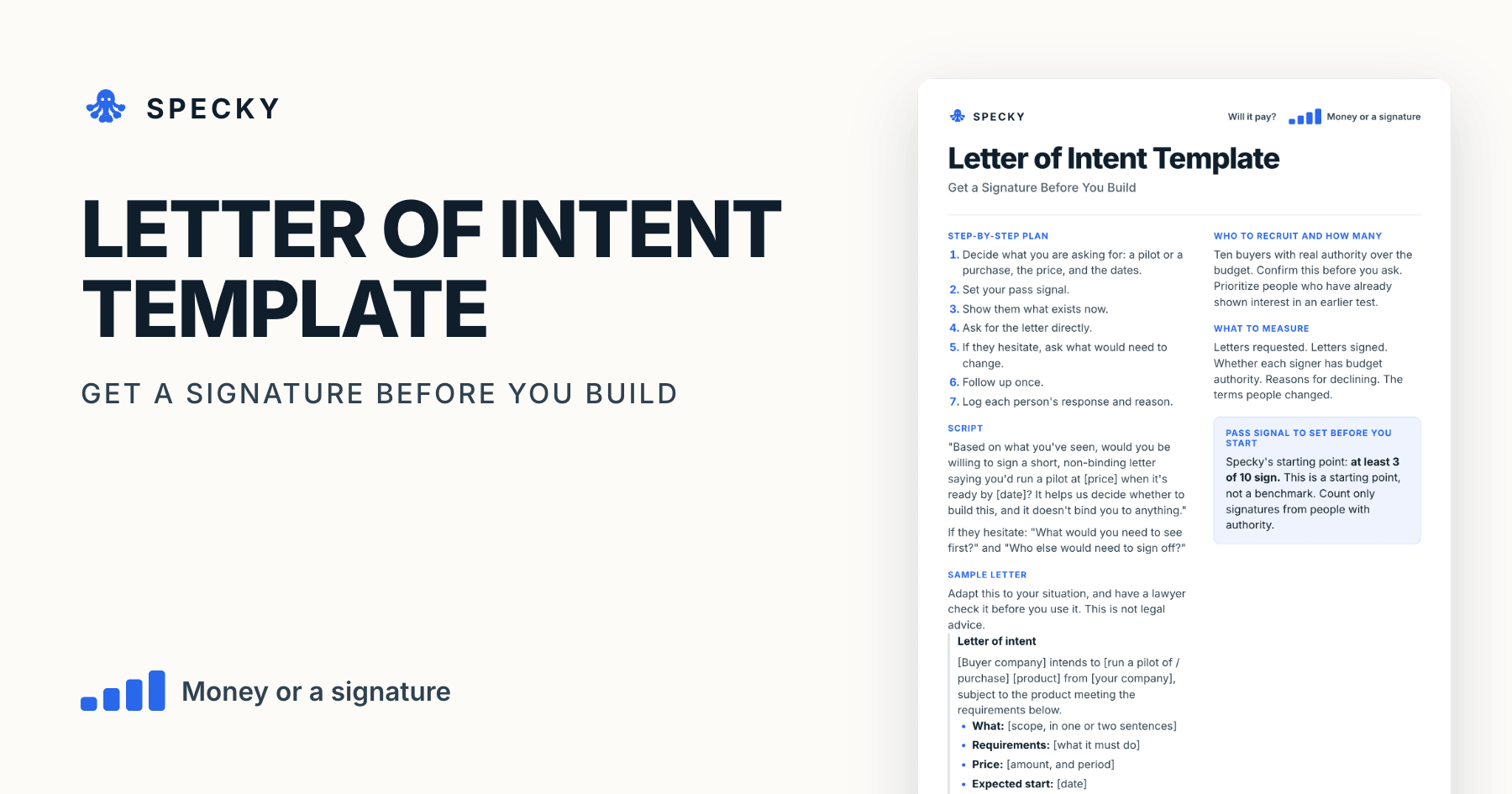
Customer Letter of Intent Template: Get a Signature Before You Build
Everyone loves your demo. Ask them to sign a short, non-binding letter, and find out who meant it.
Share
A customer letter of intent is a short, usually non-binding document in which a buyer with budget authority states that they intend to pilot or purchase your product, at a stated price and date, once it meets agreed requirements. For a B2B founder, it is one of the cheapest ways to separate polite interest from real intent before writing much code.
Key takeaways
Ask 10 buyers who control a budget, and set the bar first: 3 of 10 signing is a sensible starting pass signal.
Strategyzer's experiment library for Testing Business Ideas rates the letter of intent 1 out of 5 for cost and setup time, with evidence strength from 1 to 3 out of 5 (Strategyzer poster).
Letters of intent are typically not legally binding, but careless wording can create binding commitments (Baker McKenzie). This page is not legal advice.
A signature is intent, not revenue. If you need money on the table, run a presale next.
What is a customer letter of intent?
In product validation, a letter of intent (LOI) is a one-page statement from a buyer: "we intend to run a pilot of this, at this price, starting around this date, if it does these things." It is not a contract and not a purchase order. It is a deliberate step up from "I love it" to "I'll put my name on it."
The method comes from the experiment library in David J. Bland and Alexander Osterwalder's Testing Business Ideas, which sorts 43 experiment types by cost, time and strength of evidence (Strategyzer). The letter of intent sits in the "simulation" group of validation experiments, next to the mock sale, the Wizard of Oz and the pop-up store.
Strategyzer's poster for the library scores it like this (Strategyzer poster):
The evidence depends on who signs. The person who owns the budget sits at the top of that range; an enthusiastic user with no budget sits at the bottom.
Which risk does it test, and how strong is the evidence?
It tests viability: will someone who controls a budget commit, at this price? The evidence is commitment, the top rung in our guide to choosing a product experiment. It is strong evidence of intent, but it is not revenue.
When should you ask for a letter of intent, and when not?
Use it for business-to-business products, where you can reach the people who sign. A signature changes the conversation: friendly buyers who "love it" will often go quiet when asked to put their name on something, and that is exactly what you need to learn.
Steve Blank learned this the expensive way. At Ardent, his supercomputer company, he says he did customer discovery well but neglected customer validation. The question he wishes he had asked was simple: "Would they write us a Purchase Order now before our supercomputer was even complete" (Steve Blank, 2009). A letter of intent is the lighter version of that question.
Do not use it:
With people who have no buying authority. A signature from a junior contact is a nice gesture.
For consumer products. A crowdfunding test or presale makes more sense.
Too early. You need something concrete to show, such as a clickable prototype or a written scope. If you still don't know which problem matters most, go back to a customer interview.
When you could take money instead. If buyers can pay a deposit today, a presale gives stronger evidence for similar effort.
Is a letter of intent legally binding?
Usually not, but the wording decides. This is general information, not legal advice; have a lawyer review any letter before you send it.
Law firm Baker McKenzie's guide to US deals says that, except for matters such as confidentiality and "standstill" clauses, a letter of intent is typically not legally binding. The same guide warns that a letter not drafted carefully could inadvertently create binding commitments (Baker McKenzie). Acquisition letters often add exclusivity clauses, typically for 30 to 60 days, so some parts are written to bind.
For a product validation letter, two habits make the intent clear:
Say it in the letter. One sentence: "This letter expresses intent and is non-binding. Either party may withdraw at any time."
Leave out clauses that create duties. No exclusivity, penalties, payment schedules or minimum volumes, unless a lawyer drafts them on purpose. Rules differ by country.
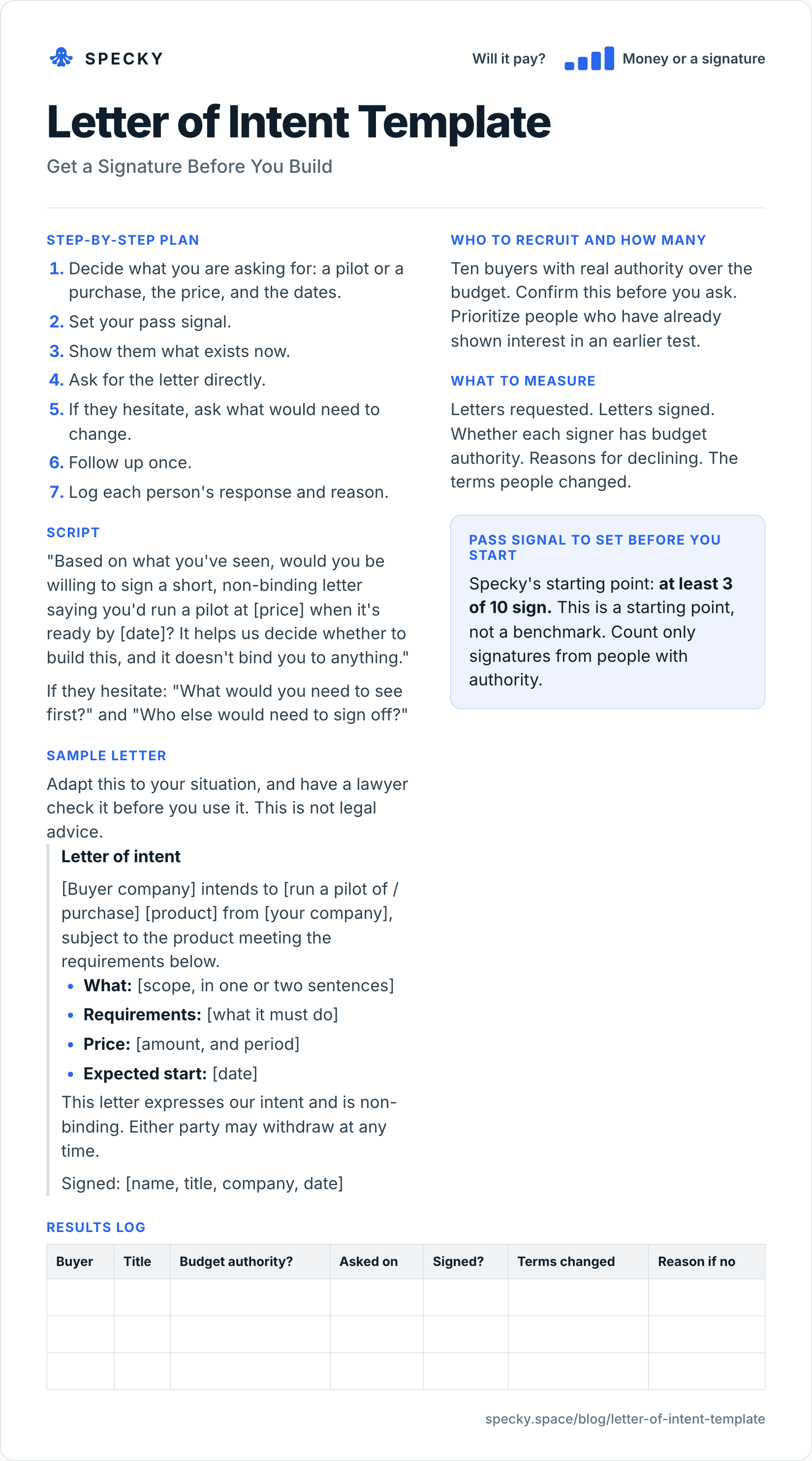
Customer letter of intent template (copy and use)
Open the image at full size, or copy the text version below.
Who to recruit and how many
Ten buyers with real authority over the budget. Confirm this before you ask. Prioritise people who have already shown interest in an earlier test.
Step-by-step plan
Decide what you are asking for: a pilot or a purchase, the price, and the dates.
Set your pass signal.
Show them what exists now.
Ask for the letter directly.
If they hesitate, ask what would need to change.
Follow up once.
Log each person's response and reason.
Script
"Based on what you've seen, would you be willing to sign a short, non-binding letter saying you'd run a pilot at [price] when it's ready by [date]? It helps us decide whether to build this, and it doesn't bind you to anything."
If they hesitate: "What would you need to see first?" and "Who else would need to sign off?"
Sample letter
Adapt this to your situation, and have a lawyer check it before you use it. This is not legal advice.
Letter of intent
[Buyer company] intends to [run a pilot of / purchase] [product] from [your company], subject to the product meeting the requirements below.
What: [scope, in one or two sentences]
Requirements: [what it must do]
Price: [amount, and period]
Expected start: [date]
This letter expresses our intent and is non-binding. Either party may withdraw at any time.
Signed: [name, title, company, date]
What to measure
Letters requested. Letters signed. Whether each signer has budget authority. Reasons for declining. The terms people changed.
Pass signal to set before you start
Specky's starting point: at least 3 of 10 sign. This is a starting point, not a benchmark. Count only signatures from people with authority.
Results log
Buyer
Title
Budget authority?
Asked on
Signed?
Terms changed
Reason if no
How do you ask a customer for a letter of intent?
Ask in the meeting, right after the demo, while the buyer can still picture the product working. A cold email a week later invites silence. A 30-minute call can run like this:
Minutes 0-5: restate the problem and its cost in their words.
Minutes 5-15: show what exists, for the one job they care about.
Minutes 15-20: state the price, start date and two or three requirements.
Minutes 20-25: ask, using the script above, then stop talking.
Minutes 25-30: if they hesitate, ask who else signs and what they need to see.
Hesitation is data. Steve Blank describes sending prospects a "fully cancelable purchase order" listing the demoed features and the price, instead of building prototypes on request. It showed who else had to approve and screened out the prospects least likely to close, and he reports that conversions of demos into orders rose sharply, though he gives no figures (Steve Blank, 2024). A non-binding letter does the same job with less weight. Borrow his pre-call questions too: what are the success criteria, the decision timeline, the budget, and who holds purchase authority?
How many letters of intent do you need?
Ten asks and three signatures is enough to make a decision, not to measure a rate. By our calculation, 3 out of 10 gives a 95% Wilson confidence interval of roughly 11% to 60%: too wide to forecast sales, but clear enough to tell "some buyers commit" from "nobody commits."
Ten is a floor. Below ten, one friendly signer can swing the result.
Count authority, not names. Four finance directors outweigh ten users.
Read the refusals. If most decliners give the same reason, that reason is your next experiment.
Y Combinator co-founder Paul Graham argues that founders must recruit early users by hand, and suggests picking a single user and acting as if you were their consultants (Paul Graham, 2013). Your first signers are often those users.
Letter of intent vs presale: which should you use?
Both ask for commitment. The difference is whether money changes hands.
Use a letter of intent when the buyer cannot pay before procurement does its work. Use a presale when they can.
What does a letter of intent test look like in practice?
This example is made up to show the method. A startup is developing software to detect billing errors for mid-sized clinics. After a successful demo, the founder asks 10 clinic finance directors for a non-binding letter to pilot at €800 a month.
Seven had said they loved the demo. Four sign. Two more say it needs their board to approve, and one wants the price tied to errors found.
Four of ten clears the bar, and the signatures came from people who hold the budget. The founder now has evidence to bring to a partner. She also has an idea worth testing: pricing based on results.
Extending the example: four pilots at €800 a month would be €3,200 a month, or €38,400 a year, if every one converted. She treats that as a ceiling, not a forecast, and tests results-based pricing next with a mock sale of two price models.
What are the most common letter of intent mistakes?
Asking people who can't sign. Find out who controls the money first.
Making it long. One page is enough.
Not being clear that it is non-binding. People should know what they are signing.
Treating it as revenue. A non-binding letter is intent, and not a contract.
Not asking why people said no. Reasons are often more useful than signatures.
Changing the terms per buyer. If each letter has a different price, you have tested nothing.
When it doesn't work: with consumers, with buyers who sign anything to be polite, and where a formal tender process stops buyers signing anything with a vendor early.
Is it fair to ask for a signature on something that doesn't exist yet?
Yes, if you are open about it. Say plainly that the product is not finished, show only what is real, and give a realistic date. Ask before naming a signer's company in a pitch deck or on your website, and report them as letters of intent, not customers or contracts.
How to run it in Specky
On the Assumptions page, click the note and choose Pick a test, then Letter of intent. Specky fills in ten buyers, the pass signal, and a four-week timeline.
Click Open in Vouch. Vouch, at vouch.specky.space, runs this as an AI interview that explores what a buyer would commit to and what stands in the way.
The letter itself is your part. Neither Specky nor Vouch writes a legal document or collects signatures for you, so send and sign it the way you normally would.
Click Start running. Paste in who signed, on what terms, and record the result.
A pass shows on the board as Supported, and moves toward the strongest evidence level, because a signature is commitment.
What should you do with each outcome?
Supported: You have signed intent. Start the pilot, or build the smallest thing that can deliver it with a single-feature MVP.
Unclear: People want changes before they sign. Collect the changes, and see which ones repeat.
Contradicted: Warm interest went cold when you asked for a signature. Believe that. Find out what stopped them. Any bet resting on this note now shows as Contradicted.
Frequently asked questions
Is a letter of intent legally binding?
Usually not. Baker McKenzie's US deal guide says letters of intent are typically not legally binding, apart from clauses such as confidentiality, but careless wording can create binding commitments. Rules differ by country. State in the letter that it is non-binding, leave out exclusivity and penalties, and have a lawyer review it. This is not legal advice.
How do you ask a customer for a letter of intent?
Ask in the meeting, straight after showing what exists. State the price, start date and requirements, then ask whether they would sign a short, non-binding letter to pilot on those terms. If they hesitate, ask what they would need to see first and who else must sign off. Follow up once, in writing, within a week.
How many letters of intent do you need before building?
Ask at least 10 buyers who control a budget. A sensible starting pass signal is 3 of 10 signing, counting only signers with authority. Ten asks will not give you a precise rate, but they show whether anyone with money commits. Set the bar before the first ask.
What should a customer letter of intent include?
One page: who intends to do what, the scope, the requirements the product must meet, the price and period, the expected start date, a clear non-binding statement, and the signer's name, title, company and date. Leave out exclusivity, penalties and payment terms unless a lawyer drafts them deliberately.
What is the difference between a letter of intent and a presale?
A letter of intent records non-binding intent; a presale takes a payment or deposit before the product exists. Strategyzer's library rates a presale's evidence at 5 out of 5, against 1 to 3 for a letter of intent. Use a letter when the buyer cannot pay early, and a presale when they can.