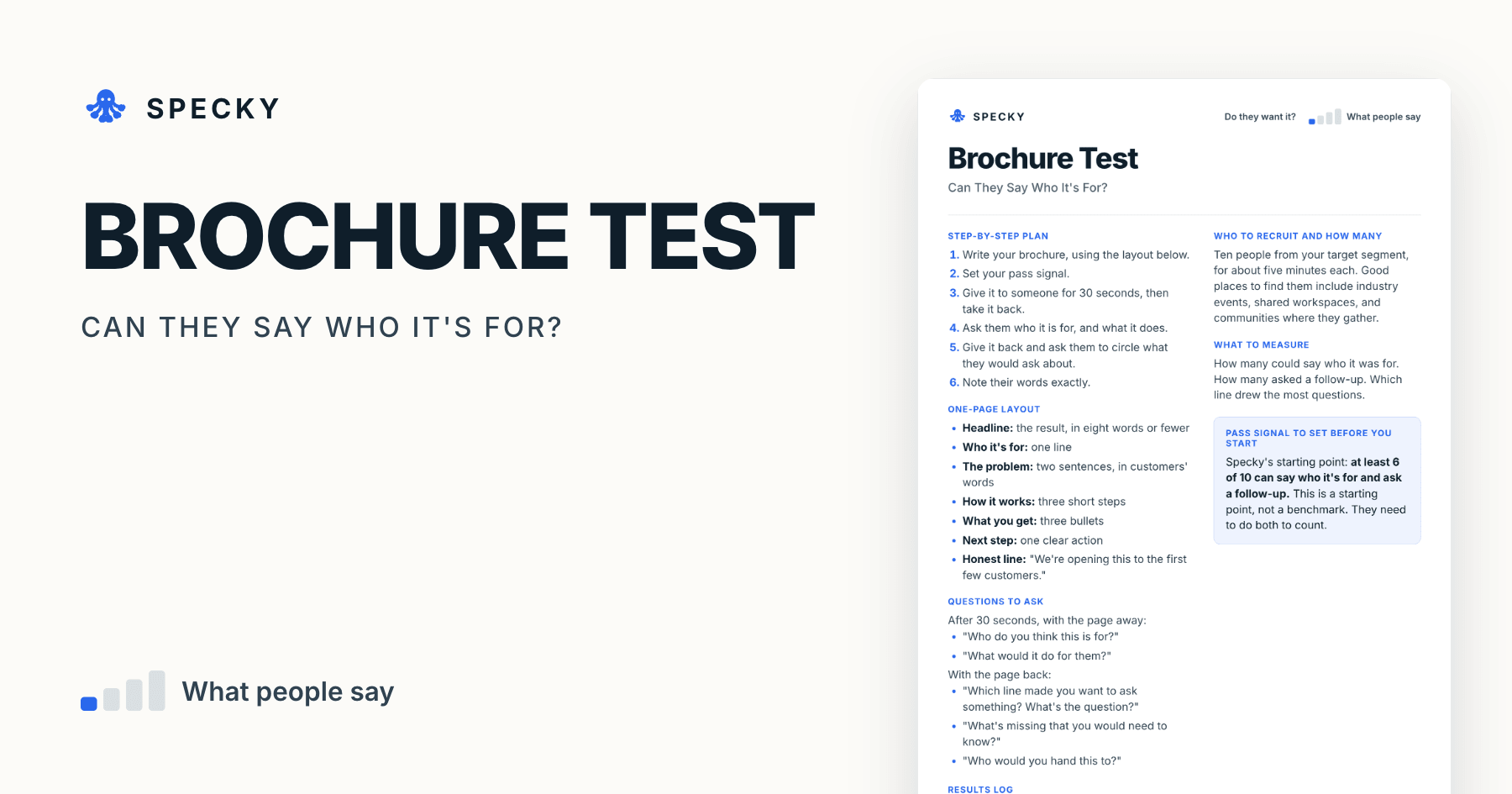
Brochure Test: Check If People Can Say Who Your Offer Is For
If people cannot repeat your offer after 30 seconds, it is not clear yet. A one-page, ten-person test that can change your pitch before you pay to promote it.
Share
A brochure test is a quick discovery experiment: you write your offer as a one-page brochure, show it to about 10 people from your target segment for 30 seconds, take it away, and ask who it is for and what it does. Then you hand it back and ask which line raised a question. It tells you whether your message is clear before you pay to promote it.
Key takeaways
The brochure is a "discussion prototype" in the Testing Business Ideas library by David J. Bland and Alex Osterwalder, rated 1 of 5 for cost and 3 of 5 for evidence strength (Strategyzer experiment library).
People skim. Visitors often leave a web page within 10 to 20 seconds and read about 20% of its words (NN/g, 2011; NN/g, 2008). A 30-second read is generous.
Specky's starting pass signal: at least 6 of 10 people can say who it's for and ask a follow-up question.
Ten people tell you whether the message is clear or muddled, not its exact score. A result of 6 of 10 fits anything from about 31% to 83% of similar people (95% interval, our calculation).
What is a brochure test?
A brochure test checks whether one page tells a stranger who your offer is for and what it does, without you there to explain it.
It comes from the experiment library in Testing Business Ideas. The library's poster lists 44 experiments, 29 for discovery and 15 for validation, and places the brochure among eight discussion prototypes, next to the data sheet, the storyboard and the explainer video. It rates the brochure 1 of 5 for cost, 3 of 5 for setup time, 2 of 5 for run time and 3 of 5 for evidence strength (Strategyzer experiment library).
How does this version differ from the book's?
Learning Loop's write-up describes the brochure as a mock-up of the value proposition, handed out where customers gather (events, cafés, shops), followed by a short interview, and measured partly by how many people reach out afterwards ().
This template asks one question: is the message clear? It measures recall and questions, not reach-outs. Add a contact line and count who gets in touch within a week, and you add a small behavioural signal.
Which risk does it test, and how strong is the evidence?
This tests desirability, specifically: is the offer clear and interesting? The evidence is opinion, because people are reacting to words in front of you. It is best for fixing your message before spending money on testing it. Read more in our guide to choosing a product experiment.
When should you use a brochure test, and when not?
Use it when you have an offer but are not sure it is clear. A brochure forces you to choose a few words, and showing it to 10 people quickly exposes anything confusing. It suits services and products bought after a conversation, including at events and through referrals.
Do not use it:
To measure demand. Nobody is asked to do anything except read and respond. For an action, use a landing page test.
When your buyer evaluates specifications. Engineers and procurement teams read numbers first. Use a data sheet.
When the product is easier to show than to describe. If people need to see it move, a short explainer video carries more than a page of text.
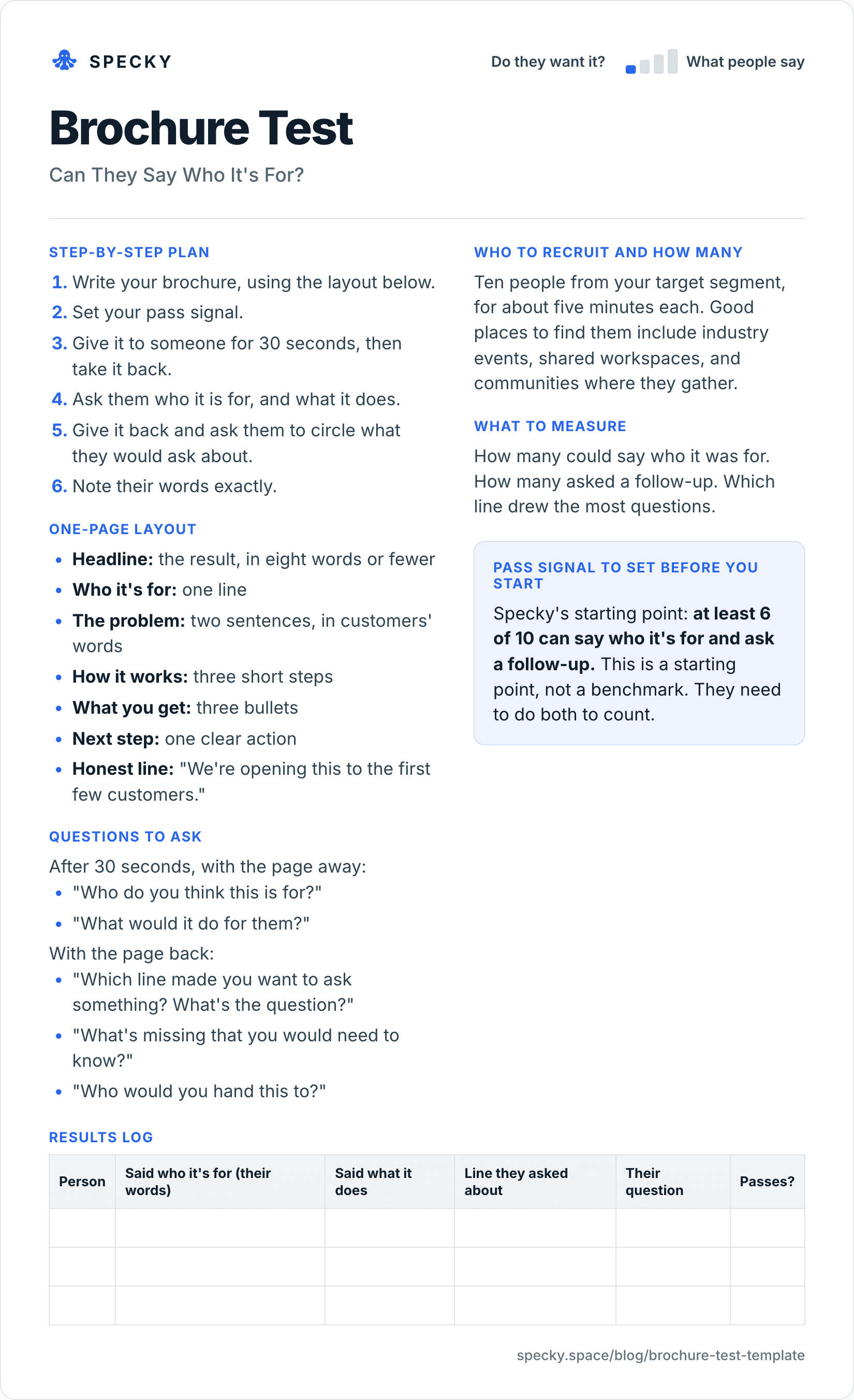
Copy-and-use brochure test template
Open the image at full size, or copy the text version below.
Who to recruit and how many
Ten people from your target segment, for about five minutes each. Good places to find them include industry events, shared workspaces, and communities where they gather. On a video call, share the page for 30 seconds, then stop sharing.
Step-by-step plan
Write your brochure, using the layout below.
Set your pass signal.
Give it to someone for 30 seconds, then take it back.
Ask them who it is for, and what it does.
Give it back and ask them to circle what they would ask about.
Note their words exactly.
One-page layout
Headline: the result, in eight words or fewer
Who it's for: one line
The problem: two sentences, in customers' words
How it works: three short steps
What you get: three bullets
Next step: one clear action
Honest line: "We're opening this to the first few customers."
Questions to ask
After 30 seconds, with the page away:
"Who do you think this is for?"
"What would it do for them?"
With the page back:
"Which line made you want to ask something? What's the question?"
"What's missing that you would need to know?"
"Who would you hand this to?"
What to measure
How many could say who it was for. How many asked a follow-up. Which line drew the most questions.
Pass signal to set before you start
Specky's starting point: at least 6 of 10 can say who it's for and ask a follow-up. This is a starting point, not a benchmark. They need to do both to count.
Decide before the first person what counts as "can say who it's for". A useful rule: their answer names the same group as your "who it's for" line, in any words. "Small clinics" matches "independent practices"; "healthcare companies" does not.
Results log
Person
Said who it's for (their words)
Said what it does
Line they asked about
Their question
Passes?
Why take the page away after 30 seconds?
Because that is closer to how people meet your offer in real life. Jakob Nielsen's analysis of Microsoft Research data on 205,873 web pages found that visitors often leave within 10 to 20 seconds, and that "the first 10 seconds of the page visit are critical" (NN/g, 2011). An earlier NN/g study of 45,237 page views found users read at most 28% of the words on an average page, and 20% is more likely (NN/g, 2008).
So the recall question tests what survives a skim. If someone cannot say who it is for after 30 seconds of reading, a buyer glancing at your stand, email or homepage will not either.
The second half, with the page back, shows where curiosity is. The line people circle often turns out to be your real headline. If you cannot find a headline at all, a product box exercise lets customers write one for you.
Why can't you judge your own brochure?
You wrote it, so every line reads as clear to you. Colleagues share your vocabulary, and friends want to be kind. Rob Fitzpatrick's The Mom Test makes the same point about customer interviews: compliments are a warning sign, not data (summary by Yevgeniy Brikman). Strangers who owe you nothing, and a silent you, are the whole method.
How many people do you need for a brochure test?
Ten is enough to tell a clear message from a muddled one and to find the confusing lines. It is not enough for a precise score.
Nielsen Norman Group frames the choice. For spotting problems, small samples work: five users find about 85% of usability problems, as each uncovers about 31% of them (NN/g, 2000). For measuring a rate, NN/g advises about 20 users. The brochure test does a bit of both, so 10 is a sensible middle.
Here is what 10 people can and cannot tell you, using a 95% Wilson interval (our calculation):
Result
Share
Plausible range for people like them
How to read it
3 of 10
30%
about 11% to 60%
Unclear. Rewrite before anything else.
6 of 10
60%
about 31% to 83%
Passes the line, but only just. Read the questions.
8 of 10
80%
about 49% to 94%
Clear. Move on to a test of demand.
Decision rule: if you land on 4 or 5 of 10, do not argue about the line. Fix the part people misread and test the new version with five fresh people.
Worked example (hypothetical)
This example is made up to show the method. A consultant is launching a service that helps small clinics prepare for inspections. Her headline is "Compliance confidence, delivered."
She shows the page to 10 clinic managers at a regional meeting. After 30 seconds, only three can say what it is. Four think it is software. But seven circle the same line, "a mock inspection in your clinic," and ask how long it takes.
The signal fails. She rewrites the headline to "A mock inspection before the real one," and runs it again with new people. This time, eight of ten can say what it is.
Extending the example. Of those eight, six also ask a follow-up, five of them about price, so six count as passes and the new version meets the line. Both changes came from the first ten readers: the clever headline went, and the line they circled became the headline. She adds a contact email, hands out 30 copies at the next meeting and gets four emails within a week. Clarity is settled; whether clinics will pay is not, so her next test is a landing page with a price on it.
Brochure test vs data sheet test vs landing page test
The brochure and the data sheet are siblings in the same library group; the landing page is the usual next step.
Brochure test
Data sheet test
Landing page test
Question it answers
Can people say who it's for and what it does?
Will a buyer who judges on numbers ask for a price or demo?
Library ratings are from Strategyzer's poster, where the landing page appears as "Simple Landing Page" (Strategyzer). This version asks for no action, so this series records it as opinion.
Common mistakes
Letting them keep the page. A 30-second read shows what really stuck.
Using a clever headline. Being clear beats being clever.
Explaining it aloud. Your job is to find out what the page says without you.
Showing it only to people you know. They already understand what you do.
Treating interest as a sale. Reading a page costs nothing.
Changing the page between people. Finish all 10 on one version, then rewrite. Otherwise you cannot tell which version passed.
Is it honest to show a brochure for something you have not built?
It can be, if every line is true. A brochure describes an offer; it must not pretend the offer is already in use.
Keep the honest line. "We're opening this to the first few customers" is true. "Trusted by 200 clinics" is not.
Take no money or binding orders. Take their details and say when you will be ready.
Follow up with anyone who asked, including if you drop the idea.
How to run it in Specky
On the Assumptions page, click the note and choose Pick a test, then Brochure. Specky fills in the steps, the pass signal, and a three-day timeline.
Click Test with a page. Specky builds a waitlist page with your offer, and collects the responses.
The 30-second recall part needs you in the room or on a call. Show the page and ask the questions yourself.
Click Start running, then paste what people said, and record the result.
A pass shows as Early signal on the board, not Supported, because reactions to a page are opinion.
What to do with each outcome
Supported (shows as Early signal): Your message is clear. Put it where people can act, with a landing page.
Unclear: People understand part of it. Rewrite the unclear part, and run it with five new people.
Contradicted: They can't tell who it is for. Rewrite your headline and "who it's for" line. Any bet resting on this note now shows as Contradicted, so check that the idea, and not just the wording, still holds.
Frequently asked questions
What is a brochure test?
A brochure test shows people a one-page description of your offer for about 30 seconds, then checks whether they can say who it is for and what it does. It tests whether your message is clear. It is one of the discussion prototypes in Bland and Osterwalder's Testing Business Ideas, rated low on cost and medium on evidence strength.
How is a brochure test different from a landing page test?
A brochure test checks understanding through conversations with about 10 people. A landing page test measures how many visitors take an action, such as leaving an email. Run the brochure first if you doubt the message, because a landing page with a muddled message fails for reasons the numbers cannot show.
How do you test whether a message is clear?
Show the message for 30 seconds, take it away, and ask the person who it is for and what it does. If they cannot tell you, it is not clear. Then hand it back and ask which line raised a question. Use strangers from your segment, stay silent while they read, and record their exact words.
How many people do you need for a brochure test?
About 10 people from your target segment, for five minutes each. That is enough to see whether most people get the message and to find the lines that confuse them. It is not enough for a precise score: 6 of 10 is consistent with anything from about 31% to 83%. If you land near the line, test five more people.