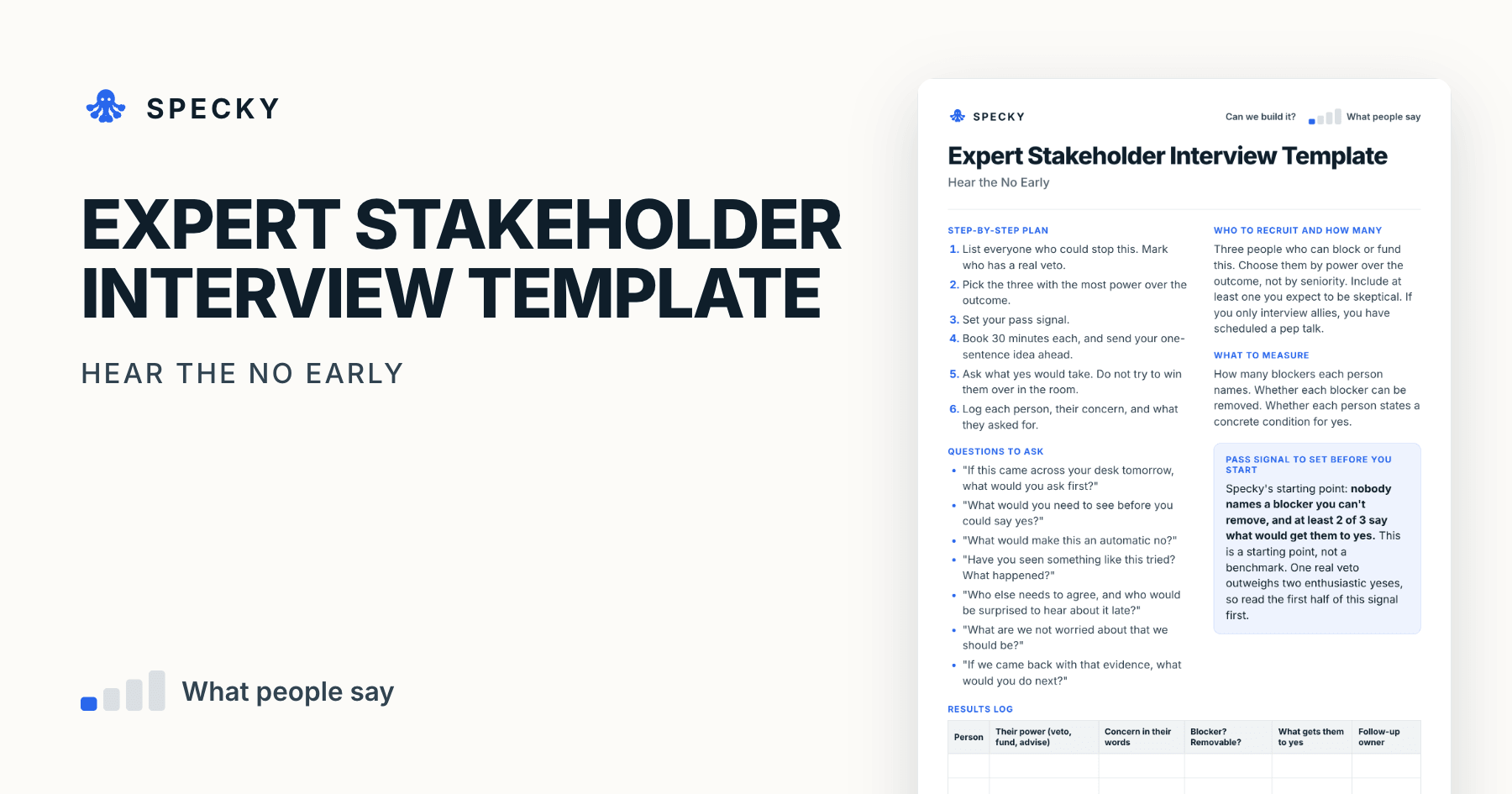
Expert Stakeholder Interview Template: Questions to Hear the No Early
Hear the no while it is still cheap. Find out exactly what legal, security, finance or a domain expert would need to see before saying yes, then turn each condition into a test.
Share
An expert stakeholder interview is a 30-minute conversation with someone who can block, approve or fund your idea, such as legal, security, finance or a respected domain expert, to learn exactly what they would need to see before saying yes. This stakeholder interview template gives you who to ask, a copyable question guide, a pass signal and a results log.
Key takeaways
Ask for conditions, not predictions. In Philip Tetlock's 20-year study, 284 professional commentators answered 82,361 forecasting questions and were no more accurate than chance (Journal of Accountancy, 2006).
Strategyzer's experiment library rates expert stakeholder interviews 2 out of 5 for evidence strength, one notch above customer interviews at 1 out of 5 (Strategyzer poster).
Talk to three people chosen by power, not seniority, one at a time, including at least one sceptic.
Set the pass signal before the first call: nobody names a blocker you can't remove, and at least 2 of 3 say what would get them to yes.
What is an expert stakeholder interview?
The method comes from Testing Business Ideas by David J. Bland and Alex Osterwalder, Strategyzer's field guide of 43 experiment types organised by cost, time and strength of evidence (Strategyzer). It sits among the discovery experiments, next to customer interviews and partner and supplier interviews.
A stakeholder, for this test, holds one of three kinds of power: veto (legal, security, a data protection officer, a regulator), fund (a budget holder or the person who signs the order) or advise (a clinician, senior engineer or industry veteran whose word others follow).
Nielsen Norman Group uses the term more broadly, for anyone with a stake in a design project (Sarah Gibbons, NN/g, 2022). The expert version has one idea on the table and one question under every other: what would yes take?
When should you use an expert stakeholder interview, and when not?
Use it when the idea can die in a meeting you are not in: legal, security, finance, a regulator, or a domain expert whose word others follow. It is also the first step when you need to know whether something is allowed at all.
Do not use it to find out what customers want. An expert's view of a customer is still secondhand; run a customer interview instead. If buyers stall on price or terms, ask the people who hear it every day with a sales team feedback round. If the question is whether investors believe your advantage, try an investor feedback test.
Which risk does it test, and how strong is the evidence?
In our catalogue this tests feasibility in the widest sense: can this actually happen, given the people and rules around it? Strategyzer's poster tags it desirability and viability instead, and rates it 2 out of 5 for cost, 2 for setup time, 3 for run time and 2 for evidence strength. Either way, the evidence is opinion, the lowest rung in our guide to choosing a product experiment.
Two findings shape how to use it:
Experts are strong on constraints and weak on forecasts. Tetlock's commentators did no better than chance at predicting events in their own fields. A compliance lead's answer about data residency is knowledge; their guess about adoption is noise.
Commitments beat compliments. Rob Fitzpatrick's The Mom Test treats most opinions as unreliable, except from industry experts who have built similar businesses. Even then, a meeting counts when it ends in a commitment of time, reputation or money (Unusual Ventures summary).
What you are really collecting is a list of conditions you can then test.
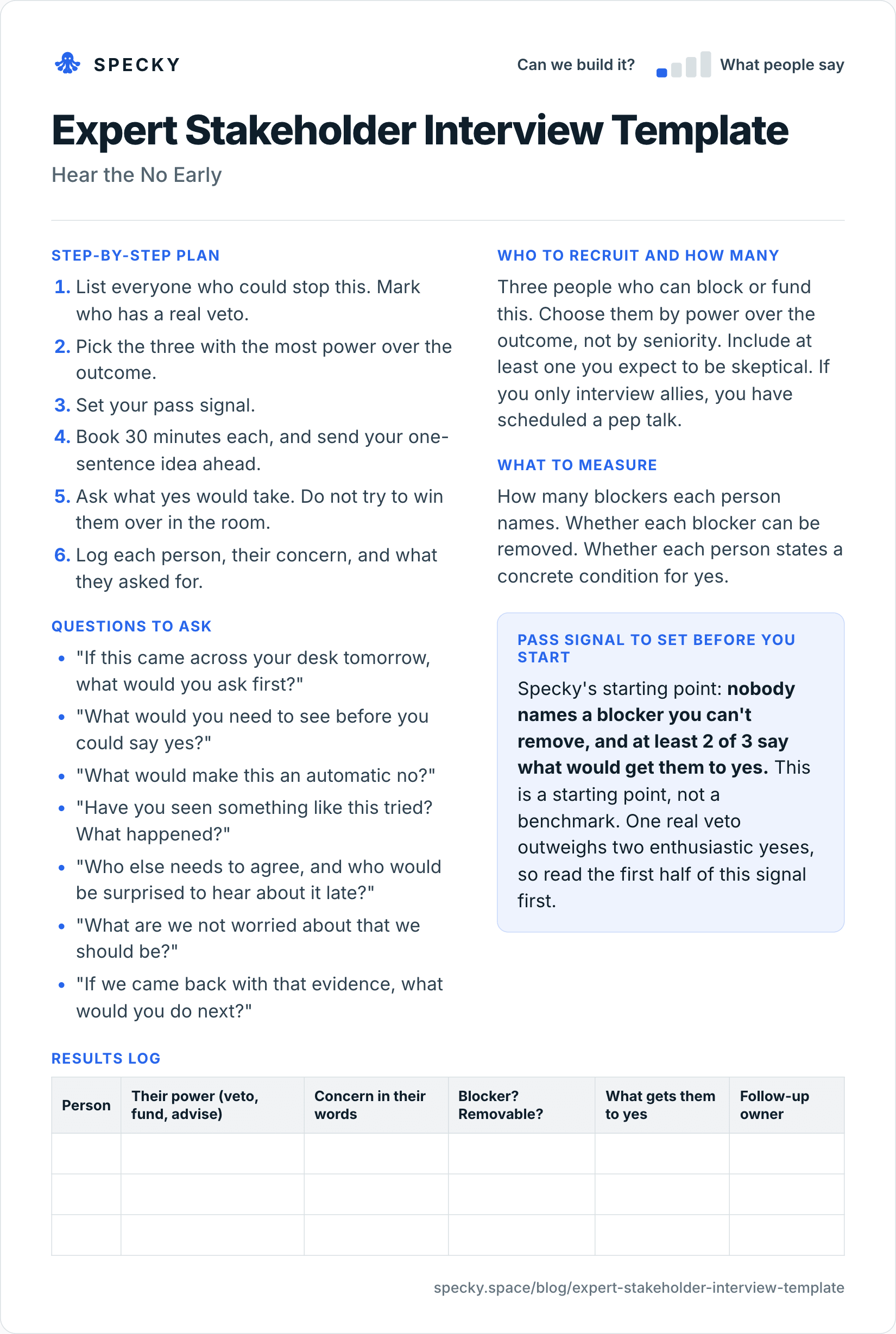
Stakeholder interview template (copy and use)
Open the image at full size, or copy the text version below.
Who to recruit and how many
Three people who can block or fund this. Choose them by power over the outcome, not by seniority. Include at least one you expect to be sceptical. If you only interview allies, you have scheduled a pep talk.
Step-by-step plan
List everyone who could stop this. Mark who has a real veto.
Pick the three with the most power over the outcome.
Set your pass signal.
Book 30 minutes each, and send your one-sentence idea ahead.
Ask what yes would take. Do not try to win them over in the room.
Log each person, their concern, and what they asked for.
Questions to ask
"If this came across your desk tomorrow, what would you ask first?"
"What would you need to see before you could say yes?"
"What would make this an automatic no?"
"Have you seen something like this tried? What happened?"
"Who else needs to agree, and who would be surprised to hear about it late?"
"What are we not worried about that we should be?"
"If we came back with that evidence, what would you do next?"
What to measure
How many blockers each person names. Whether each blocker can be removed. Whether each person states a concrete condition for yes.
Pass signal to set before you start
Specky's starting point: nobody names a blocker you can't remove, and at least 2 of 3 say what would get them to yes. This is a starting point, not a benchmark. One real veto outweighs two enthusiastic yeses, so read the first half of this signal first.
Results log
Person
Their power (veto, fund, advise)
Concern in their words
Blocker? Removable?
What gets them to yes
Follow-up owner
Copyable 30-minute stakeholder interview guide
This wraps the seven questions in a timed call, so you leave with conditions rather than "sounds interesting".
Two days before (by email): "We're exploring [one-sentence idea] and want to learn what you would need to see to support it, and what would stop it. 30 minutes, no slides, no decision needed."
0–3 minutes: set the frame. "I'm not here for approval. I'm here to learn what approval would take, so the honest no is the most useful answer. May I take notes?"
3–8 minutes: their world. "What was the last proposal like this you reviewed? What happened to it?"
8–20 minutes: conditions. Ask what they would check first, what yes would take, and what would be an automatic no. Push each answer towards something testable: "What number would make you comfortable?" Stay neutral, as NN/g advises, and probe with "Tell me more about that."
20–26 minutes: history and blind spots. Seen it tried? What are we not worried about that we should be? Who else must agree?
26–30 minutes: close with a commitment. "If we came back with that evidence, what would you do next?" Then ask for 20 minutes when you have it, or an introduction to the next person on the list.
Within an hour: fill in the results log and email a read-back. "You said yes would take [X] and [Y], and [Z] would be a no. Did I get that right?" A written read-back turns an opinion into a condition you can both point to. If they will only answer by email, NN/g suggests cutting a guide to 4 or 5 questions.
How do you find who can block or fund your idea?
List every role between first pilot and signed contract, and mark each veto, fund or advise. The table is illustrative; check it against how your customer actually buys.
Role
Usual power
What they tend to ask first
Evidence that tends to move them
Data protection officer or legal
Veto
Where does personal data go?
A data map and an impact assessment
Security reviewer
Veto
How is it accessed and logged?
A security questionnaire and access controls
Finance or budget holder
Fund
What does it cost and replace?
A price and a small pilot budget
Head of the team that will use it
Fund or veto
Who does the extra work?
A pilot plan with named people and hours
Respected domain expert
Advise
Why did this fail last time?
A credible answer to that failure
Some roles are set by law. Under GDPR Article 35, processing likely to be high-risk needs an impact assessment first, with the data protection officer's advice where one is designated (GDPR Art. 35). Health data is a special category under Article 9 (GDPR Art. 9). Touch either, and the privacy lead is on your list.
How many stakeholders should you interview?
Three per decision, chosen by power over the outcome and interviewed one at a time. NN/g recommends one-on-one stakeholder interviews; in a group, the senior voice fills the room and the person with the veto stays quiet.
That is fewer than the 5–6 per group NN/g suggests for starting a customer interview study (Maria Rosala, NN/g, 2021), on purpose. Stakeholders are not a sample; each one is a named gate. Add one or two more if the first three conflict or a hidden veto appears. With five or fewer, an informal read of your notes works; with more, NN/g suggests sorting concerns into themes first.
Expert stakeholder interview vs customer interview vs partner interview
What would it take you to deliver this, at what cost?
Typical size
3 conversations of 30 minutes
5–6 per customer type to start
3 calls per partner you can't replace
Strategyzer evidence rating
2 out of 5
1 out of 5
2 solid dots plus 2 hollow-centred ones
Run them in order of what would kill the idea first. If a regulator can say no, the stakeholder interview comes before a single customer call.
Worked example (hypothetical)
This example is made up to show the method. A five-person team wants to add an AI summary of patient messages to its clinic software. They believe clinics will accept it as long as it is accurate.
They interview a clinic's compliance lead, a practice manager who approves purchases, and an outside adviser on health data. The compliance lead names a blocker: patient data cannot leave the region. It can be removed by changing hosting. The practice manager says yes would need a two-week trial with one doctor checking every summary. The adviser says the summaries must be labelled as machine-written.
Nobody named a blocker they could not remove, and two people named a clear path to yes. They record the test as passed, and write three new assumptions: regional hosting, doctor review time, and labelling.
The scorecard: 90 minutes of calls, 1 blocker, 0 unremovable, 2 of 3 concrete conditions, and a booked 20-minute review with the practice manager. That booked slot, not the warm tone, is the real signal.
What mistakes ruin stakeholder interviews?
Only asking friendly people. The sceptic is the most useful person on your list.
Pitching instead of listening. You are there to learn the conditions, not to win the argument today.
Treating seniority as power. A mid-level security reviewer can stop a deal that a vice president loves.
Asking for a yes. You want the conditions for yes. A vague yes will not survive contact with their calendar.
Letting the notes die. A concern nobody owns will come back at the worst moment.
Turning a condition into a promise. "Legal is fine with it" is not what legal said. Ask before recording, and don't quote one stakeholder to another; the relationship outlasts the test.
When it doesn't work: when the person with the veto will not talk to you, or the idea is too vague for anyone to name a condition. An assumption map helps you sharpen it first.
How to run it in Specky
On the Assumptions page, click the note and choose Pick a test, then Expert stakeholder interviews. Specky fills in three conversations, the pass signal, and a one-week timeline.
Click Open in Vouch if you want to run it as an AI interview at vouch.specky.space. For a senior person, a live call is often the better choice.
Click Open stakeholder map and log who you asked, how much influence they hold, and what they asked for. This is what keeps each person's condition from being forgotten.
Click Start running, and record the result when the conversations are done.
A pass shows on the board as Early signal, not Supported, because a person's judgment is opinion-level evidence.
What should you do with each outcome?
Supported (shows as Early signal): Turn each condition into its own assumption and test the hardest one. If a person asked for a working demo, consider a Wizard of Oz test.
Unclear: People gave soft answers. Go back with a specific proposal and ask what they would change.
Contradicted: Someone has a blocker you cannot remove. Stop and ask whether the idea can be reshaped to avoid it. Any bet on this note now shows as Contradicted, which is a good moment to tell whoever is funding it.
Frequently asked questions
Who counts as a stakeholder for a product experiment?
A stakeholder is anyone who can block, fund or significantly delay your idea. That often includes legal, security, finance, sales leadership, a data protection officer and outside regulators. Rank them by power over the outcome, not job title: a mid-level reviewer with a veto matters more than a senior fan without one.
What questions should you ask in a stakeholder interview?
Ask what they would check first, what they would need to see before saying yes, what would make it an automatic no, and who else needs to agree. Those answers become conditions you can test. Avoid asking them to predict whether customers will like it.
How long should a stakeholder interview be?
Thirty minutes is enough for one idea: three to set the frame, five on their world, twelve on conditions for yes and no, six on history, and four on a next step. Email a read-back of what you heard within an hour.
Does a stakeholder's approval validate an idea?
No. Approval removes a blocker, but says nothing about whether customers will use or pay for the product. Strategyzer rates expert stakeholder interviews 2 out of 5 for evidence strength. Treat a yes as permission to keep testing, starting with the riskiest condition they named.