Sales Team Feedback Template: Find Out Why Buyers Stall
Someone at your company knows exactly why deals stall. Here is how to ask so that you get the truth and not agreement, and how to check what they remember.
Share
Sales team feedback is a short round of one-to-one conversations with the people who sell or renew your product. You ask what buyers hesitate on in specific recent deals, and you log each objection next to the person and the deal it came from. Done well, it tells you what to test next within a week. It does not tell you what to build.
Key takeaways
Strategyzer's Testing Business Ideas library lists "Sales Force Feedback" as a discovery experiment, in the data-analysis group with support analysis and search trends (experiment library poster).
Sellers see a slice of the buyer's decision. Gartner found B2B buyers spend 17% of their buying time meeting potential suppliers, maybe 5-6% per supplier when comparing three (destinationCRM, 2018).
Many deals die without a competitor. From about 2.5 million recorded sales conversations, Matt Dixon reports 40-60% of deals are lost to the customer doing nothing (CustomerThink, 2022).
Price gets over-blamed. In 3,400+ buyer interviews, Klue found price ranked third as a loss reason, behind product and sales experience (Klue, 2024).
Specky's starting pass signal: at least 3 of 5 sellers raise the objection without being asked.
What is sales team feedback?
Sales team feedback means asking the people who sell or renew your product what buyers hesitate on, and logging each objection next to the person who raised it.
It comes from the Testing Business Ideas library by David J. Bland and Alexander Osterwalder, which sorts 43 experiment types by cost, time and strength of evidence (Strategyzer). You are not collecting new data from buyers. You are mining what your own team already hears, then deciding which of it deserves a proper test.
Which risk does it test, and how strong is the evidence?
This tests viability: is something about the offer getting in the way of the money? The evidence is opinion, and it is secondhand: the seller's memory of what a buyer said. Our guide to choosing a product experiment places it low on the ladder. Its value is in telling you what to test.
When should you ask your sales team for feedback, and when not?
Use it when deals stall and nobody can agree why, or before changing pricing, packaging, or positioning. The people closest to buyers often know the real reason, and they can tell you in a week.
Do not use it if you have no one selling yet. In a very early company, the founder is the sales team, so look at your own lost deals instead. And be careful with what salespeople say a product needs: they hear the buyers they are talking to, and they lean toward whatever would have closed the last deal.
It is also the wrong tool for questions about people who already use the product every day. To learn whether they would miss it, use a product-market fit survey.
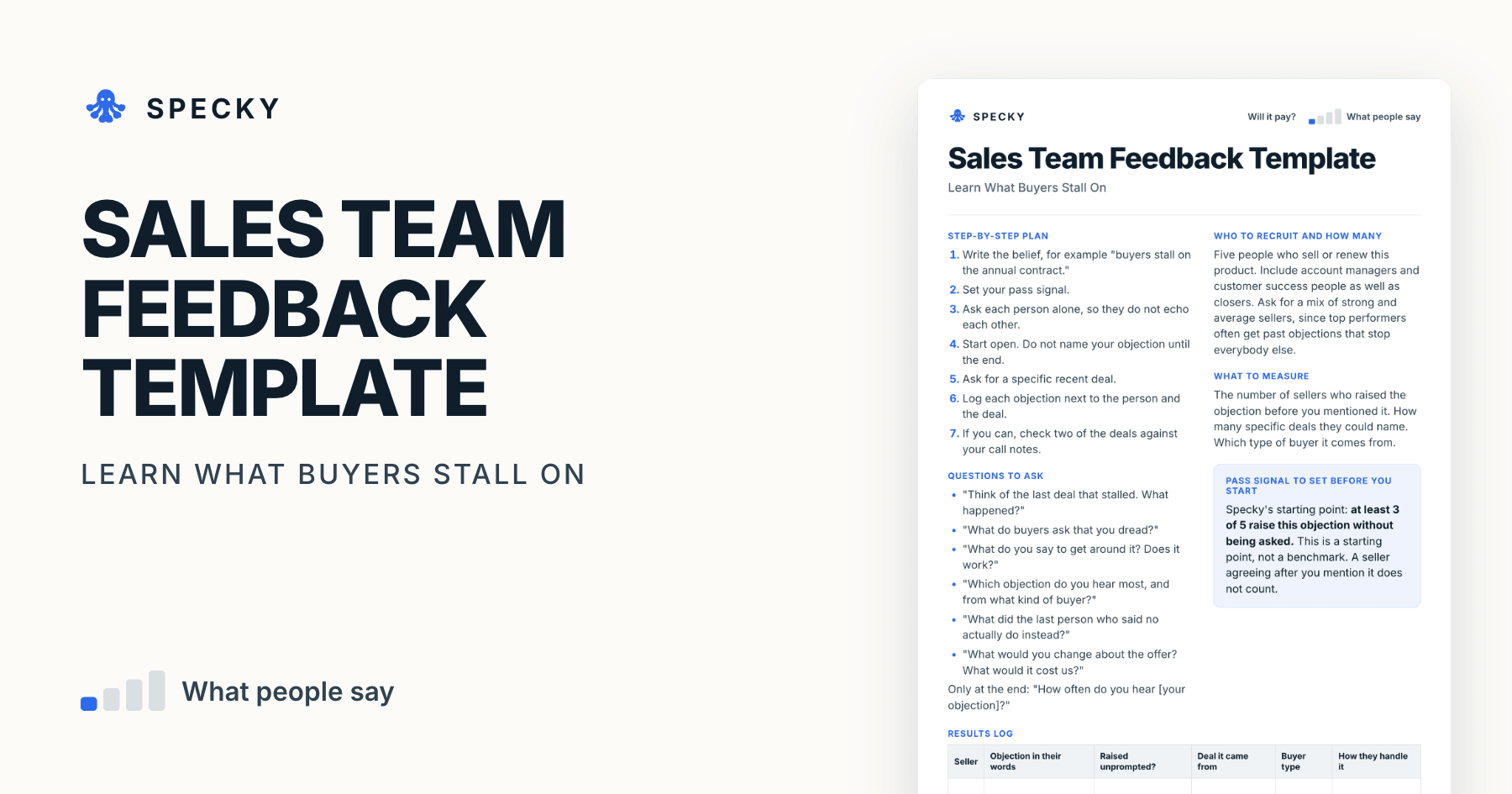
Copy-and-use sales team feedback template
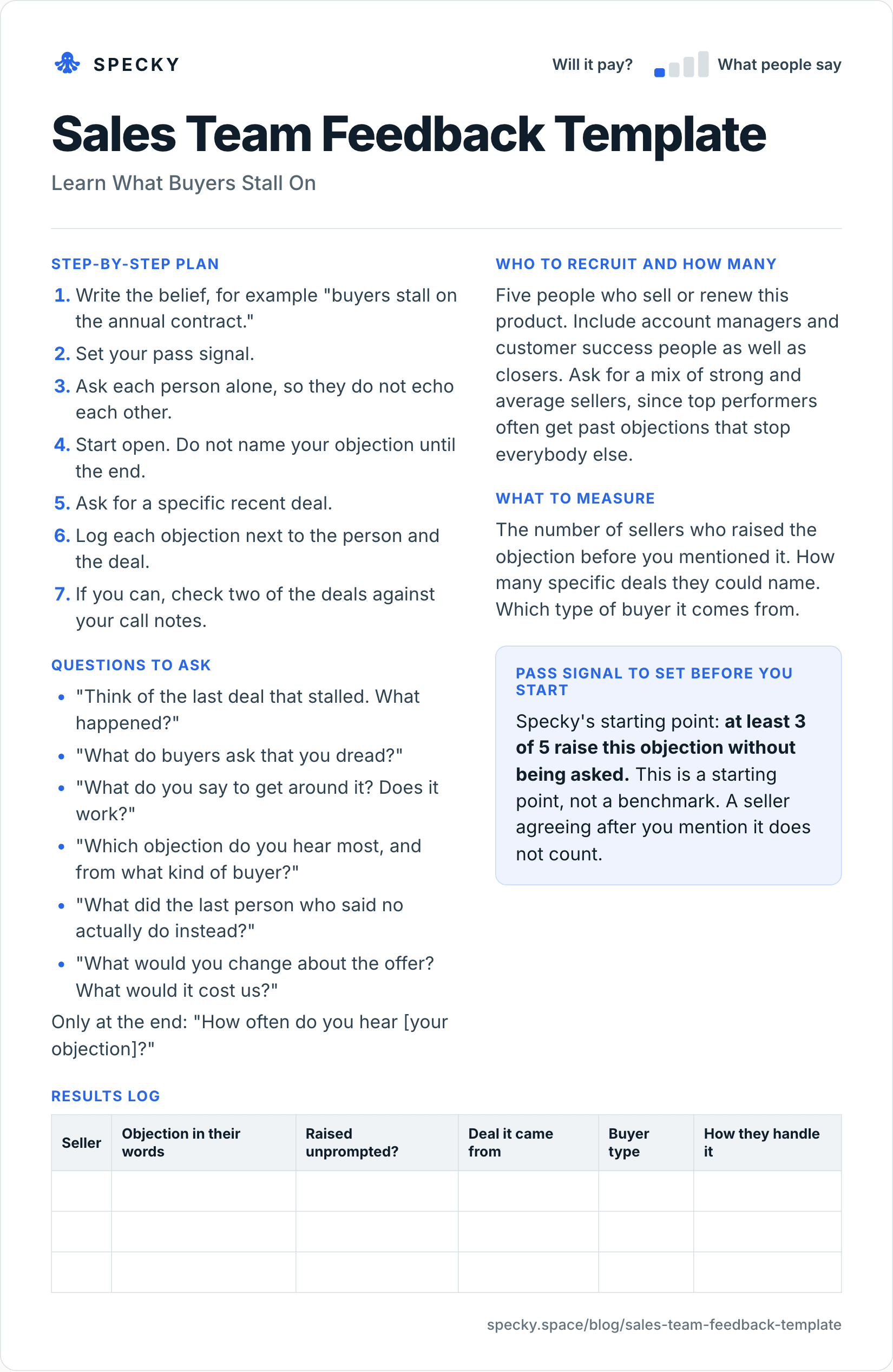
Open the image at full size, or copy the text version below.
Who to recruit and how many
Five people who sell or renew this product. Include account managers and customer success people as well as closers. Ask for a mix of strong and average sellers, since top performers often get past objections that stop everybody else.
Step-by-step plan
Write the belief, for example "buyers stall on the annual contract."
Set your pass signal.
Ask each person alone, so they do not echo each other.
Start open. Do not name your objection until the end.
Ask for a specific recent deal.
Log each objection next to the person and the deal.
If you can, check two of the deals against your call notes.
Questions to ask
"Think of the last deal that stalled. What happened?"
"What do buyers ask that you dread?"
"What do you say to get around it? Does it work?"
"Which objection do you hear most, and from what kind of buyer?"
"What did the last person who said no actually do instead?"
"What would you change about the offer? What would it cost us?"
Only at the end: "How often do you hear [your objection]?"
What to measure
The number of sellers who raised the objection before you mentioned it. How many specific deals they could name. Which type of buyer it comes from.
Pass signal to set before you start
Specky's starting point: at least 3 of 5 raise this objection without being asked. This is a starting point, not a benchmark. A seller agreeing after you mention it does not count.
Results log
Seller
Objection in their words
Raised unprompted?
Deal it came from
Buyer type
How they handle it
How do you get honest feedback from salespeople?
Salespeople are good at reading what the person in front of them wants to hear. That skill works against you here. Four rules keep the answers clean.
Ask alone. In a group, the first answer becomes everybody's answer. Book five separate 20-minute calls instead of one team meeting.
Ask open questions first, and your theory last. Pew Research Center places open questions before related closed ones, because asking about a topic first increases how often people mention it afterwards. Pew also reports that people tend to agree with statements put to them, more so when an interviewer is present (Pew Research Center). "Do buyers struggle with price?" invites a yes.
Ask about a specific past deal. Rob Fitzpatrick's The Mom Test says to talk about specifics from the past rather than opinions or generalities (Unusual Ventures review, 2024). "The Acme deal in March" beats "what do buyers usually say".
Talk less. Let silences run. The second answer is often the real one.
Tell sellers why you are asking, and that names in the log are there to give context, not to judge their performance.
What does sales team feedback miss?
Sellers report what buyers tell sellers. Much of a purchase happens out of their sight.
Most of the decision happens without them. In Gartner's research, B2B buyers spent 17% of their buying time meeting potential suppliers, 27% researching independently online, 18% researching offline and 22% meeting their own buying group. Gartner's Brent Adamson pointed to "a buying problem that has nothing to do with the supplier at all" (destinationCRM, 2018).
Many lost deals are not lost to a rival. Matt Dixon, co-author of The JOLT Effect with Ted McKenna, says that in their study of about 2.5 million recorded sales conversations, 40-60% of deals ended with the customer doing nothing. Preference for the status quo explained less than half of those; the bigger share came from buyers afraid of making a big mistake (CustomerThink, 2022). A seller may log this as "timing" or "price".
Price is the easy answer. Klue's analysis of more than 3,400 buyer interviews ranked price third among loss reasons, behind product issues and the sales experience. Within price-related losses, buyers mentioned budget constraints less than 10% of the time, even though budget is a common reason in CRM drop-downs and seller debriefs (Klue, 2024).
Use this table to decide what to check before you trust a common answer:
What sellers say
What it may really be
How to check
"Too expensive"
Weak business case, confusing pricing
Ask buyers what they compared it to; run a pricing survey
"Missing feature X"
The buyer did not see the value
Ask which job X would do; look for that job in calls
"Bad timing"
Fear of a failed rollout
Ask what the buyer said about risk or effort
"Lost to competitor"
Lost to doing nothing
Ask what the buyer did instead
Can you run it as a sales team survey?
Yes, if you have more sellers than you can talk to. With 15 or more people across regions, send a short form, then interview five of them. Keep it to five questions, and put the closed question on a separate last page so earlier answers stay unprompted. NN/g's advice for surveys applies: keep them short, and write neutral questions that don't reveal your expectations (NN/g, 2016).
"Name the last deal that stalled or was lost. What happened, in two or three sentences?" (Open)
"What objection do you hear most often, in the buyer's words?" (Open)
"Which type of buyer raises it?" (Your segments, plus "Other")
"What did the last buyer who said no do instead?" (Bought a competitor / Did nothing / Built it themselves / Don't know)
Next page: "How often do you hear [your objection]?" (Most deals / Some deals / Rarely / Never)
Count question 2 answers that match your objection before anyone reaches question 5. That is your unprompted share.
Worked example (hypothetical)
This example is made up to show the method. A 10-person company selling compliance software believes buyers stall because the price is too high. The founder talks to five people in sales and customer success, without mentioning price.
Only one brings up price. Four bring up the same thing: the security questionnaire takes six weeks, and deals go cold while waiting. Two can name specific lost deals, one of which ended with the buyer doing nothing at all.
The pass signal for price fails. The security questionnaire would have passed clearly. They replace the price assumption with one about a pre-filled questionnaire.
Extending the example. The founder checks the two named deals against call notes. In both, the buyer's IT lead raised the questionnaire in the first call, and neither mentioned budget. That moves the finding from memory to record. Next, the team tests the fix with buyers: a pre-filled questionnaire goes to the next 4 deals that reach security review, and they track days from sending to return against the six-week norm. If three of four come back within two weeks, the assumption moves to Supported.
Sales team feedback vs support analysis vs buyer interviews vs discovery survey
Start with sales team feedback because it is fastest, then confirm the top objection with buyers themselves.
Common mistakes
Naming the objection first. You will get agreement instead of information.
Asking the group together. The first answer becomes everybody's answer.
Taking feature requests literally. "If only we had X" often really means the buyer did not see the value.
Ignoring who said it. An objection from a small buyer may not matter for your target customer.
Stopping at what sellers remember. Check call notes or recordings where you can.
Taking "price" at face value. Ask what the buyer compared it to before you cut it.
How to run it in Specky
On the Assumptions page, click the note and choose Pick a test, then Sales force feedback. Specky fills in five people, the pass signal, and a three-day timeline.
You hold these conversations yourself. Click Open stakeholder map and log who you asked, their influence, and the objection they raised.
Click Start running, then record the objections and the result on the test.
If you have connected a call-recording tool, you can also ask Specky in chat to look for the same objection in past calls. That is often a useful check on what sellers remember.
A pass shows on the board as Early signal, not Supported, because secondhand reports are opinion.
Unclear: Sellers disagree. Split by buyer type, then talk to a few buyers directly.
Contradicted: The objection you expected is not the real one. Replace the assumption with what sellers actually said. Any bet resting on this note now shows as Contradicted.
Frequently asked questions
Why ask the sales team for product feedback?
The sales team hears objections from buyers every day, often before anyone else in the company. Their feedback shows what is stalling deals, which helps you decide what to test. It is fast and nearly free: five 20-minute conversations can surface the top objection within a week.
How do you get honest feedback from salespeople?
Ask each person alone and ask about a specific recent deal. Start with open questions and do not mention your own theory until the end, or you will only get agreement. Then check two of the deals they name against call notes or recordings.
Is sales feedback reliable?
Sales feedback is useful but secondhand. It reflects the deals a seller remembers, and it can lean toward whatever would have closed the last one. Gartner found buyers spend only 17% of their buying time with suppliers, so sellers miss most of the decision. Check it against call notes or buyers.
What questions should you ask your sales team?
Ask about the last deal that stalled, the buyer question they dread, how they handle it and whether it works, the most common objection and from which buyers, and what the last buyer who said no did instead. Only at the end, ask how often they hear the objection you suspect.
Should a sales team survey replace the conversations?
No. A survey reaches more sellers, but it loses the follow-up questions that turn "price" into the real reason. With a large team, send a short survey to find patterns, then hold five one-to-one conversations to understand them.