Day in the Life Study Template: Watch the Real Job, Not the Story
People cannot describe work they do on autopilot. Spend a morning watching the real job and see the workarounds, handoffs and give-ups nobody mentions.
Share
A day in the life study is a research method where you follow a customer through their real work for a few hours, on site or over a screen share, and write down every workaround, handoff and moment they give up. It shows what people do rather than what they say they do. Below is a free day in the life study template, an observation sheet, debrief questions and a pass signal.
Key takeaways
Watch, don't ask. Jakob Nielsen's rule is to pay attention to what users do, not what they say, because self-reports are bent by politeness, faulty memory and after-the-fact reasons (NN/g, 2001).
Strategyzer rates "A Day in the Life" 3 out of 5 for evidence strength, against 1 out of 5 for customer interviews, at the same 2 out of 5 cost (Strategyzer poster).
A few hours per person is enough. Karen Holtzblatt and Hugh Beyer, who created contextual inquiry, keep field interviews to a few hours, not days or weeks (IxDF).
Some companies make it a habit. Fortune reported in 2014 that Intuit ran 10,000 hours of "Follow Me Home" visits a year (Fortune).
Set the pass signal before the first visit: the problem shows up on its own with at least 2 of 3 people.
What is a day in the life study?
"A Day in the Life" is one of the discovery experiments in Testing Business Ideas by David J. Bland and Alex Osterwalder, Strategyzer's field guide of 43 experiment types (Strategyzer). In UX research the same idea is called a field study, and it comes in several strengths. Nielsen Norman Group lists them (Farrell and Fessenden, NN/g, 2024):
Direct observation. You are a fly on the wall and ask nothing until the end. This is the default in our template.
Contextual inquiry. You watch and stop to ask questions as the work happens.
Customer-site visits. A mix of observation and interview, often guided by the customer.
Ethnography. Full immersion in a group's setting over a long period.
Contextual inquiry has the deepest roots. Holtzblatt and Beyer developed it at Digital Equipment Corporation in the early 1980s and wrote it up in Contextual Design (Morgan Kaufmann, 1997). Its core idea is the master and apprentice: you learn the work the way an apprentice would, by watching a skilled person do it and asking about what you see.
When should you use a day in the life study, and when not?
Use it when people cannot describe their own work well because it has become automatic, or when you suspect the real problem sits between two tools or two people. Watching often shows a sticky note, a spreadsheet, or a shouted question that nobody would mention in an interview.
Do not use it when the job happens rarely or privately, since you will sit and wait. For a problem that shows up unpredictably over weeks, use a diary study. If you only need to know how people retell the last event, a customer interview is cheaper. If you already have a product and want to know whether people can use it, run a usability test instead.
Which risk does it test, and how strong is the evidence?
This tests desirability: does the problem actually show up in someone's working day? Strategyzer's poster agrees, tagging the method desirability only, and rates it 2 out of 5 for cost, 2 for setup time, 3 for run time and 3 for evidence strength.
Our catalogue is stricter and rates the evidence as opinion, because three people on three days is a small sample and you are interpreting what you saw. It is stronger than a retold story, but it does not show anyone will change their behaviour. See where it sits in our guide to choosing a product experiment.
The reason it beats an interview is the gap between saying and doing. Nielsen names three distortions in what people report: telling you what they think you want to hear, misremembering the small details that matter, and inventing reasons afterwards. Watching skips all three, though it adds one of its own, covered below.
Day in the life study template (copy and use)
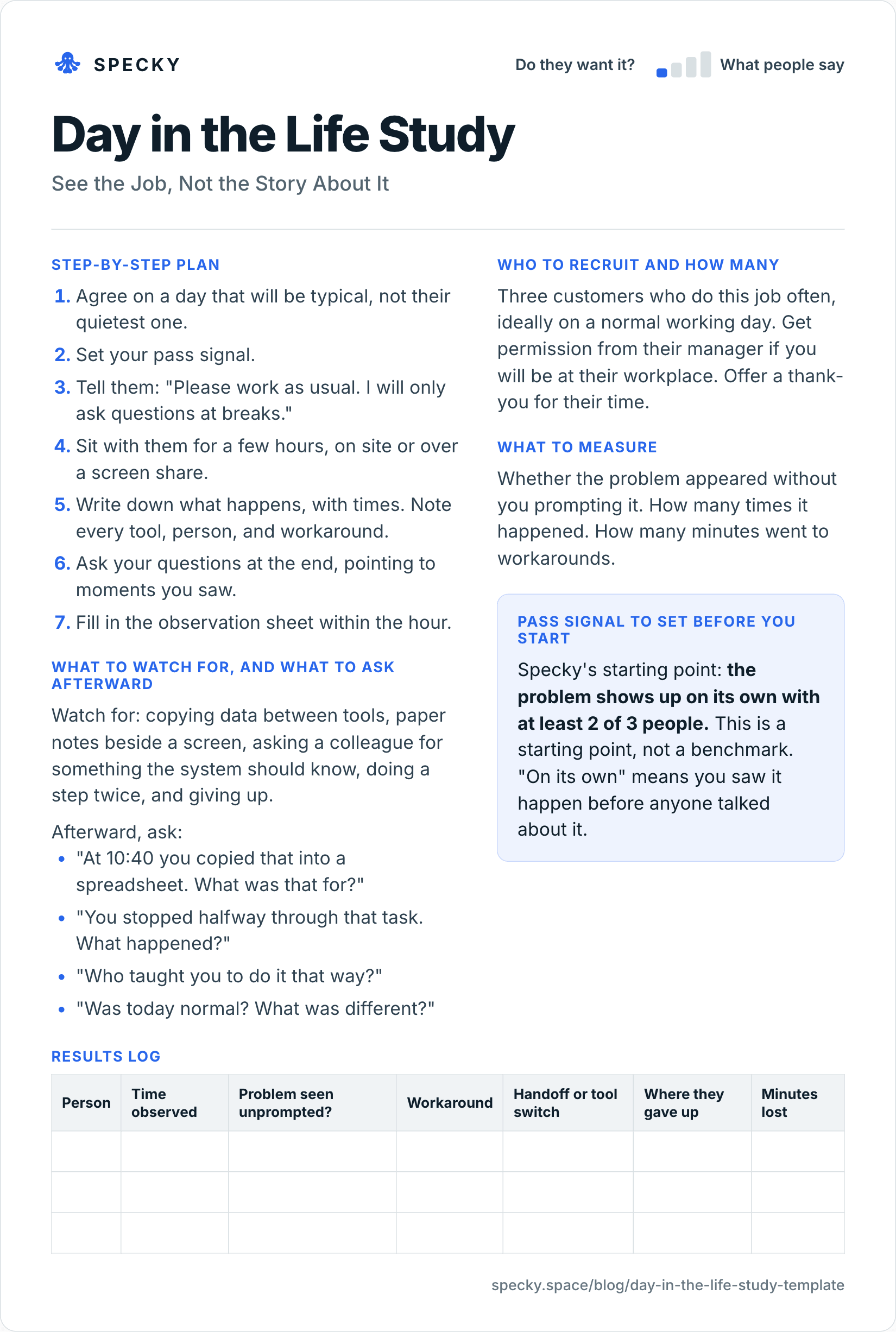
Open the image at full size, or copy the text version below.
Who to recruit and how many
Three customers who do this job often, ideally on a normal working day. Get permission from their manager if you will be at their workplace. Offer a thank-you for their time.
Step-by-step plan
Agree on a day that will be typical, not their quietest one.
Set your pass signal.
Tell them: "Please work as usual. I will only ask questions at breaks."
Sit with them for a few hours, on site or over a screen share.
Write down what happens, with times. Note every tool, person, and workaround.
Ask your questions at the end, pointing to moments you saw.
Fill in the observation sheet within the hour.
What to watch for, and what to ask afterward
Watch for: copying data between tools, paper notes beside a screen, asking a colleague for something the system should know, doing a step twice, and giving up.
Afterward, ask:
"At 10:40 you copied that into a spreadsheet. What was that for?"
"You stopped halfway through that task. What happened?"
"Who taught you to do it that way?"
"Was today normal? What was different?"
What to measure
Whether the problem appeared without you prompting it. How many times it happened. How many minutes went to workarounds.
Pass signal to set before you start
Specky's starting point: the problem shows up on its own with at least 2 of 3 people. This is a starting point, not a benchmark. "On its own" means you saw it happen before anyone talked about it.
Results log
Person
Time observed
Problem seen unprompted?
Workaround
Handoff or tool switch
Where they gave up
Minutes lost
Copyable observation sheet and debrief guide
The template tells you what to watch for. This sheet makes your notes usable an hour later, when memory has already started to tidy them up.
Consent, before you start: "Thanks for having me. I'm here to learn how this work really happens, not to judge how you do it. Please work exactly as you normally would. I'll take notes with times, and I'll save my questions for breaks. If anything is confidential, tell me and I'll stop writing. Is that all right?"
Running log. One line per event, with the time and a code:
Time
What happened, in plain words
Tool or person
Code
09:12
Opens shared spreadsheet to check yesterday's numbers
Spreadsheet
T
09:15
Copies three figures into the main system by hand
Main system
W
09:31
Walks over to ask a colleague which version is current
Colleague
H
Codes: W workaround, H handoff to a person, T tool switch, R repeated step, G gave up or postponed, S surprise you did not expect.
Debrief, 15 minutes at the end. Go through your codes in time order and ask about specific moments, never in general:
"At [time] you [did X]. What was that for?"
"What would have happened if you hadn't done that?"
"How often does that happen in a normal week?"
"Who taught you to do it that way?"
"Was today normal? What was different?"
Within the hour: count your W, H, R and G codes, add up the minutes they took, and fill in the results log. Only count the problem as "seen unprompted" if it appears in your log before anyone mentioned it.
Should you interrupt, or only watch?
It depends on the work. NN/g's guide to contextual inquiry tells participants to expect the researcher to interrupt when something interesting happens, in a repeating cycle of watch, then stop and discuss (Flaherty, NN/g, 2020). It also lets participants say "not now" and carry on to a better stopping point.
For people who cannot be interrupted, such as doctors or air traffic controllers, NN/g suggests direct observation with follow-up questions later. Use this rule:
If the work is…
Use
Why
Time-critical, customer-facing or safety-related
Direct observation, questions at breaks
Interrupting changes the outcome
Slow, screen-based and easy to pause
Contextual inquiry, ask as you go
Reasons fade within minutes
Physical and spread across a site
Direct observation, follow them
Much of it happens away from a desk
Our template defaults to questions at breaks, because a first study should disturb the work as little as possible.
How many people, and how long?
Three people for a few hours each, within one week. NN/g puts contextual inquiry sessions anywhere from an hour or two to several days, depending on the scope of the work, and recommends a small sample of people who are expert in the job. Holtzblatt and Beyer restrict field interviews to a few hours, not days or weeks.
Three is enough to answer one narrow question: does this problem show up on its own in a normal day? If it appears with two of three, you have your signal. If the three days look nothing alike, add two more people before drawing any conclusion. Intuit's 10,000 hours a year is a company-wide habit, not a target for one study.
Does being watched change what people do?
Sometimes, and nobody can say exactly how much. A systematic review of 19 studies by McCambridge, Witton and Elbourne found that taking part in research changed the behaviour being studied in most of them, but concluded there is no single "Hawthorne effect" and little is known about when it happens or how big it is (J Clin Epidemiol, 2014).
You can reduce it:
Discount the first half hour. People settle into normal work once the novelty wears off.
Sit to the side, not behind. And keep your notebook low.
Ask "Was today normal?" every time. If the answer is no, ask what a normal day looks like and consider coming back.
Look for the workaround they forgot to hide. Sticky notes and side spreadsheets rarely get tidied away for a visitor.
Day in the life study vs diary study vs customer interview
They work well in sequence: watch three people to find the problem, run a diary study to count how often it happens, then interview to understand why it matters to them.
Worked example (hypothetical)
This example is made up to show the method. A small team believes warehouse supervisors need a better way to see stock levels. They shadow three supervisors for a morning each.
Stock levels never come up. What they do see, with all three, is supervisors walking the floor to ask who is free, then writing shift swaps on a whiteboard and photographing it. Two supervisors spend over half an hour on this before lunch.
Their pass signal was about stock levels, and it failed: the problem did not show up on its own. But the observation gave them a new belief worth testing, about shift swaps, which they would never have heard about in an interview about stock.
Here is how their logs could read. Three mornings of about 3.5 hours each, so roughly 10 hours of observation. Stock-level checks coded as a problem: 0. Shift-swap events coded H or W: 11 across the three mornings, taking 35, 40 and 15 minutes. That is a clear new signal for 2 of 3 people, and the next test is a concierge MVP that handles swaps by hand for a week.
What are the most common day in the life study mistakes?
Helping or chatting. Your presence changes the work. Save the questions for the end.
Watching a staged day. If they tidied up for you, ask to come back.
Writing only what you expected. Note everything, especially what surprises you.
Going alone and trusting memory. Take timed notes as it happens.
Asking general questions afterwards. "Is this hard?" gets an opinion. "What happened at 10:40?" gets a fact.
Calling it proof. Three mornings show you a problem exists. They do not show anyone will pay to fix it.
When it doesn't work: for rare, private or unpredictable work, and for work spread over weeks, where a morning catches nothing. To turn the notes into themes, see how to analyse customer interviews, which applies just as well to observation notes.
What consent do you need?
Ask everyone whose work you will watch, not only their manager. NN/g's field study guide advises getting permission from supervisors, participants and facility managers, and arranging access for public or commercial spaces in advance. Do not photograph screens, documents or other people without asking, keep names out of your notes, and tell participants what you will keep and for how long.
How to run it in Specky
On the Assumptions page, click the note and choose Pick a test, then A day in the life. Specky fills in three people, the pass signal, and a one-week timeline.
Click Open in Vouch. Vouch, at vouch.specky.space, runs this as an AI interview that walks a person through their day. Be honest about what that gives you: it is a guided retelling, not observation. To actually watch someone, go yourself and use it to prepare your questions.
Click Start running, then paste your observation notes onto the test and record the result.
A pass shows on the board as Early signal, not Supported, because this method is rated as opinion-level evidence.
What should you do with each outcome?
Supported (shows as Early signal): The problem is real in daily work. Try a small fix by hand with a concierge test and see if people want it again.
Unclear: It appeared once or twice. Either the day was not typical or the problem is rare. Run a diary study to count how often it happens.
Contradicted: It never showed up. Check your notes for the problem that did, and rewrite the assumption around that. Any bet resting on the old note now shows as Contradicted.
Frequently asked questions
What is a day in the life study in product research?
A day in the life study is a research method where you observe a customer doing the real job for several hours and log what happens. It shows workarounds, handoffs and give-ups that people rarely mention in interviews, because the work has become automatic. Strategyzer rates it 3 out of 5 for evidence strength.
How long should a day in the life study take?
A few hours per person is usually enough, across about three people, within one week. You want one normal stretch of work, not a full week with each person. Add about 15 minutes for a debrief at the end and an hour afterwards to code your notes and fill in the log.
Can a day in the life study be done remotely?
Yes, for screen-based work, through a screen share. Ask the person to share their whole screen, not one window, so you see the side spreadsheet. For physical work, such as a warehouse or a clinic, you need to be there, because much of the job happens away from the screen.
What is the difference between a day in the life study and contextual inquiry?
A day in the life study usually means watching quietly and asking questions at breaks or at the end. Contextual inquiry, developed by Karen Holtzblatt and Hugh Beyer, mixes watching with questions as the work happens, in a master and apprentice style. Pick contextual inquiry when the work can be paused without harm.
How many participants do you need?
Start with three people who do the job often. That is enough to see whether a problem shows up on its own in normal work. If the three days look very different, add two more before you conclude anything. NN/g recommends a small sample of people who are expert in the job.