Diary Study Template: See the Pattern People Forget
"It happens all the time" often turns out to mean once a week. A diary study has people log it as it happens, so you see the real pattern.
Share
A diary study asks a small group of customers to log each time a problem happens, over one to three weeks, so you see the real pattern instead of the one they remember. It turns "it happens all the time" into a count. Use this diary study template to plan the entries, reminders and pass signal before anyone logs a thing.
Key takeaways
A diary study measures how often something happens and how much it hurts, in the moment, over days or weeks (Nielsen Norman Group, 2024).
Eight participants and 14 days is a workable default for one product question; Nielsen Norman Group puts saturation for small discovery projects at roughly 5 to 12 people.
Make each entry take under a minute, ask for a "no" on quiet days, and check in during the first three days.
Entries are still self-reported, and being studied can change behaviour, so treat the count as strong but not perfect evidence.
Set the pass signal as a number before day one: Specky's starting point is at least 5 of 8 people logging the problem several times a week.
What is a diary study?
A diary study is a research method in which participants record events and experiences as they happen, in their normal context, over a period of days or weeks. Nielsen Norman Group calls it a qualitative method for collecting insight "over time and in context", and notes that studies run from a few days to a month or longer (Nielsen Norman Group, 2024).
The method comes from psychology, where diary designs have been used for decades to study daily life. A widely cited review by Bolger, Davis and Rafaeli argues that frequent reports "capture the particulars of experience" that one-off designs miss, and that diaries let you study change within a person, not only differences between people (Bolger et al., 2003).
For a product team, the practical value is simple. An interview captures the most memorable event. A diary captures the ordinary ones, including the days when nothing happened.
When should you use a diary study?
Use a diary study when the problem comes and goes, or when people are bad at estimating how often it happens. Typical product questions it answers well:
Frequency: How often does this actually happen per week?
Triggers: What was the person trying to do when it went wrong?
Severity over time: Is it a daily annoyance or a rare disaster?
Workarounds: What do people already do about it, and what does that cost them?
Do not use it when you need an answer this week, since it takes two weeks and needs people to stick with it. For things that are constant and visible, watching for a morning with a day in the life study is quicker. If you only need people's opinions, a short customer survey is cheaper. And plan for people to forget. Reminders and a small thank-you are part of the method.
Which risk does a diary study test, and how strong is the evidence?
This tests desirability: how often does this happen, and does it matter when it does? The evidence is behaviour, since entries are recorded as life happens. It is still self-reported, and knowing you are logging something can change what you do. See where it fits in our guide to choosing a product experiment.
That last caveat is real but hard to size. A systematic review of 19 studies on the "Hawthorne effect" found most reported some evidence that being studied changes behaviour, but concluded that little can be securely known about when it happens or how large it is (McCambridge, Witton and Elbourne, 2014). The practical answer is to compare week 1 with week 2: if entries drop sharply, novelty or effort is distorting the first week.
Diary study vs interview vs day in the life: which should you pick?
Diary study
Customer interview
Day in the life study
What you get
Counts, triggers and severity over time
Stories, reasons, language
Direct observation of one stretch of work
Time to answer
2–3 weeks
1–2 weeks
1–3 days
Who reports
The participant, in the moment
The participant, from memory
You, watching
Biggest risk
Drop-out and logging fatigue
Recall bias toward vivid events
You only see one day
Best for
Problems that come and go
Why people do things
Constant, visible work
Use the three together. An interview tells you what to log; the diary tells you how often it happens; a follow-up call tells you why.
Copy-and-use template
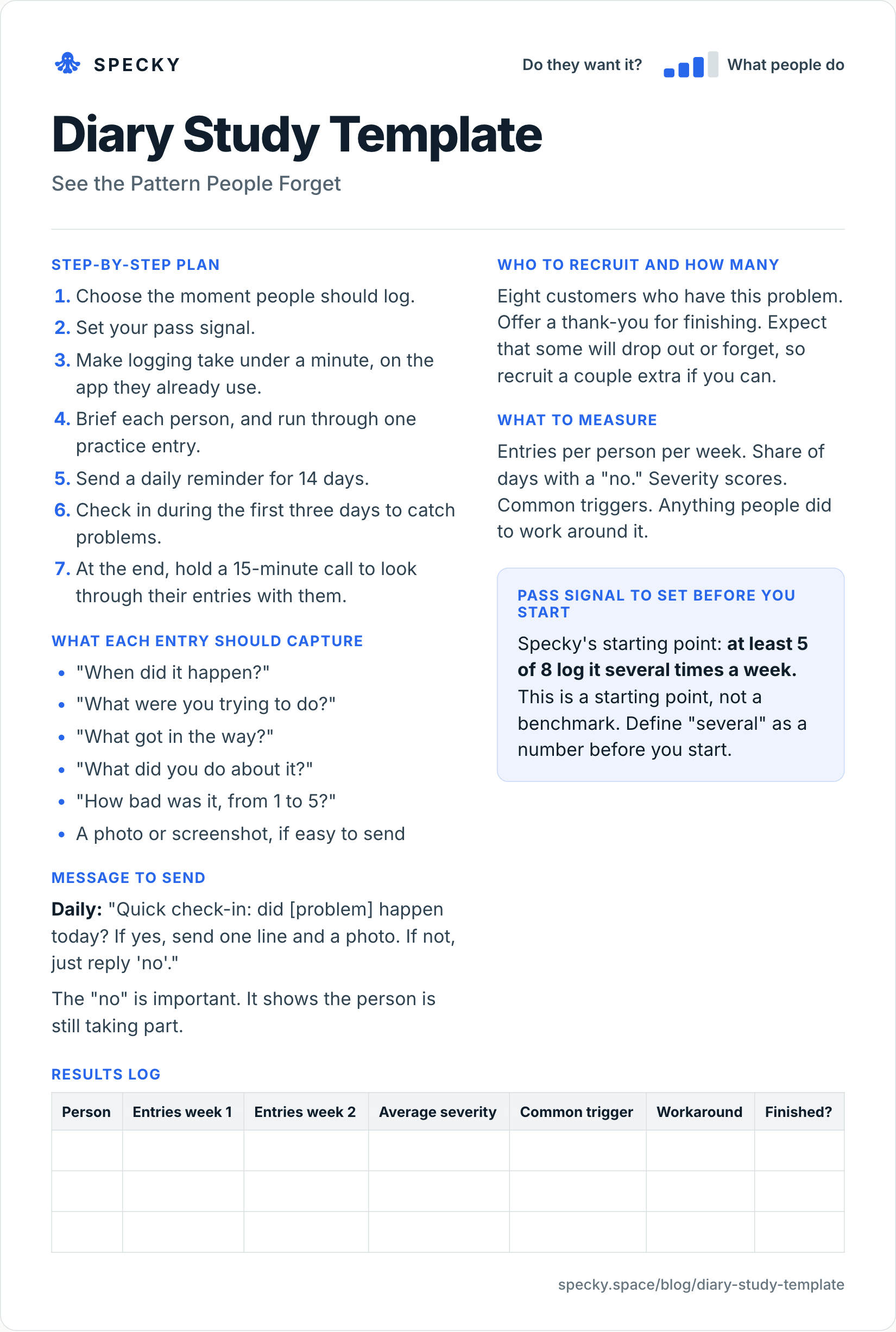
Open the image at full size, or copy the text version below.
Who to recruit and how many
Eight customers who have this problem. Offer a thank-you for finishing. Expect that some will drop out or forget, so recruit a couple extra if you can.
Step-by-step plan
Choose the moment people should log.
Set your pass signal.
Make logging take under a minute, on the app they already use.
Brief each person, and run through one practice entry.
Send a daily reminder for 14 days.
Check in during the first three days to catch problems.
At the end, hold a 15-minute call to look through their entries with them.
What each entry should capture
"When did it happen?"
"What were you trying to do?"
"What got in the way?"
"What did you do about it?"
"How bad was it, from 1 to 5?"
A photo or screenshot, if easy to send
Message to send
Daily: "Quick check-in: did [problem] happen today? If yes, send one line and a photo. If not, just reply 'no'."
The "no" is important. It shows the person is still taking part.
What to measure
Entries per person per week. Share of days with a "no." Severity scores. Common triggers. Anything people did to work around it.
Pass signal to set before you start
Specky's starting point: at least 5 of 8 log it several times a week. This is a starting point, not a benchmark. Define "several" as a number before you start.
Results log
Person
Entries week 1
Entries week 2
Average severity
Common trigger
Workaround
Finished?
How do you run a diary study step by step?
The plan above is the short version. Here is what each step involves in practice.
1. Choose when people should log. Nielsen Norman Group describes three designs (2024):
Design
Participants log…
Use it when
Event-based
Each time the event happens
You need detail on every occurrence, and it is not so frequent that logging becomes a chore
Interval-based
At set times, such as each evening
The event is very frequent, or you only need a daily summary
Signal-based (experience sampling)
When you send a prompt
You worry people will forget to log on their own
This template is event-based with a daily signal: people log when the problem happens, and the daily message catches the days they forgot.
2. Set the pass signal as numbers. Write down what "several times a week" means (for example, 3 or more entries in each week) and how many of the eight must hit it.
3. Make logging take under a minute. Use the app people already have open. For short text entries, Nielsen Norman Group suggests messaging apps such as WhatsApp or Telegram; for structured entries, a simple form. Six fields is the ceiling.
4. Brief and practise. A five-minute call with one practice entry prevents most bad data. Show an example entry, but not so many that people copy its wording.
5. Remind daily. Schedule the message so it goes out at the same time every day.
6. Check in during days 1–3. Read entries as they arrive and ask follow-up questions while the event is fresh. Most set-up problems show up early.
7. Close with a 15-minute call. Walk through the entries with each person. The counts tell you how often; the call tells you why.
How many participants and how long should a diary study last?
Eight people for 14 days is a practical default for a single, focused question. Nielsen Norman Group's guidance puts saturation for small discovery projects with a fairly similar user group at roughly 5 to 12 people, rising to 12 to 30 for broad projects with varied users. It also recommends over-recruiting, because people drop out of longer studies for ordinary life reasons (Nielsen Norman Group, 2024).
Match the length to how often the behaviour happens. Nielsen Norman Group's own examples run from one week for something people do a few times a day to three weeks for something they do once or twice a week. If you expect the problem weekly, two weeks gives you only about two data points per person, so consider three.
Expected frequency
Suggested length
Entries per person you can expect
Several times a day
1 week
15–30
A few times a week
2 weeks
4–8
About once a week
3 weeks
2–4
How much should you pay diary study participants?
Pay more than for a single interview, because you are asking for two weeks of attention. Nielsen Norman Group's broad guideline for a general US sample is about $40 per hour of the total time you expect the study to take, adjusted up for specialist audiences. It also suggests paying in instalments at milestones, such as after three days of logging, to keep people going, and setting a maximum number of paid entries so nobody invents events to earn more (Nielsen Norman Group, 2024).
For a 14-day study with one-minute entries, a 10-minute briefing and a 15-minute closing call, total time is often under an hour per person. A modest thank-you for finishing is usually enough for existing customers who want the problem fixed.
Is there a lighter alternative to a two-week diary?
Yes. If two weeks is too long, ask people to reconstruct yesterday instead. The Day Reconstruction Method, developed by Kahneman and colleagues, has participants walk through the previous day episode by episode, using procedures designed to reduce recall bias; in its first study, reports from 909 employed women closely matched results from experience sampling (Kahneman et al., 2004).
For product work, that means a 20-minute call: "Walk me through yesterday from the moment you started work. Where did [problem] come up?" It is faster, but you get one day per person, so it suits frequent problems better than rare ones.
Worked example (hypothetical)
This example is made up to show the method. A team thinks parents of toddlers lose track of nursery messages. In interviews, parents said it "happens all the time." The team asks eight parents to send a WhatsApp note each time it happens, for two weeks.
Five finish all 14 days. Across those five, the problem shows up about once a week, not all the time. Severity is mostly low, except when the message is about a pickup time change. Those cases score 5 of 5.
Only one parent logged it several times a week, so the signal fails. The real finding is much narrower and more useful: pickup changes matter a great deal.
Here is what the team's results log looked like for the five who finished (still hypothetical):
Parent
Week 1
Week 2
Average severity
Common trigger
Workaround
A
1
1
2.0
Group chat buried the message
Asks partner
B
1
0
5.0
Pickup time changed
Phones the nursery
C
4
3
2.4
Photos and notices mixed together
Screenshots everything
D
1
1
3.5
Pickup time changed
Sets a phone alarm
E
0
1
1.0
Newsletter
None
Total: 13 entries from five people over two weeks, or 1.3 per person per week. Week 2 had slightly fewer entries than week 1 (6 vs 7), so novelty did not inflate the first week much. The pickup-change cases, 3 of 13 entries, averaged 5 out of 5 severity.
How do you analyse diary study entries?
Start with the counts, then read the words.
Count per person per week. This answers the pass signal directly.
Split by trigger. Group entries by what the person was trying to do. One trigger often carries most of the pain, as in the example above.
Weight by severity. A rare 5-out-of-5 problem can matter more than a frequent 1.
List the workarounds. Workarounds show what people already pay in time or effort, which is your first clue to value.
Bring it to the closing call. Ask about the highest and lowest entries, not the average.
For the qualitative part, the same tagging approach used for interviews works: see our interview synthesis template.
What about consent and privacy?
Entries arrive on personal phones, often with photos, so collect only what you need. Under the GDPR, personal data must be "adequate, relevant and limited to what is necessary" for the purpose (GDPR Article 5). In practice:
Use a short consent form that says what you collect, why, how long you keep it, and how to stop.
Ask people not to photograph other people, children or private messages; screenshots of your own product are usually enough.
Delete raw photos once you have coded the entries.
Let people leave at any time without losing the thank-you they have already earned.
Common mistakes
Making logging too hard. If it takes more than a minute, people will stop.
Skipping the "no" reply. You cannot tell silence from "nothing happened."
Skipping the follow-up call. The context lives in the conversation.
Letting it run with no check-in. Most problems appear in the first three days.
Asking for too much. Use six fields at most.
Choosing a length that doesn't fit the frequency. A two-week study of a weekly problem gives you about two data points per person.
Reading the average only. One person with seven entries can hide four people with none.
How to run it in Specky
On the Assumptions page, click the note and choose Pick a test, then Diary study. Specky fills in eight customers, the pass signal, and a two-week timeline.
You run this one. Specky keeps the plan and the result. Collect the entries in a chat app or a simple form.
Click Start running. Paste the counts and the patterns onto the test.
Record the result.
A pass shows on the board as Supported, because logging events as they happen is rated as behavior.
What should you do with each outcome?
Supported: The problem is frequent. Try fixing it by hand for a few of these people with a concierge test.
Unclear: Frequency is mixed. Look for a trigger that separates the high-count people from the low-count ones. Your real segment may be hiding there.
Contradicted: It happens less than people said. Check whether the rare cases are severe enough to matter. If not, drop it. Any bet resting on this note now shows as Contradicted.
If the problem also shows up in support tickets, compare the two counts; a support ticket analysis gives you a free second source.
Frequently asked questions
What is a diary study?
A diary study is a research method where participants record events as they happen over days or weeks, in their normal context. It shows patterns that people cannot accurately recall in a single interview, such as how often a problem really occurs, what triggers it and how much it hurts each time.
How long should a diary study last?
Two weeks is a practical length for most product questions. Match it to how often the behaviour happens: about one week for something that happens several times a day, two weeks for a few times a week, and three weeks for roughly once a week, so each person logs enough entries to read.
How many participants do you need for a diary study?
For one focused product question, eight is a workable number. Nielsen Norman Group suggests roughly 5 to 12 people for small discovery projects with a similar user group, and more for broad projects. Recruit one or two extra, because some people drop out of multi-week studies.
How do you keep people engaged in a diary study?
Make each entry take under a minute, send a daily reminder, and ask for a "no" on quiet days. Check in during the first three days, reply to entries so people know someone is reading, and consider paying the thank-you in stages, for example after three days and at the end.
Is a diary study qualitative or quantitative?
Both. Nielsen Norman Group describes it as a qualitative method, and the entries carry context and language you would analyse like interview notes. But the entry counts per person per week are numbers, and this template uses them as the pass signal, so you get a frequency measure alongside the stories.