Discovery Survey Template: 5 Questions That Map a Problem
Find out how common a problem really is in one named group, using five questions about what people actually did, and know how much to trust the number.
Share
A discovery survey is a short set of questions about what one named group of people did recently, used to see how common a problem is and where to dig next. This discovery survey template gives you five past-behaviour questions, a guide to how many answers you need, and a pass signal to set before you send it.
Key takeaways
It maps a problem; it does not prove demand. Strategyzer's experiment library rates it 2 of 5 for cost and 1 of 5 for evidence strength (Strategyzer).
Your answer options shape the result. In a Pew poll, 58% picked "the economy" from a list, but only 35% named it unprompted (Pew Research Center). Write options from interviews, not from your head.
Every question costs answers. SurveyMonkey's study of 100,000 surveys found drop-off rises with length, most steeply up to 15 questions (SurveyMonkey). Five is plenty.
Fifty answers give a rough number: about ±14 points at 95% confidence. Good enough to map a problem, not to settle a close call.
Ask what people did last time, never what they would do.
What is a discovery survey?
A discovery survey is a short set of questions about what one named group of people did recently, used to see how common a problem is and where to dig next.
It comes from the discovery half of David J. Bland and Alex Osterwalder's Testing Business Ideas, where it sits next to the customer interview, the expert interview and "a day in the life" as an exploration method. Strategyzer's library tags it for desirability and viability, with a run time of 3 out of 5: it takes longer to collect answers than to write them.
Teresa Torres lists one-question surveys among her four kinds of assumption test (Product Talk, 2023). This template is the slightly wider version: up to five questions, all about one problem, sent to one segment.
When should you use a discovery survey, and when not?
Use it after a few conversations, when you have a problem in mind and want to know how widespread it is. It is good at finding out how many, and which kind of person has it worst.
Do not use it first. If you do not yet know the problem in people's own words, your answer options will be wrong, so start with customer interviews. Do not use it to ask whether people would buy, either. To choose between options you already understand, use a short customer survey. To test an offer people have already seen, use a validation survey.
Which risk does it test, and how strong is the evidence?
This tests desirability: how many people in this group have the problem? The evidence is opinion, because people are reporting on themselves. Think of the result as a map of the problem. It tells you where to look, not whether anyone will pay. Our guide to choosing a product experiment shows what to run next.
Osterwalder puts the limit plainly: what customers say and what they do are two different things, and surveys produce valuable but weak evidence (Strategyzer, 2017). Asking about recent behaviour narrows that gap. It does not close it.
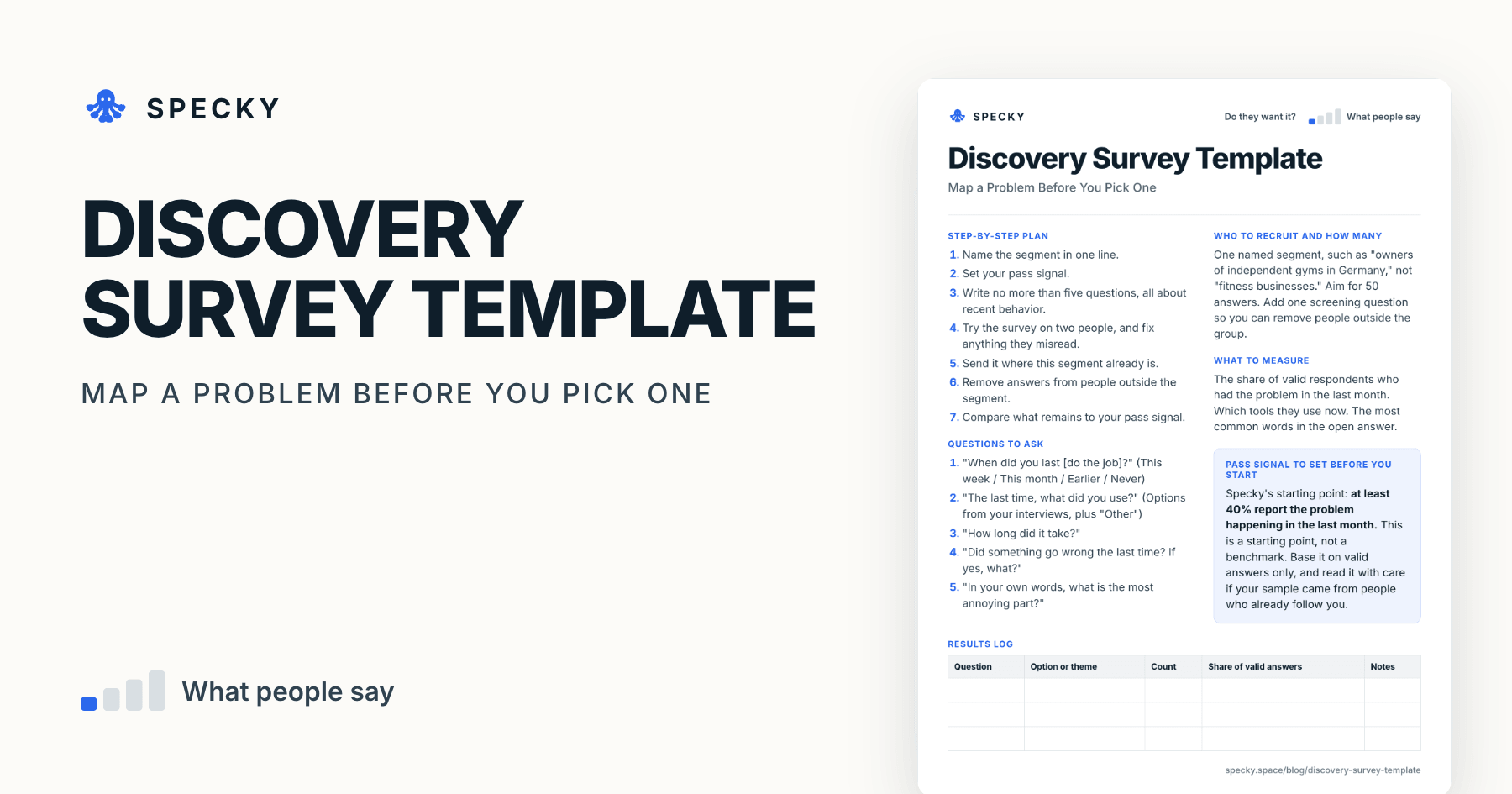
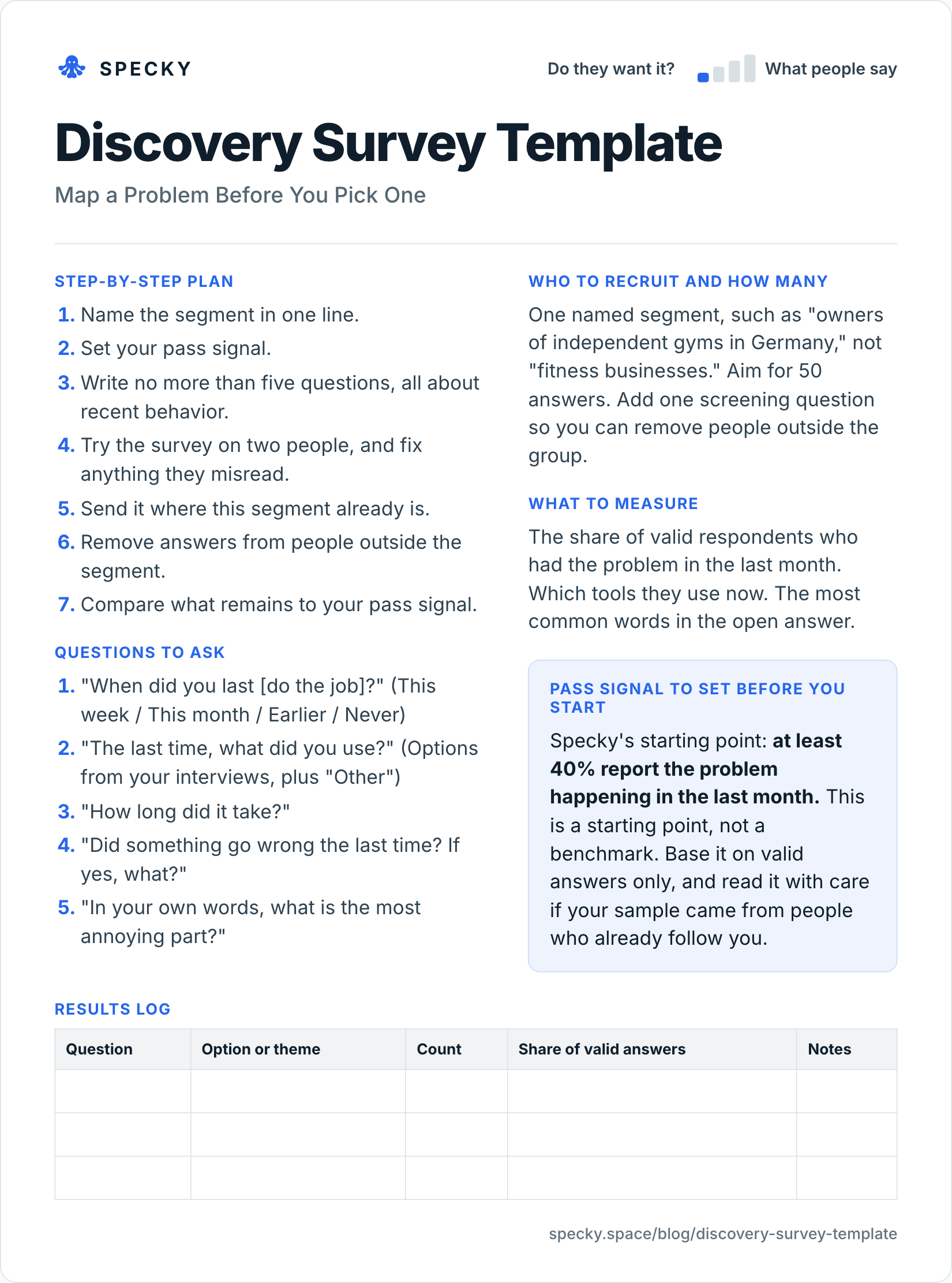
Discovery survey template (copy and use)
Open the image at full size, or copy the text version below.
Who to recruit and how many
One named segment, such as "owners of independent gyms in Germany," not "fitness businesses." Aim for 50 answers. Add one screening question so you can remove people outside the group.
Step-by-step plan
Name the segment in one line.
Set your pass signal.
Write no more than five questions, all about recent behaviour.
Try the survey on two people, and fix anything they misread.
Send it where this segment already is.
Remove answers from people outside the segment.
Compare what remains to your pass signal.
Questions to ask
"When did you last [do the job]?" (This week / This month / Earlier / Never)
"The last time, what did you use?" (Options from your interviews, plus "Other")
"How long did it take?"
"Did something go wrong the last time? If yes, what?"
"In your own words, what is the most annoying part?"
What to measure
The share of valid respondents who had the problem in the last month. Which tools they use now. The most common words in the open answer.
Pass signal to set before you start
Specky's starting point: at least 40% report the problem happening in the last month. This is a starting point, not a benchmark. Base it on valid answers only, and read it with care if your sample came from people who already follow you.
Results log
Question
Option or theme
Count
Share of valid answers
Notes
How do you write discovery survey questions people answer honestly?
The five questions above follow three rules that come from interview practice and survey science.
Ask about the last time, not about the future. Rob Fitzpatrick's The Mom Test tells founders to talk about the customer's life, ask about specifics from the past, and treat "I would" answers as fluff (Unusual Ventures, 2024). A survey cannot follow up the way an interview can, so the question itself must anchor on a real, recent event.
Write the options from what people told you. Pew Research Center found that when "the economy" appeared as an option, 58% chose it; asked open-ended, only 35% named it. And 43% of open-ended answers fell outside the list, against 8% when a list was offered (Pew Research Center). Lists steer people. If the list comes from your guesses, the result measures your guesses.
Test the wording before you send it. Pew calls pretesting an essential step, and warns against two traps: questions that ask about two things at once, and agree/disagree statements, which some people tend to agree with regardless.
Weak question
Better question
Why
"Would you use a tool that automates invoicing?"
"When did you last send an invoice late?"
Past fact, not a future guess
"Do you find scheduling hard and time-consuming?"
"How long did your last schedule take?"
One thing, measured
"Agree or disagree: no-shows are a big problem"
"How many no-shows did you have last month?"
No pull towards agreeing
"Which of these tools do you use?" (your list)
Same question, options from interviews, plus "Other"
About 50 valid answers from one segment. That is enough to see whether a problem is common, and small enough to collect in a week.
How precise is a share from 50 answers? Pew notes that the margin of error depends mainly on sample size: a simple random sample of 1,067 gives about ±3 percentage points at 95% confidence, and subgroups have wider margins (Pew Research Center, 2016). Using the standard formula for a simple random sample, for a result near 50%:
Valid answers
Margin of error (95% confidence)
30
about ±18 points
50
about ±14 points
100
about ±10 points
200
about ±7 points
400
about ±5 points
Two cautions. First, the formula assumes a random sample, and yours almost never has one: you reach whoever sees your post. Treat the margin as the best case. Second, people who answer are not typical. Jakob Nielsen warned that low response rates skew results toward your most committed users (Nielsen Norman Group, 2004). That is why the pass signal says to read the number with care if your sample came from your own followers.
Fifty answers from the right people tell you more than 500 from a mixed crowd. A number from a mixed crowd describes nobody.
How long should a discovery survey be?
Five questions, one screen if you can. SurveyMonkey's analysis of 100,000 surveys, 2,000 at each length from 1 to 50 questions, found that drop-off rises with every added question, and that the rise is steepest up to 15 questions (SurveyMonkey). Nielsen's verdict was blunter: short surveys are better surveys. He describes a bank's 32-screen survey that lost a test user after three screens.
If you have more than five questions, you have more than one belief. Split them into separate surveys, or move the extra ones into interviews.
Discovery survey vs customer interview vs validation survey
Customer interview
Discovery survey
Validation survey
Question it answers
What is the story behind the problem?
How common is the problem, and for whom?
What would stop people taking this offer?
When to use
First
After 3 to 5 interviews
After people have seen the offer
Typical sample
5 to 10 people
About 50 valid answers
People who saw the offer
Output
Words, stories, workarounds
A share, plus common words
Objections and next steps
Strategyzer evidence rating
1 of 5
1 of 5
1 to 2 of 5
Biggest risk
Leading questions
Options that steer answers
Polite enthusiasm
Worked example (hypothetical)
This example is made up to show the method. A founder thinks independent physiotherapists struggle with no-shows. After four interviews, she surveys physiotherapists in two professional groups and gets 62 replies, 54 of them valid.
Thirty of the 54 had a no-show in the last month, which is 56%, over her 40% line. But the open answers point elsewhere: most of the annoyance is about chasing insurers. No-shows were common but rarely called painful.
She records a pass, and adds a second assumption about insurer paperwork to test with a stronger method.
Check the margin before celebrating. With 54 valid answers, 56% carries a margin of about ±13 points, so the true share could plausibly sit anywhere from about 42% to 69%. Even the low end clears 40%, so the pass holds. Had she scored 46%, the honest reading would have been "unclear," not "pass."
The 8 invalid replies matter too. They came from clinic managers, not physiotherapists, which is exactly what the screening question is for.
What are the most common survey mistakes?
Asking about the future. "Would you use…" produces a cheerful yes that means nothing.
Surveying everyone. A number from a mixed crowd describes nobody.
Too many questions. Each one you add loses people. Five is plenty.
Writing options from your own head. Use the words from your interviews.
Treating frequency as pain. Common and painful are different things. The open answer helps you tell them apart.
Skipping the pretest. Two people misreading a question will save you 50 wasted answers.
Forgetting the margin. A 3-point difference between two groups of 25 is noise.
Keep it respectful. Say who you are and what the answers are for, make email optional, and collect no more personal data than the survey needs.
How to run it in Specky
On the Assumptions page, click the note and choose Pick a test, then Discovery survey. Specky fills in the steps, the pass signal, and a one-week timeline.
Click Test with a page. Specky builds a Feature interest page and collects the responses, with no account needed for respondents. Be aware of the limit: the page asks one open question, plus optional name, role, company, and email. Use it for the single question you care about most.
For a full five-question survey, use your own survey tool. If you connect Typeform, responses come in with the rest of your evidence.
Click Start running, then record the share you got and the result.
A pass shows on the board as Early signal, not Supported, because survey answers are opinion.
What should you do with each outcome?
Supported (shows as Early signal): You know the problem is common. Now test whether people act. Try a landing page.
Unclear: Look at your answers by sub-group. A number near your line often hides one group that passes and one that fails.
Contradicted: The problem is not common in this segment. Try a different segment, or drop it. Any bet resting on this note now shows as Contradicted.
Frequently asked questions
What is a discovery survey?
A discovery survey is a short questionnaire sent to one named customer group to learn how common a problem is and what people do about it today. It maps the problem and does not prove demand. It usually has five questions or fewer, all about recent behaviour, plus one screening question.
How many responses does a discovery survey need?
Aim for about 50 valid answers from one specific segment. At that size, a share near 50% carries a margin of error of roughly ±14 points at 95% confidence, which is enough to see whether a problem is common. Fifty answers from the right people tell you more than 500 from a mixed crowd.
What makes a good discovery survey question?
A good discovery survey question asks about recent behaviour, such as "When did you last do this?" Avoid questions about what someone would do in the future, because those answers are unreliable. Ask about one thing at a time, avoid agree/disagree statements, and write answer options from interview notes.
What is the difference between a discovery survey and a validation survey?
A discovery survey asks about the problem before people see any offer: how often it happens and how they handle it today. A validation survey goes to people who have seen your offer and asks what would stop them from taking it. Run discovery first; validation only makes sense once you have something to show.
Can a survey prove that people will buy?
No. A survey records what people say, which is the weakest kind of evidence, and Strategyzer rates this method 1 of 5 for evidence strength. To learn whether people will act or pay, follow up with a landing page, a fake door, a presale or a letter of intent.