Landing Page Test Template: Validate an Idea With One Page
One page can tell you whether strangers want what you plan to build. Here is what to put on it, how many visitors you need and how to read the result.
Share
A landing page test publishes one page that names the customer, the problem and the offer, then measures how many of the right visitors take a real next step, usually leaving an email for early access. It tests demand before the product exists. Done honestly, with traffic you can name, it takes about a week and tells you whether strangers care.
Key takeaways
The simple landing page is a "call to action" experiment in David J. Bland and Alex Osterwalder's Testing Business Ideas. Strategyzer's library rates it 2 out of 5 for cost and for evidence strength, and it tests both desirability and viability (Strategyzer).
Buffer's founder tested his idea with a two-page site, then added a pricing page in the middle. He built the product in about 7 weeks and had a paying customer within 4 days of launch (Buffer, 2011).
For scale: in Unbounce's 2024 dataset of 41,000 landing pages, the median converted 6.6% of visitors and the median SaaS page 3.8% (Unbounce, 2024).
Plain words convert. Pages written at a 5th to 7th grade reading level converted at 11.1%, against 5.3% for professional-level copy (PR Newswire, 2024).
This template's starting pass signal: at least 5% of target visitors leave an email, read separately for each traffic source.
What is a landing page test?
A landing page test is a single page for a product that does not exist yet, with one button and an honest line about what happens next. You send people from a source you can name and count who acts. Some call it a smoke test.
It is one of 44 experiment types in Testing Business Ideas, which splits them into discovery experiments (understanding the problem) and validation experiments (testing whether people will use and pay for a solution) (Strategyzer). The simple landing page sits in the validation half, in the "call to action" group with crowdfunding, the split test, the presale and the validation survey.
Which risk does it test, and how strong is the evidence?
This tests desirability: will the right people act on this offer? Strategyzer also marks it for viability, for example once you add a price. The evidence is behaviour, because a person gave up an email address. It is a modest step, and well short of paying, which is why the library rates its evidence 2 out of 5 while a presale scores 5. Our guide to choosing a product experiment shows the next rungs.
When should you use a landing page test?
Use it when you can state your offer clearly and want to know if strangers will act on it. It is a classic for good reason, as Buffer's story below shows.
Do not use it when:
You have no way to send the right visitors. A beautiful page with 12 visitors teaches you nothing. An online ad test can buy you strangers for about €100.
You already have a list. An email campaign is the easiest way to reach those people.
You are still working out the message. Try a brochure test first.
You want to test one feature with current users. Use a feature stub inside the product instead.
What did Buffer's landing page test look like?
His first version had two pages: one describing the product, and a second, reached by a button, asking for an email for launch news. He shared the link on Twitter and counted sign-ups and replies. In a second test he inserted a "plans and pricing" page between the two, adding one click before the email form. People kept clicking through and a few chose paid plans; only then did he start building. He built the first version in about 7 weeks, the first paying customer arrived within 4 days of launch, and about two and a half months after launch around 4% of users were on paid plans (Buffer, 2011).
Copy-and-use landing page test template
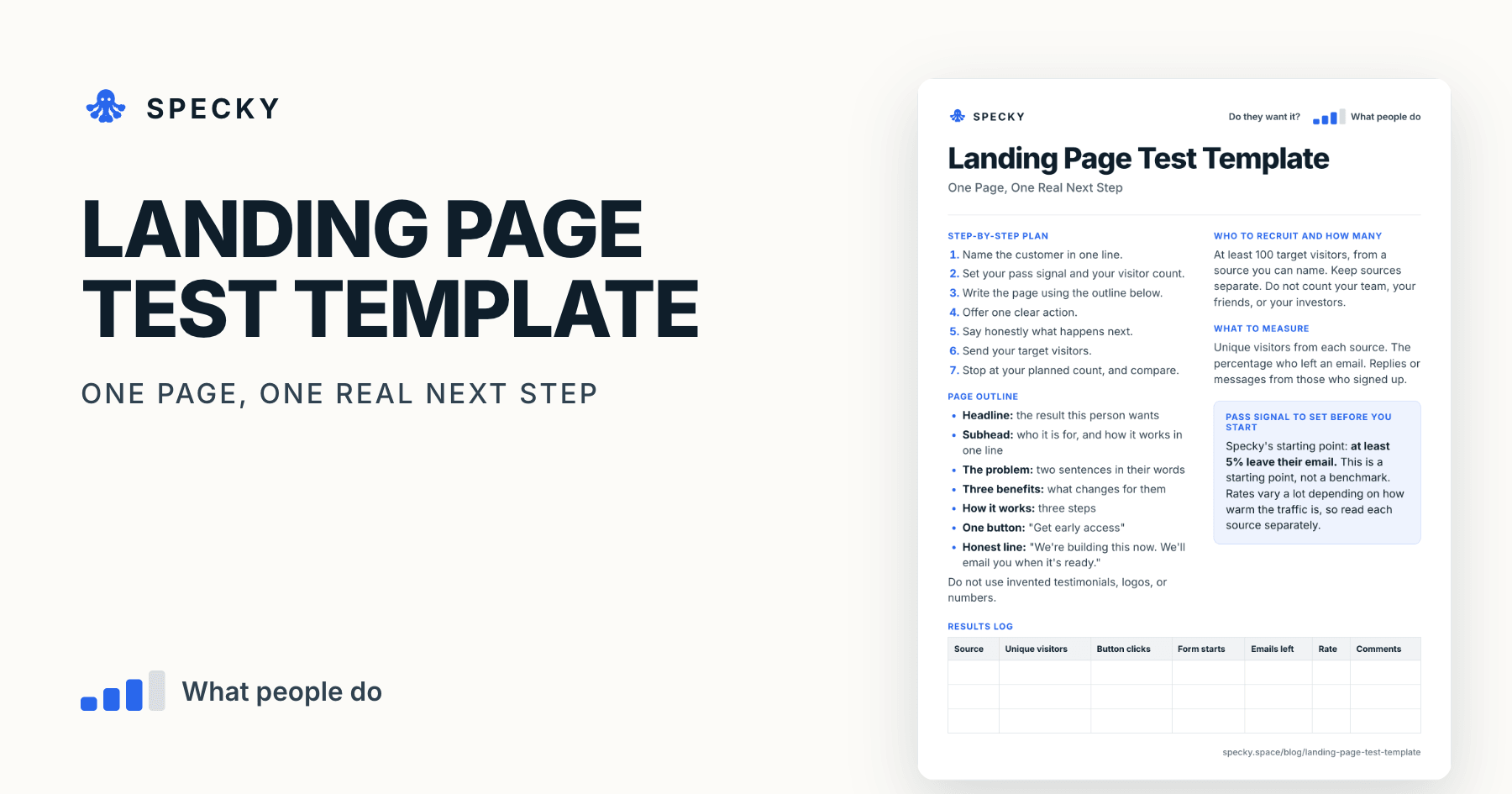
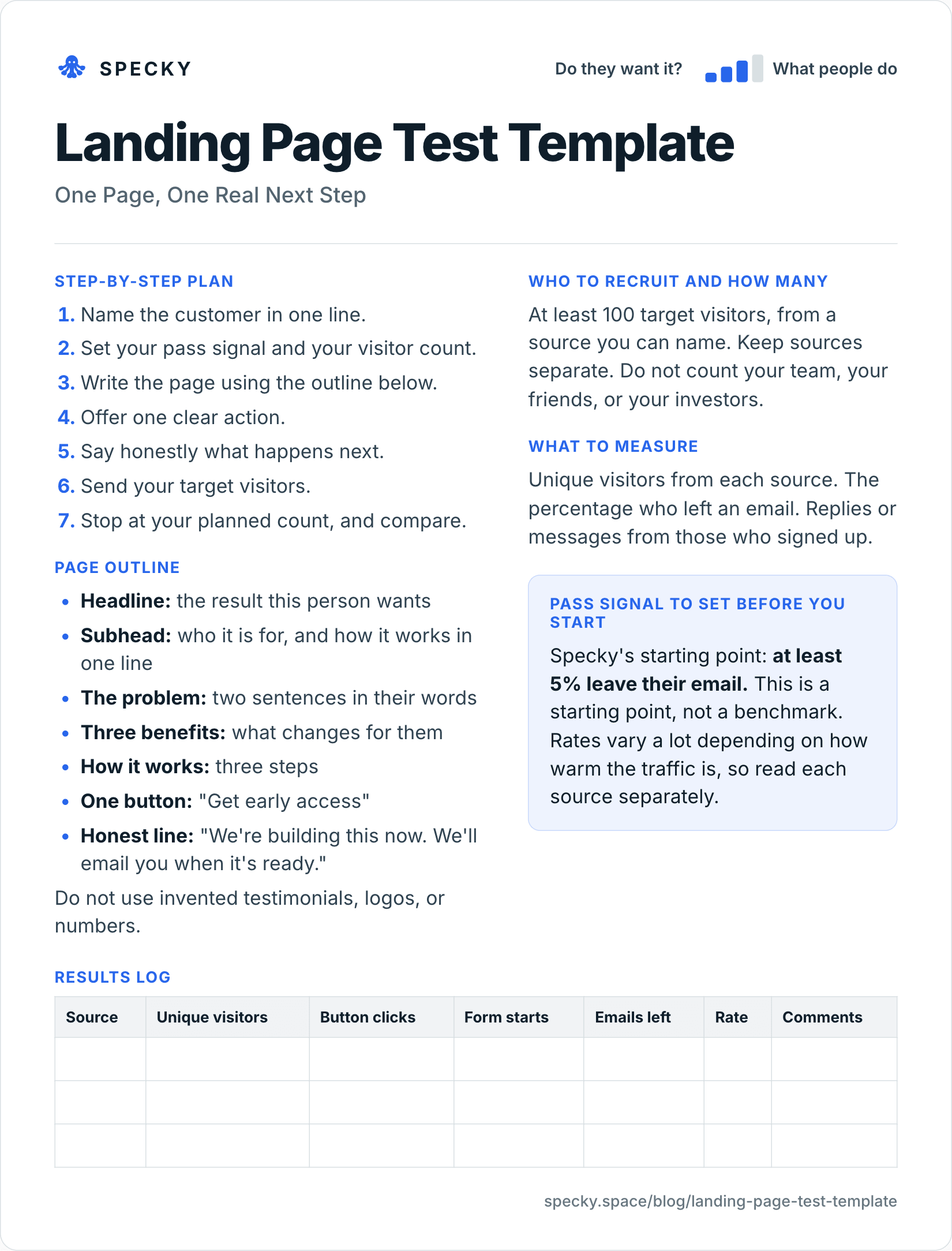
Open the image at full size, or copy the text version below.
Who to recruit and how many
At least 100 target visitors, from a source you can name. Keep sources separate. Do not count your team, your friends, or your investors.
How do you run a landing page test step by step?
Name the customer in one line.
Set your pass signal and your visitor count.
Write the page using the outline below.
Offer one clear action.
Say honestly what happens next.
Send your target visitors.
Stop at your planned count, and compare.
Page outline
Headline: the result this person wants
Subhead: who it is for, and how it works in one line
The problem: two sentences in their words
Three benefits: what changes for them
How it works: three steps
One button: "Get early access"
Honest line: "We're building this now. We'll email you when it's ready."
Do not use invented testimonials, logos, or numbers.
How should you write the page?
Short, plain and front-loaded. Jakob Nielsen's analysis of real browsing found people read at most 28% of the words on an average page, and 20% is more likely (NN/g, 2008). NN/g's 2018 eyetracking study found 57% of viewing time went above the fold (NN/g, 2018). So the headline, subhead and button belong in the first screen, and everything else is support. Write at a 5th to 7th grade reading level, roughly ages 10 to 13: that band converted best in Unbounce's 2024 data. Check the page on a phone, too; mobile brought nearly five times as many visitors as desktop in the same dataset.
What should you measure?
Unique visitors from each source. The percentage who left an email. Replies or messages from those who signed up. Button clicks and form starts help you see where people drop: many clicks and few emails point at the form, few clicks point at the page.
Pass signal to set before you start
Specky's starting point: at least 5% leave their email. This is a starting point, not a benchmark. Rates vary a lot depending on how warm the traffic is, so read each source separately.
Results log
Source
Unique visitors
Button clicks
Form starts
Emails left
Rate
Comments
What is a good landing page conversion rate for validation?
There is no benchmark for pages about products that do not exist. The best named dataset for real pages is Unbounce's 2024 Conversion Benchmark Report, covering more than 41,000 landing pages, 57 million conversions and 464 million visitors between July 2023 and July 2024 (PR Newswire, 2024).
Read them as context, not targets. Those pages sell products that exist. An early-access email is a lighter ask than a demo request, which pushes your rate up; an unknown name pushes it down. The 5% starting line sits between the two medians. Warm traffic, such as a newsletter that already trusts the sender, should clear it easily; cold ad traffic often will not.
How many visitors does a landing page test need?
At least 100 per source, and 300 or more if the result is likely to land near your line. The table gives the 95% range (a Wilson score interval, which we calculated) for two measured rates:
Visitors from one source
Measured rate
Plausible true rate (95%)
100
5%
2.2% to 11.2%
100
10%
5.5% to 17.4%
300
5%
3.1% to 8.1%
300
10%
7.1% to 13.9%
500
5%
3.4% to 7.3%
At 100 visitors, a 10% source clearly passes a 5% bar; a 5% source tells you almost nothing. Fix the count in advance and do not stop early. In Evan Miller's example, stopping at the first "significant" result raised the false positive rate from 5% to about 26.1% (Evan Miller, 2010).
Worked example (hypothetical)
This example is made up to show the method. A team is testing a service for independent pharmacies that handles repeat prescription reminders. Their page says, "Stop chasing repeat prescriptions," and asks for an email for early access.
They send 240 pharmacists from two trade newsletters and a small ad. Newsletter visitors convert at 9%, and ad visitors at 2%. Overall, 6% leave an email.
The overall signal passes, but the split is more telling. Warm trade audiences respond and cold ones do not, so the team looks more closely at why before planning any paid channel.
The numbers underneath. The newsletters sent 137 visitors and 12 left an email (8.8%, range about 5.1% to 14.7%). The ad sent 103 and 2 left one (1.9%, range 0.5% to 6.8%). Together that is 14 of 240, or 5.8%, with a range of about 3.5% to 9.6%. So the blended pass is not firm, and the ad result is too small to judge. What the team can say: warm pharmacists clear the bar on their own. Next, they email the 12 sign-ups to ask how they handle repeat prescriptions today, and run the ad again to 300 visitors before deciding anything about paid channels.
Landing page test vs fake door test vs presale page
These three sit on one ladder of commitment. The page can look almost the same; the ask is what changes.
You can explain the offer and want strangers' reaction
You want the lightest version of the same question
Interest is proven and price is the doubt
Ratings from Strategyzer's experiment library poster. Buffer's pricing page was a step from the first column towards the third.
Is a landing page test honest?
It is, if the page never claims the product exists and the ask matches what you can deliver. Four rules:
Say "early access" or "join the waitlist", never "buy now", unless you are running a presale with refunds.
Keep the honest line visible, next to the button, not in small print.
No invented proof. Fake testimonials, logos or customer counts corrupt the very thing you are measuring.
Collect only an email, say what it is for, and delete the list if you drop the idea. The GDPR requires data to be collected for a specified purpose, limited to what is necessary and kept no longer than needed (GDPR Article 5).
Common mistakes
Several calls to action. One page, one action.
Sending only friends. Their signups are a kindness.
Writing about features. People care about what changes for them.
Faking proof. Invented testimonials wreck the very thing you are measuring.
Blending sources. An average of warm and cold traffic describes neither.
How to run it in Specky
On the Assumptions page, click the note and choose Pick a test, then Simple landing page. Specky fills in the steps, the pass signal, and a one-week timeline.
Click Test with a page. Specky builds a waitlist page from your assumption. Edit the copy, then publish it at a shareable link. Pages stay out of search engines unless you opt in.
Specky builds the page and collects the responses. It counts views, unique visitors, button clicks, form starts, and responses. You send the traffic.
Click Start running, then compare the responses to your pass signal and record the result.
A pass shows on the board as Supported, because leaving an email is behavior.
Unclear: Numbers near your line, or too few visitors. Test a sharper headline with a split test, or check that traffic matches the audience.
Contradicted: Enough of the right people came and left without acting. Interview a few of them. Any bet resting on this note now shows as Contradicted.
Frequently asked questions
What is a landing page test?
A landing page test publishes a single page describing an offer and measures how many visitors take a real next step, such as leaving an email. It tests demand before the product is built. Testing Business Ideas lists it as the simple landing page, a low-cost call-to-action experiment.
How many visitors do you need for a landing page test?
Start with at least 100 target visitors per source, and 300 or more if the result may land near your line. With 100 visitors, a measured 5% could plausibly be anywhere from 2.2% to 11.2%, so one or two signups can swing the result. Fix the count before you start.
What is a good landing page conversion rate for validation?
No single rate is right for every audience. Specky's starting point is 5% of target visitors leaving an email. For context, Unbounce's 2024 data puts the median SaaS landing page at 3.8% and the all-industry median at 6.6%, for real products. Warm audiences usually convert much higher than cold ones.
Is a landing page test the same as a fake door test?
They are close relatives. A landing page test explains the customer, problem and benefits, then asks for an email. A fake door test can be as small as one offer and one button, with the truth revealed after the click. Use the landing page when the offer needs explaining.
Should a landing page test show a price?
Add a price once you know people want the offer and the open question is what they would pay. Buffer did this, inserting a pricing page before the email form. A price lowers sign-ups but makes each one mean more.