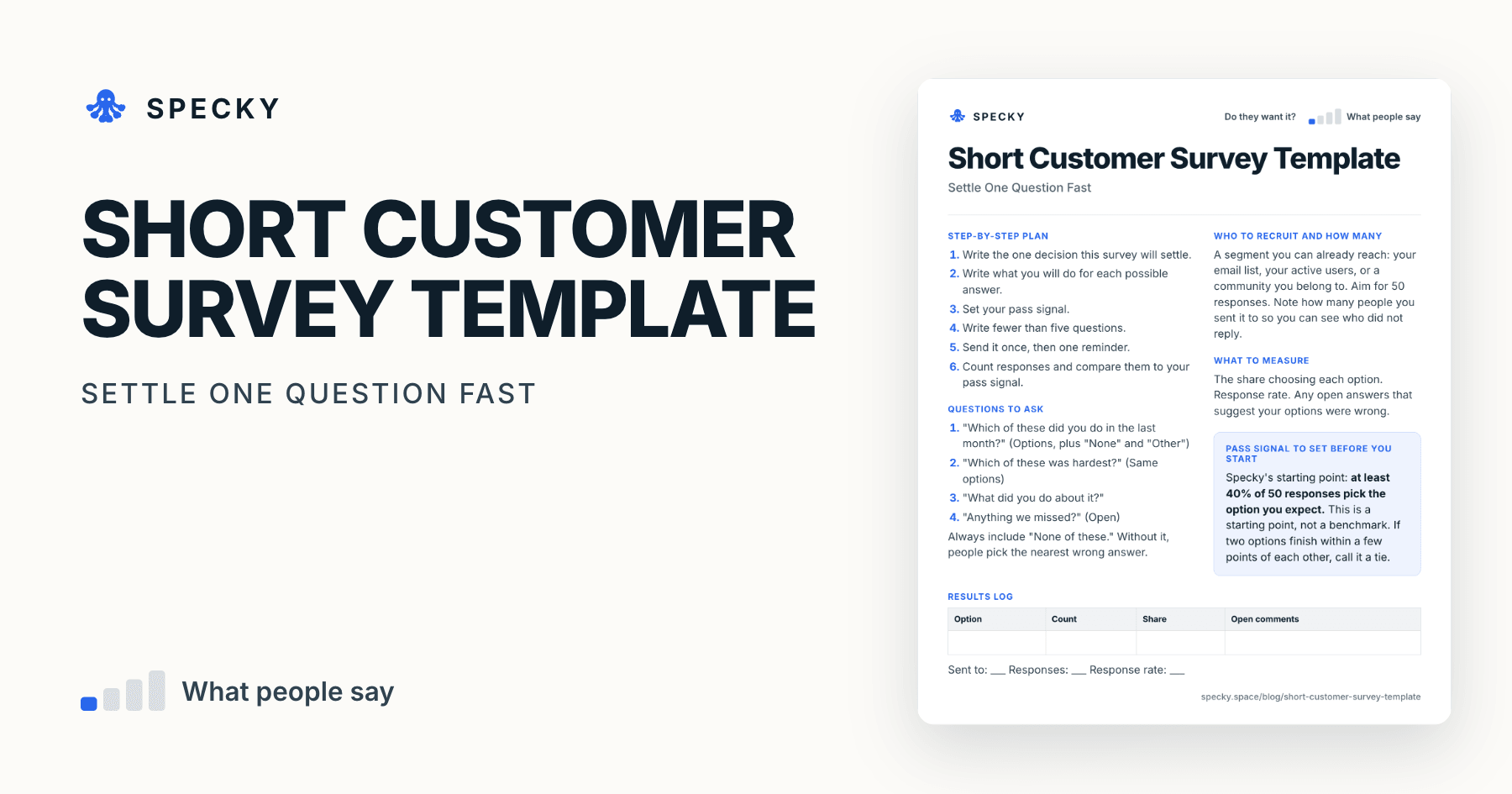
Short Customer Survey Template: 4 Questions to Settle One Choice
You have a clear choice and people to ask. Settle it in days with four questions, without fooling yourself about a narrow lead or a low response rate.
Share
A short customer survey is four or fewer questions, sent once to a group you can already reach, such as your email list, active users or a community, to settle one specific choice between options you already understand. It trades depth for speed: you get an answer within days, and you treat it as a stated preference to confirm later with behaviour.
Key takeaways
Every question costs time. In SurveyMonkey's analysis of about 100,000 surveys, the first question took about 75 seconds and a 10-question survey about 5 minutes; abandonment rose past 7-8 minutes (SurveyMonkey).
Four questions take roughly 3 minutes on those numbers. That is short enough for a busy customer to finish.
Always offer "None of these." In a Pew experiment, 43% of people gave an answer that was not on the closed list once the question was open (Pew Research Center).
With 50 responses, a lead of less than about 20 points between two options can be noise. Call it a tie.
Record how many people you sent it to. A low response rate does not make the answer wrong, but it raises the risk that only fans replied.
What is a short customer survey?
A short customer survey is a decision tool, not a research project. You write down one choice and ask the people you already know.
It sits between the two surveys in Strategyzer's experiment library: the discovery survey explores a problem, the validation survey tests an offer, and this one picks between options you can already name.
You skip recruiting because you have the list, more people finish because it is short, and because you wrote down what each answer would mean before sending, the result becomes a decision instead of a slide.
Which risk does it test, and how strong is the evidence?
This tests desirability: of these options, which do your people lean toward? The evidence is opinion. People's choices on a form are a preference, so plan to pair the answer with a later test of behaviour. Our lays out which test to pair it with.
When should you use a short customer survey, and when not?
Use it when you have a clear question and a known group. Which of these two problems comes up more? Which name makes sense? Which tool do you use today? Because you already know the group, you skip recruiting and can have an answer within days.
Do not use it to explore. If you cannot write the options, you need a discovery survey or interviews first. And remember who you are asking: your existing users are not the same as the people you hope to reach. Their answer may not hold outside your list.
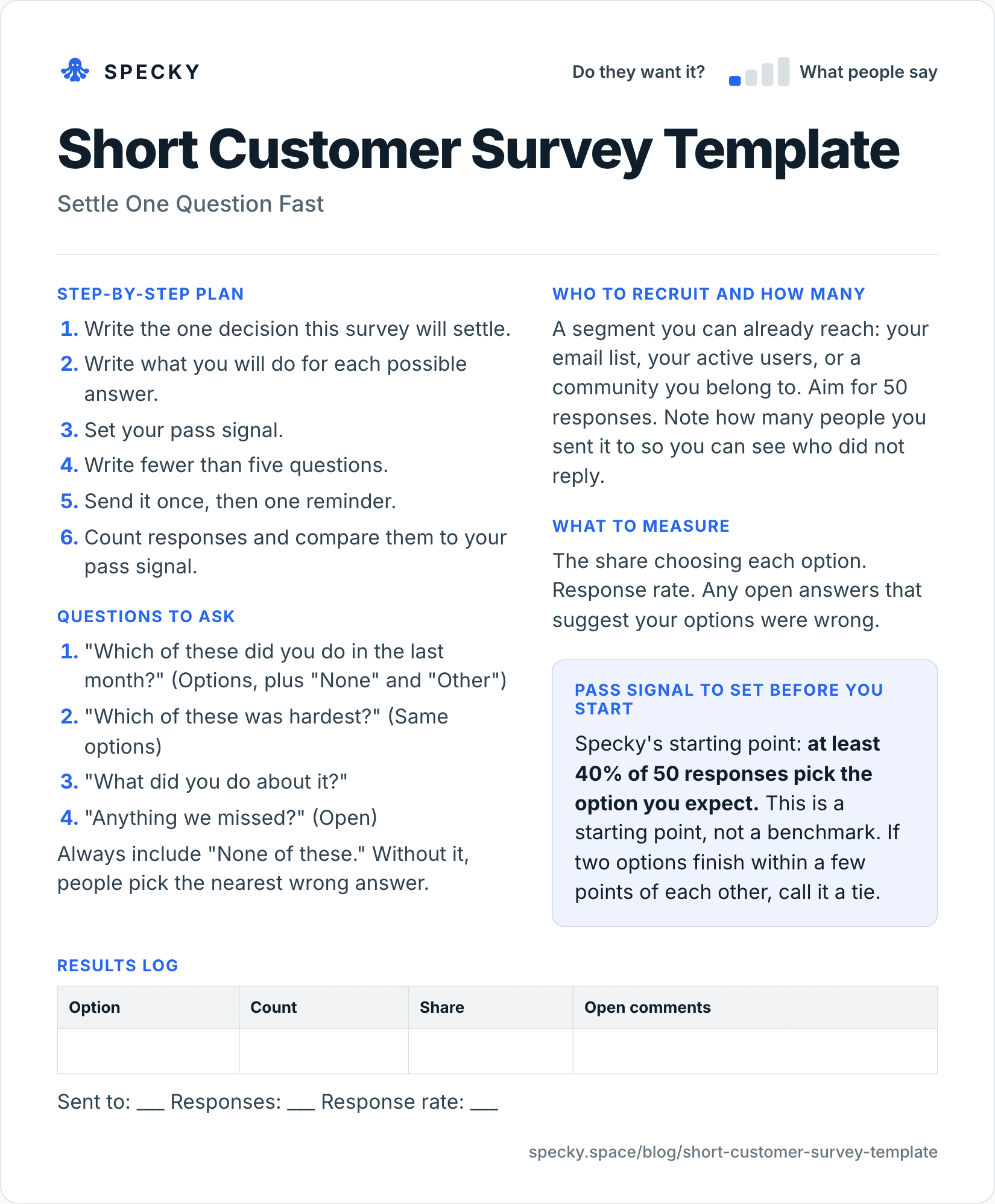
Copy-and-use short customer survey template
Open the image at full size, or copy the text version below.
Who to recruit and how many
A segment you can already reach: your email list, your active users, or a community you belong to. Aim for 50 responses. Note how many people you sent it to so you can see who did not reply.
Step-by-step plan
Write the one decision this survey will settle.
Write what you will do for each possible answer.
Set your pass signal.
Write fewer than five questions.
Send it once, then one reminder.
Count responses and compare them to your pass signal.
Questions to ask
"Which of these did you do in the last month?" (Options, plus "None" and "Other")
"Which of these was hardest?" (Same options)
"What did you do about it?"
"Anything we missed?" (Open)
Always include "None of these." Without it, people pick the nearest wrong answer.
What to measure
The share choosing each option. Response rate. Any open answers that suggest your options were wrong.
Pass signal to set before you start
Specky's starting point: at least 40% of 50 responses pick the option you expect. This is a starting point, not a benchmark. If two options finish within a few points of each other, call it a tie.
Results log
Option
Count
Share
Open comments
Sent to: ___ Responses: ___ Response rate: ___
How long should a customer survey be?
As short as the decision allows. Four questions is the default in this template, and you should cut any question whose answer would not change what you do.
SurveyMonkey's data shows why. People spend the most time on the first question, then speed up, and they start abandoning once a survey runs past 7-8 minutes, with completion rates dropping by 5% to 20% (SurveyMonkey):
Questions
Time per question (median)
Total time, roughly
1
about 75 seconds
1 minute 15 seconds
2
about 40 seconds
2 minutes
3-10
about 30 seconds each
2-5 minutes
11-15
about 25 seconds each
5-7 minutes
16-25
about 21 seconds each
7-9 minutes
26-30
about 19 seconds each
9-10 minutes
The same analysis found people tolerate long surveys less from companies they buy from than for work or school. Nielsen Norman Group draws the line in a similar place: each added question lowers response rates and reliability, and 20 questions is too many unless your participants are highly motivated (NN/g, 2016). Jakob Nielsen's older advice is stricter still: ask only core questions, ideally on one screen (NN/g, 2004).
If you have ten questions, you have two or three surveys. Send them to different halves of the list.
How do you write short survey questions that don't mislead?
Pew Research Center's guide to writing survey questions is the best free reference; four of its findings matter most here (Pew Research Center).
The list shapes the answer. In one Pew poll, 58% chose the economy when it was listed, but only 35% named it unprompted. In the closed version, 8% gave an answer outside the five options; in the open version, 43% did. Your options steer people, so test them first with a few open answers.
Options must cover everything and not overlap. Pew says closed questions should include all reasonable answers and be mutually exclusive. That is what "None of these" and "Other" are for. NN/g adds "Not applicable" or "Don't use" so people don't guess.
Order matters. In surveys people fill in themselves, options near the top get picked more. Randomise the order of unordered lists, and keep "None of these" and "Other" at the bottom.
One idea per question. "Was the setup fast and easy?" is two questions. Pew calls these double-barrelled and splits them.
Before sending, read each question aloud to one person from the list and ask what they think it means. NN/g recommends about four such rounds, changing the wording between them.
What is a good survey response rate?
There is no single good rate, and a low one is not automatically a problem. Pew reports that typical telephone survey response rates fell to 6% in 2018, from about 9% a few years earlier, and that response rates are an unreliable measure of accuracy. A low rate does signal a higher risk of error (Pew Research Center, 2019).
The risk is about who answers. Nielsen's warning is that low response rates tilt the sample toward highly committed users, who are not typical (NN/g, 2004). For a product survey that means your fans are overrepresented.
Three habits keep this honest:
Write down "sent to" before you send. Response rate is responses divided by that number.
Send once, plus one reminder.
Compare who replied with who didn't. If 80% of replies come from your most active users, say so next to the result.
How many responses do you need?
Aim for 50, and read the result as a range. These margins come from the standard formula at a 95% level, for a share near 50%:
Responses
Margin on one option's share
Margin on the gap between two close options
30
about ±18 points
about ±36 points
50
about ±14 points
about ±28 points
100
about ±10 points
about ±20 points
200
about ±7 points
about ±14 points
The gap column uses Pew's rule of thumb that the margin on a lead is about twice the margin on one share, which holds when two options split most of the vote (Pew Research Center, 2016). When the options are spread across several answers, the gap margin is smaller, but with 50 responses, a lead under about 20 points still deserves suspicion.
Subgroups shrink fast. Pew's example: a subgroup of about 160 people out of 1,067 carries about ±8 points instead of ±3. Split 50 responses by plan or role and you are reading tea leaves.
Worked example (hypothetical)
This example is made up to show the method. A team running a calendar app for tutors must choose between building group lessons and building payment reminders next. They survey the 320 tutors on their list, and get 58 responses.
The expected answer was group lessons. Instead 47% choose "chasing payment" as the hardest thing in the last month, and 21% choose "organising group lessons." "None of these" gets 12%.
Their pass signal was for group lessons, so the test fails. The team does not start building payments yet. A preference is only a preference, so they plan a fake door for payment reminders inside the app.
Extending the example. The response rate is 58 of 320, or 18%. Is the 26-point lead real? Using the formula for two options in the same question, the margin on that gap is about ±20 points, so the lead holds, though not by much. The team checks who replied: 41 of the 58 respondents, about 71%, logged in that week, so the answer leans toward active tutors. The 12% who picked "None of these" are 7 people; 4 of them wrote about cancellations, a problem nobody had listed. That becomes a new assumption to test.
Short customer survey vs discovery survey vs interviews
If people have already seen an offer and you want to know if they would commit, use a validation survey. If they already use the product and you want to know if they would miss it, use the product-market fit survey.
Common mistakes
Leaving out "none of these." It is the most honest answer you can offer.
Surveying only fans. People who read your emails are not your whole market.
Asking more than you will use. If an answer would not change a decision, cut the question.
Calling a narrow lead a win. A small gap on 50 responses can easily be noise.
Stopping here. A survey is a stated preference. Follow it with a test of behaviour.
Fixed option order. The first option on the list gets a bonus. Shuffle the options.
How to run it in Specky
On the Assumptions page, click the note and choose Pick a test, then Survey. Specky fills in the steps, the pass signal, and a one-week timeline.
Click Test with a page. Specky builds a Feature interest page and collects responses, with no respondent account. The page asks one open question, plus optional name, role, company, and email, so it suits a single question best.
For multiple-choice questions, use your survey tool. A connected Typeform brings responses in with your other evidence.
Click Start running, then attach the result.
A pass shows as Early signal on the board, not Supported. To move further, you need something people did.
What to do with each outcome
Supported (shows as Early signal): Test the winning option with behaviour, such as a feature stub inside your product.
Unclear: A tie or a low response. Either rewrite the options or ask people directly with a few interviews.
Contradicted: Your people chose something else. Use the winning option as your next assumption. Any bet resting on this note now shows as Contradicted.
Frequently asked questions
How long should a customer survey be?
A short customer survey should have four questions or fewer and take about three minutes. In SurveyMonkey's data, a 10-question survey takes about five minutes, and abandonment rises once surveys pass seven or eight minutes. Each question should change a decision you need to make; if it would not, remove it.
What is a good survey response rate?
There is no single good rate, since it depends on your list and how close they are to you. Pew reports typical telephone survey response rates of 6% in 2018, and phone polls still performed well that year. Record yours anyway, because a low rate means the people who replied may be your most committed users rather than typical ones.
Why include "none of these" in a survey?
Including "none of these" stops people from choosing the closest wrong answer. It also tells you when your options have missed the real problem. Pew found that far more people answer outside a list when the question is open, so a sizeable "none" share is a sign to rewrite your options.
How many responses do you need for a short survey?
Aim for 50. At that size, one option's share has a margin of about ±14 points, and the gap between two close options roughly double that. Treat leads under about 20 points as a tie, and don't split 50 responses into subgroups.
Should I run a survey or customer interviews?
Run a short survey when you can already name the options and need to know which one more people pick. Run interviews when you can't name the options yet, or need to understand why people chose what they did. Many teams do both: a few interviews to write the options, then a survey to count them.