Investor Pitch Feedback: Stress-Test Your Advantage Before You Raise
People who have watched companies fail can find your weak spot in ten minutes. Use that, and do not mistake it for demand.
Share
An investor feedback test means pitching your idea to a few investors or advisers who know your market, not to raise money, but purely to note what they push on. It stress-tests the advantage your business depends on, such as a data asset, a distribution edge or a timing bet. Investor pitch feedback is opinion, so it never counts as proof that customers want the product.
Key takeaways
Pitch three people who have invested in or run a similar company. Tell them up front you are not raising.
Spend 10 minutes pitching and 20 on questions. Write down every objection in their words.
Pass signal: at least 2 of 3 name the same strength, and nobody finds a flaw you can't answer with evidence or a planned test.
Paul Graham's rule for fundraising applies to feedback too: treat investors as saying no until they unequivocally say yes (Paul Graham, 2013).
In CB Insights' 2026 analysis of 385 failed VC-backed startups with known causes, 43% cited poor product-market fit (CB Insights, 2026). Investors cannot test that for you. Customers can.
What is an investor feedback test?
It is a short series of pitch meetings run as an experiment. You claim one advantage, pitch it to people who have seen many similar companies, and record where they push. The output is a list of objections, ranked by how often they repeat, and a new set of assumptions to test with customers.
David J. Bland and Alexander Osterwalder's Testing Business Ideas library of 43 experiment types has no separate investor experiment (Strategyzer). The closest entry is the expert stakeholder interview, which Strategyzer's poster rates 2 out of 5 for cost and 2 out of 5 for evidence strength (Strategyzer poster). Treat investor pitch feedback the same way: cheap, fast, and opinion.
Which risk does it test, and how strong is the evidence?
This tests : can this business defend itself and make money? The evidence is . Treat it as a stress test of your thinking. It sits on the lowest rung in our , and should never appear in your plan as evidence of demand.
When should you pitch investors for feedback, and when not?
Use it when your business depends on an advantage you are not sure is real: a distribution edge, a data asset, or a timing bet. People who have seen dozens of similar companies will quickly find the weak spot.
Do not use it as proof that customers want the product. Investors are not your customers, and enthusiasm from someone who funds many long shots means very little. Paul Graham, co-founder of Y Combinator, notes that even an investor who seems very interested probably won't invest, and that picking winners early is hard (Paul Graham, 2013).
Also skip it if you are not ready for real questions, since first impressions with investors are hard to redo. To test demand, run a landing page.
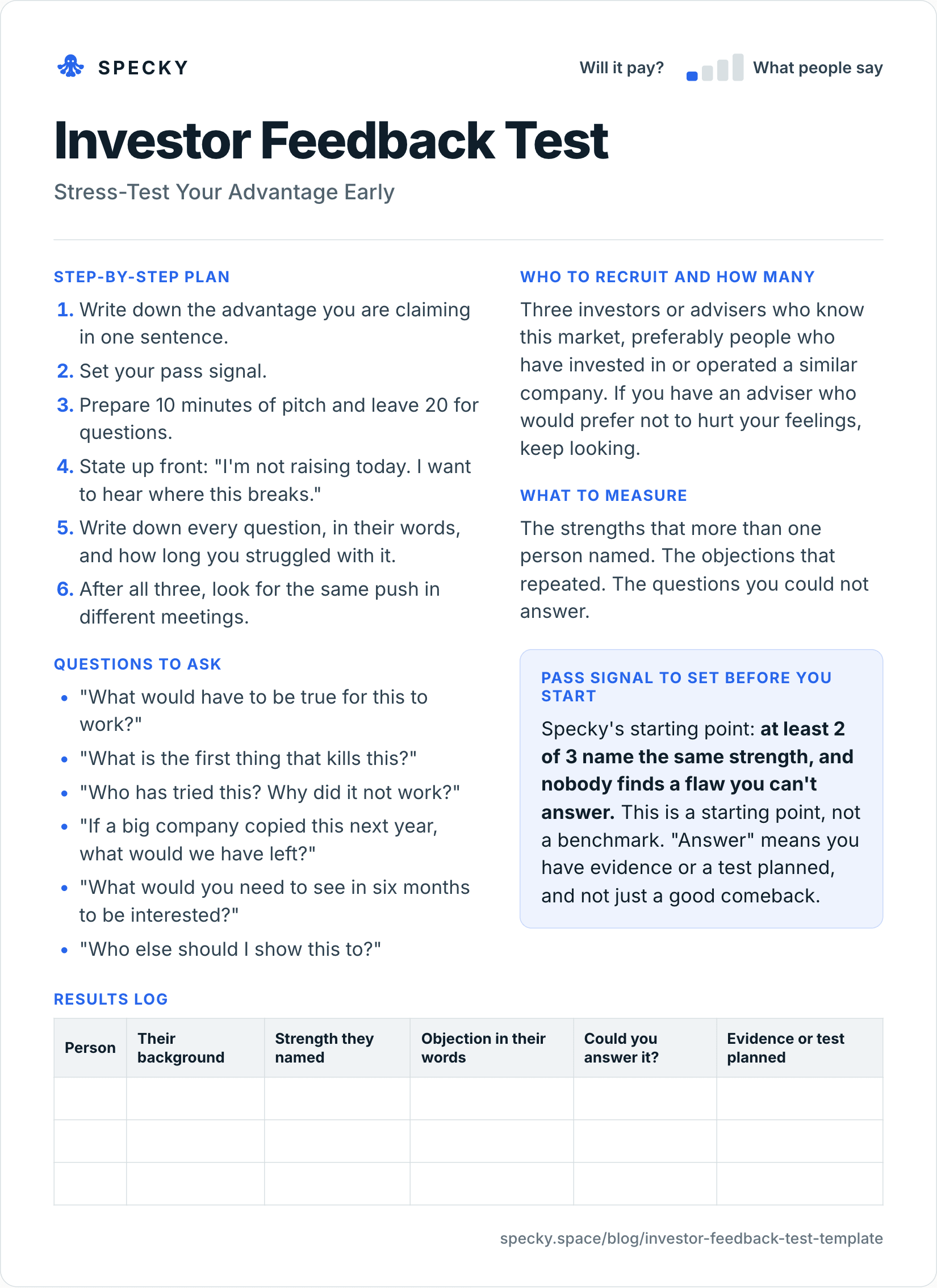
Investor feedback test template (copy and use)
Open the image at full size, or copy the text version below.
Who to recruit and how many
Three investors or advisers who know this market, preferably people who have invested in or operated a similar company. If you have an adviser who would prefer not to hurt your feelings, keep looking.
Step-by-step plan
Write down the advantage you are claiming in one sentence.
Set your pass signal.
Prepare 10 minutes of pitch and leave 20 for questions.
State up front: "I'm not raising today. I want to hear where this breaks."
Write down every question, in their words, and how long you struggled with it.
After all three, look for the same push in different meetings.
Questions to ask
"What would have to be true for this to work?"
"What is the first thing that kills this?"
"Who has tried this? Why did it not work?"
"If a big company copied this next year, what would we have left?"
"What would you need to see in six months to be interested?"
"Who else should I show this to?"
What to measure
The strengths that more than one person named. The objections that repeated. The questions you could not answer.
Pass signal to set before you start
Specky's starting point: at least 2 of 3 name the same strength, and nobody finds a flaw you can't answer. This is a starting point, not a benchmark. "Answer" means you have evidence or a test planned, and not just a good comeback.
Results log
Person
Their background
Strength they named
Objection in their words
Could you answer it?
Evidence or test planned
How do you get honest feedback from investors?
Make it easy to be blunt, and hard to be polite. Four habits help:
Remove the money. Say in the invitation and again in the room that you are not raising. Once money is on the table, people manage the relationship instead of telling you the weak spots.
Shrink the pitch. Ten minutes is enough for a short version of Sequoia's business plan outline: purpose, problem, solution, why now, market, competition and alternatives, business model, team (Sequoia Capital). Put your one-sentence advantage on the first slide.
Ask for the kill shot. "What is the first thing that kills this?" invites criticism without making it personal.
Do not argue. Write the objection down in their words, ask one clarifying question, and move on. Your rebuttal belongs in your notes, not in the room.
Recruit through warm introductions where you can, and pick people who will disagree with you. An angel who backs friends is the wrong panel. A partner who passed on a company like yours is the right one.
How do you read investor pitch feedback?
Decode it the way Graham advises founders to read fundraising signals: treat vague interest as no (Paul Graham, 2013). His essay also notes that some investors never say no; they just stop replying. Here is how to log the most common responses. The interpretations are ours.
What they say
What it usually means
What to log
"Interesting space."
Polite, no view
No evidence either way
"Keep me posted."
No, or not yet
Ask what they'd need to see in six months
"What stops a big company doing this?"
Your defensibility is unclear
An objection to test
"Who's paying for this today?"
Doubt about demand or budget
A customer test, not an argument
"We've seen this fail at X."
A known failure pattern
Find out why X failed
"I'd introduce you to Y."
Genuine interest in the problem
A lead, not validation
The useful output is the repeated push. One investor doubting your pricing is an opinion. Three investors asking the same question in different words is a signal worth testing.
How many investors should you pitch for feedback?
Three per round is enough to see a pattern without burning goodwill. If two of three name the same strength and the third raises nothing you can't answer, move on to a customer test. If all three find the same flaw, you have your next experiment.
Do not run more rounds to collect a "yes". Opinion does not get stronger with volume. CB Insights' 2026 analysis of 431 VC-backed shutdowns found that 70% ran out of capital, which the report calls usually the final cause rather than the root problem, while 43% cited poor product-market fit and 19% unsustainable unit economics (CB Insights, 2026). Investors can help you see the unit economics and timing risks. Only customers can settle the product-market fit question.
Investor feedback test vs expert stakeholder interview: which should you use?
Both collect opinion from experienced people. The difference is what they judge.
Interviewing only allies, and missing the real veto
Use investor pitch feedback when the doubt is about the business: can it be defended, and does the model work? Use a stakeholder interview when someone specific can stop the idea, and you need to know their conditions.
What does an investor feedback test look like in practice?
This example is made up to show the method. A founder is building a contract review tool and says his advantage is a proprietary set of annotated contracts. He pitches to two investors who have backed legal software and one retired general counsel.
Two of them say the annotated data is interesting. But all three ask the same question: "What stops a large model provider from doing this for free next year?" He has no real answer.
The pass signal fails because of an unanswered flaw. He records that, and writes a new assumption: buyers pay for the audit trail and not for the review itself. That is something he can test with buyers.
Extending the example: he runs the next test as a letter of intent ask to 10 legal operations leads, priced on the audit trail alone. That turns a 3-person opinion into a 10-person commitment test within four weeks.
What are the most common investor feedback mistakes?
Treating interest as validation. "Keep me posted" is a polite no.
Pitching only to friendly angels. You want people who have seen this fail.
Arguing in the room. Your job is to write it down.
Mixing this with fundraising. If you are asking for money, nobody tells you the truth about weaknesses.
Listing it as demand. An investor's opinion is not a customer's action.
Asking about your idea instead of the market. Rob Fitzpatrick's The Mom Test is about how to learn from conversations when everyone is lying to you (The Mom Test). Ask about failures they have seen, not whether they like yours.
When it doesn't work: when your panel has no experience in your market, when you treat it as a fundraise in disguise, and when the real doubt is about demand.
Is it fair to pitch investors when you're not raising?
Yes, if you say so before the meeting. A clearly labelled feedback session respects their time and lets them decline. Do not let a feedback meeting turn into a soft fundraise, and do not quote anyone's opinion publicly, or name them as a supporter, without asking.
How to run it in Specky
On the Assumptions page, click the note and choose Pick a test, then Investor interviews and pitches. Specky fills in the steps, the pass signal, and a two-week timeline.
You hold these meetings yourself. Click Open stakeholder map and log who you pitched, their influence, and what they pushed on.
Click Start running, then paste the objections onto the test and record the result.
A pass shows on the board as Early signal, not Supported, because it is the opinion of people who are not your customers.
What should you do with each outcome?
Supported (shows as Early signal): Your advantage survived scrutiny. Now show it in the market with a letter of intent.
Unclear: They agree it is interesting but cannot say why. Sharpen your advantage into one claim and try again with someone from the industry. If the doubt is about market size, check the sums with online market research.
Contradicted: Someone found a flaw you cannot answer. Write that flaw down as an assumption and test it. Any bet resting on this note now shows as Contradicted.
Frequently asked questions
Should I pitch investors to validate my idea?
Pitching investors can stress-test your thinking, but it does not validate customer demand. Investors are not your customers, and their opinions are the weakest kind of evidence. To validate demand, run a test where potential customers take an action, such as signing up, signing a letter of intent or paying.
How do I get honest feedback from investors?
Tell them up front that you are not raising money today and that you want to hear where the idea breaks. Keep the pitch to 10 minutes, leave 20 for questions, ask what would kill it first, and write down their exact words. Do not argue in the room; log objections and test them later.
What does "keep me posted" mean from an investor?
"Keep me posted" usually means no, or not yet. Treat it as no evidence either way, and ask what they would need to see in six months. Paul Graham's advice to founders is to treat investors as saying no until they unequivocally say yes, and that applies to feedback as much as funding.
How many investors should I ask for feedback?
Three per round is enough. You are looking for repeated objections, not a vote. If two of three name the same strength and nobody raises a flaw you cannot answer, move on to a customer test. If all three find the same flaw, turn it into an assumption and test that.
What should I do with negative investor feedback?
Write each objection as an assumption you can test, such as "buyers pay for the audit trail, not the review." Then pick an experiment that customers act on, like a letter of intent or a landing page. Negative feedback is useful when it points to a test, and harmful only when you argue it away.