Partner and Supplier Interview Template: Find Where Delivery Breaks
Customers can love it and you can still be unable to deliver it. Find out what your partners can really do, at what cost and volume, before you promise anything.
Share
A partner and supplier interview is a short call with the outside people your product depends on, such as a courier, a payment provider, a data vendor or a manufacturer, to learn what it would take them to deliver, what it would cost at your volume, and where it tends to break. This template gives you supplier interview questions, a call guide, a pass signal and a results log.
Key takeaways
Ask for the last time, not "can you". The answer to "can you do this?" is always yes; The Mom Test says to ask about specifics from the past (Unusual Ventures summary).
Strategyzer rates the method 2 out of 5 for cost and tags it feasibility and viability rather than desirability (Strategyzer poster).
Prices change with volume. Reddit's 2023 API price would have cost one app about $20 million a year (MacRumors, 2023). Ask for the price at 10 times today's volume.
Set the pass signal first: at least 2 of 3 confirm they can deliver at your cost and speed, with your numbers written next to it.
What is a partner and supplier interview?
It is one of the discovery experiments in Testing Business Ideas by David J. Bland and Alex Osterwalder, Strategyzer's field guide of 43 experiment types organised by cost, time and evidence strength (Strategyzer). It sits next to customer interviews and expert stakeholder interviews, but points the questions outwards, at the firms that would carry part of your promise.
Strategyzer's Business Model Canvas has nine blocks covering who you serve, what you offer, how you deliver it, what it costs and what it earns (Strategyzer). Partners sit in the delivery and cost parts, and this interview tests them before you sell anything. Partners here means suppliers of parts, data or compute; couriers, warehouses and installers; platforms and APIs you don't control, such as payments or an AI model provider; and channels such as resellers.
When should you use a partner and supplier interview, and when not?
Use it when your idea leans on someone else. If they say no, or the price is wrong, the plan falls over no matter how much customers want it. Run it before you quote a price or a delivery time to a single customer.
Do not use it to learn whether customers want the product. Your suppliers will happily tell you the market is huge, because they would like your order. Run a customer interview for that. If the risk sits inside your own code, run a technical spike instead.
Which risk does it test, and how strong is the evidence?
This tests feasibility: can this be delivered at the cost and speed you need? Strategyzer adds viability, since a partner's price sets your margin. Its poster rates the method 2 out of 5 for cost, 2 for setup time and 3 for run time. For evidence strength it shows two solid and two hollow-centred dots, which we read as 2 out of 5, rising towards 4 when you leave with more than talk.
In our catalogue the result counts as opinion, the lowest rung in our guide to choosing a product experiment. The Mom Test's idea of commitment applies: someone who gives up time, reputation or money tells you more than someone who is merely polite. In supplier terms:
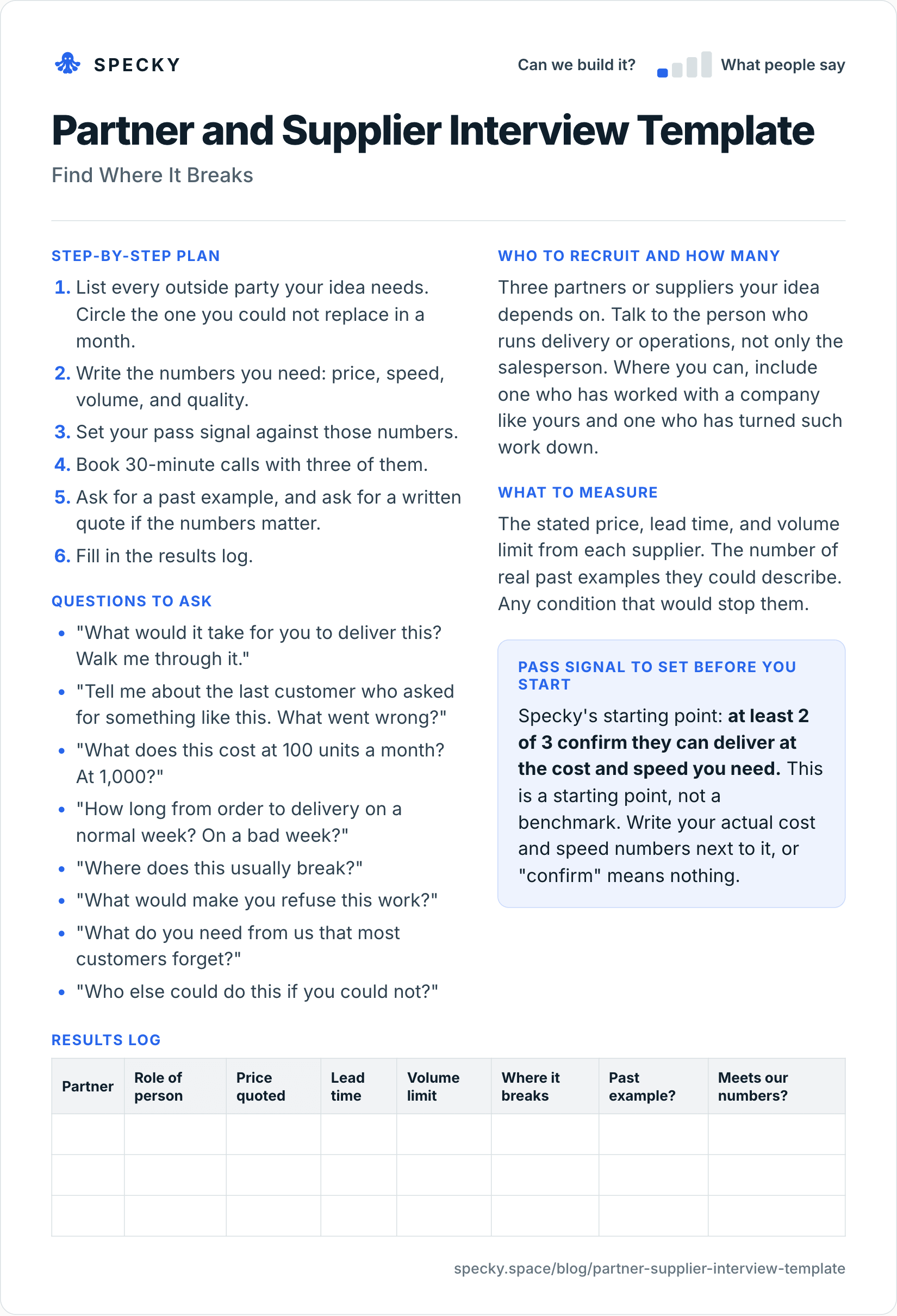
Partner and supplier interview template (copy and use)
Open the image at full size, or copy the text version below.
Who to recruit and how many
Three partners or suppliers your idea depends on. Talk to the person who runs delivery or operations, not only the salesperson. Where you can, include one who has worked with a company like yours and one who has turned such work down.
Step-by-step plan
List every outside party your idea needs. Circle the one you could not replace in a month.
Write the numbers you need: price, speed, volume, and quality.
Set your pass signal against those numbers.
Book 30-minute calls with three of them.
Ask for a past example, and ask for a written quote if the numbers matter.
Fill in the results log.
Questions to ask
"What would it take for you to deliver this? Walk me through it."
"Tell me about the last customer who asked for something like this. What went wrong?"
"What does this cost at 100 units a month? At 1,000?"
"How long from order to delivery on a normal week? On a bad week?"
"Where does this usually break?"
"What would make you refuse this work?"
"What do you need from us that most customers forget?"
"Who else could do this if you could not?"
What to measure
The stated price, lead time, and volume limit from each supplier. The number of real past examples they could describe. Any condition that would stop them.
Pass signal to set before you start
Specky's starting point: at least 2 of 3 confirm they can deliver at the cost and speed you need. This is a starting point, not a benchmark. Write your actual cost and speed numbers next to it, or "confirm" means nothing.
Results log
Partner
Role of person
Price quoted
Lead time
Volume limit
Where it breaks
Past example?
Meets our numbers?
Copyable 30-minute supplier interview guide
This puts the eight questions in order, so the call ends with numbers, not friendliness.
When you book (by email): "We're planning [one-sentence idea] and need a partner for [the job]. We'd like 30 minutes with whoever runs delivery. Our rough numbers: [price], [lead time], [volume per month], [quality bar]."
0–3 minutes: frame. "Nothing is decided yet. I'm trying to learn how this really works on your side, including where it goes wrong."
3–10 minutes: walk the job. "Walk me through it, from our order to the end customer." Note every handoff.
10–18 minutes: the last time. "Tell me about the last customer who asked for something like this. What went wrong?" When you hear "usually" or "we always", ask for the most recent example.
18–25 minutes: the numbers. Price at 100 units a month and at 1,000. Lead time on a normal week and a bad one. The volume where things change. What would make them refuse.
25–30 minutes: next step. Ask what most customers forget and who else could do it. Then ask for one commitment: a written quote with volume and lead time, or a date for a trial job.
Within an hour: fill in the results log and email a read-back: "You said [price] at [volume], [lead time] normally and [lead time] on a bad week, and [condition] would stop you. Did I get that right?"
What should you check in writing instead of on a call?
Anything a vendor publishes beats anything a vendor says, so read the docs before the call. Stripe's documentation, for example, sets a global limit of 100 API requests per second in live mode and 25 in a sandbox, and asks customers to contact support at least 6 weeks ahead for a large increase (Stripe docs). A sales call would rarely volunteer that 6-week lead time.
Terms can also change after you depend on them. In 2023, the developer of Apollo, a popular Reddit app, said Reddit planned to charge $12,000 per 50 million API requests. At about 7 billion requests a month, that came to $1.7 million a month. He said Imgur charged him $166 for the same 50 million calls (MacRumors, 2023). No interview predicts that. An interview can surface who controls the price, how much notice they give, and who else could do the job.
Physical supply teaches the same lesson. Analysing 325 companies in 13 industries, McKinsey estimated that disruptions of one to two months hit every 3.7 years on average, and that companies risk losing more than 40% of a year's profit once a decade (Insurance Journal, 2020). Hence "on a bad week?" in the template.
How many partner and supplier interviews do you need?
Three calls for each partner you could not replace within a month. For anything you could swap quickly, a look at the price list is enough.
Pick the three on purpose: one large provider, one specialist and, where you can, one who turned similar work down. If all three hedge with the same condition, such as a minimum order, that condition is the finding.
Partner and supplier interview vs technical spike vs expert stakeholder interview
What would the people who can block or fund this need to see?
Who or what you test
Suppliers, couriers, APIs, channels
Your own code and stack
Legal, security, finance, domain experts
Typical size
3 calls per partner you can't replace
One time-boxed build
3 conversations of 30 minutes
Best evidence you can get
A written quote, then one real delivery
Working code against real data
A concrete condition for yes
Worked example (hypothetical)
This example is made up to show the method. A two-person team wants to offer same-day replacement parts to small bike shops. Their plan only works if a courier can pick up from a central warehouse and deliver within four hours for under €9 a drop.
They call three courier firms. One says four hours is fine but quotes €14. One quotes €8 but only within the city centre. The third describes a past job for a pharmacy chain, confirms €8.50 inside a 20-kilometre ring, and warns that Saturdays are unreliable.
Their pass signal needed two of three meeting both numbers. Only one did, and only within a limit. They record the test as inconclusive and change the belief to "same-day delivery within 20 kilometres on weekdays" before testing it with shops.
The numbers show why the target mattered: at 200 drops a month, the gap between €8.50 and €14 is €1,100 a month. The next step is a written quote from the third firm and one real delivery.
What are the most common supplier interview mistakes?
Only talking to sales. Salespeople say yes. Delivery people tell you what happens on a Tuesday.
Asking "can you do this?" The answer is always yes. Ask for the last time they did.
Forgetting volume. A price at ten units can vanish at a thousand, in either direction.
Not having your own numbers. Without a target price, you cannot tell a good answer from a bad one.
Believing it because they want your business. Get it in writing when it matters.
When it doesn't work: when the partner's terms can change faster than your plan, as the Reddit example shows. Then the useful finding is not the price but the second supplier you could switch to.
Is it fair to the suppliers you call?
Yes, if you say that nothing is decided and you are talking to several firms. Don't present a hypothetical order as a real one to get a better price, and ask for confidentiality before you share plans, not after.
How to run it in Specky
On the Assumptions page, click the note and choose Pick a test, then Partner and supplier interviews. Specky fills in three calls, the pass signal, and a one-week timeline.
Click Open in Vouch. Vouch, at vouch.specky.space, runs this as an AI interview, with questions and a link your partner can answer on their own. For a big supplier, a live call often works better, and you can paste your notes in instead.
Add your cost and speed targets to the pass signal, then click Start running.
Paste what each partner told you onto the test and record the result.
A pass here shows as Early signal on the board, not Supported, because a promise on a call is still opinion. Attach any written quote so whoever reads it later can see the real number.
What should you do with each outcome?
Supported (shows as Early signal): Get a written quote, then prove the delivery once. A pretend-to-own test lets you do one real job through this partner.
Unclear: Usually the numbers came back with conditions. Rewrite the belief to include them, such as a region or a minimum order, and ask again.
Contradicted: No one can do it at your numbers. Look for a different partner, change the price, or change the promise. Any bet resting on this note now shows as Contradicted, so stop the work behind it until you have a new route.
Frequently asked questions
Why interview suppliers before building a product?
Suppliers show you constraints customers cannot see, such as true cost, lead times and volume limits. A product customers love still fails if nobody can deliver it at a price that works, and a week of calls costs less than a broken promise.
What questions should you ask a supplier?
Ask them to walk you through how they would deliver it, to describe the last customer who asked for something similar and what went wrong, and what it costs at 100 and at 1,000 units. Then ask about lead time on a bad week, what would make them refuse, and who else could do it.
How many partner interviews are enough?
Start with three calls for each partner you could not easily replace. If two of the three can meet your cost and speed, move on to proving one real delivery. If all three attach the same condition, rewrite your plan around it first.
Is a supplier's verbal yes good evidence?
No. A verbal yes is opinion-level evidence. A written quote with volume and lead time is stronger, a signed letter of intent or trial order stronger still, and a completed delivery at the quoted price is the strongest proof you can get before launch.