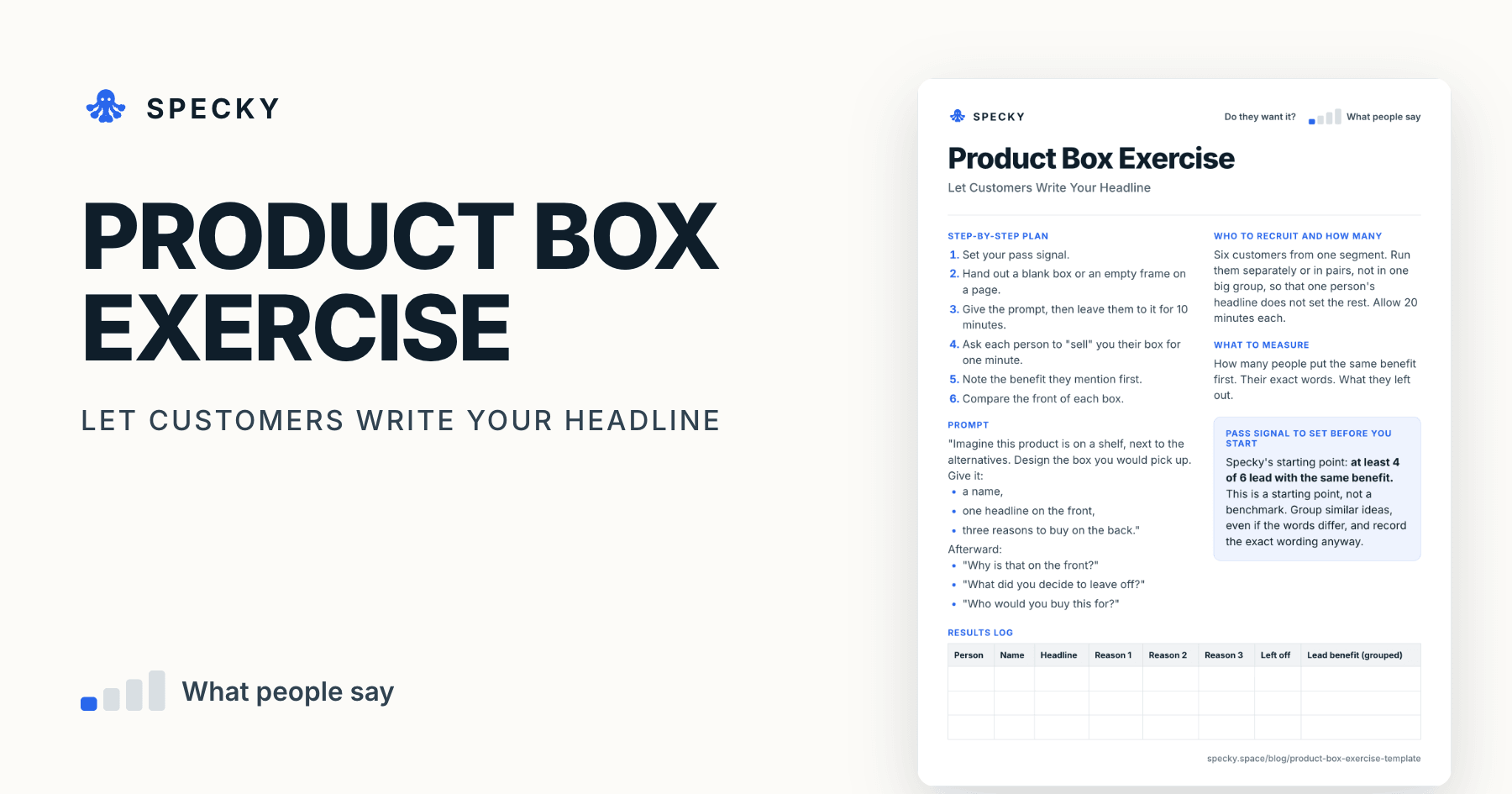
Product Box Exercise: Template to Let Customers Write the Headline
Your team has argued about the headline for weeks. Your customers could write it in ten minutes.
Share
A product box exercise asks customers to design the box they would buy, with a name, a headline on the front and three reasons to buy on the back. The benefit they put on the front shows what they care about most, in their own words. It is one of Luke Hohmann's Innovation Games, takes about 20 minutes per customer, and settles headline debates with evidence instead of seniority.
Key takeaways
Six customers from one segment, run alone or in pairs, 20 minutes each. Pass if at least 4 of 6 lead with the same benefit.
Never show your own headline first. You will get your words back.
Record what people leave off the box. It tells you what does not matter to them.
Strategyzer rates the product box 2 of 5 for cost and 2 of 5 for evidence strength, with the shortest run time on the poster, 1 of 5 (Strategyzer poster).
A designed box is opinion. Put the winning words on a landing page before you rebuild your roadmap around them.
What is a product box exercise?
A product box exercise asks customers to design the box they would buy, with a name, a headline, and three reasons to buy, which shows which benefit they lead with.
Product Box is one of the Innovation Games described in Luke Hohmann's Innovation Games (Addison-Wesley, 2006). In the classic version, people imagine selling the product at a trade show or in a store, and build the box from plain cardboard, glue, paint, crayons and scraps (Wikipedia). The craft is a device. Shelf space is small, so people must choose one promise for the front, and that choice is your data.
Strategyzer's Testing Business Ideas lists it as a "preference and prioritisation" discovery experiment, next to speed boat, card sorting and buy a feature.
Where else does the product box show up?
Two well-known practices use the same idea from the inside:
The Agile Inception Deck. Jonathan Rasmusson's 10-card kick-off for software projects makes "Design a Product Box" the third card. The team writes a slogan and the top three reasons people would buy (Rasmusson, 2010).
Amazon's working backwards. Teams write the launch press release first, then an FAQ, the customer experience and the user manual (Werner Vogels, 2006).
Both are written by the team. The product box exercise on this page hands the pen to customers, which is why it can prove the team wrong.
When should you use a product box exercise, and when not?
Use it when you are choosing what to say first, or when your team cannot agree on the core benefit. It takes under an hour per group, and customers end up writing in their own words what you have struggled to phrase.
Do not use it for a product nobody understands yet. If people do not know the problem, they will just decorate the box. And it does not tell you what people will pay. For that, use a pricing survey.
Which risk does it test, and how strong is the evidence?
This tests desirability: which benefit matters most to customers? The evidence is opinion. Designing a box is fun and costs nothing, so everything you get is a statement of preference.
Jakob Nielsen's advice applies: watch what people do, because self-reported claims are unreliable (Nielsen Norman Group, 2001). A product box tells you which words to test, not that the words will work. Our guide to choosing a product experiment shows the next step.
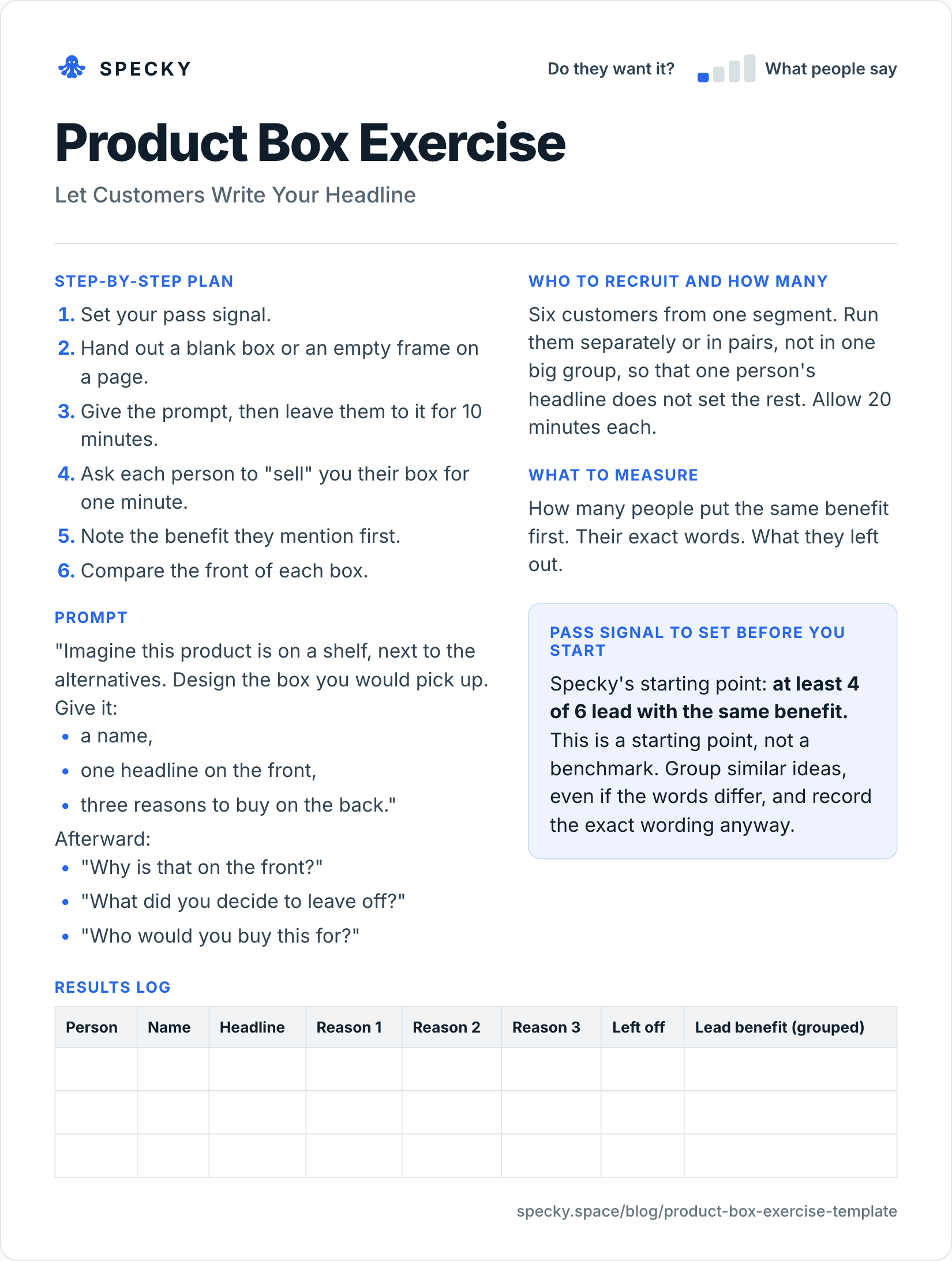
Product box exercise template (copy and use)
Open the image at full size, or copy the text version below.
Who to recruit and how many
Six customers from one segment. Run them separately or in pairs, not in one big group, so that one person's headline does not set the rest. Allow 20 minutes each.
Step-by-step plan
Set your pass signal.
Hand out a blank box or an empty frame on a page.
Give the prompt, then leave them to it for 10 minutes.
Ask each person to "sell" you their box for one minute.
Note the benefit they mention first.
Compare the front of each box.
Prompt
"Imagine this product is on a shelf, next to the alternatives. Design the box you would pick up. Give it:
a name,
one headline on the front,
three reasons to buy on the back."
Afterward:
"Why is that on the front?"
"What did you decide to leave off?"
"Who would you buy this for?"
What to measure
How many people put the same benefit first. Their exact words. What they left out.
Pass signal to set before you start
Specky's starting point: at least 4 of 6 lead with the same benefit. This is a starting point, not a benchmark. Group similar ideas, even if the words differ, and record the exact wording anyway.
Results log
Person
Name
Headline
Reason 1
Reason 2
Reason 3
Left off
Lead benefit (grouped)
How do you run a product box exercise step by step?
Each session fits in 20 minutes:
Minutes
Template step
What you do
0-3
2. Hand out the box
Describe the problem space in one neutral sentence. No features, no slogans.
3-13
3. Prompt, then silence
Read the prompt and leave. Ten minutes is enough; more time produces decoration.
13-15
4. The one-minute pitch
"Sell me your box." Time it.
15-16
5. First benefit
Write down the first benefit they say, word for word.
16-20
Follow-ups
Ask why that is on the front, what they left off and who they would buy it for.
Step 6, comparing the fronts, happens after the last session.
Remote version. Share a blank box outline on a slide or online board with three labelled zones: name, front headline, back reasons. Turn cameras on for the pitch, so you hear the emphasis. Ask people to type, not draw; you need the words.
Paper version. A sheet folded into a cube, or a plain cereal box with paper taped over it, works as well as craft supplies. Hohmann's classic version uses real boxes because the physical shelf makes the choice feel real.
How do you score the boxes?
Write each front headline on its own card.
Group cards by the benefit they promise, not the words. "Stop fighting about money" and "No more awkward bill talks" are one group.
Count the front of the box only for the pass signal. Back-of-box reasons are supporting, not leading.
Keep a word bank of exact phrases, especially verbs and nouns people repeat.
List what nobody put anywhere. That is a candidate for your "not" list.
How many customers do you need for a product box exercise?
Six from one segment is enough to see whether a lead benefit exists. With 4 of 6 as the bar, a clear winner shows up, and a 2-2-2 split tells you the segment is mixed or the problem is unclear.
Why not one big room? Group sessions of 6 to 9 people are good at surfacing needs and preferences, but Nielsen Norman Group warns that one participant can dominate, and that groups show what people say rather than what they do (Nielsen Norman Group, 1997). A strong first pitch becomes everyone's headline. Pairs are a good middle ground: two people negotiating one box is often revealing.
If you sell to two segments, run six of each. The benefit that leads for founders may not lead for their finance lead.
What does a product box exercise look like in practice?
This example is made up to show the method. A team building a budgeting app for couples believes the key benefit is "see all your accounts in one place." They ask six couples to design the box.
Four of the six boxes lead with something about ending arguments over money. One headline reads "No more 'who paid for that?'" Only one box mentions accounts at all, and it is on the back.
Four of six led with the same benefit, so the test passes for the benefit, but not the one the team assumed. They rewrite their landing page around ending money arguments, using the customers' own words.
Here is how the results log could look (names and headlines are illustrative):
Couple
Name on box
Front headline
Lead benefit (grouped)
Accounts mentioned?
1
Even Split
"No more 'who paid for that?'"
Ending money arguments
No
2
Us & Money
"Stop fighting about money"
Ending money arguments
No
3
Fair Share
"Split bills without the awkward talk"
Ending money arguments
No
4
Calm Ledger
"One budget, zero arguments"
Ending money arguments
No
5
Goal Jar
"Save for the big things together"
Shared saving goals
No
6
Month Map
"Know where the month went"
Seeing spending
Yes, on the back
Four of six is 67%, over the bar. The word bank gives the team "who paid," "awkward talk" and "arguments" for the page. The left-off column matters too: five of six boxes never mention accounts, the feature the roadmap was built around.
Product box vs brochure test vs landing page test vs press release
Run them in this order: product box to find the words, brochure test to check they are clear, landing page to see whether strangers act.
What are the most common product box mistakes?
Giving them your words first. You will get them back.
Running one big room. The first box presented shapes everyone else's.
Judging the art. The content is what counts.
Treating a box as a promise to buy. Nobody paid.
Ignoring what they left off. That shows what does not matter to them.
Counting the back as the lead. Only the front shows the one thing they would bet the shelf on.
When it doesn't work: for problems people don't yet recognise, for pricing, and when your six people come from different segments.
Is it fair to use customers' words in your marketing?
Yes, with permission. Tell people at the start that you may reuse phrases, and ask before quoting anyone by name or in a testimonial. A headline like "stop fighting about money" can go on your page unattributed; a named quote needs a yes. If the product does not exist yet, say so plainly. People are designing a box for an idea, and they should know it.
How to run it in Specky
On the Assumptions page, click the note and choose Pick a test, then Product box. Specky fills in six customers, the pass signal, and a one-day timeline.
You run this one. Specky keeps the plan and the result. Hold the sessions yourself, on paper or a shared board.
Click Start running. Paste in the headlines and lead benefits, and record the result.
A pass shows as Early signal on the board, not Supported, because a designed box is what people say they want.
What should you do with each outcome?
Supported (shows as Early signal): Put the winning headline on a landing page, and see if strangers respond.
Unclear: Benefits were scattered. Your group may contain different types of customers. Separate them, and run it again.
Contradicted: The benefit you were counting on did not appear. Rewrite the assumption in the words people used. Any bet resting on this note now shows as Contradicted.
A product box exercise is a customer research game where people design the packaging for a product they would buy. The benefit they put on the front shows what they care about most. It comes from Luke Hohmann's 2006 book Innovation Games and is listed in Strategyzer's Testing Business Ideas experiment library.
How do you run a product box exercise remotely?
Share a blank frame on a slide or an online board and give people 10 minutes to fill in a name, headline, and three reasons to buy. Then ask each person to sell you their box. Ask them to type rather than draw, keep cameras on for the pitch, and run people one at a time or in pairs.
What do you do with the results of a product box exercise?
Find the benefit most people led with, and use their exact words in your messaging. Then test those words on a landing page, since the exercise itself is only opinion. Also list what people left off: features nobody put on the box rarely deserve a place in your headline.
How long does a product box exercise take?
About 20 minutes per person: three to set up, ten to design the box, two for the pitch and five for follow-up questions. Six sessions fit in one morning, and grouping the headlines afterwards takes about an hour. Group workshops with real craft boxes usually take longer.
What is the difference between a product box and a press release?
Both force you to state the customer benefit before you build. In Amazon's working-backwards press release and the Agile Inception Deck's product box, your team writes the words. In the product box exercise, customers write them, so it can show the team which benefit really leads.