Forum Research Template: Mine Complaints People Already Posted
Your customers have already described the problem online, in their own words. Here is how to read it, count what repeats, and stay within each community's rules.
Share
Forum research is a desk test: you read about 50 recent threads in the places your customers already talk, copy their exact phrases, and count how many separate threads describe the same job or complaint. It costs nothing, asks nobody for time, and hands you the customer's own words. It cannot tell you how common the problem is among people who never post.
Key takeaways
"Discussion forums" is one of five data-analysis discovery experiments in David J. Bland and Alex Osterwalder's Testing Business Ideas (UPV course). Academic researchers call the method netnography.
People who post are not typical. In most online communities 90% of users only read, 9% contribute a little and 1% produce almost everything (Nielsen Norman Group, 2006).
Reddit reaches 25% of US adults, but 40% of 18–29-year-olds and only 6% of those 65 and over (Pew Research Center, 2026).
Count separate threads, not comments. Specky's starting pass signal is the same complaint in at least 10 separate threads.
Read by hand and quote with care. Reddit forbids scraping without written consent, and a verbatim quote can be searched back to its author.
What is forum research?
Forum research means reading the threads where your customer already complains, copying their exact phrases, and counting how often the same job comes up. Sources include subreddits, trade forums, community groups, Slack and Discord communities that allow it, and app store reviews.
The method has a research pedigree. In 2002 Robert Kozinets named it "netnography", ethnography adapted to online communities, and described it as faster, simpler and cheaper than traditional ethnography, and more natural and less obtrusive than focus groups or interviews (Journal of Marketing Research, 2002). Nobody is performing for you: these posts were written to get help, not to please a researcher.
Use it when you want to hear the problem in customers' own words without asking anyone for time. It is especially good for finding the language to use on a landing page, and for finding people to talk to later.
Do not use it:
For groups who rarely post online. You will only hear the loud minority. Pew's 2026 data shows Reddit use at 36% of US college graduates but 12% of adults with a high school education or less.
To size a problem. Forums skew toward angry people and hobbyists. For a sense of how widespread a problem is, follow up with a discovery survey.
To prove people will pay. Complaining is free.
Which risk does it test, and how strong is the evidence?
This tests desirability: is this a repeated complaint? The evidence is opinion. These are honest words that nobody prompted, which is valuable, but people who post are not typical, and you cannot follow up on many of them. Our guide to choosing a product experiment shows where it fits.
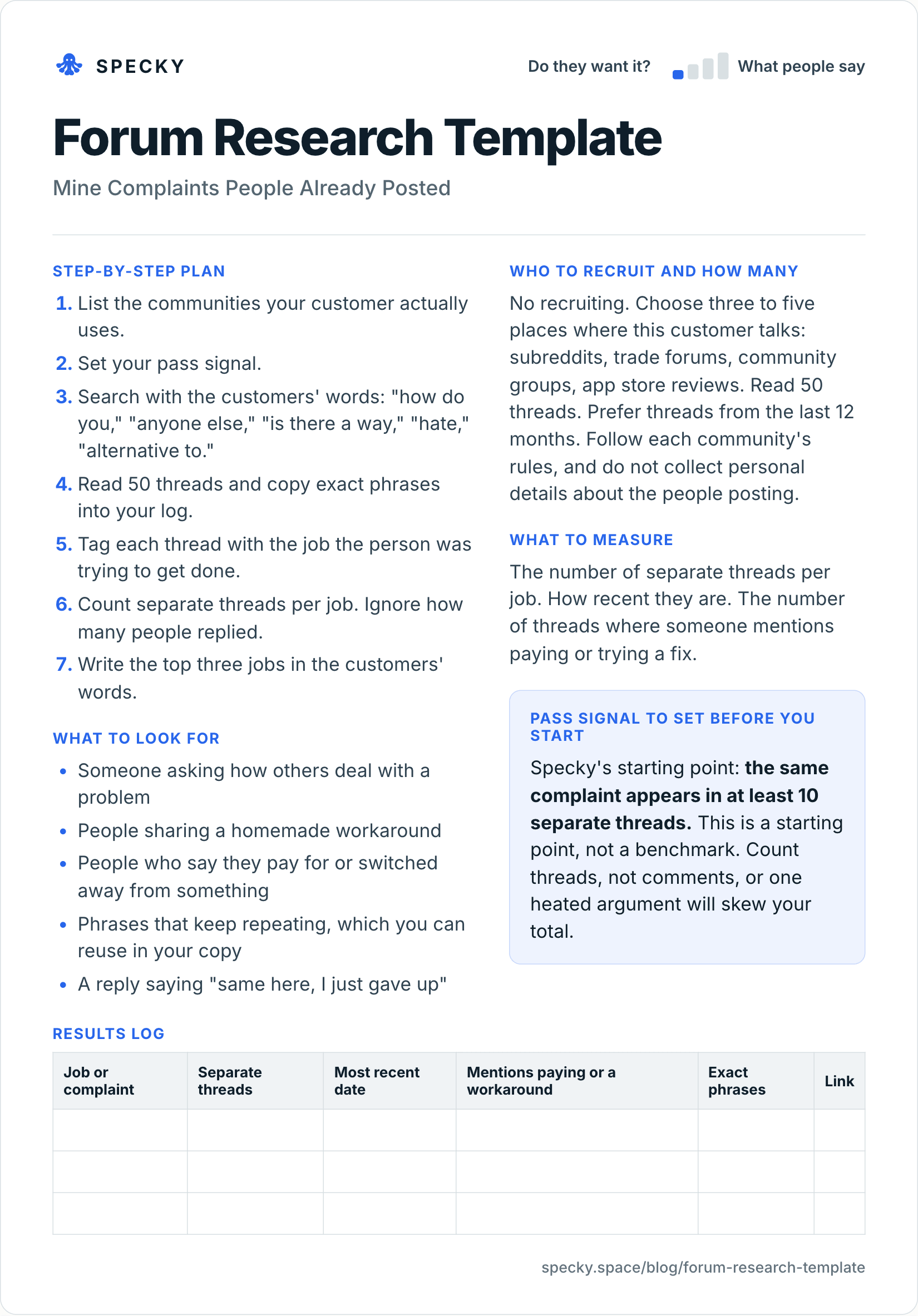
Copy-and-use forum research template
Open the image at full size, or copy the text version below.
Who to recruit and how many
No recruiting. Choose three to five places where this customer talks: subreddits, trade forums, community groups, app store reviews. Read 50 threads. Prefer threads from the last 12 months. Follow each community's rules, and do not collect personal details about the people posting.
Step-by-step plan
List the communities your customer actually uses.
Set your pass signal.
Search with the customers' words: "how do you," "anyone else," "is there a way," "hate," "alternative to."
Read 50 threads and copy exact phrases into your log.
Tag each thread with the job the person was trying to get done.
Count separate threads per job. Ignore how many people replied.
Write the top three jobs in the customers' words.
What to look for
Someone asking how others deal with a problem
People sharing a homemade workaround
People who say they pay for or switched away from something
Phrases that keep repeating, which you can reuse in your copy
A reply saying "same here, I just gave up"
What to measure
The number of separate threads per job. How recent they are. The number of threads where someone mentions paying or trying a fix.
Pass signal to set before you start
Specky's starting point: the same complaint appears in at least 10 separate threads. This is a starting point, not a benchmark. Count threads, not comments, or one heated argument will skew your total.
Results log
Job or complaint
Separate threads
Most recent date
Mentions paying or a workaround
Exact phrases
Link
How do you find the right threads?
A web search usually finds forum threads faster than a forum's own search box. Google supports four operators that do most of the work: quotes for an exact phrase, site: to stay on one site, a minus sign to exclude a word, and after: or before: to set a date range (Google Search Help).
Combine them with the customer phrases from the template:
site:reddit.com "is there a way to" invoice reminders after:2025-11-15
"we ended up building" [job] to find homemade workarounds
Run each phrase in each community, and log threads as you go so you stop at 50 rather than reading the best-ranked ones only.
How many threads should you read?
Fifty is enough to see which jobs repeat and few enough to finish in two days. Three rules keep the count honest:
Count a thread once per job, however many replies agree. Fifty "+1" comments under one post are one data point.
Prefer the last 12 months. A complaint that peaked in 2021 may have been solved since.
Separate pain from action. Track how many threads mention a workaround, a paid tool or a switch. Those are stronger than complaints alone.
If your top job reaches 10 of 50 threads, that is 20% of what you read. If nothing reaches 5 after 50 threads, read another 25 in different communities before calling it rare.
What are the rules for using Reddit and forums for research?
Reading public posts is allowed; how you collect and reuse them is where teams get into trouble.
Follow each community's rules. Reddit's Rule 2 asks users to abide by community rules, participate authentically where they have a personal interest, and not spam (Reddit Rules). Read each community's own rules before you post anything.
Don't collect personal details. Rule 3 forbids revealing someone's personal or confidential information. Log the job and the phrase, not the username.
Read, don't scrape. Reddit's User Agreement prohibits scraping without its prior written consent (Reddit User Agreement). Manual reading for 50 threads is the method; bulk data needs an agreement.
Don't pretend. Rule 5 asks users not to mislead others. If you post a question, say you are building something.
Be careful with quotes. The Association of Internet Researchers notes that a quote can identify its author through a simple string search, and suggests asking consent before publishing one, or paraphrasing (AoIR, 2019). Reuse short, common phrases in your copy; ask before you publish a full sentence someone wrote about their own work.
Worked example (hypothetical)
This example is made up to show the method. A developer wants to build a tool that sends a daily summary of pull requests. He reads 50 threads across two programming communities and one engineering managers' group.
Only four threads mention summaries. But 13 separate threads complain about the same thing: nobody knows which reviews are stuck. Several people describe their homemade bots. The phrase "PRs rot" appears repeatedly.
His pass signal is about summaries, and it fails. The stuck-review complaint would have passed easily, and "PRs rot" gives him a line to test on a landing page.
His log adds detail, also invented: of the 13 stuck-review threads, 9 are from the last six months, 6 describe a homemade bot or script, and 2 mention paying for a tool they later dropped. "PRs rot" appears in 5 threads from different authors, so it is common language, not one person's line, and safe to reuse. He messages two authors of workaround threads, says he is building something, and books one call.
Forum research vs discovery survey vs search trend analysis
What exactly do people complain about, in what words?
How common is each problem in a defined group?
Is interest rising, and in which words?
Who you hear
People who chose to post
People you invited
Anonymous searchers
Evidence
Opinion, unprompted
Opinion, prompted
Directional behaviour
Cost and time
€0, 1–3 days
Low, 1–2 weeks
€0, about a day
Weak spot
Loud minority
Leading questions, low response
No "who" or "why"
A sensible order: forum research for the pain and the words, search trends to see whether those words are searched, then a survey or customer interviews to learn how common the problem is among people who never post. For customers you already have, support ticket analysis does the same job on your own inbox.
What are the most common forum research mistakes?
Quoting the loudest reply. Upvotes reward wit. Count the job that keeps coming back.
Reading only the top threads. Popular posts are often jokes or rants.
Paraphrasing. The exact words are the whole value of this method.
Treating complaints as demand. Complaining is free. Look for people who tried to fix it.
Being a nuisance. Do not promote yourself in the thread. Ask permission if you want to reach out.
How to run it in Specky
On the Assumptions page, click the note and choose Pick a test, then Discussion forums. Specky fills in the steps, the pass signal, and a two-day timeline.
You run this one. Specky keeps the plan and the result. Read the threads yourself and keep your log.
Click Start running. Paste the counts, the best phrases, and links onto the test.
Record the result.
A pass shows on the board as Early signal, not Supported, because forum posts are what people say.
What to do with each outcome
Supported (shows as Early signal): The complaint repeats. Interview a few people with this problem, then test their exact words on a landing page.
Unclear: Few threads match. Try other communities, or check search trends with the words you found.
Contradicted: The complaint is rare or old. Look at what people do complain about, and decide if your idea should change. Any bet resting on this note now shows as Contradicted.
Frequently asked questions
How do you use forums for product research?
Read about 50 recent threads where your customers talk, copy their exact words, and count how many separate threads repeat the same problem. Tag each thread by the job the person was trying to do, and note workarounds and payments. This shows you real complaints and real language without asking anyone for time.
Is Reddit good for customer research?
Reddit is good for hearing unprompted complaints in people's own words, and it reaches about a quarter of US adults. But its users skew young and college-educated, and in most communities a small minority writes almost everything. Use it to form a belief and find language, then test the belief with people who don't post.
Is it legal and ethical to use Reddit posts for research?
Reading public posts and noting patterns is normal practice. Stay within Reddit's rules and each community's rules, don't scrape without Reddit's written consent, and don't collect usernames or personal details. Before publishing a verbatim quote, ask the author or paraphrase, because a quote can be searched back to the person who wrote it.
What is netnography?
Netnography is ethnography adapted to online communities, a term Robert Kozinets introduced in the Journal of Marketing Research in 2002. Researchers observe how people talk in forums and groups, unprompted, to understand their meanings and habits. Forum research is a fast, lightweight version focused on one product question.
What is the difference between forum research and a survey?
Forum research reads what people already wrote without being asked. A survey asks a defined group your questions. Forums give you honest language and unexpected problems; surveys give you a count from a known group. Use forums first to find the words, then a survey to measure how common the problem is.