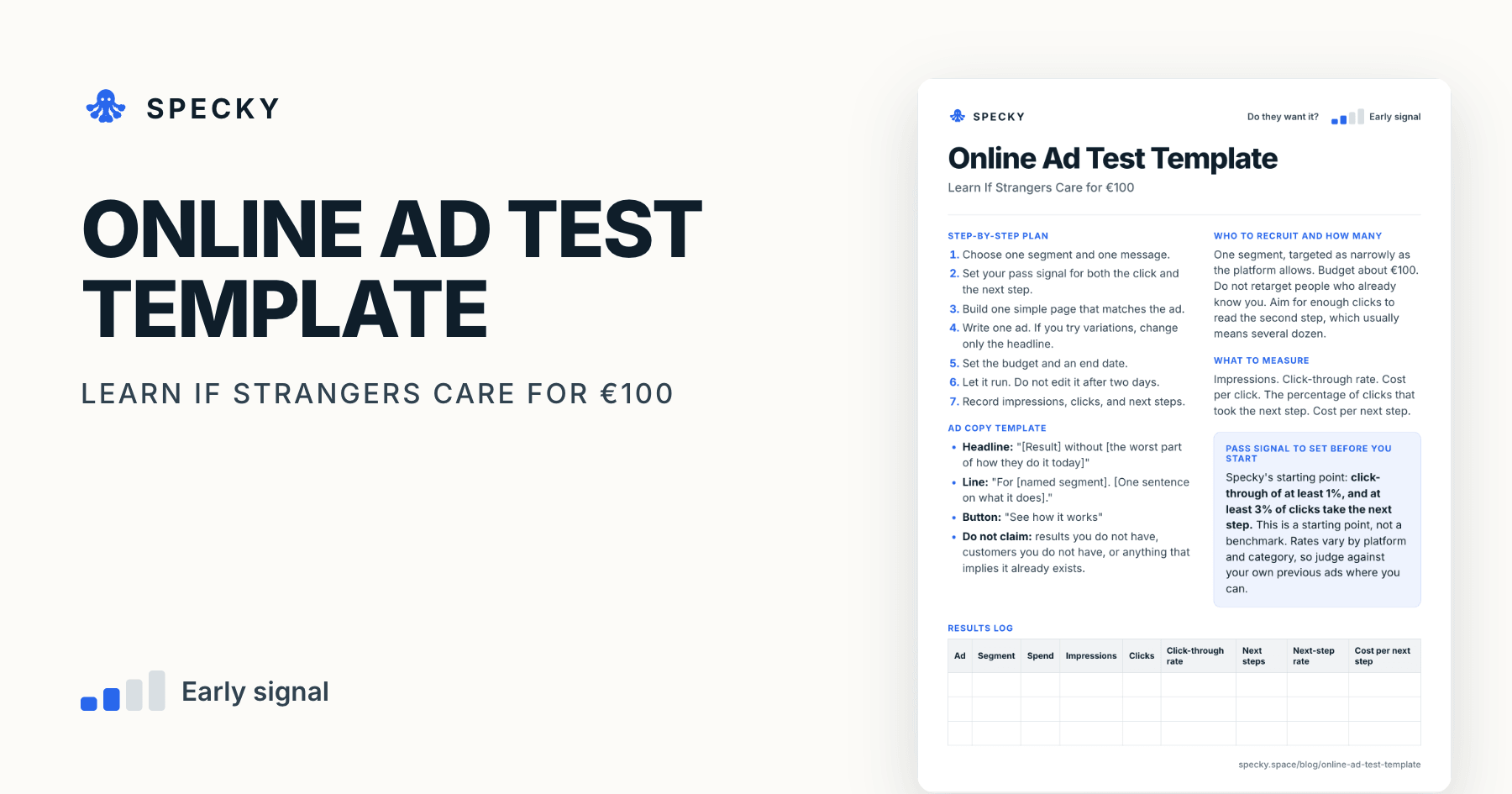
Online Ad Test Template: Learn If Strangers Care for €100
Friends go easy on you. Strangers do not. Find out what a cold audience does with your offer for about €100, and read the click and the next step separately.
Share
An online ad test is a small paid experiment: you show one ad with one message to one narrowly targeted group of strangers, usually for about €100 over a week, then count who clicks and, more importantly, who takes the next step on the page behind it. It tells you whether a message earns attention from people who owe you nothing.
Key takeaways
The online ad is one of the "interest discovery" experiments in David J. Bland and Alex Osterwalder's Testing Business Ideas (2019), a library of more than 40 experiment types sorted by cost, time and strength of evidence (Strategyzer).
Benchmarks depend on the channel. In LocaliQ's 2026 data, Facebook traffic ads average a 1.93% click-through rate at $0.60 a click; Google search ads average 6.64% at $5.42 a click (LocaliQ, 2026; LocaliQ, 2026).
At those averages, $100 buys about 165 clicks on Facebook but only about 18 on Google search. Check the likely cost per click before you choose where to test.
The click is not the result. Specky's starting pass signal is a click-through rate of at least 1% and at least 3% of clicks taking the next step.
What is an online ad test?
An online ad test puts one offer in front of one group of strangers on a small budget, then measures who clicks and who takes the next step.
The method comes from the experiment library in Testing Business Ideas. A Universitat Politècnica de València (UPV) course built on the book lists it under "interest discovery", next to link tracking, the feature stub, the 404 test, the email campaign, the social media campaign and the referral program (UPV course slides). Interest discovery tests ask one thing: does anyone outside your circle care enough to act?
Which risk does it test, and how strong is the evidence?
This tests : does this message get a reaction from cold strangers? The evidence is , an early signal. A click is interest, not a purchase, and platforms deliver ads based on their own rules, so the clickers are not a neutral sample. The step after the click tells you more. See where it fits in our .
When should you run an online ad test, and when not?
Use it when you want to hear from people who have never heard of you. Friends, followers and your email list all go easy on you. Strangers on an ad platform have no reason to.
Do not use it when:
You cannot target your segment. You will pay for the wrong clicks.
You have no budget, but your customers gather somewhere you are welcome. Try a social media demand test instead.
Your category is very expensive. In LocaliQ's 2026 search data, Business Services clicks average $5.87 and a lead costs $93.69, so €100 may buy one or two leads.
You want to know what a customer costs to acquire. This test is about the message. Run a full funnel test for that.
Copy-and-use online ad test template
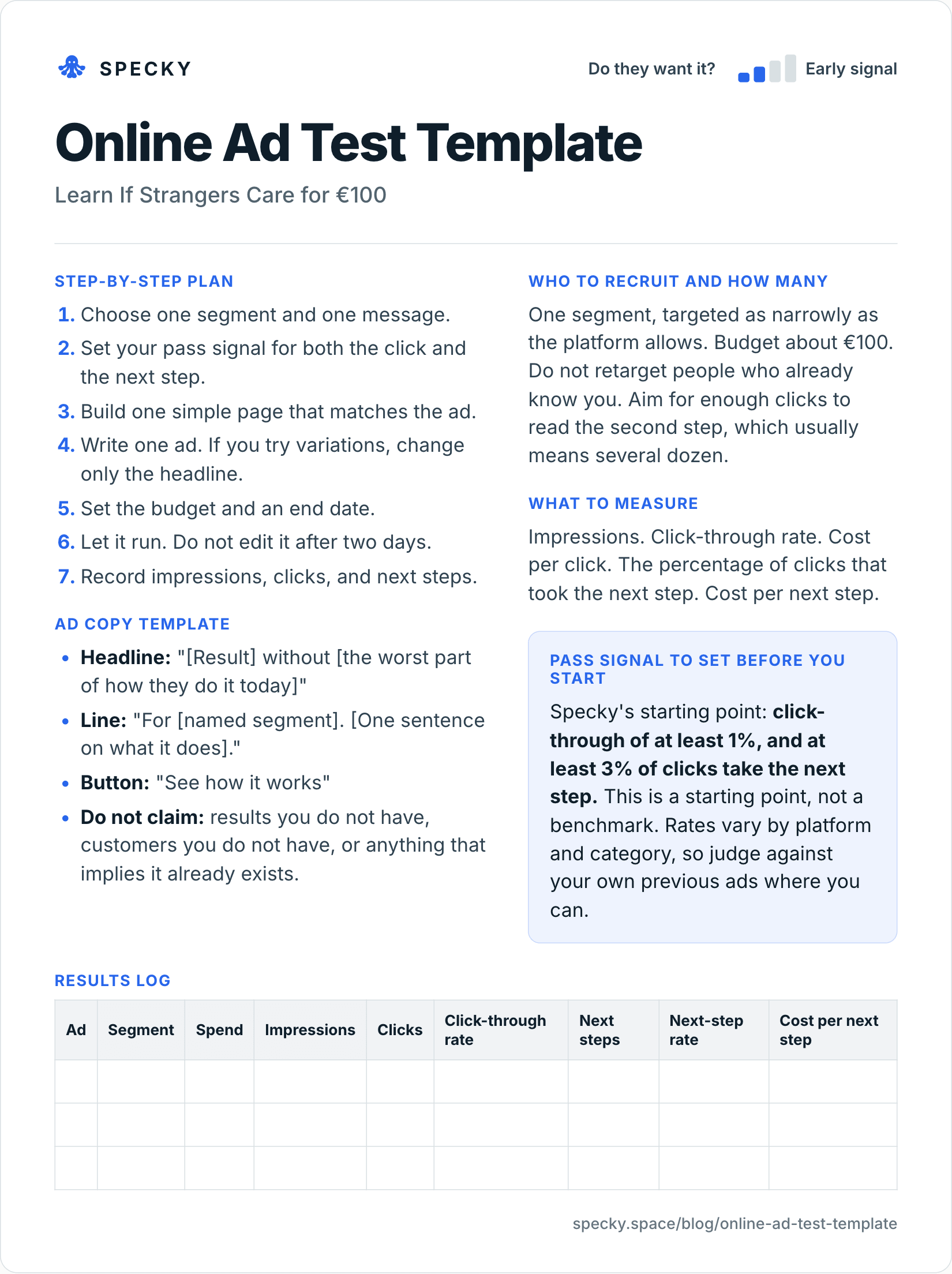
Open the image at full size, or copy the text version below.
Who to recruit and how many
One segment, targeted as narrowly as the platform allows. Budget about €100. Do not retarget people who already know you. Aim for enough clicks to read the second step, which usually means several dozen, and ideally 100 or more (see the budget section below).
Step-by-step plan
Choose one segment and one message.
Set your pass signal for both the click and the next step.
Build one simple page that matches the ad.
Write one ad. If you try variations, change only the headline.
Set the budget and an end date.
Let it run. Do not edit it after two days.
Record impressions, clicks, and next steps.
Ad copy template
Headline: "[Result] without [the worst part of how they do it today]"
Line: "For [named segment]. [One sentence on what it does]."
Button: "See how it works"
Do not claim: results you do not have, customers you do not have, or anything that implies it already exists.
What to measure
Impressions. Click-through rate. Cost per click. The percentage of clicks that took the next step. Cost per next step.
Tag the ad's link with utm_source, utm_medium and utm_campaign, the three parameters Google Analytics says to always use, and keep the values lowercase, because values are case sensitive and "Facebook" and "facebook" become two sources (Google Analytics Help).
Pass signal to set before you start
Specky's starting point: click-through of at least 1%, and at least 3% of clicks take the next step. This is a starting point, not a benchmark. Rates vary by platform and category, so judge against your own previous ads where you can.
Results log
Ad
Segment
Spend
Impressions
Clicks
Click-through rate
Next steps
Next-step rate
Cost per next step
What click-through rate should you expect?
It depends on where the ad runs. Search ads reach people who are already typing about the problem, so they get clicked far more than ads in a feed, which interrupt people doing something else. Here are the latest published averages from LocaliQ's 2026 benchmark reports, based on its customers' campaigns:
The 1% click bar in the template suits feed ads. On search, where the average is 6.64%, raise it. These averages come from running businesses with optimised ads, so a new offer will often sit below them; your own past ads in the same channel are a better yardstick.
Search ads or social ads?
Search ads answer "are people already looking for a fix?" Social ads answer "does this message stop the right people mid-scroll?" Run them as separate tests with separate links, and compare channels with a link tracking test.
How much should you spend on an online ad test?
About €100 is enough for a first read on one message and one segment in a cheap channel. The maths is simple: budget divided by expected cost per click gives you clicks, and clicks times your next-step bar gives you the number of people you will actually learn from.
Channel
Clicks per $100 at the 2026 average
Next steps at 3% of clicks
Facebook traffic ($0.60 a click)
about 165
about 5
Google search ($5.42 a click)
about 18
under 1
At 3%, 100 clicks give you only about three signups. Treat anything under roughly 100 clicks as a read on the ad, not on the page. If your channel's cost per click means €100 buys fewer than 100 clicks, either raise the budget or choose a cheaper channel for this test.
Watch the cost side too. Drew Houston's own slides record that Dropbox's search ads cost $233 to $388 per customer for a $99 product (Houston, 2010). A message can work while the channel never pays.
Worked example (hypothetical)
This example is made up to show the method. A founder is testing a tool that files expense receipts for sole traders. She runs one ad, "Your receipts, filed before your accountant asks," to sole traders in one country for €100.
It gets 21,000 impressions and 273 clicks, a 1.3% click-through rate. Her page asks for an email in exchange for early access. Five people give one, or 1.8% of clicks.
The first half passes, and the second fails. People liked the headline, but the page did not convince them. She records the test as inconclusive and rewrites the page, because the ad seems to work.
Extending the example. Her cost was about €0.37 a click and €20 per email. She keeps the same ad and the same audience, rewrites only the page so its headline repeats the ad word for word, and spends another €100. This time, 260 clicks bring 11 emails, or 4.2%. Because she changed one thing, she knows which change worked. Both halves now pass, and she moves to a landing page test that asks for a stronger commitment.
Online ad test vs landing page test vs funnel test
They can share the same ad and page; what differs is the question.
Run the ad test first when the message is the doubt; the other two test the offer and the economics.
Common mistakes
Testing several things at once. If you change the message and the audience, you learn nothing.
Judging by clicks alone. A catchy ad can be clicked by people with no intention of buying.
A page that doesn't match the ad. Visitors think they landed in the wrong place.
Editing mid-test. Decide your budget and leave it alone.
Stopping the moment it looks good. In Evan Miller's well-known example, checking after every observation and stopping at the first "significant" result raised the false positive rate from 5% to 26.1% (Evan Miller, 2010). Fix the end date in advance.
Implying it exists. Be careful what the ad promises. Say early access, and mean it.
Is it honest to advertise a product that doesn't exist yet?
It can be, if the ad and the page say what is true. Ad platforms police this: Google's Misrepresentation policy rejects ads for offers that are unavailable and claims that promise an improbable result (Google Ads policy). Three rules keep the test honest and inside the rules:
Say "early access" or "join the waitlist", never "buy now". Do not take payment for something you cannot deliver.
Tell people what happens next within a week of signing up, including if you decide not to build it.
Collect only what you need, usually an email, say what you will use it for, and delete the list if the idea dies.
A fake door test inside an existing product raises the same questions; the same rules apply.
How to run it in Specky
On the Assumptions page, click the note and choose Pick a test, then Online ad. Specky fills in the steps, the pass signal, and a one-week timeline.
Click Create validation page. Specky builds the page the ad will point to, and collects responses.
Running the ad is your part, in whichever ad platform you use. Specky does not buy ads or spend your budget. Put UTM tags on your ad's link, so Specky can show the page's numbers by source.
Click Start running. Paste in impressions and spend from the ad platform, and record the result.
A pass shows as Early signal on the board, not Supported, because the test is rated directional. A click is interest, not a purchase.
What to do with each outcome
Supported (shows as Early signal): Your message reaches strangers. Move to a landing page test with a stronger ask, or a funnel test.
Unclear: Often one half passes and the other fails. If clicks are fine and next steps are low, fix the page. If clicks are low, fix the message.
Contradicted: Strangers do not respond. Try one other message, then revisit the segment. Any bet resting on this note now shows as Contradicted.
Frequently asked questions
How much should I spend to test an idea with ads?
About €100 is enough for a first read on one message and one segment in a channel where clicks cost under a euro. Divide the budget by the channel's typical cost per click: if that gives fewer than 100 clicks, raise the budget or switch channel, because at a 3% next-step rate you would learn from only two or three people.
What does a good ad click-through rate prove?
A good click-through rate shows that a message caught attention. It does not prove demand. The step after the click, such as leaving an email, tells you more. Judge the click against the channel: LocaliQ's 2026 averages are 1.93% for Facebook traffic ads and 6.64% for Google search ads, so the same rate means different things in each.
Should I use a fake door or an online ad?
They work together. An online ad brings cold strangers, and a fake door gives them something to act on. The ad tests the message, and the page tests the offer. If you already have visitors or users, a fake door alone may be enough; if nobody outside your circle has seen the idea, start with the ad.
How long should an online ad test run?
Run it for about a week, and set the end date before you start. A week smooths out weekday and weekend differences, and fixing the date stops you ending the test the moment the numbers look good, which inflates false positives. If the budget runs out early because clicks are cheap, that is fine; do not top it up mid-test.
Can you run an online ad test for a B2B product?
Yes, but expect higher costs and lower volume. In LocaliQ's 2026 search data, Business Services clicks average $5.87 and a lead $93.69. Target by job title or company size where the platform allows it, make the next step light (an email or a short question), and plan on a larger budget or a longer run to reach 100 clicks.