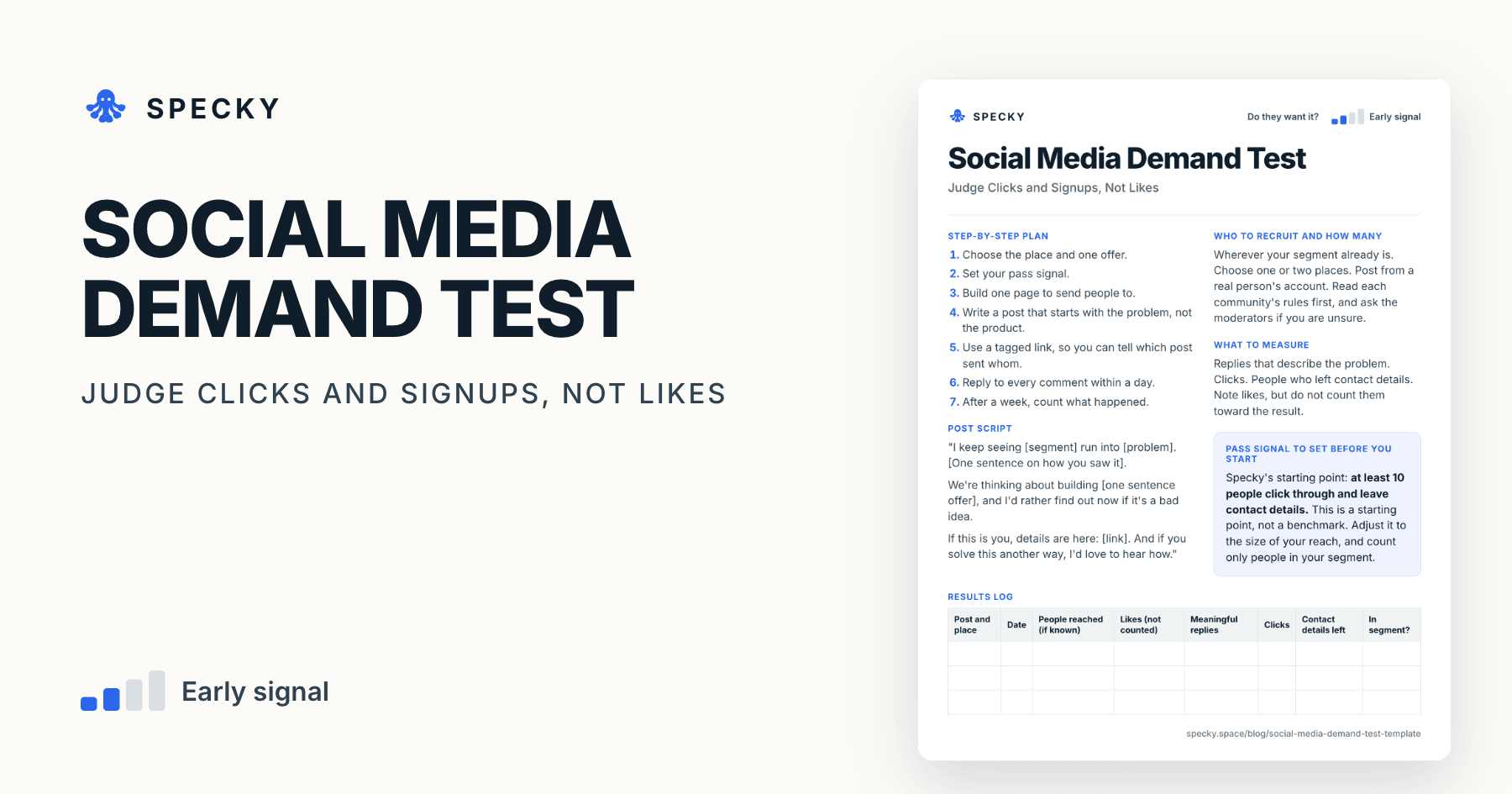
Social Media Demand Test Template: Count Signups, Not Likes
A post with 300 likes can tell you nothing. Here is what to count instead when you test demand on LinkedIn, Reddit or a niche community, and how to read it.
Share
A social media demand test posts one offer, from a real person's account, in a place where your customers already spend time, then judges it by replies that describe the problem, clicks on a tagged link and signups. Likes are recorded but never counted. It costs time rather than money, and it shows whether an idea makes people in your segment do something.
Key takeaways
The social media campaign is one of the "interest discovery" experiments in David J. Bland and Alexander Osterwalder's Testing Business Ideas (Wiley, 2019), a library of 43 experiment types (Strategyzer).
Likes are public token support. A 2014 Journal of Consumer Research study found more meaningful help followed private token support than public support (Kristofferson, White and Peloza, 2014).
Expect few replies. Jakob Nielsen's 90-9-1 rule says about 90% of community users only read, 9% contribute now and then, and 1% write most of the content (NN/g, 2006).
Organic engagement is falling: down 16% to 48% across platforms in Rival IQ's 2025 report.
Specky's starting pass signal: at least 10 people in your segment click through and leave contact details.
What is a social media demand test?
It is a free, public demand experiment from the library in Testing Business Ideas. A Universitat Politècnica de València (UPV) course built on the book lists the social media campaign under "interest discovery", alongside the online ad, link tracking, the email campaign and the referral program (UPV course slides).
Which risk does it test, and how strong is the evidence?
This tests : does this offer get people where they already spend time to do something? The evidence is . Replies and signups are real, but reach is unpredictable and your followers are not a neutral sample. Our explains how to read it.
When should you run a social media demand test, and when not?
Use it when your segment gathers somewhere specific, like a LinkedIn circle, a niche community, or a subreddit that allows it, and you can post without paying. It also gives you a chance to read replies from people who care.
Do not use it when:
You have no presence and no right to be there. Dropping a pitch into a community will get you ignored or banned.
You need a controlled audience. A post can catch on or vanish for reasons unrelated to your offer. Use an online ad when you need to choose who sees it.
Your buyers are not active on social platforms. Some segments read but rarely act in public. An email campaign to an opted-in list may reach them better.
You can only post once. One post is a lottery ticket, not a sample.
Copy-and-use social media demand test template
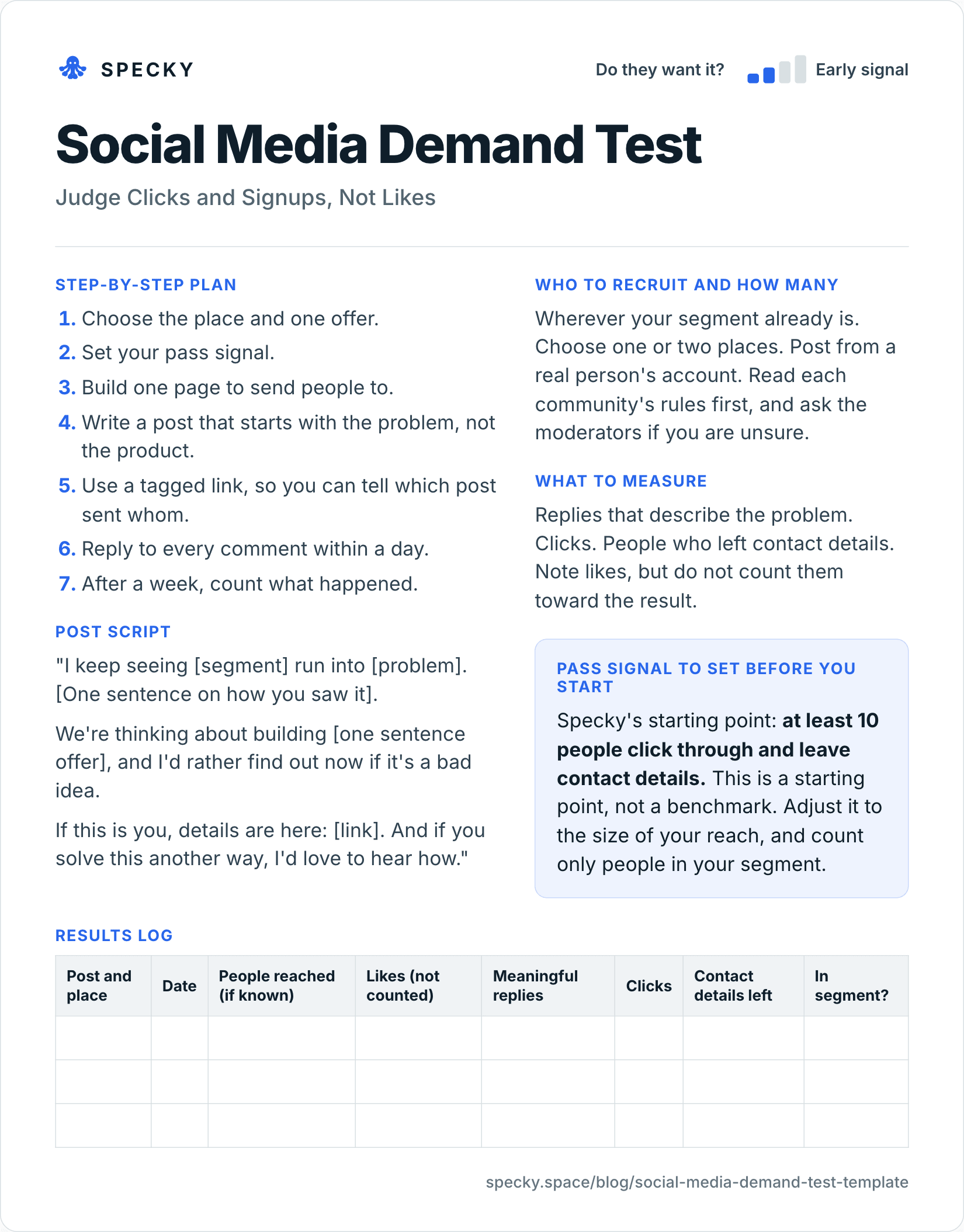
Open the image at full size, or copy the text version below.
Who to recruit and how many
Wherever your segment already is. Choose one or two places. Post from a real person's account. Read each community's rules first, and ask the moderators if you are unsure.
Step-by-step plan
Choose the place and one offer.
Set your pass signal.
Build one page to send people to.
Write a post that starts with the problem, not the product.
Use a tagged link, so you can tell which post sent whom.
Reply to every comment within a day.
After a week, count what happened.
Post script
"I keep seeing [segment] run into [problem]. [One sentence on how you saw it].
We're thinking about building [one sentence offer], and I'd rather find out now if it's a bad idea.
If this is you, details are here: [link]. And if you solve this another way, I'd love to hear how."
What to measure
Replies that describe the problem. Clicks. People who left contact details. Note likes, but do not count them toward the result.
Pass signal to set before you start
Specky's starting point: at least 10 people click through and leave contact details. This is a starting point, not a benchmark. Adjust it to the size of your reach, and count only people in your segment.
Results log
Post and place
Date
People reached (if known)
Likes (not counted)
Meaningful replies
Clicks
Contact details left
In segment?
Why don't likes count as demand?
A like costs one tap, is visible to everyone, and commits the person to nothing. Research on "slacktivism" studies exactly this kind of cheap, public support. Kirk Kristofferson, Katherine White and John Peloza found that greater helping on a later, more meaningful task followed private token support rather than public support, such as joining a Facebook group or wearing a ribbon (Journal of Consumer Research, 2014). Their study was about social causes, not products, but the lesson carries: a public gesture is not a commitment.
So rank signals by what they cost the person:
Signal
What it costs them
Counts toward the pass?
Like or reaction
One tap
No
Share without comment
One tap, some reputation
No
Click on your link
A few seconds
Partly: it is interest
Reply describing the problem
Minutes, and it is public
Yes, read every one
Contact details left
Their inbox, a future conversation
Yes, this is the pass signal
Why are there so few replies?
Because most people never post. Nielsen's 90-9-1 rule describes online communities where 90% of users are lurkers who read but never contribute, 9% contribute from time to time, and 1% account for most contributions (Nielsen Norman Group, 2006). A quiet comment section is normal. Treat each reply as a voice for many readers who stayed silent, and judge the test on clicks and signups, where lurkers do show up.
How do you tag links so you know which post worked?
Give every post its own link with UTM tags. Google Analytics says to always use utm_source, utm_medium and utm_campaign, and to use utm_content to tell creatives apart (Google Analytics Help). For example:
Keep values lowercase. Google says values are case sensitive, so "LinkedIn" and "linkedin" become two sources.
Use social as the medium. In Google Analytics 4, a medium of social, social-network, social-media or sm counts as Organic Social. A medium the rules don't recognise can end up as "Unassigned" (GA4 default channel group).
How long should a social media demand test run?
About a week, with two or three posts in different places or at different times. Most of a post's clicks arrive fast. When Bitly measured link "half-life", the time a link takes to collect half its clicks, it found an average of 2.8 hours on Twitter and 3.2 hours on Facebook (Poynter, 2011). The figures are old, but a single post still has a short life.
That is why the template says to reply to every comment within a day, while people are still looking.
Reach is also less reliable than it was. Rival IQ's 2025 Social Media Industry Benchmark Report, based on more than 4 million posts across 14 industries, found engagement rates had fallen on every platform it tracked: Facebook by 36%, Instagram by 16%, TikTok by 34% and X by 48% (Rival IQ, 2025). If a post dies, it may be the platform, not your idea. Post again before you conclude anything.
How many people do you need to reach?
Work backwards from the pass signal. The rates below are illustrative, not benchmarks, so replace them with your own as soon as you have a first post's numbers.
Step
Illustrative rate
People needed for 10 signups
Leave contact details after clicking
25% of clickers
40 clicks
Click the link after seeing the post
2% of viewers
2,000 views
If your posts reach a few hundred people, spread the bar across two or three posts, or lower it before you start.
Worked example (hypothetical)
This example is made up to show the method. A founder is testing a tool that helps nurses swap shifts. She posts in two nursing forums where she has been active for months, with moderators' permission.
One post gets 300 likes and little else. The other, which opens by describing a swap that went wrong, gets 41 replies, 58 clicks, and 16 people leaving their contact details. Fourteen of those work as nurses.
The pass signal is met, by the second post alone. The popular post would have looked like the winner if she had been counting likes.
Reading the numbers. On the second post, 16 of 58 clickers left details, a 28% rate, and 14 of 16 (88%) were in the segment. The 41 replies matter as much as the signups. She sorts them into problem descriptions, existing workarounds and encouragement; only the first two go into her evidence. Her next step is to book 30-minute calls with the 14 nurses using a customer interview template.
Social media demand test vs online ad test vs email campaign test
All three put one offer in front of people and count who acts. The difference is who sees it and how much you control.
Start with social if you already belong to the community; move to ads when you need strangers you can target.
Is it honest to post about a product that doesn't exist?
Yes, if you say what it is. The post script says "we're thinking about building", which is true. Four rules keep it fair:
Be a member first. Post where you already take part, and follow the community's rules.
Say who you are. Disclose that you are the founder. Never use fake accounts.
Never imply it exists. "Join the early list", not "sign up now".
Collect only what you need, usually an email, say why, and delete the list if the idea dies.
A fake door test inside an existing product raises the same questions.
Common mistakes
Counting likes. Likes are polite and free.
Showing up only to sell. Communities notice, and it will cost you.
Reading one post as the answer. Reach is partly luck, so post more than once.
Using an unmarked link. Without a tag, you cannot tell which post worked.
Letting your followers vote. People who follow you are not your market.
How to run it in Specky
On the Assumptions page, click the note and choose Pick a test, then Social media campaign. Specky fills in the steps, the pass signal, and a one-week timeline.
Click Test with a page. Specky builds the waitlist page and collects responses.
Writing and posting are your part for this test. Put UTM tags on your links, so that the page's numbers break down by post.
Click Start running. Paste in the count of meaningful replies, and record the result.
A pass shows as Early signal on the board, not Supported, because reach on social is unpredictable and the test is rated directional.
What to do with each outcome
Supported (shows as Early signal): Contact the people who left details and book interviews, then ask for a real step with a fake door.
Unclear: The post may just not have travelled. Try a different opening and a different place, or use a link tracking test to compare messages.
Contradicted: Lots of people saw it and nobody acted. Rethink the offer before you post again. Any bet resting on this note now shows as Contradicted.
Frequently asked questions
Do social media likes show demand for a product?
No. Likes cost one tap, are public and commit nobody to anything. Research on token support found that more meaningful help followed private gestures than public ones. Count replies that describe the problem, clicks on a tagged link, and people who leave contact details instead, and record likes only as context.
How do you test an idea on LinkedIn or Reddit?
Post from your own account in a place your segment already uses and where you already take part. Read the community's rules first. Open with the problem, link to one page with a UTM-tagged link, reply to every comment within a day, and count replies and signups after a week. Post at least twice before drawing conclusions.
Why are social media test results so unpredictable?
Reach depends on platform algorithms, timing and luck, and engagement has been falling: Rival IQ's 2025 report found drops on every platform it tracked, up to 48% on X. A post that dies may say nothing about your offer. Post more than once, and use paid ads when you need a controlled audience.
How many signups count as a pass?
Specky's starting point is at least 10 people from your segment who click through and leave contact details. Adjust it to your reach before you post: a founder whose posts reach 300 people needs a lower bar than one whose posts reach 20,000. Count only people who match your segment, and write the bar down first.
Is a social media demand test better than an online ad?
Neither is better; they answer different questions. A social media test is free and brings replies you can read, but you cannot control who sees it. An online ad costs about €100 and reaches targeted strangers. Many teams run the social test first, then put the winning message into an ad.