Funnel Testing: Learn What a Customer Costs Before You Scale
Plenty of products are loved by people who cost too much to reach. Find out what a customer really costs before you plan around it.
Share
Funnel testing means sending a small paid budget through your whole acquisition path, from ad to page to signup to first payment, and working out what each step costs. A funnel test tells you whether a customer costs less to acquire than they are worth, before you plan growth around a channel that can never pay for itself.
Key takeaways
The stages come from Dave McClure's AARRR "pirate metrics" (acquisition, activation, retention, referral, revenue), which he proposed in 2007 (McClure; Amplitude). A funnel test measures the first two and the start of revenue.
Channel decides cost. In LocaliQ's 2026 data, a Facebook traffic click averages $0.60 and a search-ad click $5.42 (LocaliQ; LocaliQ).
A signup is not a customer. Across 1,000+ products, a "good" free-trial-to-paid rate is 8% to 12% within six months (Lenny's Newsletter, 2023).
Specky's starting pass signal: cost per signup below what a customer is worth. Then hold cost per paying customer to the same test, and aim higher later: David Skok's rule of thumb for the best SaaS businesses is customer value above 3 times acquisition cost (Skok).
What is funnel testing?
Funnel testing is buying a small amount of real traffic and following it through every step to a paying customer, so you can see the conversion rate and the cost at each step.
It borrows its stages from McClure's Startup Metrics for Pirates, which tells startups to pick five to ten conversion steps and measure each one (McClure). It is not one of the 44 experiments in Bland and Osterwalder's Testing Business Ideas library; it strings together an online ad test and a landing page test, then adds the money side.
Dropbox's is the best-known example. Drew Houston's slides record that search ads cost $233 to $388 per customer for a $99 product, a result he summed up in one word: fail (). The same slides credit a referral program with permanently raising signups by 60%.
Which risk does it test, and how strong is the evidence?
This tests viability: can you afford to acquire a customer? The evidence is behaviour: real people clicked and signed up, and you know what it cost you. But small budgets give you rough numbers, and a signup is not a paying customer. Read more in our guide to choosing a product experiment.
When should you run a funnel test, and when not?
Use it when you have an offer that seems to work, and you need to know whether the numbers can ever add up. Many products are loved by people who cost too much to reach. This test finds that out early.
Do not use it:
Before you know that people want the offer. If the message is unproven, an online ad or a landing page is the cheaper first step.
For products sold through a long, hands-on sales process, where a click is only the first of many steps.
When you cannot afford several dozen signups' worth of traffic in your channel (see the budget section below).
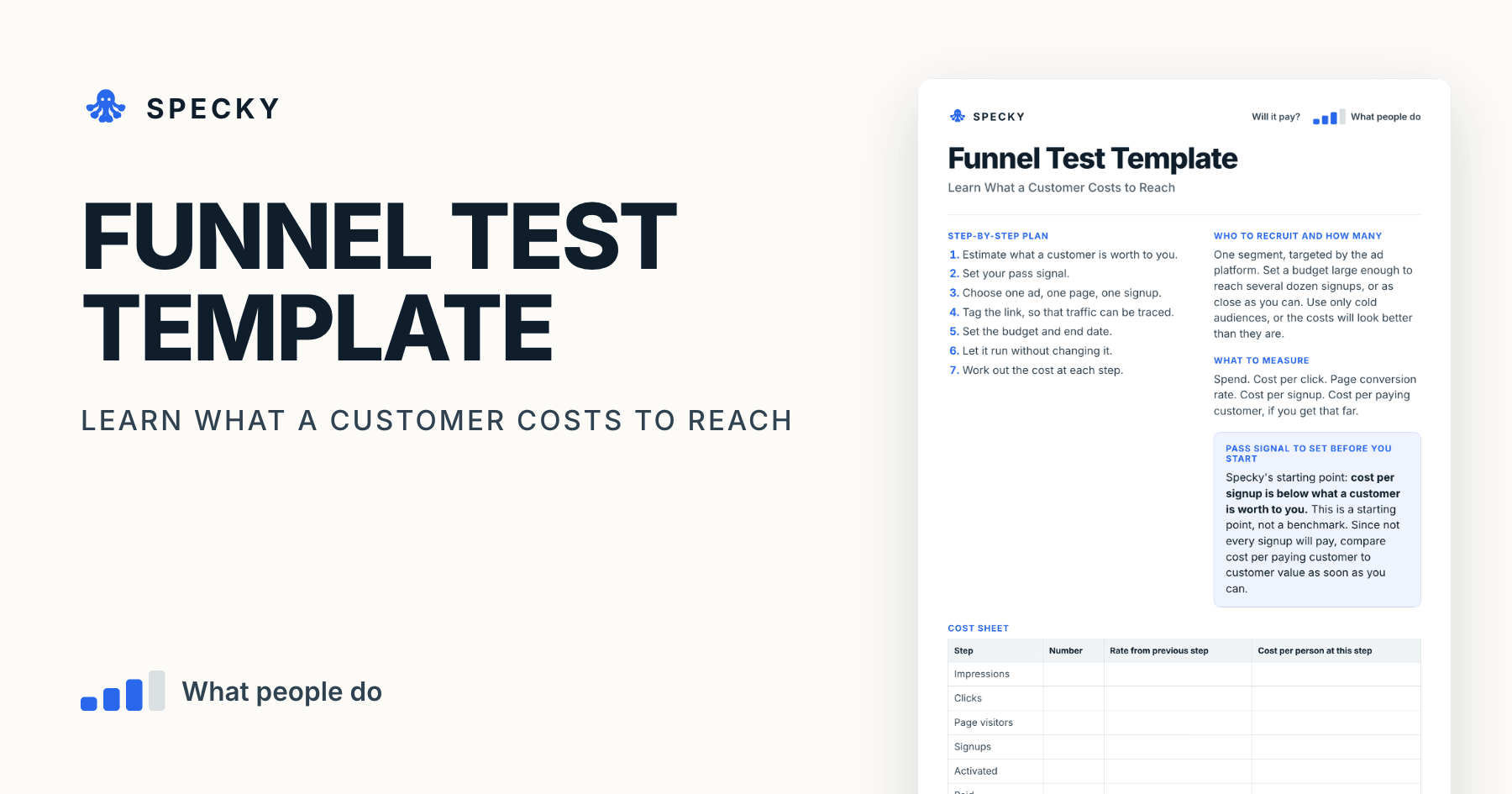
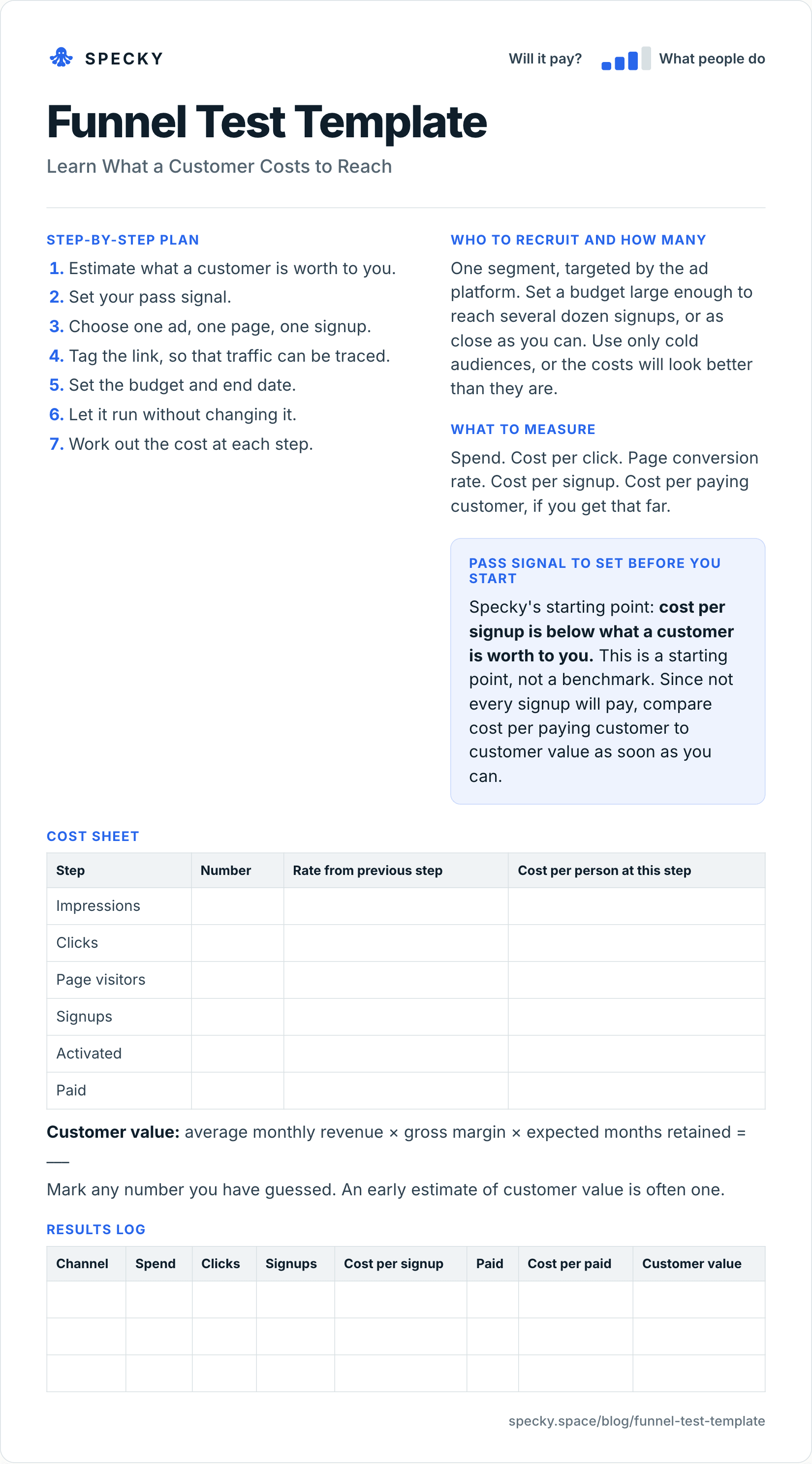
Copy-and-use funnel test template
Open the image at full size, or copy the text version below.
Who to recruit and how many
One segment, targeted by the ad platform. Set a budget large enough to reach several dozen signups, or as close as you can. Use only cold audiences, or the costs will look better than they are.
Step-by-step plan
Estimate what a customer is worth to you.
Set your pass signal.
Choose one ad, one page, one signup.
Tag the link, so that traffic can be traced.
Set the budget and end date.
Let it run without changing it.
Work out the cost at each step.
For step 4, Google Analytics says to always use utm_source, utm_medium and utm_campaign, and warns that values are case sensitive, so keep them lowercase (Google Analytics Help).
Mark any number you have guessed. An early estimate of customer value is often one.
What to measure
Spend. Cost per click. Page conversion rate. Cost per signup. Cost per paying customer, if you get that far.
Pass signal to set before you start
Specky's starting point: cost per signup is below what a customer is worth to you. This is a starting point, not a benchmark. Since not every signup will pay, compare cost per paying customer to customer value as soon as you can.
Results log
Channel
Spend
Clicks
Signups
Cost per signup
Paid
Cost per paid
Customer value
What do funnel benchmarks look like?
Use benchmarks to sanity-check your numbers, not to set your pass line. These come from named datasets of running businesses with optimised campaigns, so a new offer will often sit below them.
Customer value = monthly revenue × gross margin × months a customer stays.
Cost per paying customer = total spend ÷ paying customers.
Value-to-cost ratio = customer value ÷ cost per paying customer. Above 1 means the channel can pay for itself; Skok's bar for the best SaaS businesses is above 3.
Payback months = cost per paying customer ÷ (monthly revenue × gross margin). Skok notes the best recover it in 5 to 7 months, and calls anything beyond 12 months weak.
The ratio tells you if the channel can ever work. Payback tells you how long your cash is tied up while it does.
How much should you spend on a funnel test?
Enough to reach several dozen signups. Work it backwards from your channel's cost per click and conversion rate. Using LocaliQ's 2026 averages to reach about 40 signups (our calculation):
Channel
Conversion rate
Clicks for 40 signups
Approximate spend
Facebook lead campaigns ($1.80 a click)
8.54%
about 470
about $845
Search ads ($5.42 a click)
8.18%
about 490
about $2,650
Then apply the signup-to-paid rate. At a "good" free-trial rate of 8% to 12%, 40 signups bring only 3 to 5 paying customers, so your cost per paying customer will be rough. That is fine for a first read; it is not a basis for a big budget.
Fix the budget and end date before you start, and do not stop early because the numbers look good. In Evan Miller's well-known example, stopping at the first "significant" result raised the false positive rate from 5% to 26.1% (Miller, 2010).
Worked example (hypothetical)
This example is made up to show the method. A founder sells a €24-a-month tool to independent personal trainers. She estimates that a customer stays for 10 months at a 75% margin, making each worth about €180.
She spends €600 on one ad. It brings 420 clicks and 38 signups, for about €16 per signup. Six of them start paying, or about €100 per paying customer.
The signal passes at both levels: €16 per signup, and €100 per paying customer, against €180. The sample is small, and customer value is an estimate, so she records it as a pass, and notes both caveats.
Extending the example. Running the four numbers adds detail the pass hides:
Clicks cost about €1.43 each, between LocaliQ's Facebook traffic ($0.60) and search-ad ($5.42) averages.
Click to signup was 9.0% (38 of 420). With that sample, the plausible range is about 6.7% to 12.2% (95% Wilson interval, our calculation), so cost per signup could be anywhere from about €12 to €21.
Signup to paid was 16% (6 of 38), in the "great" free-trial band, which with 38 signups is a reason for caution. The plausible range is about 7% to 30%. At the low end, a paying customer would cost about €210, more than the €180 they are worth.
Payback is about 5.6 months (€100 ÷ €18 gross profit a month): healthy.
Value-to-cost ratio is 1.8, below Skok's 3.
The weak point is not the ad. It is the 10-month retention guess and the small number of payers. Her next steps: run a second €600 with no changes to firm up the paid rate, and track whether those six customers are still paying in month three with a product analytics check.
Funnel test vs online ad test vs landing page test
They can share the same ad and page; what differs is the question.
Run the funnel test last: after the message and the offer have passed, it tells you whether the economics work.
Common mistakes
Stopping at signups. A cheap signup that never pays is not cheap.
Using warm audiences. Retargeting your followers flatters the numbers.
Invented customer value. Label your estimates and test them later.
Changing it midway. You will no longer know what you measured.
Forgetting the rest of the cost. Add any sales or onboarding time.
Mixing up UTM values. "Facebook" and "facebook" become two sources and split your numbers.
If the product is not live yet, the page should say "early access" or "waitlist" and take no payment. Our online ad test covers what ad platforms allow.
How to run it in Specky
On the Assumptions page, click the note and choose Pick a test, then Funnel test. Specky fills in the steps, the pass signal, and a two-week timeline.
Click Test with a page. Specky builds a waitlist page and collects responses, showing views, unique visitors, clicks, form starts, responses, and a breakdown by UTM tag.
Buying the traffic is your part, on your ad platform. Specky does not place ads or spend your budget. Your signup page has no payment on it, so paying customers will need to be tracked elsewhere.
Click Start running. Paste in the spend and record the result.
A pass shows on the board as Supported, because this measures what people did and what it cost.
What to do with each outcome
Supported: The numbers can work. Try a bigger budget, and check whether the cost holds. Then see if signups stay with a product analytics check.
Unclear: Costs are close to your line. Look at where most people drop off, and fix that one step with a split test.
Contradicted: It costs more than a customer is worth. Change the channel, the price, or the audience. Word of mouth may cost less, which a referral program test can show. Any bet resting on this note now shows as Contradicted.
Frequently asked questions
What is funnel testing?
Funnel testing runs a small paid budget through the entire path from ad to signup to first payment, to find out what it costs to acquire a customer. It shows whether the economics can work. It measures each step separately, so when the numbers fail you can see which step is responsible.
What are the AARRR pirate metrics?
AARRR is Dave McClure's five-stage model of a customer's path: acquisition, activation, retention, referral and revenue. He proposed it in 2007, and his slide deck, Startup Metrics for Pirates, is still online. A funnel test measures acquisition, activation and the first step of revenue, the stages you can buy traffic into.
How do you calculate customer value for a new product?
Multiply average monthly revenue by gross margin and by the months you expect a customer to stay. For a new product these are estimates, so label them clearly. The months are usually the weakest guess; check them against real retention as soon as your first customers reach month three.
How much should I spend on a funnel test?
Spend enough to get several dozen signups, if you can. With only a handful, a single conversion can change your cost per signup significantly. Work backwards: at LocaliQ's 2026 averages, about 40 signups cost roughly $845 through Facebook lead campaigns or $2,650 through search ads.
What is a good customer acquisition cost?
One well below what a customer is worth. David Skok's guideline is that the best SaaS businesses earn more than three times their acquisition cost over a customer's life, and many recover it in five to seven months. Early on, a ratio above 1 shows the channel can pay for itself; above 3 puts you with the best businesses in Skok's guideline.