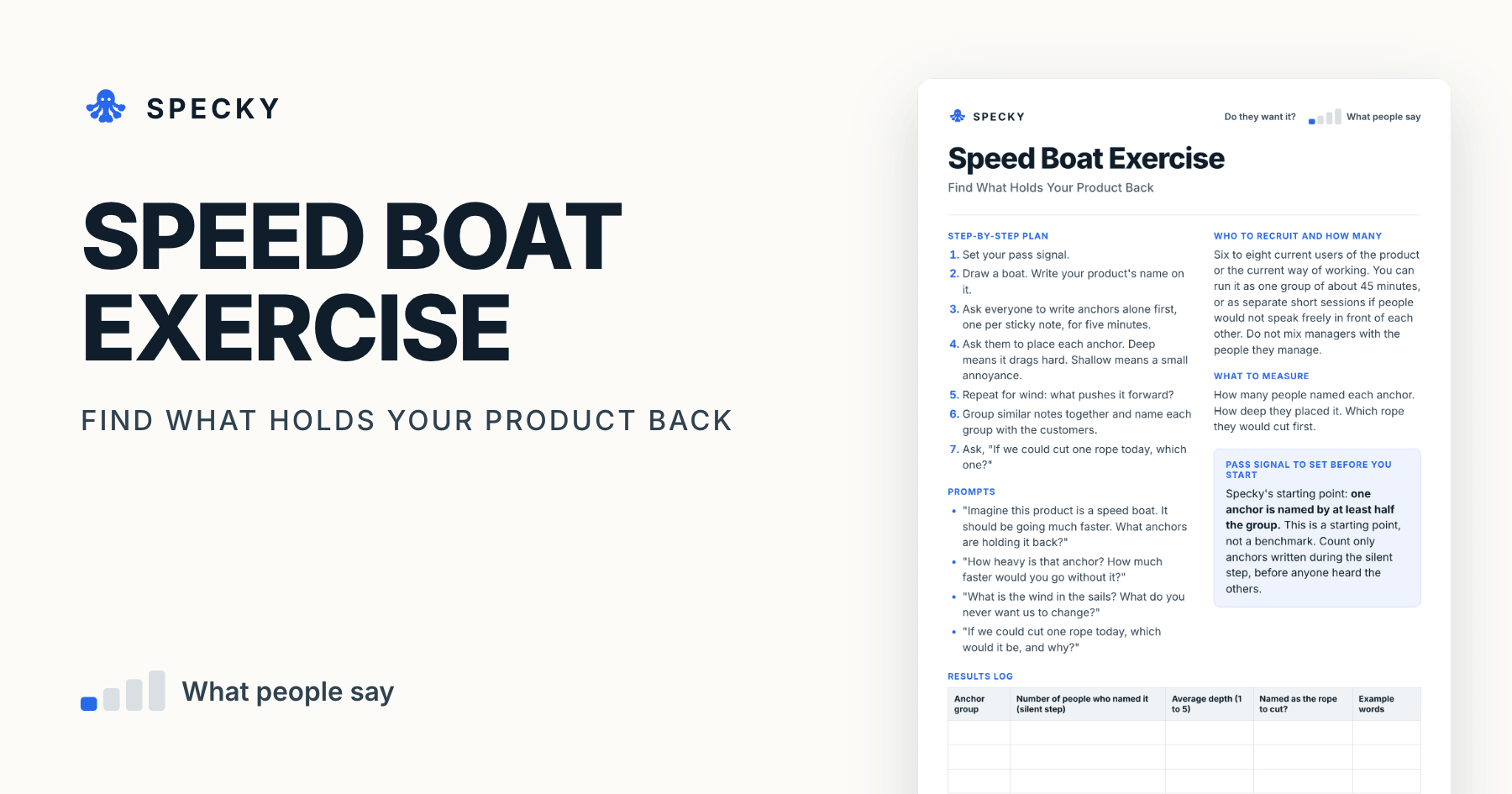
Speed Boat Exercise: Free Template to Find What Holds a Product Back
Customers are too polite to criticise your product. Give them a boat instead, and get a ranked list of what is holding it back.
Share
A speed boat exercise asks customers to picture your product as a boat and name the anchors slowing it down and the winds pushing it forward. Complaints come out as sticky notes you can group, weigh and rank, instead of polite reassurance. It is one of Luke Hohmann's Innovation Games, takes about 45 minutes with six to eight people, and tells you where to look next.
Key takeaways
Have everyone write anchors silently for five minutes before anyone speaks. Count only those notes for the pass signal.
Depth matters as much as count. In Hohmann's game, the lower the anchor, the worse the problem (Wikipedia).
Strategyzer rates speed boat 2 of 5 for cost, 1 of 5 for run time and about 2 to 3 of 5 for evidence strength (Strategyzer poster).
Six to eight people of one type works. Never put managers in a room with the people they manage.
The result is opinion: a ranked list of pain to check against behaviour, not a roadmap.
What is a speed boat exercise?
A speed boat exercise asks customers to picture your product as a boat and name the anchors slowing it down and the winds pushing it forward, so complaints come out as a list you can group and rank.
The game is one of the Innovation Games described by Luke Hohmann in Innovation Games (Addison-Wesley, 2006). In the usual description of Hohmann's version, a boat drawn on a whiteboard or butcher paper stands for the product, and each anchor is a feature or problem people dislike. The lower they hang the anchor, the more it holds the boat back (Wikipedia). That summary mentions only anchors. This template also asks about wind, because people will tell you what you must not break.
Strategyzer's Testing Business Ideas lists speed boat among its "preference and prioritisation" discovery experiments, next to buy a feature, product box and card sorting.
Is the speed boat the same as a sailboat retrospective?
Close cousins, different audience. Agile teams often use the same picture, under names like sailboat retrospective, to review their own sprint. A team retrospective of that kind, such as Atlassian's standard play, runs about 60 minutes for four to eight people (Atlassian Team Playbook). The customer version on this page asks outsiders about your product. The questions are the same; the people and what you do with the answers are not.
When should you use a speed boat exercise, and when not?
Use it when you have an existing product or a well-known way of doing the job, and you want people to criticise it without feeling rude. Giving someone a boat to talk about lowers the social cost of complaining.
Do not use it for an idea nobody has used yet, because there is nothing to name anchors on. For a brand-new concept, try a storyboard. And do not treat the top anchor as a priority list by itself. People name what annoys them, which is not always what makes them leave.
Which risk does it test, and how strong is the evidence?
This tests desirability: which problems do customers feel most? The evidence is opinion. Group sessions add a further wrinkle, since one loud voice can pull the room toward its own complaint.
Strategyzer's poster scores it as cheap and quick, with evidence strength of 2 out of 5 and a partly filled third dot. Jakob Nielsen's rule explains the ceiling: pay attention to what people do, and do not trust their predictions about what they will do (Nielsen Norman Group, 2001). In our guide to choosing a product experiment, this is a good way to sort what to test next.
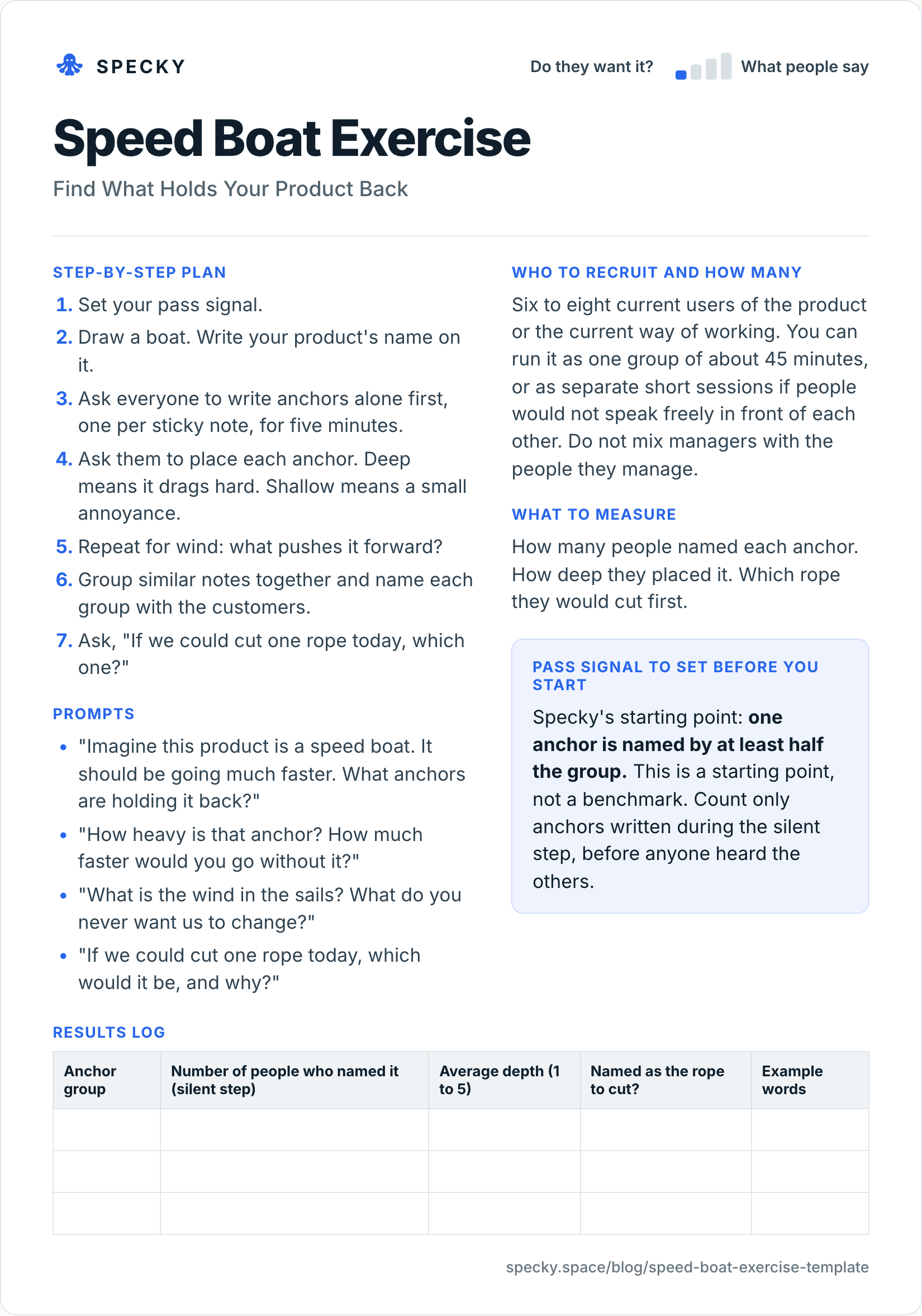
Speed boat exercise template (copy and use)
Open the image at full size, or copy the text version below.
Who to recruit and how many
Six to eight current users of the product or the current way of working. You can run it as one group of about 45 minutes, or as separate short sessions if people would not speak freely in front of each other. Do not mix managers with the people they manage.
Step-by-step plan
Set your pass signal.
Draw a boat. Write your product's name on it.
Ask everyone to write anchors alone first, one per sticky note, for five minutes.
Ask them to place each anchor. Deep means it drags hard. Shallow means a small annoyance.
Repeat for wind: what pushes it forward?
Group similar notes together and name each group with the customers.
Ask, "If we could cut one rope today, which one?"
Prompts
"Imagine this product is a speed boat. It should be going much faster. What anchors are holding it back?"
"How heavy is that anchor? How much faster would you go without it?"
"What is the wind in the sails? What do you never want us to change?"
"If we could cut one rope today, which would it be, and why?"
What to measure
How many people named each anchor. How deep they placed it. Which rope they would cut first.
Pass signal to set before you start
Specky's starting point: one anchor is named by at least half the group. This is a starting point, not a benchmark. Count only anchors written during the silent step, before anyone heard the others.
Results log
Anchor group
Number of people who named it (silent step)
Average depth (1 to 5)
Named as the rope to cut?
Example words
How do you run a speed boat exercise step by step?
The seven template steps fit a 45-minute session. Set the pass signal (step 1) before anyone arrives.
Minutes
Step
What the facilitator does
0-5
2. Draw the boat
Explain the picture. Say there are no wrong answers and that you built the boat, so you will not be offended.
5-10
3. Silent anchors
Five minutes, one anchor per note, no talking. Collect or photograph the notes before anyone speaks.
10-20
4. Place and explain
Each person places their notes and says how deep. You only ask, "How heavy is that one?"
20-25
5. Silent wind
Two to five minutes on what pushes the boat forward.
25-35
6. Group
Cluster similar notes and let the customers name each group in their words.
35-42
7. Cut one rope
Each person names one rope to cut. One vote each, said out loud or by private poll.
42-45
Close
Thank people and say what happens next.
For a remote session, use an online board with the boat already drawn, private notes for the silent step, and a timer on screen. For one-to-one sessions, run the same steps in 20 minutes per person and do the grouping afterwards.
How do you group and rank the anchors?
Group by meaning, not by wording: "midnight approvals" and "I have to OK every swap" are the same anchor. Then rank on two numbers, the people who named it in the silent step and its average depth from 1 (surface) to 5 (sea floor). Multiplying them gives a simple weight. Use it to sort the list, then check the top three against the rope votes. If they disagree, the votes are the better tiebreaker, because people chose under a limit of one.
How many people do you need for a speed boat exercise?
Six to eight per session, all of one type. That matches the 6 to 9 users Nielsen Norman Group gives for a focus group, which runs about 2 hours, against your 45 minutes. NN/g also warns that the moderator must stop one participant dominating, and advises running more than one group because one session may not be representative (Nielsen Norman Group, 1997).
Three practical rules:
One segment per session. Owners and staff, or small and large accounts, feel different anchors. Run them apart.
Two sessions beat one big one. Twelve people in two rooms give you a check on each other. Twelve in one room give you the loudest four.
Go one-to-one when rank or rivalry gets in the way, such as competitors in the same market or people who report to each other.
What does a speed boat exercise look like in practice?
This example is made up to show the method. A small team runs an app that helps restaurants schedule staff. They believe the anchor is the lack of a mobile app.
They gather eight restaurant managers on a video call. In the silent step, six write some version of "swaps need my approval, and I get them at midnight." Only two mention a mobile app, placed near the surface. When asked which rope to cut, five choose swap approvals.
Their pass signal was about the mobile app and it failed. But one anchor, late-night swap approvals, was named by more than half the group. That becomes the next assumption.
Here is how the full results log could look:
Anchor group
People (silent step)
Average depth (1-5)
Weight (people x depth)
Rope-to-cut votes
Shift swaps need my approval, often at midnight
6
4.5
27
5
Payroll export needs manual fixes
3
3.0
9
2
Too many notifications
3
2.0
6
0
Adding a new location is slow
1
4.0
4
0
No mobile app
2
1.5
3
1
On the wind side, five managers named "copy last week's rota in one click," so any redesign of scheduling must keep it. The team's next step is a support ticket analysis to count how often swap approvals come up when nobody is prompting.
Speed boat vs support ticket analysis vs customer interview vs buy a feature
Skipping the silent step. Without it, the first speaker sets the agenda for the whole room.
Defending the product. Your only job is to ask how heavy that anchor is.
Treating the list as a roadmap. Anchors tell you where to look. Test before you build.
Ignoring the wind. People also tell you what you must not break.
Mixing ranks in one room. People censor themselves around their boss.
When it doesn't work: for ideas nobody has used, for questions about price, and with fewer than about five people, where one person's pet complaint can top the list.
How do you keep it safe for people to complain?
The exercise only works if criticism costs nothing. Ask before you record and say who will see the notes. Report anchor groups, not who wrote what, and never pass a named complaint to the person's account manager or boss. Do not promise fixes in the room; say what you will test next, and follow up.
How to run it in Specky
On the Assumptions page, click the note and choose Pick a test, then Speed boat. Specky fills in the steps, the pass signal, and a one-day timeline.
Click Open in Vouch. Vouch, at vouch.specky.space, runs this as an AI interview: one person at a time, in conversation, naming what speeds it up and slows it down. It is not a shared whiteboard. For a live group, use a real board and paste the results in.
Click Start running, then paste the anchor groups onto the test and record the result.
A pass shows on the board as Early signal, not Supported, because this is what people say rather than what they do.
Unclear: Anchors were spread thin. Your group may be too mixed. Split by type of customer and run it again.
Contradicted: The anchor you expected is shallow or missing. Drop the assumption, and look at what people did name. Any bet on this note now shows as Contradicted.
Frequently asked questions
What is a speed boat exercise?
A speed boat exercise is a customer research game where people name the anchors holding a product back and the winds pushing it forward. It makes criticism feel safe and gives you a grouped list of pain points. Luke Hohmann described it in his 2006 book Innovation Games.
How many people do you need for a speed boat exercise?
Six to eight people works well in one session. Have everyone write anchors silently first, so that one loud voice cannot steer the group. Keep each session to one type of customer, and run a second session rather than one big group if you need more people.
How long does a speed boat exercise take?
About 45 minutes for a group of six to eight: five minutes of silent writing for anchors, ten for placing and explaining them, a few minutes for wind, ten for grouping and a final vote on which rope to cut. One-to-one sessions take about 20 minutes each.
Is speed boat good for validating a new idea?
No. Speed boat works best on an existing product or a known way of working, because people need something real to criticise. Use a storyboard or interview for a brand-new idea. Even for an existing product, treat the result as a ranked list of where to look, not proof.
What is the difference between anchors and wind?
Anchors are what slow the product down: missing features, friction, bugs, slow support. Wind is what pushes it forward: the parts people value and want you to keep. Anchors show where to fix; wind shows what any change must not break. Depth shows how much each anchor hurts.