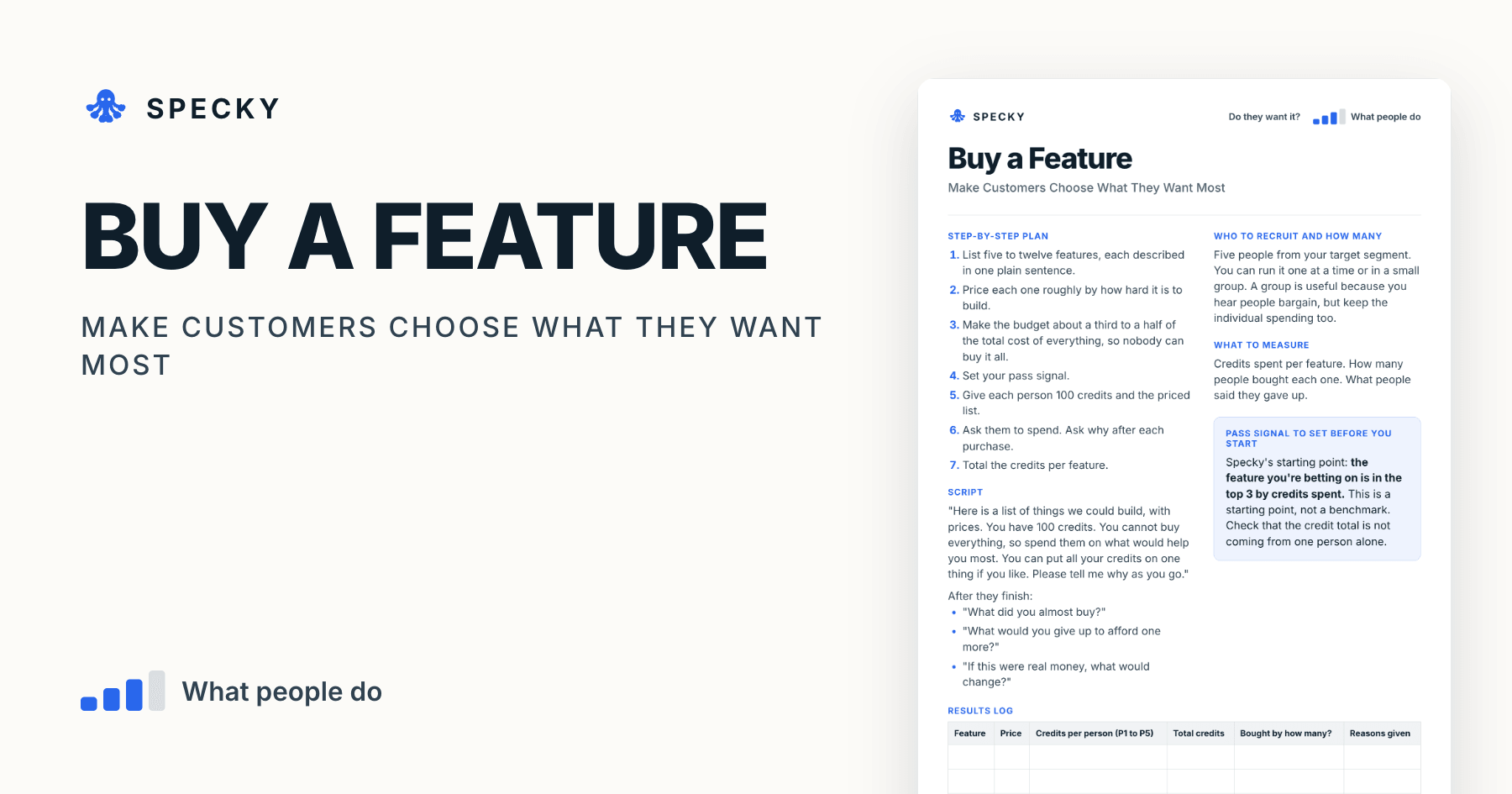
Buy a Feature: Free Template, Pricing Rules and Facilitator Script
When customers say everything matters, hand them a budget. What they spend it on shows what they value most.
Share
Buy a feature is a prioritisation game: you give customers a limited budget of credits and a priced list of features, then watch what they spend it on and listen to why. Because nobody can afford everything, their trade-offs show what they value most. Luke Hohmann published it as one of 12 Innovation Games in 2006. Below are a free template, budget rules and a facilitator script.
Key takeaways
Price features by build effort, and give each person a third to a half of the total price list.
Use five to twelve real options and five people from one segment.
Strategyzer's experiment library rates buy a feature 2 of 5 for cost and 2 of 5 for evidence strength, with a run time of 1 of 5 (Strategyzer poster).
It scales: San José ran Hohmann-style budget games with groups of five to eight from 2011 (Route Fifty, 2016).
It shows the order of priorities, not willingness to pay. Nobody spent real money.
What is buy a feature?
Buy a feature is a test where you give people a limited budget of credits and a priced list of features, then watch what they spend it on and listen to why.
The game is one of the Innovation Games from Luke Hohmann's Innovation Games (Addison-Wesley, 2006), a 192-page book that also describes product box and speed boat. In the original group version, players see features with a cost, which can be development effort or a street price. Some features cost more than one player can afford, so players pool their money to buy them (Wikipedia). The bargaining shows what people fight for and what they let go.
The template below also supports a solo version, one person at a time, which is easier to schedule and keeps choices uninfluenced.
How did a city use buy a feature to set its budget?
San José, California, ran the same mechanic on its public budget, with Hohmann's company Conteneo and its non-profit Every Voice Engaged. The first events were in 2011. Hundreds of residents were split into groups of five to eight, each with a trained volunteer facilitator, and each member got an equal share of the budget to spend alone or jointly. One question asked whether to spend $20 million on 40 police officers or on paving streets. Hohmann called it "a collaborative, not competitive, process" (Route Fifty, 2016).
By January 2014 it was the fourth annual Budget Games, with about 100 neighbourhood and youth leaders in person and an online version built with Conteneo (California Forward, 2014). If it can rank police staffing against library hours, it can rank your backlog.
When should you use buy a feature, and when not?
Use it when customers say everything is important, and you have to choose. A budget forces the trade-off that a survey never does. It works best when you have a list of five to twelve features that are real options.
Do not use it to find new problems, since people can only spend on what is on your list. For that, use a customer interview. And do not read the credits as dollars. Nobody paid anything, so for willingness to pay use a letter of intent or a pricing survey.
Which risk does it test, and how strong is the evidence?
This tests desirability: of everything you could build, what do people value most? The evidence is behaviour, because people make real trade-offs with a scarce budget. But it is low-stakes behaviour. The money is pretend.
Strategyzer files it under "preference and prioritisation" discovery experiments, next to product box, speed boat and card sorting, all low on cost and evidence strength. It orders a list fast; it does not prove anyone will use what wins. Our guide to choosing a product experiment explains why that still beats a rating scale.
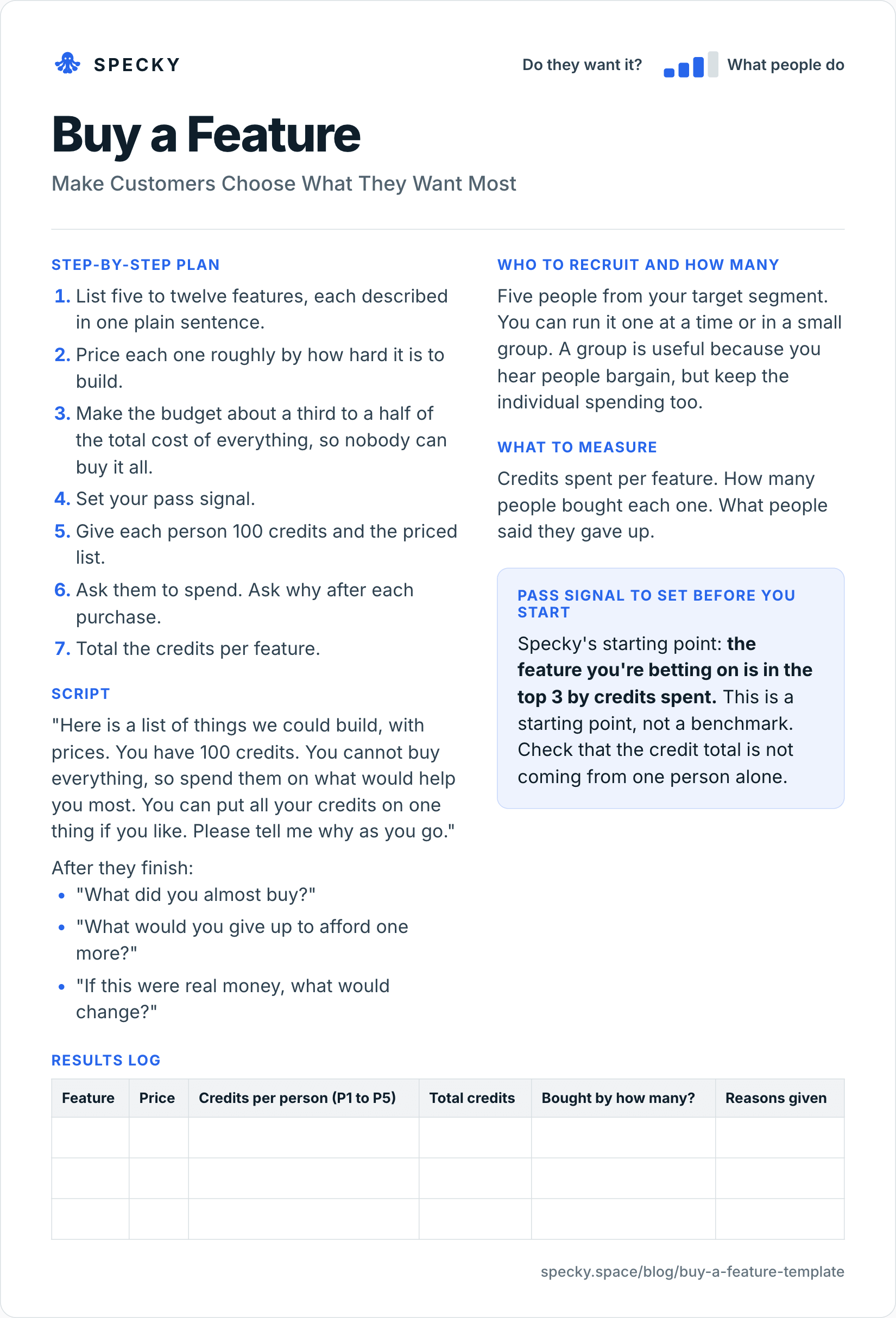
Buy a feature template (copy and use)
Open the image at full size, or copy the text version below.
Who to recruit and how many
Five people from your target segment. You can run it one at a time or in a small group. A group is useful because you hear people bargain, but keep the individual spending too.
Step-by-step plan
List five to twelve features, each described in one plain sentence.
Price each one roughly by how hard it is to build.
Make the budget about a third to a half of the total cost of everything, so nobody can buy it all.
Set your pass signal.
Give each person 100 credits and the priced list.
Ask them to spend. Ask why after each purchase.
Total the credits per feature.
Script
"Here is a list of things we could build, with prices. You have 100 credits. You cannot buy everything, so spend them on what would help you most. You can put all your credits on one thing if you like. Please tell me why as you go."
After they finish:
"What did you almost buy?"
"What would you give up to afford one more?"
"If this were real money, what would change?"
What to measure
Credits spent per feature. How many people bought each one. What people said they gave up.
Pass signal to set before you start
Specky's starting point: the feature you're betting on is in the top 3 by credits spent. This is a starting point, not a benchmark. Check that the credit total is not coming from one person alone.
Results log
Feature
Price
Credits per person (P1 to P5)
Total credits
Bought by how many?
Reasons given
How do you price features and set the budget?
Prices carry the trade-off, so spend 30 minutes on them with whoever will build the features.
Price by relative effort. Twice the work costs twice as much. Round to multiples of 5.
Add up the price list. With eight features, 200 to 300 credits works well against a 100-credit budget.
Size the budget. In the solo version, each person gets a third to a half of the total. In the group version, a common guideline is a combined budget of about half the total price, split equally among players (Lucid).
Price at least one feature above a single player's share in group play, so people must pool and negotiate.
Should you run the solo or the group version?
Solo version
Group version
Players
One per session, five sessions
Five to eight per table
Budget
100 credits each, a third to a half of the price list
About half the price list for the whole table, split equally
With a 250-credit list
100 credits each
125 in total: 25 each for five players
Pooling
Totals added afterwards
Live: some features cost more than one player holds
What you hear
Each person's reasons, uninfluenced
Bargaining: what people argue for and give up
Main risk
No negotiation to learn from
One loud player steers the table
If you only run one, run the solo version and ask "What would you give up to afford one more?"
How many participants do you need?
Start with five people from one segment. Five sessions show whether spending clusters or spreads thin. If you sell to two clearly different segments, run five of each; mixing them hides both answers.
For a group version, keep tables to five to eight, as San José did. Nielsen Norman Group gives a similar size for focus groups, 6 to 9 users for about 2 hours, and warns that the moderator must stop one participant dominating (Nielsen Norman Group, 1997). Record each person's spend before the table pools it.
What does buy a feature look like in practice?
This example is made up to show the method. A team building an email tool for small shops is about to spend a quarter on an AI subject-line writer. They list eight possible features, priced by build effort, and give five shop owners 100 credits each.
The AI writer costs 40 credits. Only one owner buys it. Four of five put most of their budget on "send automatically when a product is back in stock," and three buy "see which email sold what." The AI writer finishes sixth.
Their pass signal said the AI writer would be in the top three. It is not. The team records the test as failed and moves the back-in-stock feature up as the next thing to test.
Here is what the full results log could look like. As in Hohmann's game, owners could split credits, and credits from several people count toward one feature:
Feature
Price
Credits (P1 to P5)
Total
People who spent
Send automatically when back in stock
60
55, 55, 60, 55, 0
225
4
See which email sold what
50
25, 25, 0, 0, 30
80
3
Abandoned-cart reminder
35
20, 0, 0, 25, 20
65
3
Birthday discount emails
20
0, 20, 0, 0, 25
45
2
Template editor
20
0, 0, 0, 20, 25
45
2
AI subject-line writer
40
0, 0, 40, 0, 0
40
1
SMS add-on
15
0, 0, 0, 0, 0
0
0
Dark-mode preview
10
0, 0, 0, 0, 0
0
0
The price list totals 250 credits, so each budget covered 40% of it. Back-in-stock took 225 of the 500 credits, 45%, with no owner giving more than 60. All 40 credits on the AI writer came from one person: that is what the concentration check catches.
Buy a feature vs ranking survey vs RICE vs speed boat
They fit together: speed boat finds problems, buy a feature shows which fixes customers would fund, and RICE weighs that against reach and effort.
What are the most common buy a feature mistakes?
Making the budget too big. If people can buy almost everything, you learn nothing.
Pricing everything the same. Prices should reflect real build cost, or the trade-off is fake.
Listing vague features. "Better reporting" will always sell. Describe specifically what it does.
Skipping the why. The reason behind a purchase is often worth more than the total.
Reading credits as revenue. Nobody paid. It tells you order, not price.
When it doesn't work: for finding new problems, for pricing, and when your list has fewer than five real options.
Is it fair to the customers who play?
Yes, if you are clear about what it is. Say up front that the credits are pretend and that buying is not a promise to build. Ask before you record, and afterwards tell players what won and what happens next.
How to run it in Specky
On the Assumptions page, click the note and choose Pick a test, then Buy a feature. Specky fills in five people, 100 credits, the pass signal, and a two-day timeline.
Click Open in Vouch. Vouch, at vouch.specky.space, runs this as an AI interview: it presents your priced list in conversation, and asks the person how they would spend and why. It is not a shared game board. If you want a live group auction, run it on a call and paste the totals in.
Click Start running, then paste the spend per feature onto the test and record the result.
A pass shows on the board as Supported, because spending a scarce budget is rated as behavior. It supports the order of priorities, not the price.
What should you do with each outcome?
Supported: Your feature is a top priority. Build the smallest slice with a single-feature MVP and see if people come back.
Unclear: Spending was spread evenly, or one person skewed the total. Tighten the budget, sharpen the wording, and run it with more people from a narrower group.
Contradicted: People spent elsewhere. Do not build it yet. Any bet resting on this note now shows as Contradicted, and the winning feature is your next assumption to test.
Frequently asked questions
What is the buy a feature game?
Buy a feature is a prioritisation game where customers spend a limited budget on a priced list of features. Because they cannot afford everything, the spending shows what they value most. Luke Hohmann described it in his 2006 book Innovation Games, and Strategyzer's Testing Business Ideas lists it as a discovery experiment.
How much budget should you give in buy a feature?
Give each person enough for about a third to a half of the total cost of all features. That forces them to give things up. In a group version, give the whole table about half the total price, split equally, so expensive features need pooling.
Does buy a feature show willingness to pay?
No. Buy a feature shows relative priority, not willingness to pay, because the credits are not real money. Use a letter of intent, a presale or a real offer to test what people will pay, and use buy a feature to decide which feature to put in that offer.
How many features should you include in buy a feature?
Five to twelve, each described in one plain sentence and priced by build effort. Fewer than five gives people too little to trade off. More than twelve is hard to hold in mind, especially remotely, and spreads credits so thin that no clear winner appears.
Can you run buy a feature remotely?
Yes. Share the priced list on a slide or online board, or run it one person at a time on a video call or in an AI interview. Ask people to explain each purchase out loud, and ask what they would give up to afford one more.